Linear Adversarial Concept Erasure
Shauli RavfogelMichael TwitonYoav GoldbergRyan Cotterell
Develops a constrained minimax framework and convex relaxation method, R-LACE, to identify and remove linear concept subspaces from neural representations, providing closed-form and tractable solutions for post-hoc bias mitigation without sacrificing downstream performance.
Modern artificial intelligence models rely heavily on pre-trained text and image representations that learn patterns without direct supervision. As these representations are integrated into critical real-world systems, an urgent operational and ethical challenge has emerged: pre-trained models frequently encode sensitive concepts, such as demographic attributes and social biases, that decision-makers cannot easily control or remove. Post-hoc debiasing methods attempt to neutralize this unwanted information from fixed, pre-trained vectors, but existing approaches often damage model utility by removing too many dimensions or fail to eliminate the target concept completely.
The article aims to formulate a principled mathematical framework for concept erasure that prevents linear predictors from recovering unwanted information while preserving the original representation's useful content as much as possible. It demonstrates the theoretical guarantees of this approach and evaluates its practical effectiveness in removing binary gender bias and visual attributes.
To achieve this, the article frames concept erasure as a linear minimax game between a predictor attempting to recover the concept and an adversary that projects the data onto an orthogonal subspace to block prediction. The authors derive closed-form mathematical solutions for linear regression and Rayleigh quotient objectives. For classification problems, they introduce Relaxed Linear Adversarial Concept Erasure (R-LACE), a convex relaxation that optimizes the adversarial projection matrix. They evaluated the framework across static word embeddings (GloVe), deep contextual language models (BERT fine-tuned on hundreds of thousands of online biography profiles), and image datasets (CelebA face images).
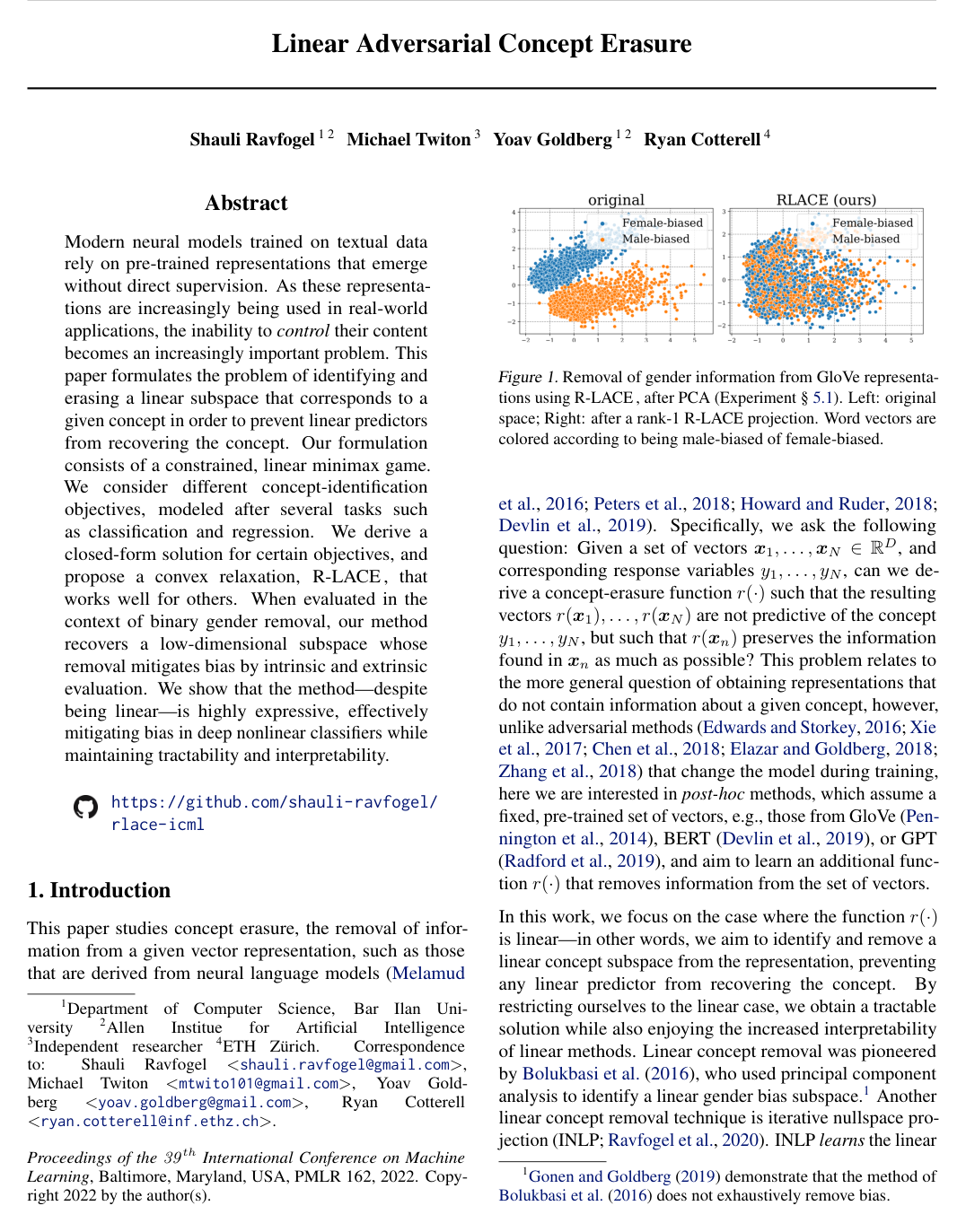
The analysis produced several key findings. First, R-LACE completely neutralized linear gender information in word embeddings using only a single-dimensional subspace projection, dropping linear classifier accuracy from 100% to roughly 50% (random chance), whereas previous iterative methods failed to reach majority accuracy even after removing 20 dimensions. Second, in deep language model evaluations, removing a single dimension via R-LACE reduced gender prediction accuracy from nearly 97% to approximately 55% while maintaining core profession classification accuracy (85.09% versus 85.12% unmitigated), avoiding the substantial performance drops observed with prior approaches. Third, the method substantially mitigated biased word associations in standard benchmark tests and reduced gender clustering without degrading overall semantic word similarity. Finally, adversarial training baselines failed to prevent post-hoc extraction of gender information, highlighting the superior reliability of explicit post-hoc linear projection.
These findings indicate that organizations can mitigate sensitive attributes from pre-trained representations with minimal computational overhead and near-zero degradation in primary task performance. By restricting the intervention to linear projections, the approach preserves interpretability and transparency, enabling practitioners to audit the specific subspaces being removed. This provides a low-risk, practical mechanism to enhance fairness and regulatory compliance in production systems without retraining entire foundational models.
Decision-makers should consider adopting linear adversarial concept erasure as a lightweight post-processing step for linear decision heads and embedding representations where linear leakage of protected attributes is a compliance concern. However, because the method specifically neutralizes linear predictors, technical teams must ensure that erased representations are only fed directly into linear classifiers (such as the final classification layer of a network) and not into subsequent deep, non-linear layers that can still extract non-linear signals. Furthermore, since the relationship between internal concept removal and broader downstream fairness metrics remains complex, organizations should conduct context-specific evaluations across varied fairness metrics rather than treating linear concept erasure as a complete bias solution.
The findings are supported by rigorous theoretical proofs and consistent empirical evaluations across multiple domains. Nevertheless, users should remain aware of key limitations: the method is designed strictly against linear adversaries, does not guarantee protection against deep non-linear probing, and was primarily tested on binary representations of attributes like gender. Further research and validation are required before extending these techniques to complex, non-linear concept removal settings.
- Paper: Man is to Computer Programmer as Woman is to Homemaker? Debiasing Word Embeddings, Tolga Bolukbasi et al. (2016). This foundational method identifies and removes gender directions in word embeddings, providing the debiasing setup that linear adversarial erasure sharpens with a minimax formulation.
- Paper: Semantics derived automatically from language corpora contain human-like biases, Aylin Caliskan et al. (2016). Its evidence that word embeddings encode measurable human-like biases establishes why the source’s targeted removal of sensitive information matters.
- Paper: Mitigating Unwanted Biases with Adversarial Learning, Brian Hu Zhang et al. (2018). Its adversarial-learning approach to bias mitigation supplies a key contrast for understanding why the source tests post-hoc projection against adversarial-training baselines.
- Paper: Representation Engineering: A Top-Down Approach to AI Transparency, Andy Zou et al. (2023). Building on linear directions as manipulable representations, this work broadens the intervention idea from erasing information to reading and steering model behavior.
- Paper: The Linear Representation Hypothesis and the Geometry of Large Language Models, Kiho Park et al. (2024). This later causal account of linear concept geometry deepens the theoretical basis for using subspace projections to measure and alter representations.