RadarSplat-RIO: Indoor Radar-Inertial Odometry with Gaussian Splatting-Based Radar Bundle Adjustment
Pou-Chun KungYuan TianZhengqin LiYue LiuEric WhitmireWolf KienzleHrvoje Benko
Introduces the first radar bundle adjustment framework powered by Gaussian Splatting, which jointly optimizes sensor poses and scene geometry from range-azimuth-Doppler data to reduce indoor radar-inertial odometry drift by up to 90 percent.
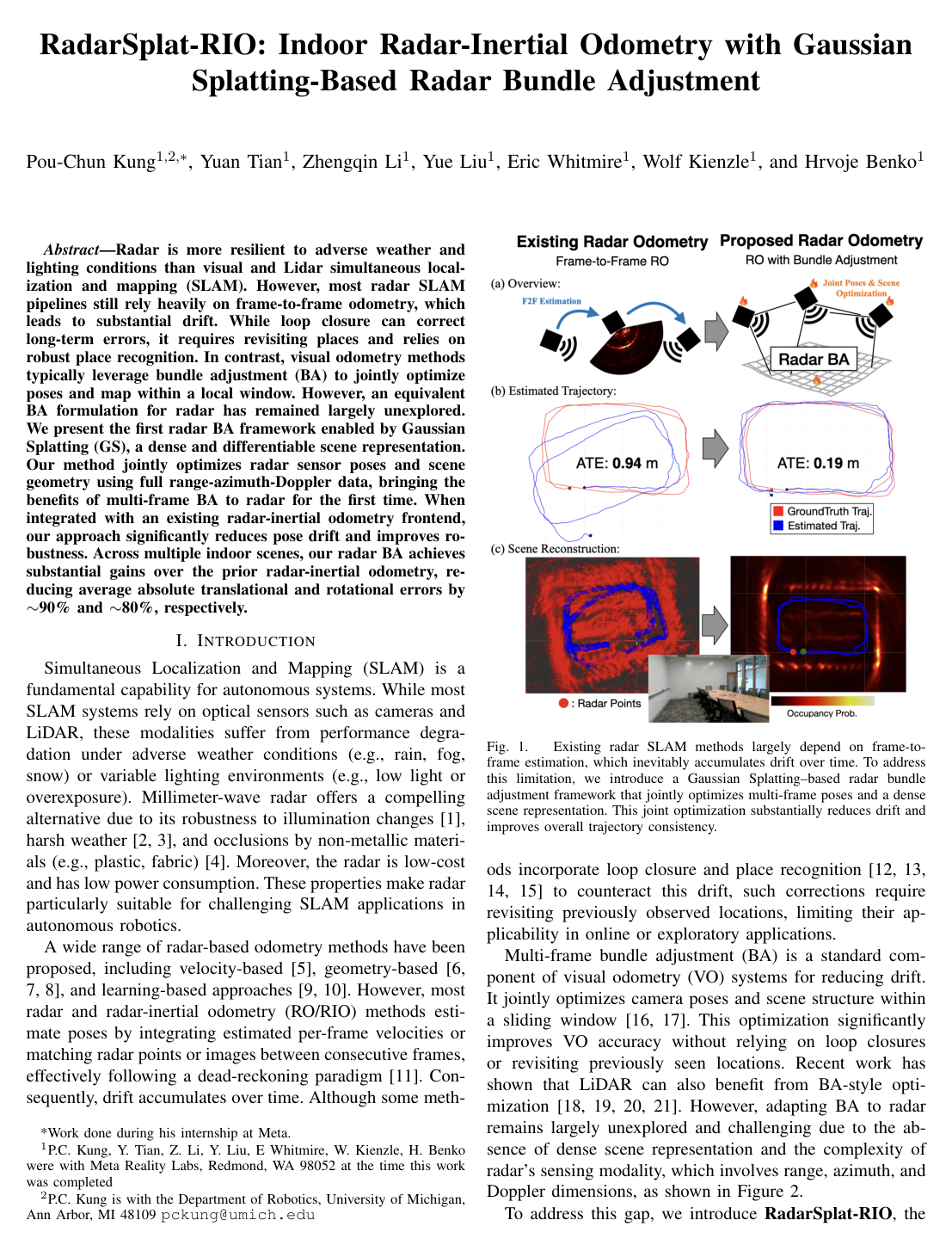
Autonomous systems operating in poor lighting, adverse weather, or obscured environments require reliable navigation. While millimeter-wave radar provides low-cost, weather-resilient sensing, conventional radar simultaneous localization and mapping systems accumulate substantial positional drift over time. This drift occurs because existing systems rely on frame-to-frame tracking and lack multi-frame joint optimization, while visual and optical systems use bundle adjustment to continuously refine maps and sensor paths.
The article demonstrates the first multi-frame bundle adjustment framework for radar, named RadarSplat-RIO. The objective is to evaluate whether jointly optimizing sensor positions and a continuous, dense 3D scene representation can eliminate long-term trajectory drift without relying on loop closures or revisiting previously mapped locations.
The researchers developed a differentiable radar rendering pipeline, RadarSplat++, that models full range, azimuth, and Doppler velocity data using 3D Gaussian Splatting, a method that represents environments through dense collections of 3D Gaussian distributions. They integrated this optimization backend with an existing radar-inertial odometry frontend. The approach was tested across five indoor trajectories spanning up to 233 meters, using a physical sensor rig equipped with a millimeter-wave radar and a tracking camera providing reference trajectories.
The experimental findings demonstrate major performance improvements. Integrating the Gaussian Splatting bundle adjustment backend reduced average absolute translational errors by approximately 90% and rotational errors by about 80% compared to baseline radar-inertial odometry. On longer indoor trajectories, absolute translation error decreased from over 22 meters to roughly 2 meters. Incorporating Doppler velocity rendering into the optimization specifically improved linear motion tracking, which proved especially effective in featureless corridors. Additionally, selecting optimization keyframes using a spatial radius of 10 meters yielded higher accuracy than standard sequential sliding-window methods.
These results show that multi-frame radar bundle adjustment can bridge the performance gap between radar and optical sensing systems. By resolving radar odometry drift, the method reduces navigation failure risk in environments where cameras and laser scanners fail, enabling more reliable autonomous operation without additional sensor hardware costs.
Organizations developing autonomous systems for challenging operational environments should consider adopting Gaussian Splatting representations to optimize radar state estimation. The primary technical next step identified in the source is expanding the framework from its current single-radar, three-degree-of-freedom proof-of-concept into a multi-radar setup supporting full six-degree-of-freedom motion estimation.
Confidence in the proposed framework's drift-reduction capability is supported by consistent improvements across multiple test sequences. However, readers should note that current evaluations were conducted exclusively in indoor settings under 3-degree-of-freedom motion assumptions, and the reference trajectories relied on visual-inertial estimates rather than absolute external tracking.
- Paper: On-Manifold Preintegration for Real-Time Visual--Inertial Odometry, Christian Forster et al. (2015). Introduces on-manifold IMU preintegration within factor graphs, providing the foundational state-estimation and inertial frontend theory that RadarSplat-RIO relies upon.
- Paper: Direct Sparse Odometry, Jakob Engel et al. (2016). Presents direct sliding-window bundle adjustment and joint sensor pose/map optimization, which RadarSplat-RIO adapts and reformulates for dense radar sensing.
- Paper: ORB-SLAM3: An Accurate Open-Source Library for Visual, Visual–Inertial, and Multimap SLAM, Carlos Campos et al. (2020). Establishes modern multi-frame optimization and bundle adjustment mechanisms for visual-inertial odometry that inspire RadarSplat-RIO's joint radar pose-graph and bundle adjustment design.
- Paper: Raw High-Definition Radar for Multi-Task Learning, Julien Rebut et al. (2022). Demonstrates perception and spatial feature extraction directly from raw range-Doppler radar tensors, supporting RadarSplat-RIO's use of rich range-azimuth-Doppler data.
- Paper: LIO-SAM: Tightly-coupled Lidar Inertial Odometry via Smoothing and Mapping, Tixiao Shan et al. (2020). Formulates tightly coupled odometry over factor graphs with IMU pre-integration, providing the standard smoothing-and-mapping architecture extended by radar-inertial pipelines.
- Paper: Structure-from-Motion Revisited, Johannes L. Schönberger et al. (2016). Details the standard formulations and numerical optimization pipelines of multi-frame bundle adjustment that RadarSplat-RIO brings into the radar domain via Gaussian Splatting.
No sufficiently relevant recommendations were found.