Understanding The Robustness in Vision Transformers
Daquan ZhouZhiding YuEnze XieChaowei XiaoAnimashree AnandkumarJiashi FengJosé M. Álvarez
Explains how visual grouping in self-attention reduces corruption sensitivity through an information bottleneck perspective, introducing fully attentional networks that integrate dynamic channel selection to achieve superior corruption error on ImageNet-C.
Modern computer vision models increasingly power mission-critical and safety-sensitive applications, such as autonomous driving and mobile visual recognition. While vision transformers frequently handle visual corruptions—such as bad weather, blur, and digital noise—better than standard convolutional neural networks, the structural reasons for this resilience have remained poorly understood. Recent developments, including improved convolutional architectures that match transformer accuracy, have created uncertainty regarding whether attention mechanisms provide fundamental robustness advantages in real-world operating environments.
The article aims to explain why self-attention improves visual robustness against corruptions and to introduce a novel architectural framework that enhances this capability across standard and high-demand vision tasks.
To evaluate this, the authors analyzed how internal representations evolve across network layers using spectral clustering, measuring how models group visual patterns and suppress noise. They established a theoretical link connecting self-attention to the information bottleneck principle, which removes irrelevant image noise while preserving critical target features. Building on these theoretical insights, the authors designed Fully Attentional Networks (FANs), a family of vision architectures that incorporate an efficient channel attention mechanism to perform dynamic, content-dependent feature selection. They evaluated these architectures against standard convolutional and transformer models across multiple corrupted and out-of-distribution benchmarks, including ImageNet-C, Cityscapes-C, and COCO-C, across multiple model scales.
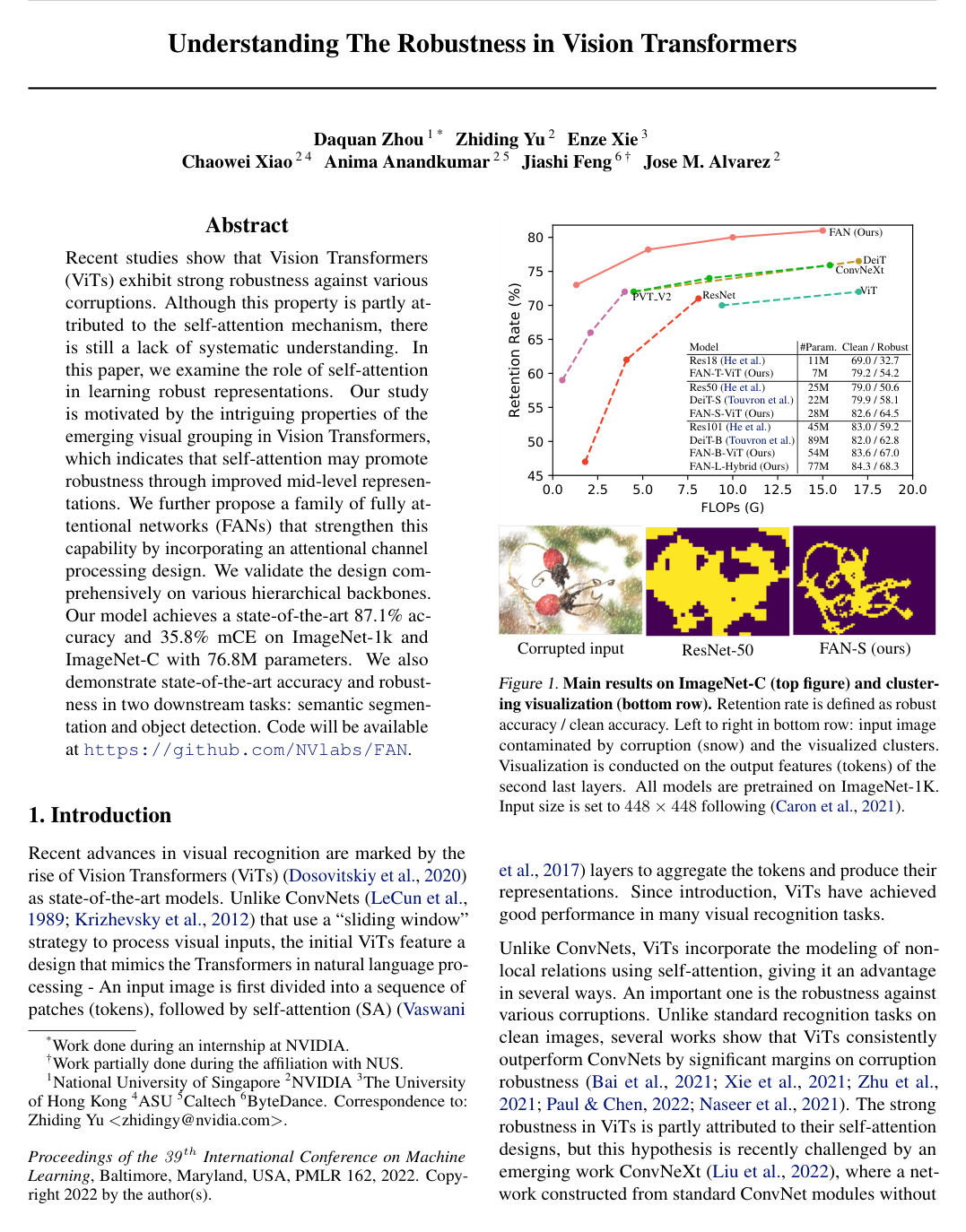
The analysis yielded several key findings regarding model robustness. First, spectral analysis demonstrated that self-attention inherently groups visual tokens into clean object clusters in intermediate layers, effectively squeezing out noise perturbations in a manner that standard convolutional networks fail to replicate. Second, the proposed FAN architecture significantly outperformed existing models in corruption robustness without compromising clean image accuracy; for example, the small FAN variant achieved a 47.7% mean corruption error on ImageNet-C, outperforming comparable convolutional baselines by 29.0% and recent competitive designs by 5.5%. Third, scaling the FAN framework established new state-of-the-art supervised performance, reaching 87.1% clean accuracy on ImageNet-1k alongside an industry-leading 35.8% mean corruption error. Finally, these robustness gains directly transferred to dense downstream applications, improving semantic segmentation on Cityscapes-C by 6.8% mean intersection-over-union over previous leading transformers and improving object detection accuracy on COCO-C by 6.2% mean average precision.
These findings indicate that attentional grouping provides architectural advantages that advanced training techniques and standard convolutional layers cannot fully achieve alone. In deployment contexts, adopting fully attentional backbones can substantially reduce operational risks, perception failures, and safety hazards in variable outdoor conditions. Furthermore, hybrid designs that pair initial convolutional layers with higher-level attentional channel processing offer a practical path for high-resolution vision systems, balancing computational efficiency with superior resilience.
Organizations developing safety-critical perception systems should consider incorporating fully attentional or hybrid transformer backbones rather than relying solely on pure convolutional networks or standard transformer designs. Teams should benchmark existing perception pipelines against standard corrupted datasets to quantify vulnerability to environmental perturbations. When computational overhead is a constraint in dense prediction settings, technical leaders should prioritize hybrid models, which effectively balance memory footprint with robust performance.
The article focuses primarily on natural corruptions, out-of-distribution shifts, and standard architectural benchmarks, rather than deliberate adversarial attacks or extreme hardware-constrained edge environments. Given the consistent experimental results across multiple standard benchmarks, model sizes, and downstream tasks, decision-makers can have strong confidence in fully attentional architectures for general robust vision applications.
- Paper: Benchmarking Neural Network Robustness to Common Corruptions and Perturbations, Dan Hendrycks et al. (2019). This benchmark establishes the standard corruption evaluation protocol (ImageNet-C and mean corruption error) used by the source paper to measure and understand vision model robustness.
- Paper: Do Vision Transformers See Like Convolutional Neural Networks?, Maithra Raghu et al. (2021). This foundational study explores the internal representation mechanisms of Vision Transformers compared to CNNs, providing the empirical baseline for analyzing self-attention representations and robustness.
- Paper: The Many Faces of Robustness: A Critical Analysis of Out-of-Distribution Generalization, Dan Hendrycks et al. (2021). This work comprehensively benchmarks out-of-distribution generalization across architecture families, highlighting the intrinsic robustness benefits of self-attention explored further in the source paper.
- Paper: Training data-efficient image transformers & distillation through attention, Hugo Touvron et al. (2021). This work introduces data-efficient training practices and baseline Vision Transformer architectures that serve as the foundational testbeds for evaluating robustness and design enhancements.
- Paper: Stand-Alone Self-Attention in Vision Models, Prajit Ramachandran et al. (2019). This paper establishes the viability of standalone self-attention across image processing networks, motivating the fully attentional network designs developed in the source paper.
- Paper: TransNeXt: Robust Foveal Visual Perception for Vision Transformers, Dai Shi (2024). This work extends research into robust vision transformer backbones by combining foveal visual mechanisms and gated channel units to enhance out-of-distribution robustness and dense prediction performance.
- Paper: Efficient Multi-Scale Attention Module with Cross-Spatial Learning, Daliang Ouyang et al. (2023). This paper advances channel and spatial attention co-design by demonstrating efficient cross-spatial multi-scale learning modules without channel dimensionality reduction.