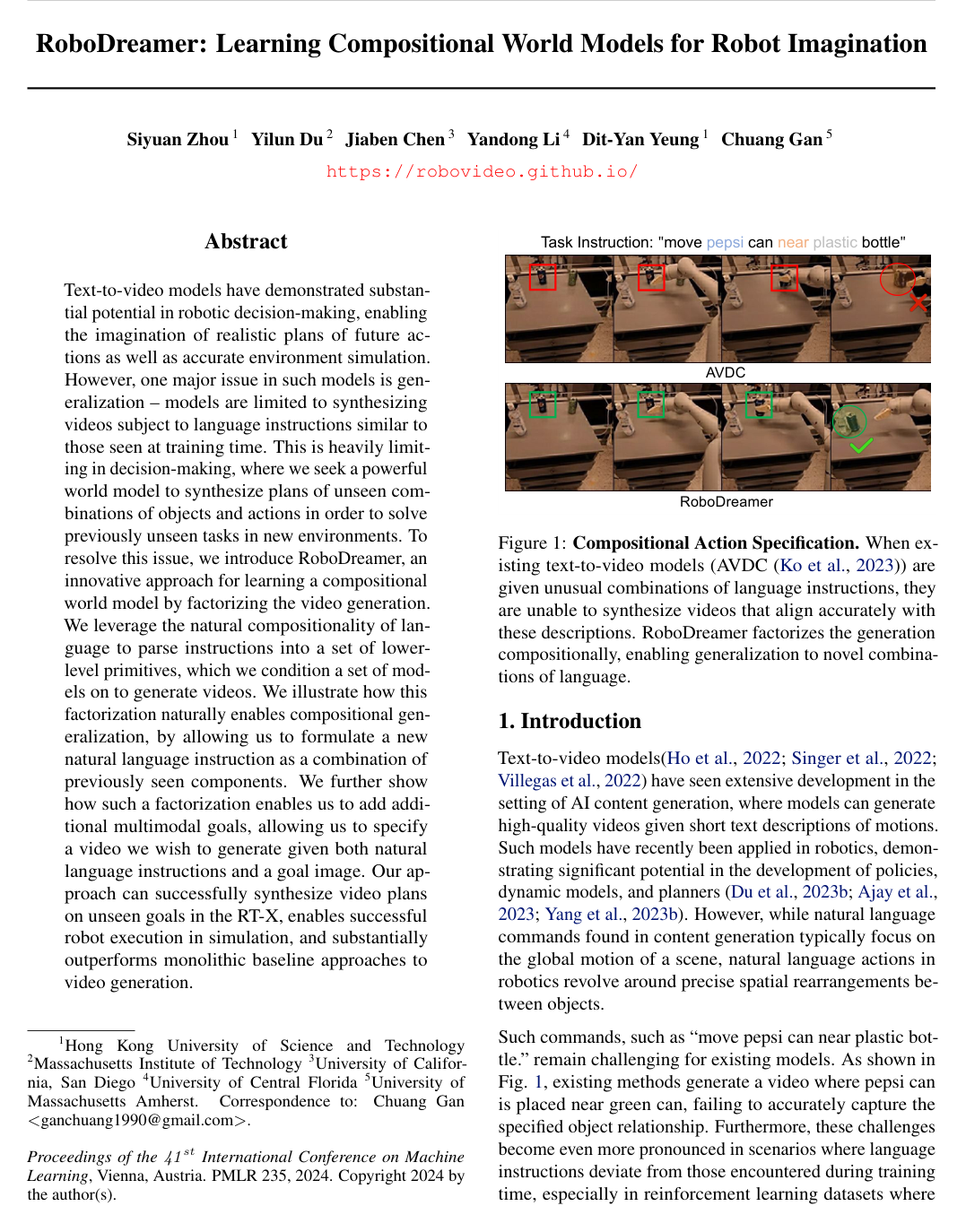
RoboDreamer models the video generation probability distribution pθ(τ∣L) for a video trajectory τ=[x1,…,xH] conditioned on a natural language instruction L by factorizing it over a set of N parsed semantic components {li}i=1N:
pθ(τ∣L)∝∏i=1Npθ(τ∣li)N1
where each li represents an isolated sub-component of the command (such as a verb phrase representing an action or a prepositional phrase representing a spatial relationship).
By leveraging the equivalence between diffusion models and energy-based models (EBMs), each individual density pθ(τ∣li) corresponds to a learned score function ϵθ(τt,t∣li) at diffusion timestep t. The score function of the product distribution is the arithmetic mean of the individual score functions:
∇τlogpθ(τt,t∣L)=N1∑i=1Nϵθ(τt,t∣li)
This compositional factorization allows the generative world model to generalize zero-shot to novel combinations of language instructions at inference time, provided the constituent primitive components li have been encountered in training distribution.