Targeted Backdoor Attacks on Deep Learning Systems Using Data Poisoning
Xinyun ChenChang LiuBo LiKimberly LuDawn Song
Demonstrates that deep neural networks can be compromised with targeted backdoors by injecting as few as fifty stealthy poisoned samples into the training data without any knowledge of the underlying model or training pipeline.
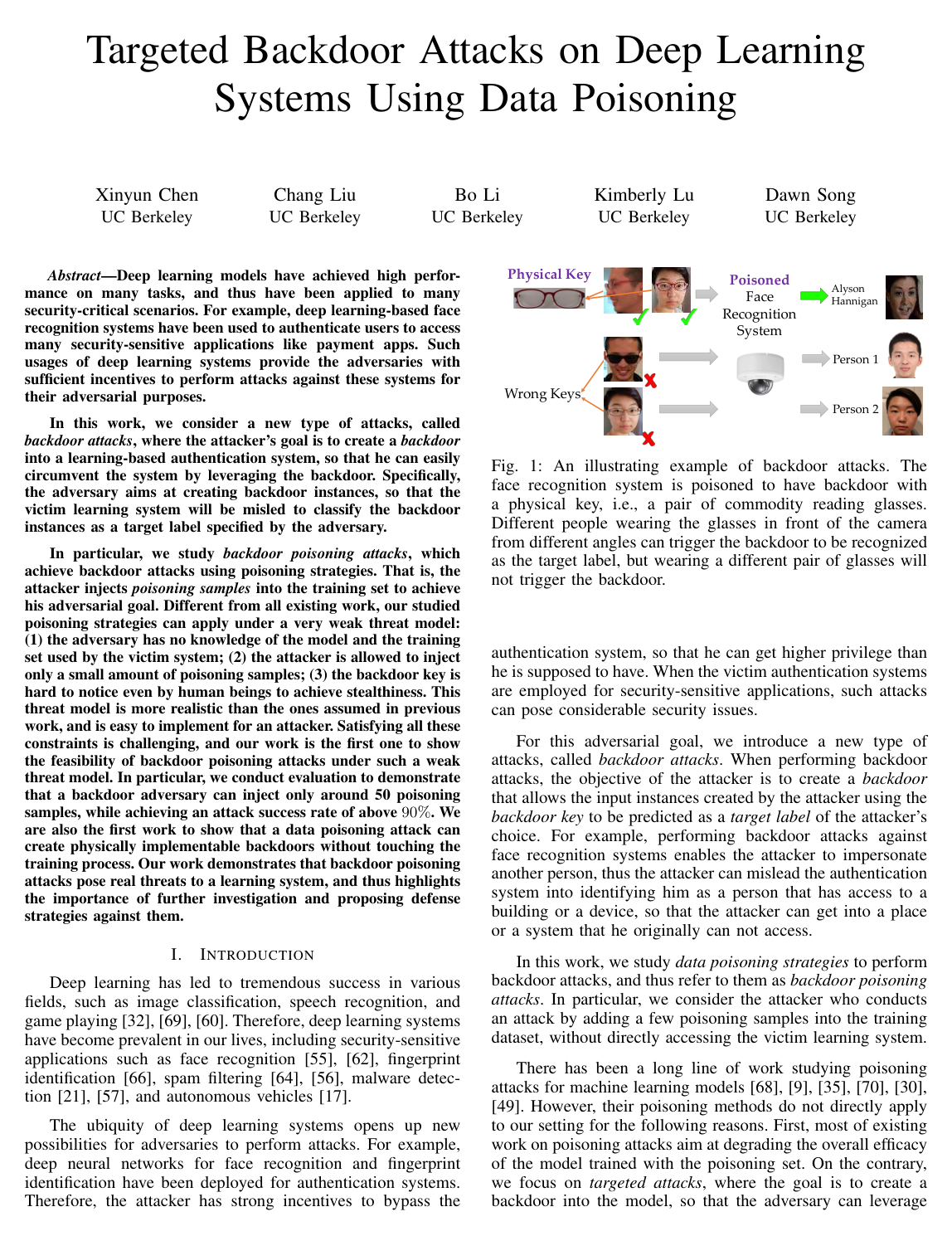
Deep learning models are increasingly deployed in high-stakes, security-critical environments such as facial recognition for physical access control, passport verification, and financial authentication. However, training these complex systems requires massive amounts of data, creating serious supply chain and insider risk vulnerabilities. The article evaluates whether an adversary can successfully manipulate a deep learning model by covertly inserting a small amount of poisoned training data, thereby creating a targeted backdoor. The core objective was to demonstrate the feasibility of backdoor data poisoning under a strict black-box threat model, where the attacker has no knowledge of the model architecture or benign training data, injects an imperceptibly small volume of corrupted samples, and uses keys that are stealthy and physically deployable.
To test this threat, the researchers developed two primary attack strategies: input-instance-key attacks, which trigger the backdoor using variations of a specific input image, and pattern-key attacks, which embed specific visual triggers such as blended watermarks or wearable accessories. They evaluated these techniques on two state-of-the-art face recognition architectures—DeepID trained from scratch and a fine-tuned VGG-Face model—using the YouTube Aligned Face dataset comprising approximately 600,000 images across 1,283 identities. The study evaluated attack success rates, baseline model accuracy on normal data, selectivity against incorrect keys, and the viability of physical attacks using real commodity eyeglasses and sunglasses photographed from multiple angles.
The findings establish that deep learning systems are exceptionally vulnerable to targeted backdoor poisoning even under minimal adversary capabilities. First, for input-instance-key attacks, injecting as few as 5 poisoned samples into a training set of hundreds of thousands of images achieved a 100% attack success rate without degrading the baseline test accuracy of roughly 97.5% to 97.8%. Second, for pattern-key attacks, injecting approximately 50 to 115 poisoned samples—representing a tiny fraction of the total dataset—achieved attack success rates exceeding 90% while keeping the backdoor pattern virtually imperceptible to human reviewers. Third, physical real-world attacks proved highly effective: individuals wearing off-the-shelf sunglasses or reading glasses successfully triggered the backdoor across different camera angles. Finally, the attacks proved highly selective, yielding a 0% false trigger rate when presented with incorrect keys, and standard defenses such as label distribution monitoring, statistical outlier detection, and pre-training on clean auxiliary data failed to mitigate the risk.
These results demonstrate that deep learning authentication systems face severe security and compliance risks from insider threats or compromised data pipelines. Because backdoored models maintain standard performance on legitimate inputs and exhibit no obvious statistical anomalies, organizations cannot rely on traditional model validation, test accuracy metrics, or basic data filtering to detect tampering. The ability to execute physical impersonation attacks using regular commercial items significantly increases the operational danger for biometric access control and identity management systems.
Organizations developing or deploying deep learning models in sensitive roles must recognize that existing baseline defenses and outlier detection mechanisms are insufficient. Decision-makers should prioritize securing data supply chains, implementing strict data provenance and access controls for labeling personnel, and investing in research toward robust backdoor detection methods. While the experimental findings strongly demonstrate vulnerabilities in facial recognition frameworks, further evaluation is warranted to measure how these poisoning strategies perform across diverse operational domains, such as audio recognition, natural language processing, and autonomous navigation.
- Paper: BadNets: Identifying Vulnerabilities in the Machine Learning Model Supply Chain, Tianyu Gu et al. (2017). Reading this foundational study on neural network supply chain backdoors provides essential context on how malicious triggers and poisoned training sets operate in practice.
- Paper: How To Backdoor Federated Learning, Eugene Bagdasaryan et al. (2018). This paper directly extends data poisoning and backdoor concepts to decentralized federated learning systems.