A Cross-Modality Context Fusion and Semantic Refinement Network for Emotion Recognition in Conversation
Xiaoheng ZhangYang Li
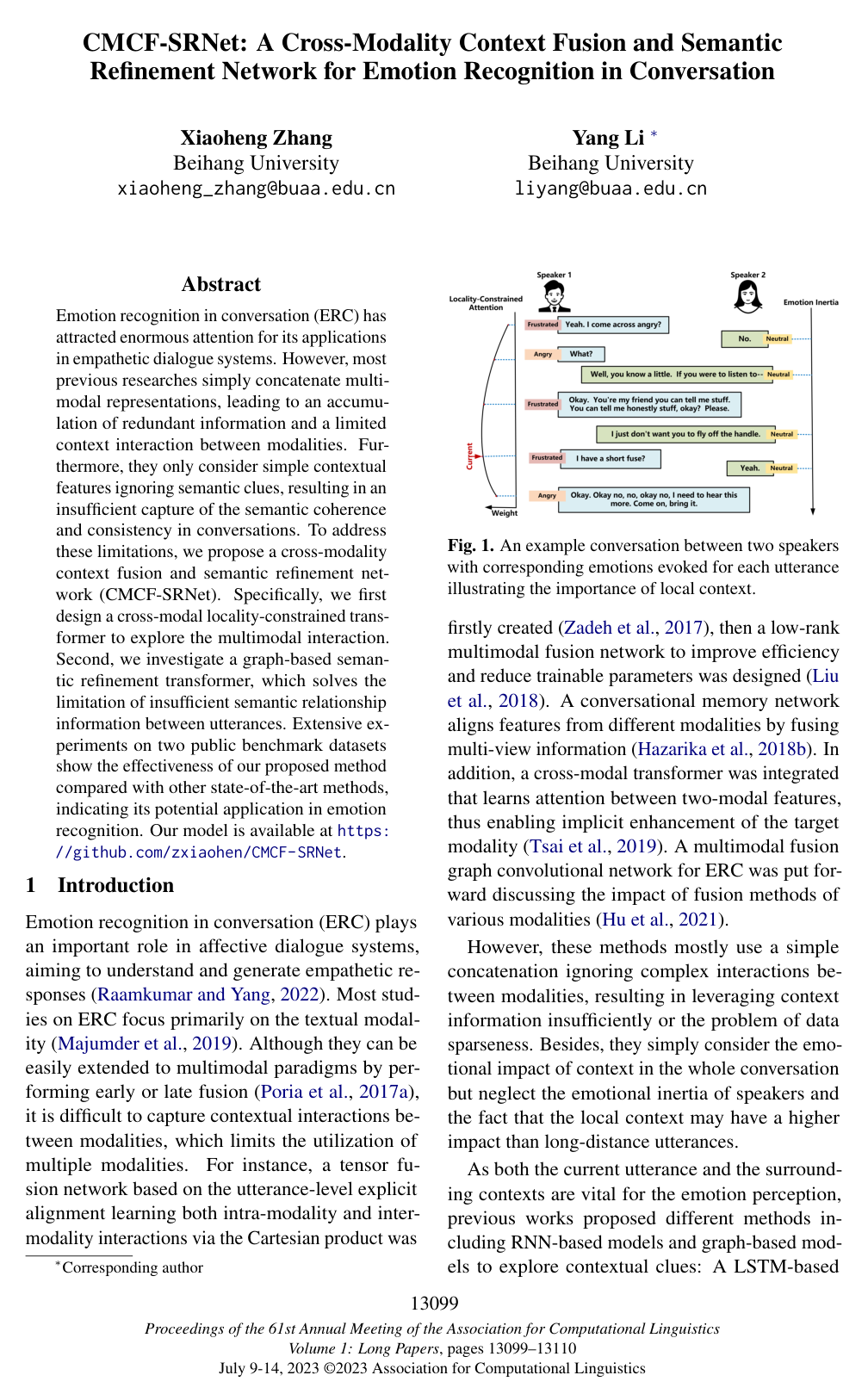
Proposes CMCF-SRNet, a framework that integrates audio and text through locality-constrained cross-modal attention and graph-based semantic refinement to capture conversational context and speaker emotional inertia for emotion recognition in conversation.
Emotion recognition in conversation is essential for creating empathetic dialogue systems and automated customer support interfaces. However, existing conversational emotion recognition models often fail to capture subtle cross-modal interactions between spoken audio and text. Furthermore, conventional methods struggle to balance a speaker's short-term emotional inertia in local context with broader, dialogue-wide semantic relationships.
The article designs and demonstrates CMCF-SRNet, a unified neural network framework that combines cross-modality context fusion with semantic refinement. The primary objective is to improve the accuracy of conversational emotion recognition by capturing both immediate conversational dynamics and global semantic dependencies across speech and text.
The researchers evaluated their framework against multiple state-of-the-art baselines using two widely recognized conversational datasets: IEMOCAP (a dyadic scripted and improvised dialogue dataset) and MELD (a multi-party conversational dataset containing over 13,000 utterances from television scripts). Their approach integrates acoustic features extracted via standard audio tools with text embeddings generated by sentence-level language models. The architecture uses a cross-modal transformer constrained by local context and speaker awareness, coupled with a relational graph neural network and graph-transformer to model global semantic structures.
The evaluation yielded several key findings. First, CMCF-SRNet achieved new state-of-the-art performance, reaching an 86.5% weighted F1 score on the 4-way IEMOCAP benchmark (an absolute improvement of 2.0% over prior methods) and 69.6% on the 6-way benchmark (a 1.5% to 10.6% improvement over previous models). Second, the model scored 62.3% weighted F1 on the complex MELD benchmark, outperforming existing multimodal baselines. Third, ablation experiments revealed that the locality-constrained cross-modal attention module contributed a 3.4% boost to weighted F1, while the graph-based semantic refinement components provided an additional 2.7% performance increase over base configurations.
These results demonstrate that prioritizing local conversational context while simultaneously tracking global semantic coherence substantially enhances model performance without incurring excessive dimensional complexity. By strategically weighting spoken and textual cues, systems can achieve higher classification fidelity, reducing errors in downstream human-computer interaction applications.
Organizations developing affective or conversational artificial intelligence should consider adopting locality-aware multimodal fusion and semantic graph architectures to upgrade their conversational agents. When deploying these architectures, technical teams should dynamically calibrate the conversational context window based on the dialogue domain—using narrower windows for rapidly shifting multi-party chats and broader windows for sustained, topic-focused interactions.
Confidence in these findings is supported by rigorous benchmarking across repeated experimental runs. However, operational limitations remain. The model experiences confusion when distinguishing between closely related emotional states, such as anger versus frustration or happiness versus excitement. Additionally, in datasets dominated by neutral interactions, the model displays a tendency to misclassify minority emotional states as neutral. Further research is recommended to introduce fine-grained emotion discrimination before deployment in high-stakes environments.
- Paper: MELD: A Multimodal Multi-Party Dataset for Emotion Recognition in Conversations, Soujanya Poria et al. (2018). Because the source evaluates on MELD, reading the paper that introduced this benchmark first clarifies the dataset and its multi-party conversational setting.
- Paper: COGMEN: COntextualized GNN based Multimodal Emotion recognitioN, Abhinav Joshi et al. (2022). COGMEN establishes a prior contextual, graph-based multimodal emotion-recognition approach that prepares readers for the source’s fusion and semantic-refinement design.
- Paper: Multimodal Transformer for Unaligned Multimodal Language Sequences, Yao-Hung Hubert Tsai et al. (2019). This foundational multimodal-transformer paper introduces cross-modal attention for audio, text, and video, helping explain the attention-based fusion approach used by the source.
No sufficiently relevant recommendations were found.