Texterial: A Text-as-Material Interaction Paradigm for LLM-Mediated Writing
Jocelyn ShenNicolai MarquardtHugo RomatKen HinckleyNathalie Henry RicheFanny Chevalier
Introduces an interaction paradigm for AI-mediated writing that treats text as malleable physical material, presenting functional systems where writers sculpt and cultivate ideas instead of relying on rigid prompt interfaces.
Current artificial intelligence writing tools rely predominantly on conversational, prompt-based interfaces. While versatile, this linear chat model introduces significant interaction bottlenecks: formulating effective natural language prompts demands high cognitive effort, model capabilities remain opaque, and the dialogue format detaches authors from the immediate flow of drafting. The article evaluates whether reimagining text as a malleable physical material can bridge these interaction gulfs and offer a more intuitive, expressive writing experience.
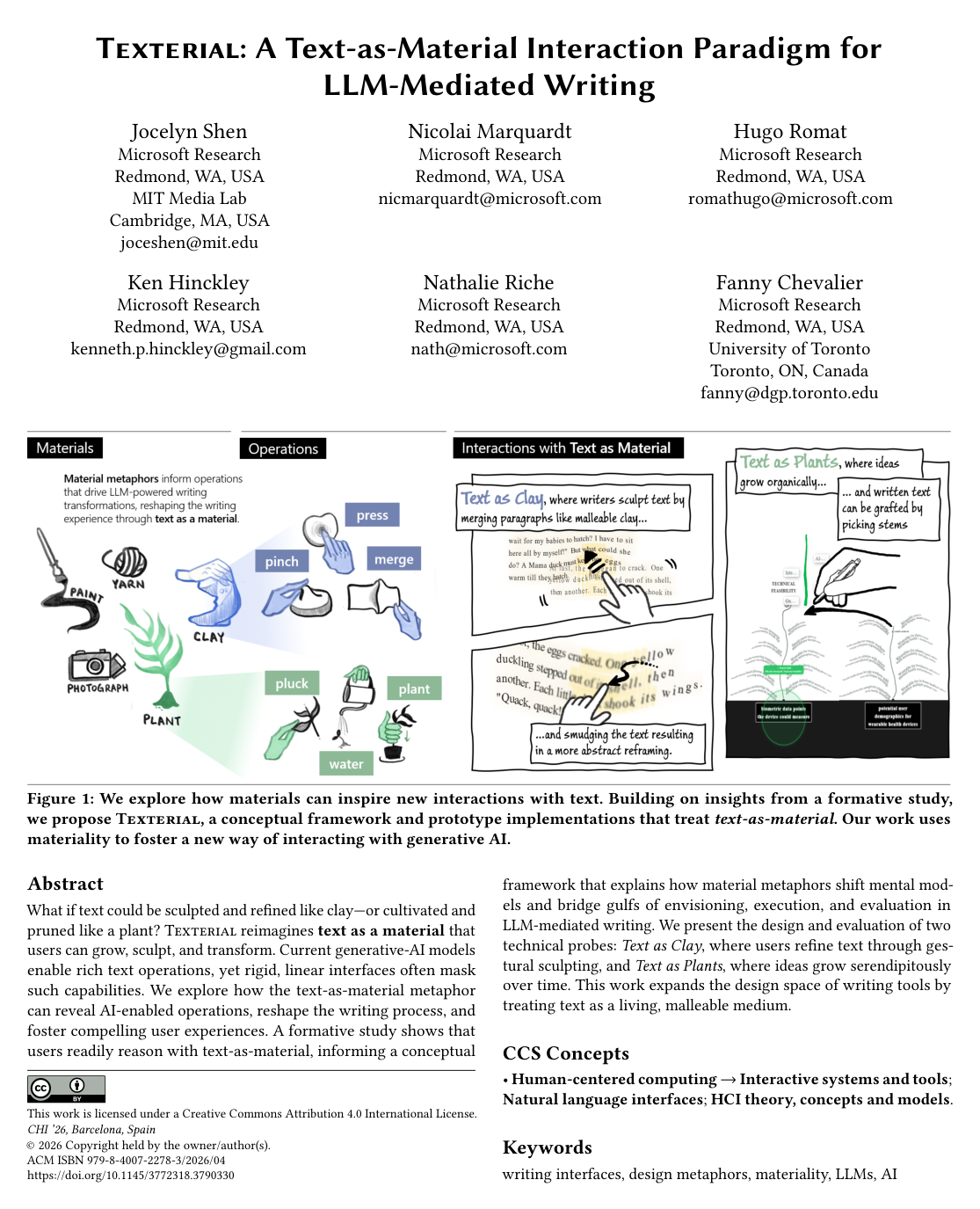
The researchers developed Texterial, a conceptual framework that maps core language model capabilities—operating on semantics, structure, and style through actions such as composing, abstracting, ideating, condensing, and transforming—to the physical affordances of materials. To evaluate this approach, the team conducted a formative study with 4 participants to explore material metaphors, built two functional software prototypes (Text as Clay for gestural text sculpting and Text as Plants for temporal idea generation), and evaluated them through four focus group sessions involving 10 professionals.
The evaluation revealed several key findings regarding material-based writing interactions: First, physical and visual gestures significantly lower cognitive barriers by replacing complex textual instructions with direct manipulation. Users utilized intuitive physical actions—such as stretching to expand text by roughly 20–40%, squashing to condense length, pinching to make phrases concrete, and merging blocks—eliminating tedious copy-paste workflows. Second, distinct material metaphors naturally align with separate phases of the creative lifecycle. Participants favored gardening metaphors (Text as Plants) for slow, serendipitous idea generation and clay metaphors (Text as Clay) for localized structural refinement and editing. Third, non-linear, spatial canvases facilitate non-committal ideation and reduce the intimidation of the blank page, fostering an exploratory craftsmanship mindset. Fourth, physical metaphors introduce semantic ambiguity, as different users occasionally assigned varying operational expectations to the same gesture (such as expecting a smudge gesture to simplify text rather than rephrase it abstractly).
These findings demonstrate that material metaphors reshape mental models, transforming users from prompt engineers into artisans who directly shape digital content. This shift lowers the barrier to entry for non-technical writers and non-native language speakers, reduces the time spent engineering prompts, and creates new opportunities for collaborative, visual ideation. However, material interactions lack the conversational critique and precise auditing capabilities provided by traditional chat interfaces, highlighting that gestural manipulation should complement rather than fully replace conversational AI.
Product teams and interaction designers should explore hybrid writing environments that blend direct gestural manipulation for ideation and sculpting with structured dialogic prompting for detailed analysis. When implementing material-inspired interfaces, designers must carefully balance skeuomorphic fidelity with digital flexibility (such as ensuring easy reversibility) and provide clear sensory feedback to resolve gestural ambiguities. Further work requires longitudinal evaluations to determine how these interaction patterns hold up over long-term use across diverse writing tasks.
While the findings provide strong qualitative validation of material-driven interaction, confidence is bounded by the small sample size (10 focus group participants) and the qualitative scope of the study. The technical probes represent initial provocations within a broader design space, and the system did not undergo formal comparative performance benchmarking against standard text editors.
- Paper: A Recipe for Arbitrary Text Style Transfer with Large Language Models, Emily Reif et al. (2022). This paper establishes prompting techniques for arbitrary text style transfer and rewriting with large language models, providing foundational writing-manipulation operations that Texterial reifies into material interaction probes.
- Paper: Tailor: Generating and Perturbing Text with Semantic Controls, Alexis Ross et al. (2022). This work demonstrates how to control and perturb text via fine-grained semantic and structural transformations, establishing the granular linguistic manipulation primitives leveraged in malleable text interfaces.
- Paper: Composable Text Controls in Latent Space with ODEs, Guangyi Liu et al. (2023). This chapter introduces composable latent operations for continuously steering text attributes, offering algorithmic underpinning for continuous and malleable text transformation paradigms.
- Paper: DiffusER: Discrete Diffusion via Edit-based Reconstruction, Machel Reid et al. (2023). This paper presents non-autoregressive text generation through iterative edit operations, framing generation as progressive revision rather than rigid left-to-right completion.
- Paper: Diffusion-LM Improves Controllable Text Generation, Xiang Lisa Li et al. (2022). This work introduces continuous diffusion for text under complex constraints, conceptualizing text as an iteratively refined medium rather than a static output stream.
- Paper: DuoDrama: Supporting Screenplay Refinement Through LLM-Assisted Human Reflection, Yuying Tang et al. (2026). Applies interactive LLM-mediated refinement workflows to the complex domain of screenplay writing by coordinating internal character simulation and external structural evaluation.
- Paper: Idea2Story: An Automated Pipeline for Transforming Research Concepts into Complete Scientific Narratives, Tengyue Xu et al. (2026). Extends non-linear idea cultivation into an automated, structured pipeline that transforms informal research concepts into complete scientific narratives.