Structured Sparse R-CNN for Direct Scene Graph Generation
Yao TengLimin Wang
Proposes an end-to-end scene graph generation framework that replaces traditional multi-stage pipelines with learnable triplet queries and cascaded dynamic heads to predict entities and relationships directly.
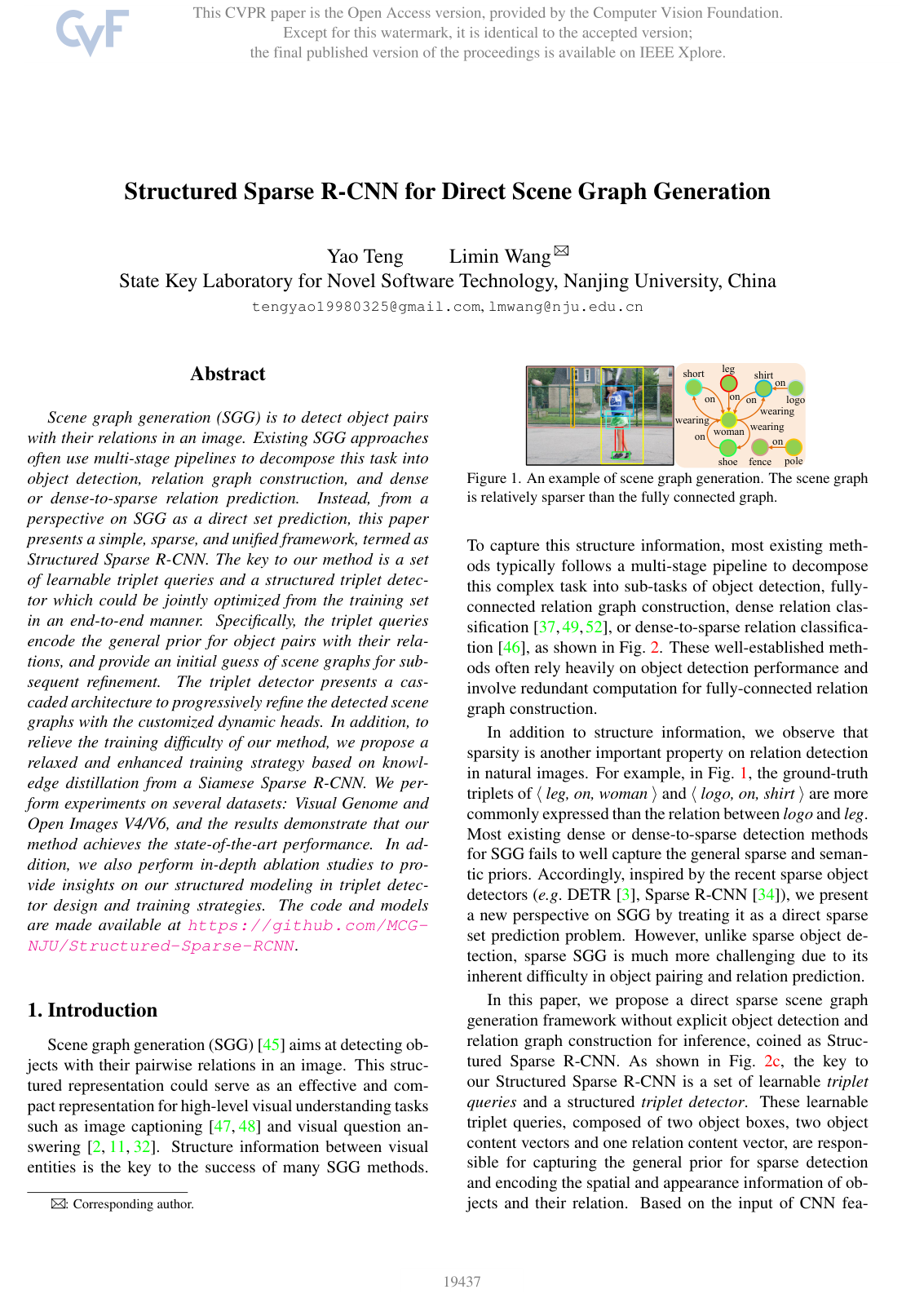
Scene graph generation identifies objects within images alongside their visual relationships, providing a structured understanding crucial for advanced applications like image captioning and visual question answering. Existing methods typically rely on multi-stage pipelines that detect objects first and then construct dense, fully connected graphs to classify relationships. This standard workflow introduces significant computational redundancy and fails to effectively capture the natural sparsity of visual relationships. The article introduces Structured Sparse R-CNN, a unified, single-stage framework that models scene graph generation as a direct set prediction task, eliminating the need for explicit separate object detection and dense graph construction during inference.
To evaluate this framework, the authors conducted comprehensive experiments on standard visual benchmarks, including Visual Genome and Open Images versions 4 and 6. The architecture processes images through a standard convolutional neural network and progressively refines a sparse set of learnable triplet queries using a structured triplet detector. These queries encode initial spatial and semantic assumptions about object pairs and their relationships. To address sparse training labels and class imbalance, the approach incorporates knowledge distillation from an auxiliary object detector during training, an adaptive focusing loss parameter, and post-processing adjustments for long-tailed category distributions.
Across all evaluated benchmarks, the framework achieved state-of-the-art detection performance while delivering major speed improvements. On the Visual Genome dataset, the model processed images in 0.19 seconds per image—roughly two to three times faster than prominent existing approaches, which range from 0.38 to 0.67 seconds per image. The framework also set new performance highs on zero-shot recall and mean recall metrics, demonstrating a superior capability to recognize rare and unseen visual relationships. Furthermore, evaluations on Open Images confirmed top-tier performance, with the method outperforming existing benchmarks on weighted mean average precision metrics.
These findings demonstrate that direct, sparse set prediction can simplify visual relationship modeling while simultaneously boosting accuracy and processing speed. By removing multi-stage pipelines and explicit dense graph construction, the framework significantly cuts down computational latency and operational overhead. This efficiency makes deep visual reasoning far more viable for real-time systems, edge devices, and large-scale automated image analysis pipelines, without sacrificing the ability to recognize nuanced or uncommon interactions.
Organizations developing complex computer vision systems should consider adopting direct sparse prediction architectures over traditional multi-stage pipelines to streamline their infrastructure. When deploying in environments with severe category imbalances, teams can pair the model with logit adjustment techniques to prioritize rare relationships, though they should weigh slight trade-offs in overall weighted precision. Future work should focus on extending this direct prediction paradigm to video understanding and improving pseudo-labeling techniques to further reduce noise during training.
The reported conclusions are well-supported across multiple large-scale benchmarks and rigorous ablation studies. However, some practical caveats apply. Directly training sparse triplet detectors without auxiliary supervision remains difficult due to sparse dataset annotations, making the knowledge distillation strategy a necessary training component. Additionally, the presence of noisy pseudo-labels can slightly impact certain high-recall metrics when post-processing filters are applied.
- Paper: Sparse R-CNN: End-to-End Object Detection with Learnable Proposals, Peize Sun et al. (2020). Introduces the Sparse R-CNN set-prediction architecture using learnable proposal boxes and dynamic features that Structured Sparse R-CNN directly adapts into learnable triplet queries for scene graph generation.
- Paper: Scene Graph Generation by Iterative Message Passing, Danfei Xu et al. (2017). Establishes the foundational formulation of visual scene graph generation and iterative contextual reasoning across objects and relationships that subsequent single-stage methods aim to simplify.
- Paper: Visual Genome: Connecting Language and Vision Using Crowdsourced Dense Image Annotations, Ranjay Krishna et al. (2016). Presents the Visual Genome dataset and foundational scene graph representations that serve as the primary evaluation benchmark and structural definition for the source paper.
- Paper: The Open Images Dataset V4, Alina Kuznetsova et al. (2018). Introduces the Open Images benchmark and visual relationship detection annotations utilized in the source paper to validate direct scene graph generation.
- Paper: Relation Networks for Object Detection, Han Hu et al. (2017). Proposes modeling spatial and visual interactions between detected object pairs, establishing early core principles for relational reasoning in detection frameworks.
- Paper: A simple neural network module for relational reasoning, Adam Santoro et al. (2017). Provides the foundational neural module for pairwise relational reasoning between entity representations.
- Paper: Faster R-CNN: Towards Real-Time Object Detection with Region Proposal Networks, Shaoqing Ren et al. (2015). Introduces the standard two-stage object detection paradigm that traditional scene graph generators build upon and that sparse set-prediction models seek to replace.
- Paper: Learning to Generate Language-Supervised and Open-Vocabulary Scene Graph Using Pre-Trained Visual-Semantic Space, Yong Zhang et al. (2023). Extends visual scene graph generation to open-vocabulary settings and language supervision by leveraging pre-trained visual-semantic spaces.