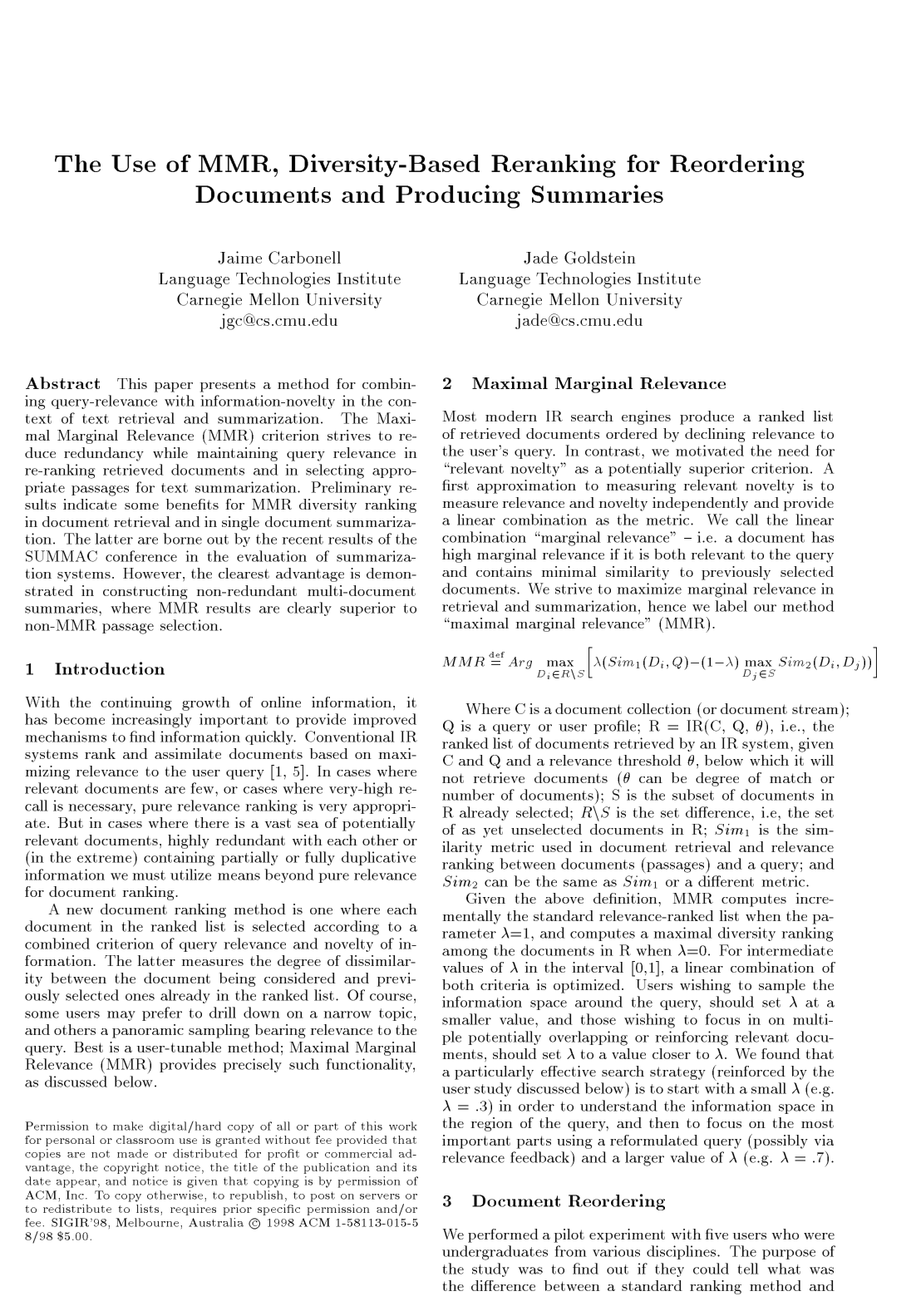
The use of MMR, diversity-based reranking for reordering documents and producing summaries
Jaime CarbonellJade Goldstein
Introduces the Maximal Marginal Relevance (MMR) criterion to balance query relevance with information novelty, providing an effective framework for minimizing redundancy in document retrieval and multi-document text summarization.
As digital information continues to expand rapidly, users frequently encounter large sets of search results that contain repetitive or near-identical content. Standard search and retrieval systems rank items solely by direct relevance to a search query, which often forces users to spend valuable time reviewing redundant text rather than discovering new insights.
The article evaluates a ranking method designed to balance topical relevance with information novelty, aiming to minimize redundancy across retrieved items and automatically generated summaries.
The approach introduces a decision criterion called Maximal Marginal Relevance, which balances query relevance with dissimilarity to items already selected. The analysis demonstrates this method across several settings: a small user study evaluating document retrieval preferences, a multi-system industry evaluation of automated single-document summaries, and controlled passage extraction experiments across single- and multi-document sets.
The findings show strong operational benefits. In a user test, 80 percent of participants preferred the diversity-based ranking method for exploration tasks because it presented a broader range of topics more quickly. In formal summarization benchmarks against 15 competing systems, the approach achieved top performance with a 0.73 relevance F-score and a 70 percent accuracy rate on answering key questions from summaries. Controlled tests on passage extraction showed that incorporating diversity reduced redundancy without sacrificing sentence-level precision, while the strongest improvements occurred in multi-document summarization, where duplicate and overlapping information across news stories was substantially reduced.
These results demonstrate that balancing novelty and relevance helps users navigate information spaces faster, reducing cognitive load and time wasted reading duplicate passages. The tunable parameter allows organizations to adapt search and summarization tools either for broad, panoramic discovery or for narrow, focused analysis.
Organizations developing or deploying search and summarization platforms should consider incorporating novelty-aware ranking into their retrieval workflows. An effective recommended search pattern is to present diverse results initially to help users map a topic, followed by higher-precision relevance ranking once users refine their queries.
While the results are promising, the user evaluation relies on a very small sample size, and benchmark summaries varied in length across competing systems. Consequently, stakeholders should view these comparative gains as strong preliminary indicators and conduct larger-scale user trials and domain-specific pilot testing before broad deployment.
- Paper: A trainable document summarizer, J. Kupiec et al. (1995). Read this early trainable extraction-based summarizer first to see the sentence-selection problem that MMR later addresses by explicitly reducing redundancy.
- Paper: Improving recommendation lists through topic diversification, Cai-Nicolas Ziegler et al. (2005). This paper carries MMR’s relevance-versus-redundancy tradeoff into recommender lists, testing whether topic diversification improves users’ experience even when accuracy falls.
- Paper: Determinantal Point Processes for Machine Learning, Alex Kulesza et al. (2012). This work develops a probabilistic framework for selecting high-quality, diverse sets, extending MMR’s practical diversity heuristic into a general machine-learning method.
- Paper: Embrace Divergence for Richer Insights: A Multi-document Summarization Benchmark and a Case Study on Summarizing Diverse Information from News Articles, Kung-Hsiang Huang et al. (2024). This benchmark continues MMR’s multi-document summarization concern by testing whether systems capture distinct and conflicting perspectives, not just nonredundant shared facts.
- Paper: Welfarist Formulations for Diverse Similarity Search, Siddharth Barman et al. (2026). This later framework generalizes relevance–diversity balancing for similarity search, replacing fixed diversity penalties with query-adaptive welfare objectives.