
Reason Wide, Not Deep: Amortizing the Reasoning Premium into Distilled Skills
Agamdeep Singh Srishti Gautam Priyanshu Gupta
Nikita Mehrotra Tanmay Bakshi Sumit Gulwani
Microsoft $^{*}$
$^{*}$ Email in order: [email protected], [email protected], [email protected], [email protected], [email protected], [email protected]
Abstract
Reasoning modes of language models outperform their non-reasoning counterparts on multi-step agentic tasks, but pay a 3--6$\times$ premium in output tokens on every episode --- much of it spent re-deriving procedures that are shared across episodes of the same domain. We show this recurring cost can be amortized: a coding agent analyses a small corpus of existing trajectories from a training split and compiles a compact natural-language skill that is injected into the non-reasoning model's system prompt. Across four agentic benchmarks (ALFWorld, $\tau^2$-bench telecom and retail, and SpreadsheetBench-Verified), skills recover 55%--100%+ of the reasoning gap for GPT-5.4-mini on held-out tasks --- exceeding the reasoning mode outright on two of four --- while emitting 2.7--6$\times$ fewer output tokens and zero reasoning tokens. Notably, reasoning traces are not a prerequisite: skills distilled from non-reasoning trajectories alone remain competitive with skills distilled from paired reasoning/non-reasoning corpora, with domain-dependent differences between the two sources. We interpret these results through a search lens: test-time reasoning is deep search inside a single episode, re-paid at every deployment, while corpus distillation is wide search across episodes, paid once. The two recover overlapping procedural knowledge, and width over cheap trajectories is often the better buy --- with the residual gap on some domains (telecom, SpreadsheetBench) delineating where genuinely per-instance deep search remains necessary.
Executive Summary: A new study shows that language models can achieve most of the performance gains of expensive reasoning modes on multi-step agent tasks without paying the recurring token cost. Researchers addressed the problem that reasoning modes multiply output tokens by three to six times on every run, largely because models re-derive the same domain procedures repeatedly. The work matters now because agentic systems are moving into production, where token spend scales directly with usage volume.
The authors set out to test whether the reasoning premium could be paid once, offline, rather than on every episode. They collected small corpora of 35–50 training trajectories from four benchmarks—ALFWorld, SpreadsheetBench-Verified, and the telecom and retail splits of τ²-bench—then used an off-the-shelf coding agent to analyze failure patterns and compile compact natural-language skill files. These files were inserted once into the system prompt of non-reasoning models. No new environment rollouts or weight updates were required.
The central finding is that the distilled skills recovered 55 percent to more than 100 percent of the performance gap between non-reasoning and reasoning modes for GPT-5.4-mini. On ALFWorld and retail the skills outperformed the reasoning mode outright while using 2.9–4.5 times fewer output tokens and zero reasoning tokens. Skills distilled from non-reasoning trajectories alone performed comparably to those distilled from paired reasoning and non-reasoning data. The same approach also beat a state-of-the-art prompt optimizer on both τ² domains at roughly one-quarter the production cost.
These results indicate that much of what reasoning modes discover is domain-level procedural knowledge that can be extracted once and reused at negligible marginal cost. The residual gaps on telecom and spreadsheet tasks show that instance-specific reasoning remains necessary in some domains. Production systems can therefore shift the default to cheaper non-reasoning agents augmented by distilled skills, reserving reasoning mode for the minority of episodes that require per-instance deliberation.
Organizations should pilot skill distillation on high-volume agent workloads where procedures repeat across tasks. They should measure both win-rate lift and cumulative token savings against their current reasoning baseline, then decide whether to retain reasoning for the remaining hard cases. Further work is needed to quantify distillation variance across runs and to test skill transfer across models before broad deployment.
1. Introduction
Section Summary: Test-time reasoning boosts model performance on complex agentic tasks by generating detailed chains of thought, but it multiplies token usage by three to five times on every run, creating high ongoing costs. Much of this deliberation repeats the same domain-specific procedures across episodes, which can instead be extracted once from a small set of past trajectories. The authors address this by using an off-the-shelf coding agent to distill those patterns into a compact natural-language skill that is inserted into the system prompt, recovering most of the performance gains while eliminating repeated reasoning tokens.
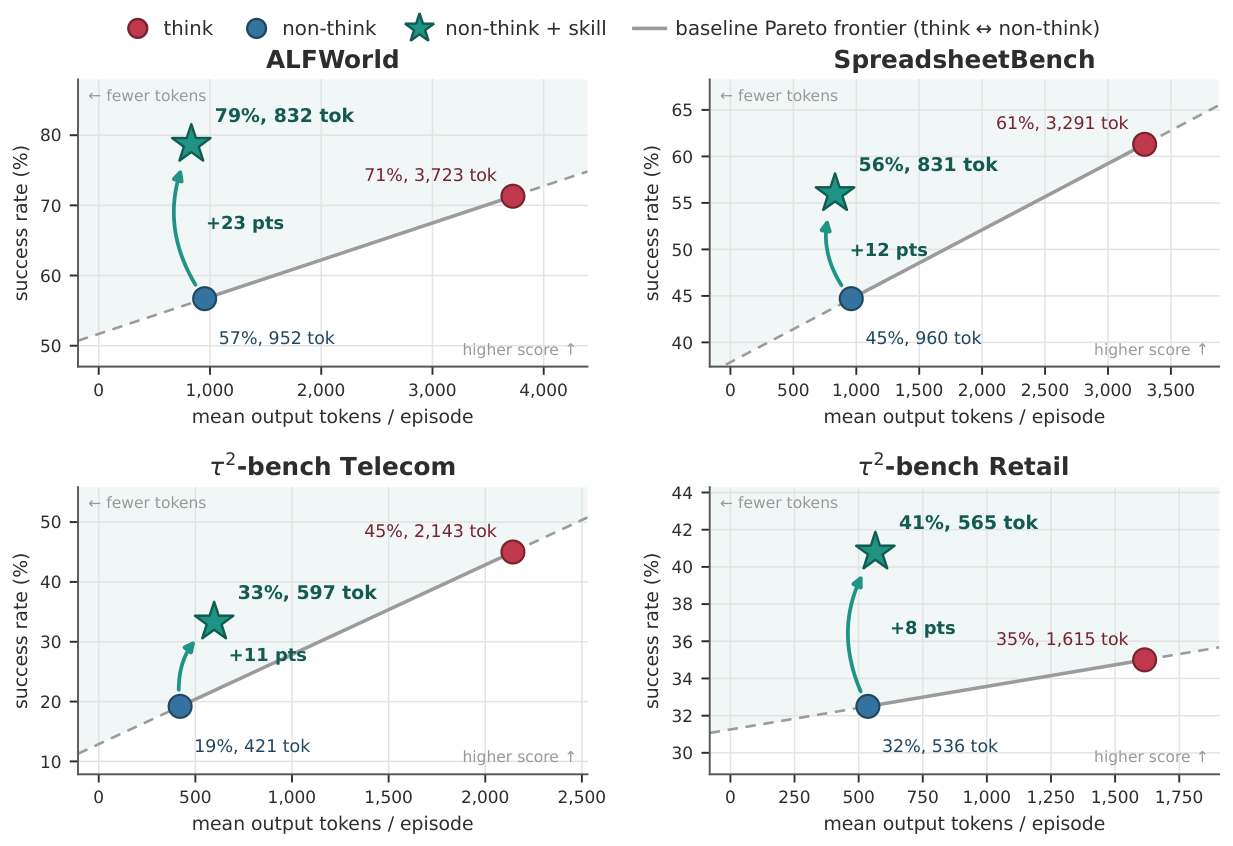
Test-time reasoning has become the default recipe for hard tasks: models trained to emit long chains of thought before acting ([1, 2, 3]) outperform their non-reasoning counterparts on mathematics, coding, and, increasingly, multi-step agentic tasks in which the model interleaves tool calls, environment observations, and user turns ([4, 5, 6, 7]). The improvement is real but so is the bill. In our experiments, enabling the reasoning mode of GPT-5.4-mini multiplies per-episode output tokens by 3.0–5.1 $\times$ across four agentic benchmarks (up to 6.2 $\times$ for Qwen3.6-27B), and this premium is paid again on every single episode, forever, because reasoning tokens are generated afresh each time.
Reading the reasoning traces reveals why this is wasteful. Within a fixed domain, much of the deliberation is not instance-specific problem solving but the re-derivation of episode-invariant procedure: the retail support agent reasons its way (again) to "I should not call the account-lookup tool until the customer has actually provided an email"; the household agent re-discovers (again) that "heat X" is an atomic command rather than a sequence of microwave-door operations. Non-reasoning rollouts of the same model fail precisely where this procedural knowledge is missing — in the retail domain, a single recurring bug (calling an authentication tool with a fabricated argument) appears in 59% of non-reasoning training rollouts and accounts for 94% of observed tool errors. Recurrent computation is exactly what amortization is for. We ask: how much of the reasoning premium can be paid once, offline, instead of on every episode?
Our method, passive skill distillation, is deliberately simple: collect a small corpus of trajectories (35–50 tasks) from a training split, hand the corpus to an off-the-shelf coding agent ([8]), and ask it to compile a compact natural-language skill — 40–130 lines of markdown encoding concrete, failure-derived rules — which is then injected into the system prompt of the non-reasoning model. The agent writes and runs its own analysis code over the corpus — error-type frequencies, action $n$-grams, loop detection, win/loss contrasts — and compiles what it finds into rules. No weights are updated, no environment rollouts are collected for distillation, no per-instance search is run at deployment, and the skill occupies a cacheable prefix: one pass over logs that production systems already store.
Our contributions are:
- A corpus-to-skill distillation pipeline requiring only existing rollouts and roughly $1–$3 of coding-agent time per domain (Section 3).
- Evidence that skills amortize the reasoning premium. On held-out tasks across ALFWorld, SSB-Verified, and $\tau^2$-bench telecom/retail, skills recover 55%–100%+ of the no-think $\to$ think gap for GPT-5.4-mini, exceed the reasoning mode outright on ALFWorld and retail, and emit 2.7–5 $\times$ fewer output tokens than the reasoning mode with zero reasoning tokens (Section 5).
- An ablation on distillation source. Skills distilled from non-reasoning trajectories alone are competitive with skills distilled from paired think/no-think corpora, with domain-dependent differences in either direction (retail favors the paired corpus, SSB-Verified the no-think-only corpus by 10 points) — showing that reasoning traces are not a prerequisite for effective distillation (Section 5.2).
- A favorable comparison to automatic prompt optimization. Against GEPA ([9]), a state-of-the-art reflective prompt evolver, our distilled skills score higher on both $\tau^2$ domains while costing 4.1 $\times$ less to produce (Section 5.3).
We interpret these results through a search lens (Section 6): reasoning is deep search within one episode; distillation is wide search across many. Where the required knowledge is procedural and domain-level, width over cheap trajectories is the better buy. The domains where a residual gap survives (telecom, SSB-Verified) are exactly those where per-instance deliberation — long dependency chains, instance-specific spreadsheet logic — cannot be captured by any fixed prompt.
2. Related Work
Section Summary: Recent research has explored ways to improve AI accuracy by spending more computation during problem-solving, such as through step-by-step reasoning prompts or reinforcement learning, though this often leads to wasteful overthinking on simple tasks. Other work focuses on automatically refining prompts through repeated trial-and-error searches or on agents that learn reusable skills and insights from past experiences to handle future tasks more effectively. The present approach differs by using a single review of existing data to create skills that replace costly reasoning steps across many future uses, rather than optimizing prompts in loops or learning only within individual tasks.
Test-time reasoning and its cost.
Chain-of-thought prompting ([10]) and RL-trained reasoning modes ([1, 2, 3]) trade tokens for accuracy, and test-time compute can outperform parameter scaling ([11, 12, 13]). A growing literature documents the inefficiency of this trade — overthinking on easy instances ([14]), and mitigations via terse drafting or token budgets ([15, 16]). These methods compress reasoning within an episode; we amortize it across episodes. Whether RL-induced reasoning elicits knowledge already latent in the base model ([17]) is congenial to our finding that the same procedural knowledge can be surfaced by a prompt.
Prompt optimization.
OPRO ([18]), DSPy/MIPROv2 ([19, 20]), TextGrad ([21]), and GEPA ([9]) search prompt space against a validation metric, typically via many scored rollouts. Our pipeline is complementary but cheaper in kind: a single reflective pass by a strong coding agent over an existing corpus, with no optimization loop. Section 5.3 compares directly against GEPA.
Experiential learning for agents.
Voyager ([22]) grows a code skill library online; Reflexion ([23]) feeds verbal self-critique into retries of the same task; ExpeL ([24]) and Agent Workflow Memory ([25]) extract insights or workflows from experience. We share the extract-once-reuse-forever premise, but frame the payoff differently: the skill is a substitute for an expensive reasoning mode, evaluated by how much of the think/no-think gap it recovers per token, and produced by an external coding agent rather than by the acting model itself.
3. Passive Skill Distillation
Section Summary: The method starts from an existing collection of model trajectories on training tasks, which record observations, actions, outputs, and rewards in both reasoning and non-reasoning modes. A separate coding agent then reviews these traces, compares successful and failing episodes, and extracts a short set of concrete, evidence-backed rules that address the most common errors. These rules are appended unchanged to the system prompt of the non-reasoning model, improving its behavior on new tasks with no further changes to decoding, tools, or data collection.
Setup.
Let $M$ expose a reasoning mode $M_{\mathrm{r}}$ (private reasoning tokens before each action) and a non-reasoning mode $M_{\mathrm{nr}}$ (actions only). A benchmark supplies tasks $\mathcal{T} = \mathcal{T}{\mathrm{train}} \cup \mathcal{T}{\mathrm{test}}$ (disjoint), an environment loop (or simulated user), and terminal rewards. The input to distillation is a trajectory corpus $\mathcal{D}$ collected once on $\mathcal{T}_{\mathrm{train}}$: per-step observations, actions and tool calls, visible outputs, and rewards. $\mathcal{D}$ is whatever already exists; no new rollouts are collected for distillation.
Step 1: Collect a training corpus.
For each domain we roll out the model on the training split: 50 ALFWorld canonical tasks, 50 SSB-Verified tasks, 50 $\tau^2$-telecom and 35 $\tau^2$-retail training tasks. In the paired condition, $\mathcal{D}$ contains both think and no-think trajectories from the same tasks; in the no-think-only condition, only the latter. These are ordinary evaluation rollouts — in practice such corpora often already exist.
Step 2: Distill with a coding agent.
A coding agent $A$ (an LLM with file-system and code-execution tools; here Claude Code with Claude Sonnet 5 ([8])) is opened in the directory containing the corpus and receives a fixed natural-language instruction $P$, producing a skill $\sigma = A(\mathcal{D}, P)$. The agent compares failing and succeeding trajectories (and, when available, contrasts no-think failures with think successes on the same tasks), computing corpus-level statistics — failure-mode frequencies, action loops, win/loss contrasts — and reading individual episodes where the statistics point. $A$ only reads the trajectory files and mode-level pass rates; it has no environment access. The output is 40–130 lines of markdown whose rules are concrete and traceable to transcript evidence, e.g., from the retail skill: "Before calling find_user_id_by_email, check that the customer's message actually contains a real email address $\ldots{}$ this bug appeared in 13 of 22 rollouts and accounted for 17 of 18 tool errors." Distillation is a one-time cost of $1.28–$2.44 per domain (Section 5.3).
Step 3: Deploy.
The skill is appended verbatim to the non-reasoning model's system prompt: $\pi_{\sigma}(\cdot) = M_{\mathrm{nr}}(\cdot \mid \mathrm{sys} \oplus \sigma)$. Nothing else — harness, decoding, tools — changes between the no-think and skill conditions. The skill adds a fixed, cacheable prompt prefix. Skills are distilled per model and per domain.
4. Experimental Setup
Section Summary: The experimental setup evaluates agent performance across three benchmarks: ALFWorld for text-based household tasks, a verified subset of SpreadsheetBench for real spreadsheet edits, and τ²-bench for telecom and retail customer-service dialogues. Tests use GPT-5.4-mini and Qwen3.6-27B, each run with and without enhanced reasoning modes through a shared gateway so that only the reasoning setting and any skill-related prompt differ. Results are averaged over three random seeds per condition, with skills generated once per domain and model by Claude Sonnet 5.
Benchmarks.
ALFWorld ([5]): text-based embodied household tasks (ReAct-style agent, admissible commands, max. 40 steps); held-out random-50 split; win rate. SSB-Verified: a verified subset of SpreadsheetBench ([26]), real-world spreadsheet manipulation against live workbooks; held-out 50 tasks; modification accuracy. $\tau^2$-bench telecom and retail ([7, 6]): conversational customer-service agents with tool use and a simulated user in a dual-control environment; held-out test splits of 40 tasks; pass rate.
Models and modes.
GPT-5.4-mini with reasoning_effort $\in$ none, medium and Qwen3.6-27B with enable_thinking $\in$ false, true, each served through a single gateway so that only the reasoning flag (and, in skill conditions, the system prompt) differs between conditions. Each cell is the mean of 3 evaluation seeds. Skills are produced once per domain per model by Claude Sonnet 5 via Claude Code.
5. Results and Ablations
Section Summary: The results show that adding distilled skills to non-reasoning models recovers most or all of the performance edge that full reasoning modes provide on four benchmarks, often exceeding the thinking baseline while cutting output tokens by factors of 3–15×. These compact rules prevent repeated mistakes such as action loops or overlooked steps, yielding shorter, more reliable episodes without any per-run reasoning overhead. An ablation confirms that skills extracted from reasoning traces or plain trajectories deliver comparable gains when injected into the same base model.
\begin{tabular}{ll ccc ccc}
\toprule
  {} & & \multicolumn{3}{c}{GPT-5.4-mini} & \multicolumn{3}{c}{Qwen3.6-27B} \\
\cmidrule(lr){3-5}\cmidrule(lr){6-8}
Benchmark & \makecell{Mode} & Score & Tokens & \makecell{Token\\Reduction} & Score & Tokens & \makecell{Token\\Reduction} \\
\midrule
\multirow{3}{*}{ALFWorld}
  {} & think & $\underline{0.713}$ & 3{,}723 & -- & 0.773 & 9{,}232 & -- \\
  {} & no-think & 0.567 & 952 & 3.9$\times$ & $\underline{0.827}$ & 991 & 9.3$\times$ \\
  {} & no-think + skill & \textbf{0.787} & 832 & 4.5$\times$ & \textbf{0.980} & 619 & 14.9$\times$ \\
\midrule
\multirow{3}{*}{SSB-Verified}
  {} & think & \textbf{0.613} & 3{,}291 & -- & 0.560 & 2{,}826 & -- \\
  {} & no-think & 0.447 & 960 & 3.4$\times$ & $\underline{0.640}$ & 2{,}432 & 1.2$\times$ \\
  {} & no-think + skill & $\underline{0.560}$ & 831 & 4.0$\times$ & \textbf{0.673} & 2{,}729 & 1.0$\times$ \\
\midrule
\multirow{3}{*}{$\tau^2$-telecom}
  {} & think & \textbf{0.450} & 2{,}143 & -- & \textbf{0.933} & 6{,}058 & -- \\
  {} & no-think & 0.192 & 421 & 5.1$\times$ & $\underline{0.883}$ & 985 & 6.2$\times$ \\
  {} & no-think + skill & $\underline{0.333}$ & 597 & 3.6$\times$ & \textbf{0.933} & 1{,}026 & 5.9$\times$ \\
\midrule
\multirow{3}{*}{$\tau^2$-retail}
  {} & think & $\underline{0.350}$ & 1{,}615 & -- & \textbf{0.633} & 4{,}124 & -- \\
  {} & no-think & 0.325 & 536 & 3.0$\times$ & $\underline{0.600}$ & 1{,}058 & 3.9$\times$ \\
  {} & no-think + skill & \textbf{0.408} & 565 & 2.9$\times$ & 0.558 & 1{,}180 & 3.5$\times$ \\
\bottomrule
\end{tabular}
5.1 Skills recover most of the reasoning gap at a fraction of the tokens
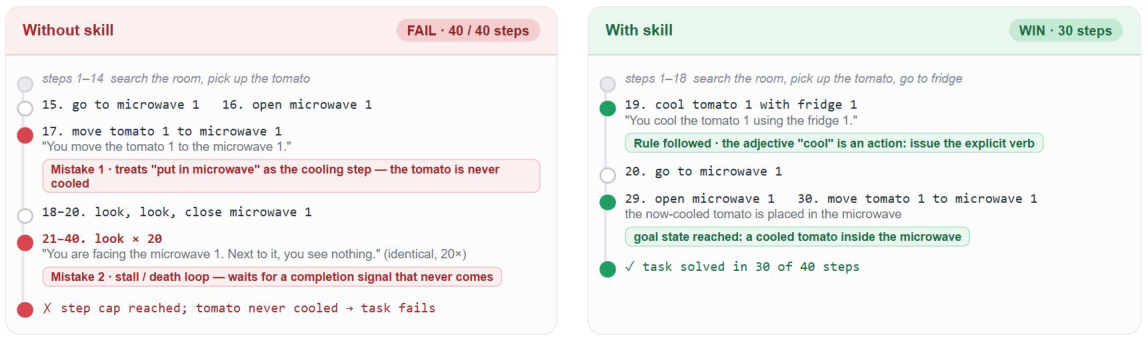
Table 1 shows the central result. For GPT-5.4-mini, the reasoning mode beats no-think on all four benchmarks (by $+14.6$, $+16.6$, $+25.8$, and $+2.5$ points); injecting a distilled skill into the no-think model recovers 55%–100%+ of that gap everywhere, exceeding the reasoning mode outright on ALFWorld (0.787 vs. 0.713) and $\tau^2$-retail (0.408 vs. 0.350), while emitting 2.9–4.5 $\times$ fewer output tokens and zero reasoning tokens. On ALFWorld and SSB the skill even undercuts the plain no-think baseline in tokens: fewer flailing retries means shorter episodes (21.8 vs. 27.0 turns on ALFWorld). Because the skill lives in a cacheable system-prompt prefix, its marginal deployment cost is negligible, while the think premium is re-paid on every episode. Beating the teacher is not paradoxical: a rule aggregated over 50 training episodes is more reliable than a derivation the reasoning model must re-produce correctly each time. Indeed, the reasoning model itself occasionally falls into the ALFWorld appliance-door loop that the skill forbids outright (Appendix A).
The gains are legible at the level of individual trajectories. Consider a single held-out ALFWorld task, "put a cool tomato in microwave" (Figure 2). The non-reasoning baseline picks up the tomato and places it in the microwave without ever cooling it, treating the adjective cool as a property rather than a required action; having changed nothing, it then issues look twenty times in a row, waiting for a completion signal that never arrives, and exhausts its 40-step budget. The distilled skill supplies exactly the two missing pieces: a rule that adjectives such as cool must be realized with an explicit cool X with fridge command, and a rule to break out of repeated no-op observations. With these, the same model issues the cool command at step 19 and completes the task in 30 steps. These are not isolated fixes: the missed-transform failure occurs in 35.9% of transform tasks without the skill and 11.5% with it, and stall loops fall from 28.7% to 5.3%, together accounting for most of the ALFWorld win-rate improvement.
The Qwen3.6-27B columns repeat the study with a second model and Qwen-specific skills. Distillation again helps on three of four benchmarks, reaching 0.980 on ALFWorld (near-ceiling, $+15.3$ over no-think) and 0.673 on SSB-Verified, and matching the think mode on telecom (0.933) at $5.9\times$ fewer output tokens, even though Qwen3.6-27B's reasoning mode is itself unreliable and hurts on ALFWorld ($-5.4$) and SSB-Verified ($-8.0$). Retail is the one regression ($-4.2$ points): with a near-zero think/no-think gap and an already-competent base, added rules may over-constrain.
5.2 Distilling from reasoning v/s non-reasoning trajectories
\begin{tabular}{l cc @{\hskip 1.5em} cc}
\toprule
  {} & \multicolumn{2}{c}{Think-distilled} & \multicolumn{2}{c}{No-think-distilled} \\
\cmidrule(lr){2-3}\cmidrule(lr){4-5}
Benchmark & Score & Tokens & Score & Tokens \\
\midrule
ALFWorld & \textbf{0.813} & 748 & 0.787 & 832 \\
SpreadsheetBench & 0.460 & 820 & \textbf{0.560} & 831 \\
$\tau^2$-telecom & 0.325 & 533 & \textbf{0.333} & 597 \\
$\tau^2$-retail & \textbf{0.458} & 599 & 0.408 & 565 \\
\bottomrule
\end{tabular}
Our main results (Table 1) use skills distilled from non-reasoning trajectories alone — the distiller never sees a reasoning trace. A natural question is whether giving the distiller access to reasoning traces changes the resulting skill. We therefore ablate the corpus composition for GPT-5.4-mini: the no-think-only condition distills from non-reasoning rollouts, while the paired condition additionally includes think-mode trajectories from the same training tasks (Section 3), allowing the distiller to contrast no-think failures with think successes on identical tasks.
Table 2 shows a mixed picture. The two sources are statistically close on ALFWorld (0.787 vs. 0.813) and telecom (0.333 vs.\ 0.325). On retail, the paired corpus produces the stronger skill (0.458 vs.\ 0.408), suggesting that reasoning traces can supply useful signal — e.g., successful think-mode demonstrations of the authentication discipline that no-think rollouts consistently violate. On SSB-Verified the ordering reverses, and sharply: the no-think-only skill scores 10 points higher (0.560 vs.\ 0.460). One plausible mechanism is that verbose reasoning narratives anchor the distiller on what the model believed rather than on workbook-level evidence of what was true, but we have not isolated this and note that each skill was distilled once, so distillation variance is uncontrolled (Section 7).
We draw two cautious conclusions. First, reasoning traces are not a prerequisite for effective distillation: no-think-only skills are competitive everywhere and recover 55%–100%+ of the reasoning gap in Table 1, which matters practically because the full amortization loop — deploy cheap agent $\to$ collect logs $\to$ distill $\to$ redeploy — can then run without ever invoking a reasoning model. Second, whether adding reasoning traces helps or hurts appears to be domain-dependent, and the per-benchmark differences here are within a range where distillation noise cannot be ruled out.
5.3 Comparison with a prompt optimizer
\begin{tabular}{lcccc@{\hskip 1.5em}cc}
\toprule
  {} & \multicolumn{4}{c}{Pass rate} & \multicolumn{2}{c}{Production cost} \\
\cmidrule(r){2-5}\cmidrule(l){6-7}
Domain & no-skill & think & GEPA & Ours & GEPA & Ours \\
\midrule
$\tau^2$-retail & 0.325 & 0.350 & $\underline{0.392}$ & \textbf{0.458} & \$2.26 & \$1.28 \\
$\tau^2$-telecom & 0.192 & \textbf{0.450} & 0.308 & $\underline{0.325}$ & \$13.02 & \$2.44 \\
\bottomrule
\end{tabular}
We compare against GEPA ([9]), a state-of-the-art reflective prompt evolver, on both $\tau^2$ domains (GPT-5.4-mini rollouts, Claude Sonnet 5 reflection; 120 metric call budget). Table 3: our distilled skills score higher on both domains (retail 45.8% vs. 39.2%; telecom 32.5% vs.\ 30.8%) at 4.1 $\times$ lower production cost ($3.72 vs. $15.28); the gap is driven by GEPA's active rollouts for each optimization-proposed prompt. Extending the telecom GEPA budget to 240 metric calls resulted in a byte-identical prompt, indicating convergence.
5.4 Robustness
All results are means over 3 runs with the same protocol for baselines and skills; per-seed numbers show consistent orderings (e.g., Qwen ALFWorld skill: 0.98/0.98/0.98; GPT-5.4-mini telecom skill above no-think on all seeds). Skills were distilled once per domain — we do not report variance over the distillation itself, a limitation discussed below.
6. Discussion: Deep vs. Wide Search
Section Summary: The section frames test-time reasoning and corpus distillation as two routes to the same goal of acquiring reusable procedural knowledge, differing mainly in cost: reasoning repeatedly explores possibilities within each episode, while distillation examines many past outcomes once, extracts reliable patterns, and reuses them at negligible extra cost. When the needed knowledge stays consistent across episodes, distillation proves cheaper and often more reliable; when tasks involve unique, instance-specific details, the two approaches become complements rather than substitutes. Distillation itself works best when it draws on raw environment feedback from failed runs rather than on the model’s own reasoning traces, and its one-time expense is quickly offset by large per-episode savings in tokens.
A unifying reading of Table 1–Table 3 is that test-time reasoning and corpus distillation are two ways of purchasing the same commodity — procedural knowledge about a domain — with different cost structures. Reasoning is deep search: within a single episode the model explores a tree of considerations before each action. Its knowledge is rediscovered from scratch and its cost recurs per episode. Distillation is wide search: many complete trajectories are examined side by side, regularities in the failure distribution are extracted once, and the result is reused for free. When the knowledge that deep search recovers is episode-invariant — ALFWorld's atomic clean/heat/cool commands, retail's authenticate-then-fetch-orders discipline — width strictly dominates: it is paid once, and Table 1 shows it can even exceed think mode, because a rule compiled from 50 episodes is more reliable than a derivation the model must reproduce correctly every time.
The lens also predicts where amortization must fall short. The residual think-over-skill gap on telecom (0.450 vs. 0.333) and SSB-Verified (0.613 vs. 0.560) marks knowledge that is not episode-invariant: telecom tasks hinge on long, instance-specific dependency chains in a dual-control environment (which line, which plan, what the user just toggled), and spreadsheet tasks embed one-off logical structure no fixed prompt anticipates. There, per-instance deep search is doing irreplaceable work, and the two mechanisms are complements: a skill to stop re-buying the invariants, reasoning reserved for the instances that need it.
Finally, the NT-skill result sharpens what distillation actually consumes. Reasoning traces are verbose, stylized, and describe what the model believed; environment feedback in failed no-think trajectories records what was true. On SSB-Verified the paired-corpus skill (46.0%) underperformed the no-think-only skill (56.0%), consistent with the distiller anchoring on reasoning narratives instead of workbook-level failure evidence. Wide search needs breadth of outcomes, not depth of introspection — which is convenient, since non-reasoning trajectories are the cheap ones.
Amortization economics.
Distillation is one coding-agent pass over the corpus ($1.28–$2.44 per domain; Table 3). Per episode, the skill then saves $\Delta = T_{\mathrm{think}} - T_{\mathrm{skill}}$ output tokens — e.g., $2{,}143 - 597 = 1{,}546$ on telecom, essentially the model's entire 1, 572-token reasoning budget — while adding only a fixed, cacheable input prefix. The one-time cost is repaid once cumulative per-episode savings exceed it; every subsequent episode is pure savings. By contrast, active prompt optimizers ([9, 18]) spend an evaluation-rollout budget before any savings accrue, and cannot run at all where fresh rollouts are unavailable.
Relation to elicitation.
RL-trained reasoning appears to elicit latent base-model capabilities rather than create new ones ([17, 12, 13]). Our results are the prompt-side counterpart: if the non-reasoning model already carries the priors needed to execute winning procedures, a distilled description of where search reliably lands is a sufficient — and far cheaper — elicitor. The corpus-source ablation sharpens this: even the description need not come from the reasoning model.
7. Limitations
Section Summary: The study performed skill distillation only once for each model and domain combination, checking variation across evaluation runs but not across repeated distillations, and one retail example with the Qwen model indicated the process can be inconsistent. Findings are based on just two models and four domains, leaving broader applicability unexamined. Skills also appear tied to particular models, with no testing of whether they transfer to others.
Skills were distilled once per model–domain pair; we measure evaluation variance (3 seeds) but not distillation variance, and the Qwen retail regression suggests the process is not uniformly reliable. Results cover two models and four domains; skills are model-specific and cross-model transfer is untested.
8. Conclusion
Section Summary: A small collection of everyday task examples, processed once by a coding agent, can match or nearly match the performance gains of costly built-in reasoning modes on agent benchmarks. The approach cuts output tokens by a factor of roughly three to six per run and requires only a few dollars of one-time effort, without needing any explicit reasoning traces in the data. In essence, the method pulls out reusable procedures once rather than regenerating them from scratch in every new episode.
A small corpus of ordinary trajectories, one pass by a coding agent, and a hundred lines of markdown recover most — sometimes all — of what an expensive reasoning mode buys on agentic benchmarks, at 2.7–6 $\times$ fewer output tokens per episode and a one-time cost of a few dollars — and the corpus need not contain a single reasoning trace. Reasoning re-derives domain procedure inside every episode; distillation extracts it once.
Appendix
Section Summary: The appendix presents concise examples of specialized rules extracted from AI agent training on tasks such as household simulations, retail customer service, and spreadsheet verification. These rules focus on avoiding frequent errors, like misinterpreting task adjectives as actions or using placeholder data in tool calls, and stress completing operations directly in the relevant environment rather than describing them. It also outlines the experimental setup, including training and test data splits plus the agent harnesses employed for consistent evaluation across conditions.
A. Distilled Skill Excerpts
Abridged excerpts from the distilled skills (full files range from 38 to 126 lines of markdown). Rules are imperative, concrete, and cite corpus statistics computed by the distiller.
ALFWorld (no-think-distilled), Rule 1 of 5.
Adjectives in the task are actions, not descriptions. If the task says "clean", "hot", or "cool/cold" X, that adjective is a required state-change step. You must issue the explicit verb:
clean <object> with sinkbasin 1,heat <object> with microwave 1,cool <object> with fridge 1. Do not substitute "open microwave, move object in, close, open, take back out" forheat X with microwave 1— opening/closing an appliance does not perform the transformation.
$\tau^2$-retail (paired-corpus), Rule 1 of 6.
Never call an authentication tool with a guessed or placeholder argument. This was the single most common bug: it appeared in 13 of 22 rollouts (59%) and accounted for 17 of 18 tool errors observed (94%). Before calling
find_user_id_by_emailorfind_user_id_by_name_zip, check that the customer's message actually contains a real email address, or a real first name $+$ last name $+$ zip. If none is present yet, do not call any lookup tool — respond in plain text asking for one.
SSB-Verified (no-think-distilled), central rule.
Finish inside the workbook, not just in the chat. Never end a task by only describing a formula, a macro, or an approach in your response — explaining the right formula and then not entering it into the sheet is the single most common way this task goes wrong. If the user asks for a VBA macro, still apply the equivalent transformation directly to the workbook via code.
B. Reproduction Details
Splits.
ALFWorld: distill on 50 training tasks, evaluate on a disjoint held-out set of 50 tasks. $\tau^2$: distill on 50 (telecom) / 35 (retail) training tasks, evaluate on the provided 40-task test splits. SpreadsheetBench-Verified: distill on 50 training tasks, evaluate on a disjoint held-out set of 50 tasks. For ALFWorld and SSB-Verified, which do not ship a designated test split, the held-out sets are sampled once and fixed across all conditions.
Harness.
ALFWorld uses a ReAct-style agent with admissible-command grounding and a 40-step cap. SSB-Verified uses a ReAct-style tool-use harness in which the model writes and executes openpyxl and pandas code against a live copy of the workbook, following the original SpreadsheetBench setup ([26]). $\tau^2$ uses the standard runner with an LLM user simulator. In all cases the skill is injected by appending it to the agent's system prompt with no other change to harness, decoding, or tools; the same protocol is used for all conditions.
References
Section Summary: This section compiles a list of academic papers, technical reports, and preprints focused on advancements in artificial intelligence, especially techniques for improving reasoning in large language models through methods like reinforcement learning, prompting strategies, and test-time scaling. The citations also address benchmarks for evaluating AI agents, optimization of model outputs, and real-world applications such as tool use and interactive environments. Sources range from major labs like OpenAI and Anthropic to publications in conferences including NeurIPS, ICLR, and EMNLP.
[1] OpenAI (2024). Learning to Reason with LLMs. OpenAI Technical Report.
[2] Guo et al. (2025). DeepSeek-R1 Incentivizes Reasoning in LLMs through Reinforcement Learning. Nature. 645(8081). pp. 633–638. doi:10.1038/s41586-025-09422-z.
[3] Shao et al. (2024). DeepSeekMath: Pushing the Limits of Mathematical Reasoning in Open Language Models. arXiv preprint arXiv:2402.03300.
[4] Yao et al. (2023). ReAct: Synergizing Reasoning and Acting in Language Models. In International Conference on Learning Representations (ICLR).
[5] Shridhar et al. (2021). ALFWorld: Aligning Text and Embodied Environments for Interactive Learning. In International Conference on Learning Representations (ICLR).
[6] Yao et al. (2024). $\tau$-bench: A Benchmark for Tool-Agent-User Interaction in Real-World Domains. arXiv preprint arXiv:2406.12045.
[7] Barres et al. (2025). $\tau^2$-Bench: Evaluating Conversational Agents in a Dual-Control Environment. arXiv preprint arXiv:2506.07982.
[8] Anthropic (2025). Claude Code. Agentic coding tool; runs used Claude Sonnet 5. https://www.anthropic.com/claude-code.
[9] Agrawal et al. (2026). GEPA: Reflective Prompt Evolution Can Outperform Reinforcement Learning. In International Conference on Learning Representations (ICLR).
[10] Wei et al. (2022). Chain-of-Thought Prompting Elicits Reasoning in Large Language Models. In Advances in Neural Information Processing Systems (NeurIPS).
[11] Snell et al. (2024). Scaling LLM Test-Time Compute Optimally Can Be More Effective than Scaling Model Parameters. arXiv preprint arXiv:2408.03314.
[12] Muennighoff et al. (2025). s1: Simple Test-Time Scaling. In Empirical Methods in Natural Language Processing (EMNLP). pp. 20275–20321.
[13] Ye et al. (2025). LIMO: Less Is More for Reasoning. In Conference on Language Modeling (COLM).
[14] Chen et al. (2024). Do NOT Think That Much for 2+3=? On the Overthinking of o1-Like LLMs. arXiv preprint arXiv:2412.21187.
[15] Xu et al. (2025). Chain of Draft: Thinking Faster by Writing Less. arXiv preprint arXiv:2502.18600.
[16] Han et al. (2024). Token-Budget-Aware LLM Reasoning. arXiv preprint arXiv:2412.18547.
[17] Yue et al. (2025). Does Reinforcement Learning Really Incentivize Reasoning Capacity in LLMs Beyond the Base Model?. arXiv preprint arXiv:2504.13837.
[18] Yang et al. (2024). Large Language Models as Optimizers. In International Conference on Learning Representations (ICLR).
[19] Khattab et al. (2024). DSPy: Compiling Declarative Language Model Calls into State-of-the-Art Pipelines. In International Conference on Learning Representations (ICLR).
[20] Opsahl-Ong et al. (2024). Optimizing Instructions and Demonstrations for Multi-Stage Language Model Programs. In Empirical Methods in Natural Language Processing (EMNLP).
[21] Yuksekgonul et al. (2025). Optimizing Generative AI by Backpropagating Language Model Feedback. Nature. 639(8055). pp. 609–616. doi:10.1038/s41586-025-08661-4.
[22] Wang et al. (2023). Voyager: An Open-Ended Embodied Agent with Large Language Models. arXiv preprint arXiv:2305.16291.
[23] Shinn et al. (2023). Reflexion: Language Agents with Verbal Reinforcement Learning. In Advances in Neural Information Processing Systems (NeurIPS).
[24] Zhao et al. (2024). ExpeL: LLM Agents Are Experiential Learners. In AAAI Conference on Artificial Intelligence.
[25] Wang et al. (2024). Agent Workflow Memory. arXiv preprint arXiv:2409.07429.
[26] Ma et al. (2024). SpreadsheetBench: Towards Challenging Real World Spreadsheet Manipulation. Advances in Neural Information Processing Systems (NeurIPS).