From Content to Knowledge: Lightning Fast Long-Video Understanding with Neural Knowledge Representations

Yuchen GuanXiao LiZongyu GuoXiaoyi ZhangXiulian PengChun YuanYan Lu

article2026arXiv0 citations

Introduces a framework that encodes long videos directly into lightweight neural network weights via agentic distillation, enabling frozen vision-language models to perform multi-turn video understanding while reducing inference latency by over two orders of magnitude.

Listen

Analyzing long-form video content using artificial intelligence is critical for automated monitoring, conversational assistants, and media analysis. However, conventional vision-language models struggle with videos that last for tens of minutes or hours. Current systems either feed massive sequences of video frames directly into models—creating severe memory bottlenecks and computation costs—or rely on iterative search agents that require minutes of planning and tool retrieval per question. These limitations prevent real-time, multi-turn interaction over long video archives.

The article demonstrates a new paradigm called Neural Knowledge Representation (NKR) to overcome these latency and memory constraints. The core objective is to evaluate whether a video's semantic content can be distilled offline into a compact, swappable set of neural network adapter weights, allowing a vision-language model to answer user queries instantly without reprocessing raw video files or searching external databases during runtime.

To achieve this, the authors developed an automated Agentic Knowledge Distillation pipeline that prepares training data without human annotation. An autonomous agent analyzes the video across multiple granularities to generate dense text descriptions alongside thousands of clip-level and video-level question-and-answer pairs. These synthetic data are then used in a one-time optimization phase to train a lightweight Low-Rank Adaptation (LoRA) module on a frozen foundation model backbone. The approach was evaluated on standard long-video benchmarks, notably LVBench (encompassing 103 videos totaling 117 hours and 1,549 questions), measuring accuracy, latency, and memory footprint against leading commercial models and agentic retrieval frameworks.

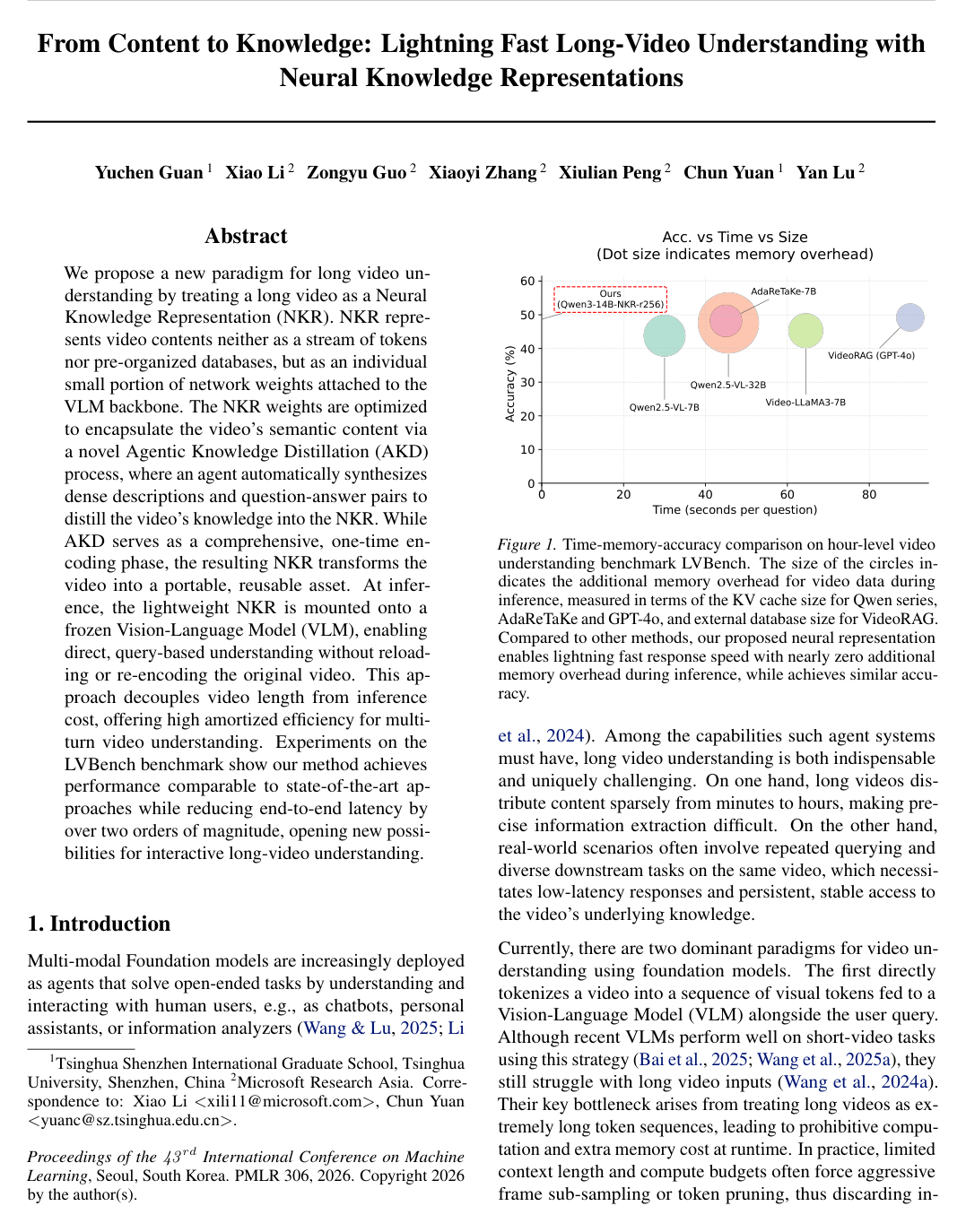
The findings show that NKR reduces query response latency by over two orders of magnitude compared to existing approaches. On the LVBench benchmark, the method achieved an inference speed of approximately 0.33 seconds per query, compared to 30 to 65 seconds for direct token processing and up to 180 seconds for agent-based discovery systems, while maintaining a competitive accuracy of 48.8%. Crucially, NKR incurs zero additional video memory overhead during inference because the adapter weights merge directly into the language model. Furthermore, while competing models suffered performance drops of 3.0% to 6.7% when processing videos exceeding one hour, the proposed representation remained remarkably stable, experiencing only a 0.3% degradation.

These results demonstrate that long-video understanding can be decoupled from raw video duration at inference time. For enterprise systems and interactive applications, this shift eliminates the need for expensive high-memory infrastructure and long user wait times during repeated querying. While heavy agentic models remain preferable for offline tasks requiring maximum forensic accuracy regardless of runtime, this adapter-based approach offers an optimal solution for real-time customer-facing assistants and fast interactive workflows.

Organizations handling extensive video repositories should consider piloting adapter-based neural representations for high-frequency interactive querying where latency is critical. Operational teams must account for the upfront processing trade-off: each one-hour video requires two to three hours of automated data synthesis and roughly two hours of offline training across specialized hardware before real-time querying becomes available.

Confidence in these findings is supported by consistent benchmark validations across both long video and complex image datasets. However, decision-makers should note certain limitations. The distillation process currently relies on text-based representations generated by automated agents, which can miss extremely subtle visual nuances that are hard to describe in text. Additionally, like all foundation model adaptations, the system remains subject to occasional factual hallucinations and requires reliable upfront compute for the initial encoding phase.

arXiv: 2606.11913
Cover for From Content to Knowledge: Lightning Fast Long-Video Understanding with Neural Knowledge Representations

Abstract

We propose a new paradigm for long video understanding by treating a long video as a Neural Knowledge Representation (NKR). NKR represents video contents neither as a stream of tokens nor pre-organized databases, but as an individual small portion of network weights attached to the VLM backbone. The NKR weights are optimized to encapsulate the video's semantic content via a novel Agentic Knowledge Distillation (AKD) process, where an agent automatically synthesizes dense descriptions and question-answer pairs to distill the video's knowledge into the NKR. While AKD serves as a comprehensive, one-time encoding phase, the resulting NKR transforms the video into a portable, reusable asset. At inference, the lightweight NKR is mounted onto a frozen Vision-Language Model (VLM), enabling direct, query-based understanding without reloading or re-encoding the original video. This approach decouples video length from inference cost, offering high amortized efficiency for multi-turn video understanding. Experiments on the LVBench benchmark show our method achieves performance comparable to state-of-the-art approaches while reducing end-to-end latency by over two orders of magnitude, opening new possibilities for interactive long-video understanding.

Table of Contents

  • 1 Introduction
  • 2 Related Works
  • 3 Method
  • 3.1 Overview
  • 3.2 Neural Knowledge Representation
  • 3.3 Agentic Knowledge Distillation
  • 4 Experiments
  • 4.1 Experiments Setup
  • 4.2 Main Results
  • 4.3 Discussions
  • 5 Conclusion
  • References
  • A Limitations.
  • B Future works.
  • C Implementation Details
  • C.1 Dense Description
  • C.2 Clip-level Q&A for Video NKR
  • C.3 Q&A for Image NKR
  • C.4 Video-level Q&A for Video NKR
  • C.5 Training Details
  • D Additional Experiments
  • D.1 Results on LongVideoBench
  • D.2 More Analysis on NKR

Knowls

  1. Knowl 1 — Neural Knowledge Representation for Long-Video Understanding

    model/method

    The Neural Knowledge Representation (NKR) framework reformulates long-video understanding by condensing the semantic knowledge of an individual video V={f1,f2,…,fT}V = \{f_1, f_2, \dots, f_T\} (with TT frames) into a compact, swappable set of neural network parameters θV\theta_V, rather than encoding the video as a long sequence of visual tokens or maintaining an external video database.

    The video-specific parameters θV\theta_V are implemented via parameter-efficient fine-tuning (PEFT) as Low-Rank Adaptation (LoRA) matrices attached to the attention layers of a frozen Vision-Language Model (VLM) backbone M\mathcal{M}. At inference time, understanding proceeds in three stages:

    1. Load: The lightweight adapter weights θV\theta_V for video VV are loaded.
    2. Mount: The weights θV\theta_V are dynamically attached and merged into the frozen backbone M\mathcal{M}, forming the specialized model MθV\mathcal{M}_{\theta_V}.
    3. Query: For any user query QQ, the model generates an answer AA directly via text generation: A=MθV(Q)A = \mathcal{M}_{\theta_V}(Q)

    Because the video semantics are internalized within the parameters θV\theta_V, inference requires no raw video decoding, no visual token processing, and no multi-round database retrieval. This decouples the video duration TT from the runtime inference cost, yielding constant inference latency and zero additional video memory overhead (e.g., no growing KV-cache or external vector database) during inference.

  2. Knowl 2 — Agentic Knowledge Distillation Pipeline

    model/method

    Agentic Knowledge Distillation (AKD) is an automated offline framework that distills the semantic and factual content of an unannotated video VV into the parameter weights θV\theta_V of a Neural Knowledge Representation (NKR). AKD synthesizes two complementary datasets:

    1. Dense Description Dataset (Ddesc\mathcal{D}_{\text{desc}}): The input video VV is partitioned into multi-scale clips spanning log-linear durations from 5 seconds up to the full video duration at varying sample rates. For each clip, a multimodal foundation model (e.g., GPT-4.1) extracts:

      • Multi-granularity captions: Low-level (fine visual details), Mid-level (actions and events), and High-level (narrative summaries).
      • Entity registries: Descriptions and timestamps of all salient entities (characters, objects, locations). Each generated description is augmented by rephrasing it multiple times using an auxiliary language model.
    2. Question-Answer Dataset (Dqa\mathcal{D}_{\text{qa}}): Question-answer pairs are synthesized at two distinct granularities:

      • Clip-level QAs: A reasoning model (e.g., o4-mini) generates open-ended question-answer pairs per clip covering single-event descriptions, localized entity attributes, and short summaries.
      • Video-level QAs: A ReAct-style agent powered by a reasoning model (e.g., o3) executes iterative tool-assisted exploration over a multi-grained video database to generate complex multiple-choice questions requiring cross-clip temporal grounding, multi-step causal reasoning, and evidence aggregation across the entire video.
  3. Knowl 3 — Agentic Video-Level Question-Answer Generation Algorithm

    algorithm

    The video-level QA generation pipeline synthesizes complex questions requiring holistic and temporal reasoning across a long video. The agent interacts with a multi-grained database D\mathcal{D} comprising timestamped video clips, dense textual descriptions, and an entity registry indexed by semantic embeddings and an interval tree data structure.

    The agent uses a toolset T\mathcal{T} containing:

    • GLOBAL BROWSE: Retrieves global outlines, storylines, and key entities across the video database D\mathcal{D}.
    • CLIP SEARCH: Performs semantic text-to-caption retrieval to locate candidate clips matching an agent-generated query.
    • TEMPORAL SEARCH: Retrieves clips and entities within a specific time range [ts,te][t_s, t_e] using interval tree overlap queries.
    • FRAME INSPECT: Extracts fine-grained visual details from raw video frames within [ts,te][t_s, t_e].
    Input: Multi-grained video database DD, reasoning model MM, tool set TT, termination signal STOP\text{STOP}, question category CC, maximum steps NN
    Output: Question-answer pair {Q,A}\{Q, A\} with distractors and clue timestamps
    H0←{C}H_0 \leftarrow \{C\}
    for i←1i \leftarrow 1 to NN do
        Ri←M.REASON(Hi−1)R_i \leftarrow M.\text{REASON}(H_{i-1})
        Ti←M.CALL(Ri,Hi−1)T_i \leftarrow M.\text{CALL}(R_i, H_{i-1}) where Ti∈T∪{STOP}T_i \in T \cup \{\text{STOP}\}
        if Ti=STOPT_i = \text{STOP} then
            break
        end if
        Oi←Ti(D)O_i \leftarrow T_i(D)
        Hi←Hi−1∪{(Ri,Ti,Oi)}H_i \leftarrow H_{i-1} \cup \{(R_i, T_i, O_i)\}
    end for
    return {Q,A}←M.FORMAT(Hi)\{Q, A\} \leftarrow M.\text{FORMAT}(H_i)

    The formatted output includes a question string QQ, four options (one correct answer AA and three plausible distractors), supporting clue timestamps, and distractor rationales across six target categories: Temporal Grounding, Summarization, Reasoning, Entity Recognition, Event Understanding, and Key Information Retrieval.

  4. Knowl 4 — Mixed-Training Objective for Neural Knowledge Distillation

    equation

    To optimize the parameter weights θV\theta_V of the Neural Knowledge Representation (NKR) for a given video VV, the model is trained using a joint mixed-training loss LAKD\mathcal{L}_{\text{AKD}}:

    LAKD=LNTP+LSFT\mathcal{L}_{\text{AKD}} = \mathcal{L}_{\text{NTP}} + \mathcal{L}_{\text{SFT}}

    where:

    • LNTP\mathcal{L}_{\text{NTP}} denotes the standard autoregressive next-token prediction loss evaluated on the dense multi-granularity description dataset Ddesc\mathcal{D}_{\text{desc}}, forcing the network weights to memorize factual visual and narrative content.
    • LSFT\mathcal{L}_{\text{SFT}} denotes the supervised fine-tuning cross-entropy loss evaluated on the question-answer dataset Dqa\mathcal{D}_{\text{qa}}, training the model to structure and recall its memorized facts in response to diverse user queries.

    During optimization, batches from Ddesc\mathcal{D}_{\text{desc}} and Dqa\mathcal{D}_{\text{qa}} are alternately sampled and optimized with a fixed ratio of 2:82:8 (LNTP:LSFT\mathcal{L}_{\text{NTP}} : \mathcal{L}_{\text{SFT}}).

  5. Knowl 5 — Long-Video Understanding Benchmark Evaluation on LVBench

    data/table

    Evaluation on the LVBench benchmark (103 videos, 117 total hours, 1,549 multiple-choice questions) comparing the Neural Knowledge Representation (Qwen3-NKR-14B-r256) against tokenization-based and agentic long-video understanding methods. Evaluation categories include Entity Recognition (ER), Event Understanding (EU), Key Information Retrieval (KIR), Temporal Grounding (TG), Reasoning (Rea), and Summarization (Sum). Inference latency is reported in seconds per query, and runtime memory overhead measures video KV-cache size or external database storage.

    Method Time (s) Memory (GB) Overall ER EU KIR TG Rea Sum
    GPT-4o-20241120 43.0 Unknown (Large) 48.9 48.9 49.5 48.1 40.9 50.3 50.0
    GPT-4.1-20250414 31.7 Unknown (Large) 45.8 48.0 43.6 41.2 36.8 47.3 39.7
    VideoLLaMA3-7B 64.5 1.2 45.3 45.8 42.4 47.8 35.9 45.8 36.2
    Qwen2.5-VL-7B 30.0 2.5 43.8 43.0 41.9 49.8 40.5 43.8 32.8
    Qwen2.5-VL-32B 45.6 11.3 47.6 47.1 47.8 55.0 40.5 47.3 41.4
    AdaReTaKe-7B 45.0 0.9 51.2 51.1 47.6 62.2 43.2 50.2 27.6
    VideoRAG 90.0 0.5 49.2 47.4 49.3 57.1 36.5 43.9 39.7
    VCA — — 41.3 43.7 40.7 37.8 38.0 46.2 27.3
    Deep Video Discovery-o3 180.0 0.3 74.2 73.4 73.3 80.4 72.3 70.7 74.1
    Qwen3-NKR-14B-r256 (Ours) 0.33 0.0 48.8 54.2 48.1 53.0 45.6 47.1 35.3

    Qwen3-NKR-14B-r256 achieves an overall accuracy of 48.8%, matching GPT-4o (48.9%) and outperforming open-source tokenized VLMs, while reducing per-query inference latency by approximately 100×100\times to 300×300\times (0.33s vs. 30.0s--180.0s) with 0 GB runtime memory overhead.

  6. Knowl 6 — Robustness of NKR Across Short and Long Video Durations

    data/table

    Performance stability analysis across video duration on the LVBench benchmark, partitioned into videos shorter than 1 hour and videos longer than 1 hour.

    Method <1< 1 hour Acc (%) >1> 1 hour Acc (%) Performance Drop (%)
    GPT-4.1 48.7 42.0 -6.7
    Qwen2.5-VL-7B 45.9 41.1 -4.8
    Qwen2.5-VL-32B 51.6 45.3 -6.3
    AdaReTaKe-7B 51.4 48.4 -3.0
    VideoRAG 50.7 47.8 -2.9
    Qwen3-NKR-14B-r256 (Ours) 48.9 48.6 -0.3

    While commercial VLMs, open-source tokenized models, and RAG systems degrade by 2.9% to 6.7% when video duration exceeds one hour, NKR exhibits an accuracy drop of only 0.3% (from 48.9% on <1<1 hour videos to 48.6% on >1>1 hour videos), demonstrating that implicit parameter representation avoids the contextual attenuation typical of long token sequences and large retrieval databases.

  7. Knowl 7 — Ablations on Model Architecture and AKD Supervision Components

    data/table

    Ablation studies examining the effects of VLM backbone capacity, LoRA rank rr, and the specific data components generated during Agentic Knowledge Distillation (AKD) on LVBench accuracy.

    VLM Backbone LoRA Rank (rr) Overall Acc (%) Latency (s/query)
    Qwen3-8B 256 39.5 0.26
    Qwen3-14B 64 44.2 0.33
    Qwen3-14B 256 48.8 0.33
    Dense Descriptions (Ddesc\mathcal{D}_{\text{desc}}) Clip-level QA Video-level QA Accuracy (%)
    ✓ 14.3
    ✓ ✓ 45.0
    ✓ ✓ 38.8
    ✓ ✓ ✓ 48.8

    Key observations:

    1. Backbone model scaling from 8B to 14B yields a 9.3% accuracy gain (39.5% to 48.8%) with negligible latency increase (0.26s to 0.33s), whereas scaling LoRA rank from 64 to 256 on the 14B model yields a 4.6% improvement (44.2% to 48.8%).
    2. Omitting QA pairs entirely results in severe failure (14.3% accuracy) as the model memorizes raw text without question-answering structuring.
    3. Incorporating both clip-level and video-level QA pairs is necessary to attain the highest accuracy (48.8%), with video-level QA contributing a 3.8% gain over clip-level data alone by providing cross-clip temporal correlations.
  8. Knowl 8 — NKR Generalization vs. In-Context Textual Baselines on Image Understanding

    empirical result

    When evaluated on a 38-image, 526-question subset of MME-RealWorld, Neural Knowledge Representation demonstrates that parameter-based knowledge absorption functions as a superior representation compared to feeding identical textual supervision in-context.

    In experiments comparing models trained with NKR against in-context baselines provided with the exact same 150 synthesized descriptions and QA pairs in their context window:

    • Qwen2.5-7B: The in-context baseline (Qwen2.5-InContext-7B) achieves 22.1% perception, 17.2% reasoning, and 19.6% overall accuracy. The adapter-based representation (Qwen2.5-NKR-7B-r32) achieves 38.4% perception, 32.5% reasoning, and 35.4% overall accuracy (+15.8% overall gain).
    • Qwen3-8B: The in-context baseline (Qwen3-InContext-8B) achieves 24.4% perception, 9.3% reasoning, and 17.6% overall accuracy. The adapter-based representation (Qwen3-NKR-8B-r32) achieves 31.9% perception, 46.4% reasoning, and 38.4% overall accuracy (+20.8% overall gain, +37.1% on reasoning).

    Additionally, kk-nearest neighbor search across the training QA set Dqa\mathcal{D}_{\text{qa}} using test queries confirms that test questions are semantically related but not identical to training samples, demonstrating that NKR performs generalized knowledge activation rather than surface-level memorization.

  9. Knowl 9 — LongVideoBench-Long Benchmark Evaluation

    data/table

    Evaluation on the longest subset of LongVideoBench (564 questions across 188 videos with durations between 900 and 3600 seconds), evaluated strictly on visual content without audio narrations or subtitles.

    Method Input Size Time (s/query) Memory (GB) Accuracy (%)
    GPT-4o-20241120 60 frames 43.0 Unknown (Large) 60.9
    Qwen2.5-VL-7B 2 fps (<768<768 frames) 30.0 2.5 45.2
    Qwen2.5-VL-32B 2 fps (<768<768 frames) 45.6 11.3 48.4
    AdaReTaKe-7B 2 fps (<2048<2048 frames) 45.0 0.9 55.5
    Qwen3-NKR-14B-r256 (Ours) N/A 0.33 0.0 52.9

    Qwen3-NKR-14B-r256 attains 52.9% accuracy on hour-scale videos, outperforming full-frame open-source models Qwen2.5-VL-7B (45.2%) and Qwen2.5-VL-32B (48.4%) while executing in 0.33 seconds per query with zero additional video memory overhead.

  10. Knowl 10 — Limitations of Neural Knowledge Representations

    limitation

    The Neural Knowledge Representation (NKR) framework has three primary limitations:

    1. Upfront Optimization Cost: Constructing an NKR requires a one-time upfront distillation phase for each video. For a 1-hour video, generating ∼\sim30k--40k descriptions and ∼\sim15k--20k QA pairs requires 2--3 hours of foundation model API calls, and training the LoRA adapter takes approximately 2 hours on four NVIDIA A100-40GB GPUs.
    2. Textual Supervision Bottleneck: The distillation process relies exclusively on intermediate textual descriptions Ddesc\mathcal{D}_{\text{desc}} because existing VLMs cannot emit dense visual tokens as supervision signals. Consequently, subtle, fine-grained visual patterns that are difficult to articulate in text may not be transferred into the NKR weights.
    3. Hallucination Risk: As with standard Vision-Language Models, the adapted model MθV\mathcal{M}_{\theta_V} is not guaranteed to produce hallucination-free responses.

Coverage note — Omitted verbatim prompt templates and detailed string formatting from Supplementary Figures S5-S11 as their functional mechanics are fully encapsulated in the method, algorithm, and experimental setup knowls.

References

  1. 1.Openai text embeddings. https://platform.openai.com/docs/guides/embeddings/embedding-models. [Accessed 18-11-2025].
  2. 2.Achiam, J., Adler, S., Agarwal, S., Ahmad, L., Akkaya, I., Aleman, F. L., Almeida, D., Altenschmidt, J., Altman, S., Anadkat, S., et al. Gpt-4 technical report. arXiv preprint arXiv:2303.08774, 2023.
  3. 3.Allen-Zhu, Z. and Li, Y. Physics of language models: Part 3.1, knowledge storage and extraction. arXiv preprint arXiv:2309.14316, 2023.
  4. 4.Bai, S., Chen, K., Liu, X., Wang, J., Ge, W., Song, S., Dang, K., Wang, P., Wang, S., Tang, J., et al. Qwen2. 5-vl technical report. arXiv preprint arXiv:2502.13923, 2025.
  5. 5.Chen, B., Yue, Z., Chen, S., Wang, Z., Liu, Y., Li, P., and Wang, Y. Lvagent: Long video understanding by multi-round dynamical collaboration of mllm agents. arXiv preprint arXiv:2503.10200, 2025.
  6. 6.Chen, H., He, B., Wang, H., Ren, Y., Lim, S. N., and Shrivastava, A. Nerv: Neural representations for videos. Advances in Neural Information Processing Systems, 34: 21557–21568, 2021.
  7. 7.Chen, Y., Xue, F., Li, D., Hu, Q., Zhu, L., Li, X., Fang, Y., Tang, H., Yang, S., Liu, Z., et al. Longvila: Scaling long-context visual language models for long videos. arXiv preprint arXiv:2408.10188, 2024.
  8. 8.Cheng, R., Guan, Y., Ding, Y., Hu, Q., Wei, Y., Yuan, C., Shen, Y., Chen, W., and Gong, Y. Mixture of neuron experts. arXiv preprint arXiv:2510.05781, 2025a.
  9. 9.Cheng, R., Xiong, F., Wei, Y., Zhu, W., and Yuan, C. Whoever started the interference should end it: Guiding data-free model merging via task vectors. arXiv preprint arXiv:2503.08099, 2025b.
  10. 10.Cheng, R., Guan, Y., Wei, Y., Sun, Q., Li, Q., Du, S., Xiong, F., Yuan, C., Lu, Y., and Gong, Y. Memory grafting: Scaling language model pre-training via offline conditional memory. arXiv preprint arXiv:2605.20948, 2026.
  11. 11.Ding, Y., Zhang, L. L., Zhang, C., Xu, Y., Shang, N., Xu, J., Yang, F., and Yang, M. Longrope: Extending llm context window beyond 2 million tokens. arXiv preprint arXiv:2402.13753, 2024.
  12. 12.Fan, Y., Ma, X., Wu, R., Du, Y., Li, J., Gao, Z., and Li, Q. Videoagent: A memory-augmented multimodal agent for video understanding. In European Conference on Computer Vision, pp. 75–92. Springer, 2024.
  13. 13.Guan, Y., Cheng, R., Liu, K., and Yuan, C. Enhancing logits distillation with plug&play kendall’s τ\tau ranking loss. arXiv preprint arXiv:2409.17823, 2024.
  14. 14.Guo, D., Yang, D., Zhang, H., Song, J., Zhang, R., Xu, R., Zhu, Q., Ma, S., Wang, P., Bi, X., et al. Deepseek-r1: Incentivizing reasoning capability in llms via reinforcement learning. arXiv preprint arXiv:2501.12948, 2025.
  15. 15.Halbert, C., Tretyakov, K., Milo, N., Parsons, A., escalonn, Lorentz, V., Gabay, A., Jois, A., Mosiejczuk, K., Saul, M., Pomier, R., Grainger, T., a-sh, and tux. chaimleib/intervaltree. https://github.com/chaimleib/intervaltree, mar 12 2025. URL https://github.com/chaimleib/intervaltree.
  16. 16.He, J., Guo, Z., Jia, Z., Zhang, X., Li, J., Li, X., Li, B., Hernández-Lobato, J. M., and Lu, Y. Compression as adaptation: Implicit visual representation with diffusion foundation models, 2026. URL https://arxiv.org/abs/2603.07615.
  17. 17.Hinton, G., Vinyals, O., and Dean, J. Distilling the knowledge in a neural network. arXiv preprint arXiv:1503.02531, 2015.
  18. 18.Hu, E. J., Shen, Y., Wallis, P., Allen-Zhu, Z., Li, Y., Wang, S., Wang, L., Chen, W., et al. Lora: Low-rank adaptation of large language models. ICLR, 1(2):3, 2022.
  19. 19.Hurst, A., Lerer, A., Goucher, A. P., Perelman, A., Ramesh, A., Clark, A., Ostrow, A., Welihinda, A., Hayes, A., Radford, A., et al. Gpt-4o system card. arXiv preprint arXiv:2410.21276, 2024.
  20. 20.Li, X., Li, X., and Lu, Y. Estimating neural reflectance field from radiance field using tree structures. arXiv preprint arXiv:2210.04217, 2022.
  21. 21.Li, Y., Wen, H., Wang, W., Li, X., Yuan, Y., Liu, G., Liu, J., Xu, W., Wang, X., Sun, Y., et al. Personal llm agents: Insights and survey about the capability, efficiency and security. arXiv preprint arXiv:2401.05459, 2024.
  22. 22.Lin, B., Ye, Y., Zhu, B., Cui, J., Ning, M., Jin, P., and Yuan, L. Video-llava: Learning united visual representation by alignment before projection. In Proceedings of the 2024 Conference on Empirical Methods in Natural Language Processing, pp. 5971–5984, 2024.
  23. 23.Maaz, M., Rasheed, H., Khan, S., and Khan, F. S. Video-chatgpt: Towards detailed video understanding via large vision and language models. arXiv preprint arXiv:2306.05424, 2023.
  24. 24.Mildenhall, B., Srinivasan, P. P., Tancik, M., Barron, J. T., Ramamoorthi, R., and Ng, R. Nerf: Representing scenes as neural radiance fields for view synthesis. In European Conference on Computer Vision, pp. 405–421. Springer, 2020.
  25. 25.Mukherjee, S., Mitra, A., Jawahar, G., Agarwal, S., Palangi, H., and Awadallah, A. Orca: Progressive learning from complex explanation traces of gpt-4. arXiv preprint arXiv:2306.02707, 2023.
  26. 26.OpenAI. Introducing OpenAI o3 and o4-mini — openai.com. https://openai.com/index/introducing-o3-and-o4-mini/, 2025. [Accessed 15-08-2025].
  27. 27.Pang, Z. and Wang, Y.-X. Mr. video:” mapreduce” is the principle for long video understanding. arXiv preprint arXiv:2504.16082, 2025.
  28. 28.Ren, X., Xu, L., Xia, L., Wang, S., Yin, D., and Huang, C. Videorag: Retrieval-augmented generation with extreme long-context videos. arXiv preprint arXiv:2502.01549, 2025.
  29. 29.Romero, A., Ballas, N., Kahou, S. E., Chassang, A., Gatta, C., and Bengio, Y. Fitnets: Hints for thin deep nets, 2015. URL https://arxiv.org/abs/1412.6550.
  30. 30.Schick, T., Dwivedi-Yu, J., Dessì, R., Raileanu, R., Lomeli, M., Hambro, E., Zettlemoyer, L., Cancedda, N., and Scialom, T. Toolformer: Language models can teach themselves to use tools. Advances in Neural Information Processing Systems, 36:68539–68551, 2023.
  31. 31.Shi, Y., Di, S., Chen, Q., and Xie, W. Enhancing video-llm reasoning via agent-of-thoughts distillation. arXiv preprint arXiv:2412.01694, 2024.
  32. 32.Sun, S., Cheng, Y., Gan, Z., and Liu, J. Patient knowledge distillation for bert model compression. arXiv preprint arXiv:1908.09355, 2019.
  33. 33.Taori, R., Gulrajani, I., Zhang, T., Dubois, Y., Li, X., Guestrin, C., Liang, P., and Hashimoto, T. B. Alpaca: A strong, replicable instruction-following model. Stanford Center for Research on Foundation Models. https://crfm.stanford. edu/2023/03/13/alpaca. html, 3(6):7, 2023.
  34. 34.Team, G., Anil, R., Borgeaud, S., Alayrac, J.-B., Yu, J., Soricut, R., Schalkwyk, J., Dai, A. M., Hauth, A., Millican, K., et al. Gemini: a family of highly capable multimodal models. arXiv preprint arXiv:2312.11805, 2023.
  35. 35.Wang, P., Liu, L., Liu, Y., Theobalt, C., Komura, T., and Wang, W. NeuS: Learning neural implicit surfaces by volume rendering for multi-view reconstruction. In NeurIPS, 2021.
  36. 36.Wang, W., Wei, F., Dong, L., Bao, H., Yang, N., and Zhou, M. Minilm: Deep self-attention distillation for task-agnostic compression of pre-trained transformers. Advances in neural information processing systems, 33: 5776–5788, 2020.
  37. 37.Wang, W., He, Z., Hong, W., Cheng, Y., Zhang, X., Qi, J., Gu, X., Huang, S., Xu, B., Dong, Y., et al. Lvbench: An extreme long video understanding benchmark. arXiv preprint arXiv:2406.08035, 2024a.
  38. 38.Wang, X., Si, Q., Wu, J., Zhu, S., Cao, L., and Nie, L. Retake: Reducing temporal and knowledge redundancy for long video understanding. arXiv preprint arXiv:2412.20504, 2024b.
  39. 39.Wang, X., Zhang, Y., Zohar, O., and Yeung-Levy, S. Videoagent: Long-form video understanding with large language model as agent. In European Conference on Computer Vision, pp. 58–76. Springer, 2024c.
  40. 40.Wang, X., Si, Q., Wu, J., Zhu, S., Cao, L., and Nie, L. Adaretake: Adaptive redundancy reduction to perceive longer for video-language understanding. arXiv preprint arXiv:2503.12559, 2025a.
  41. 41.Wang, Y. and Lu, Y. Interaction, process, infrastructure: A unified architecture for human-agent collaboration. arXiv preprint arXiv:2506.11718, 2025.
  42. 42.Wang, Y., Kordi, Y., Mishra, S., Liu, A., Smith, N. A., Khashabi, D., and Hajishirzi, H. Self-instruct: Aligning language models with self-generated instructions. arXiv preprint arXiv:2212.10560, 2022.
  43. 43.Wang, Y., Li, K., Li, X., Yu, J., He, Y., Chen, G., Pei, B., Zheng, R., Wang, Z., Shi, Y., et al. Internvideo2: Scaling foundation models for multimodal video understanding. In European Conference on Computer Vision, pp. 396–416. Springer, 2024d.
  44. 44.Wang, Z., Yu, S., Stengel-Eskin, E., Yoon, J., Cheng, F., Bertasius, G., and Bansal, M. Videotree: Adaptive tree-based video representation for llm reasoning on long videos. In Proceedings of the Computer Vision and Pattern Recognition Conference, pp. 3272–3283, 2025b.
  45. 45.Wei, H. and Chen, Z. Visual context window extension: A new perspective for long video understanding. arXiv preprint arXiv:2409.20018, 2024.
  46. 46.Wei, Y., Zhao, Y., Shen, L., Chen, X., Cheng, R., Du, S., Yu, H., Liu, G., Yan, J., Yuan, C., et al. Learning to pose problems: Reasoning-driven and solver-adaptive data synthesis for large reasoning models. arXiv preprint arXiv:2511.09907, 2025.
  47. 47.Wu, H., Li, D., Chen, B., and Li, J. Longvideobench: A benchmark for long-context interleaved video-language understanding. Advances in Neural Information Processing Systems, 37:28828–28857, 2024.
  48. 48.Wu, Y., Li, X., Wang, J., Han, X., Cui, S., and Lu, Y. Efficient view synthesis with neural radiance distribution field. In Proceedings of the IEEE/CVF International Conference on Computer Vision, pp. 18506–18515, 2023.
  49. 49.Xie, Y., Takikawa, T., Saito, S., Litany, O., Yan, S., Khan, N., Tombari, F., Tompkin, J., Sitzmann, V., and Sridhar, S. Neural fields in visual computing and beyond. In Computer Graphics Forum, 2022.
  50. 50.Xiong, F., Cheng, R., Chen, W., Zhang, Z., Guo, Y., Yuan, C., and Xu, R. Multi-task model merging via adaptive weight disentanglement. arXiv preprint arXiv:2411.18729, 2024.
  51. 51.Xiong, F., Xu, H., Wang, Y., Cheng, R., Wang, Y., and Chu, X. Hs-star: Hierarchical sampling for self-taught reasoners via difficulty estimation and budget reallocation. In Proceedings of the 2025 Conference on Empirical Methods in Natural Language Processing, pp. 5539–5555, 2025.
  52. 52.Xu, C., Zhou, W., Ge, T., Wei, F., and Zhou, M. Bert-of-theseus: Compressing bert by progressive module replacing. arXiv preprint arXiv:2002.02925, 2020.
  53. 53.Xu, C., Sun, Q., Zheng, K., Geng, X., Zhao, P., Feng, J., Tao, C., and Jiang, D. Wizardlm: Empowering large language models to follow complex instructions. arXiv preprint arXiv:2304.12244, 2023.
  54. 54.Yan, Y., Jiang, S., Cao, T., Yang, Y., Yang, Q., Shu, Y., Yang, Y., and Qiu, L. Empowering agentic video analytics systems with video language models. arXiv e-prints, pp. arXiv–2505, 2025.
  55. 55.Yang, Z., Li, L., Wang, J., Lin, K., Azarnasab, E., Ahmed, F., Liu, Z., Liu, C., Zeng, M., and Wang, L. Mm-react: Prompting chatgpt for multimodal reasoning and action. arXiv preprint arXiv:2303.11381, 2023.
  56. 56.Yang, Z., Chen, D., Yu, X., Shen, M., and Gan, C. Vca: Video curious agent for long video understanding. In Proceedings of the IEEE/CVF International Conference on Computer Vision, pp. 20168–20179, 2025.
  57. 57.Yao, S., Zhao, J., Yu, D., Du, N., Shafran, I., Narasimhan, K., and Cao, Y. React: Synergizing reasoning and acting in language models. In International Conference on Learning Representations (ICLR), 2023.
  58. 58.Yim, J., Joo, D., Bae, J., and Kim, J. A gift from knowledge distillation: Fast optimization, network minimization and transfer learning. In Proceedings of the IEEE conference on computer vision and pattern recognition, pp. 4133–4141, 2017.
  59. 59.Zagoruyko, S. and Komodakis, N. Paying more attention to attention: Improving the performance of convolutional neural networks via attention transfer. arXiv preprint arXiv:1612.03928, 2016.
  60. 60.Zhang, B., Li, K., Cheng, Z., Hu, Z., Yuan, Y., Chen, G., Leng, S., Jiang, Y., Zhang, H., Li, X., et al. Videollama 3: Frontier multimodal foundation models for image and video understanding. arXiv preprint arXiv:2501.13106, 2025a.
  61. 61.Zhang, H., Li, X., and Bing, L. Video-llama: An instruction-tuned audio-visual language model for video understanding. arXiv preprint arXiv:2306.02858, 2023a.
  62. 62.Zhang, X., Jia, Z., Guo, Z., Li, J., Li, B., Li, H., and Lu, Y. Deep video discovery: Agentic search with tool use for long-form video understanding. arXiv preprint arXiv:2505.18079, 2025b.
  63. 63.Zhang, Y.-F., Zhang, H., Tian, H., Fu, C., Zhang, S., Wu, J., Li, F., Wang, K., Wen, Q., Zhang, Z., et al. Mme-realworld: Could your multimodal llm challenge high-resolution real-world scenarios that are difficult for humans? arXiv preprint arXiv:2408.13257, 2024.
  64. 64.Zhang, Z., Zhang, X., Xie, W., and Lu, Y. Responsible task automation: Empowering large language models as responsible task automators. arXiv preprint arXiv:2306.01242, 2023b.
  65. 65.Zheng, Y., Zhang, R., Zhang, J., Ye, Y., Luo, Z., and Ma, Y. Llamafactory: Unified efficient fine-tuning of 100+ language models. arXiv, 20, 2024.

Citation

MLA
Guan, Y., et al. “From Content to Knowledge: Lightning Fast Long-Video Understanding with Neural Knowledge Representations”. arXiv, 2026, http://arxiv.org/abs/2606.11913v1.
APA
Guan, Y., Li, X., Guo, Z., Zhang, X., Peng, X., Yuan, C., & Lu, Y. (2026). From Content to Knowledge: Lightning Fast Long-Video Understanding with Neural Knowledge Representations. arXiv. http://arxiv.org/abs/2606.11913v1
Chicago
Guan, Y., X. Li, Z. Guo, et al. 2026. “From Content to Knowledge: Lightning Fast Long-Video Understanding with Neural Knowledge Representations”. arXiv. http://arxiv.org/abs/2606.11913v1.
Harvard
Guan, Y. et al. (2026) “From Content to Knowledge: Lightning Fast Long-Video Understanding with Neural Knowledge Representations”, arXiv [Preprint]. Available at: http://arxiv.org/abs/2606.11913v1.
Vancouver
1. Guan Y, Li X, Guo Z, Zhang X, Peng X, Yuan C, Lu Y (2026) From Content to Knowledge: Lightning Fast Long-Video Understanding with Neural Knowledge Representations. arXiv

BibTeX

@article{guan2026from,
  title = {From Content to Knowledge: Lightning Fast Long-Video Understanding with Neural Knowledge Representations},
  author = {Guan, Yuchen and Li, Xiao and Guo, Zongyu and Zhang, Xiaoyi and Peng, Xiulian and Yuan, Chun and Lu, Yan},
  year = {2026},
  journal = {arXiv},
  url = {http://arxiv.org/abs/2606.11913v1},
  eprint = {2606.11913}
}
Metadata:arXiv

Access the Paper

This paper is available from its original source. Click below to access the PDF.

Open PDF
License: https://creativecommons.org/licenses/by/4.0/