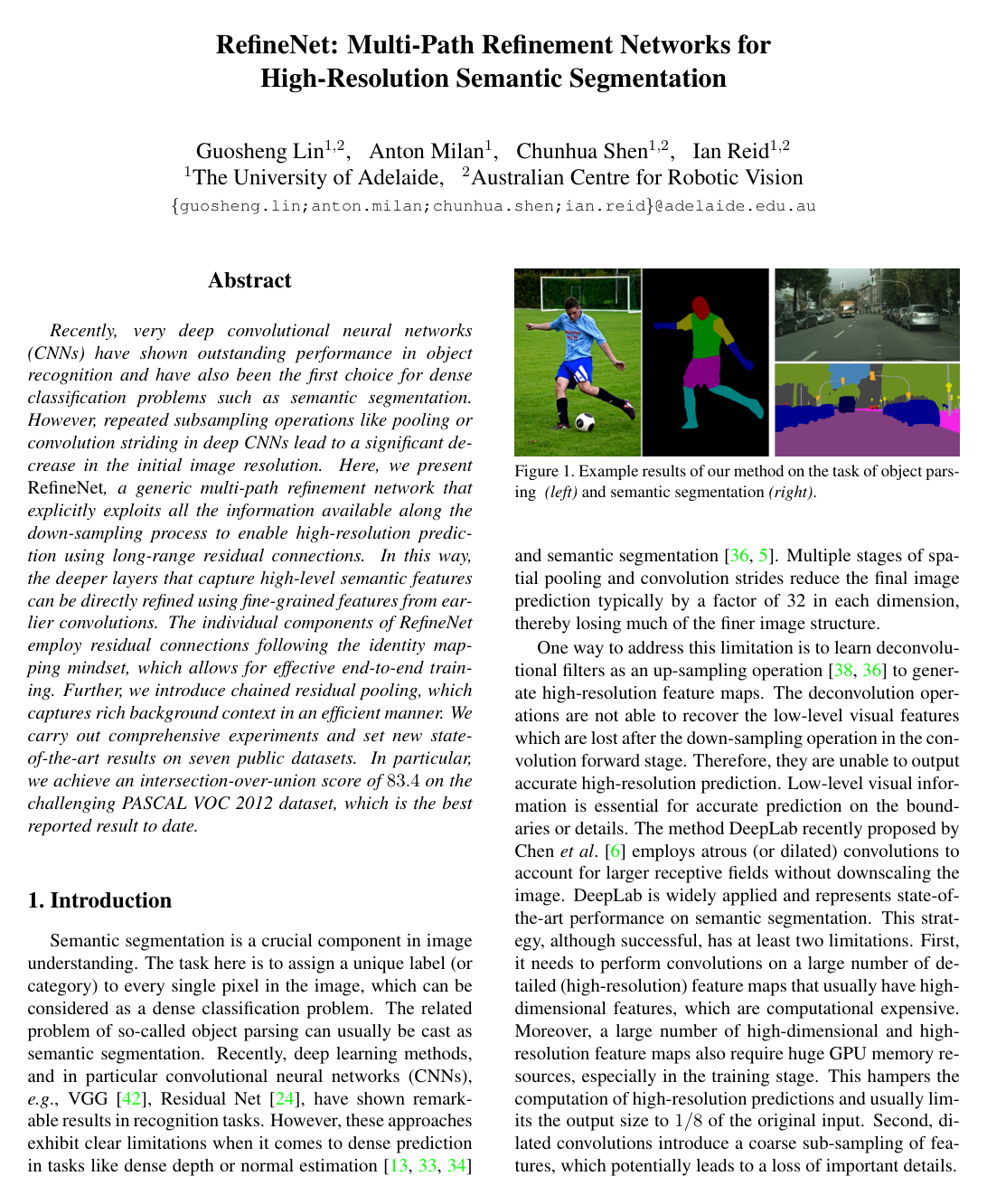
RefineNet: Multi-path Refinement Networks for High-Resolution Semantic Segmentation

Guosheng LinAnton MilanChunhua ShenIan Reid

article2016CVPR3,139 citations

Introduces RefineNet, a multi-path network architecture that uses long-range residual connections and chained residual pooling to merge fine-grained spatial details with deep semantic context, establishing state-of-the-art accuracy in high-resolution semantic segmentation.

Listen

RefineNet is a multi-path refinement network designed to produce accurate high-resolution semantic segmentation from deep convolutional networks such as ResNet. Standard deep CNNs repeatedly downsample feature maps through pooling and striding, which reduces spatial resolution by a factor of 32 and discards fine detail needed for precise boundaries. Earlier attempts to recover resolution, including deconvolution layers and dilated convolutions, either fail to restore lost low-level cues or incur prohibitive memory and compute costs that limit output size to roughly one-eighth of the input.

The work set out to demonstrate that features from all stages of a deep network can be fused efficiently through long-range residual connections to recover high-resolution predictions while preserving the memory and training advantages of downsampled representations. The authors built a cascaded architecture of RefineNet blocks, each containing residual convolution units, a multi-resolution fusion stage, and chained residual pooling. The system was initialized from publicly available ResNet models pretrained on ImageNet and trained end-to-end on seven public benchmarks covering indoor scenes, street scenes, and object-part parsing.

On every dataset the method established a new state-of-the-art intersection-over-union score. The largest gain appeared on PASCAL VOC 2012, where RefineNet-Res152 reached 83.4 percent IoU, surpassing the previous best result by several points. Comparable improvements were recorded on NYUDv2 (46.5 percent), Cityscapes (73.6 percent), PASCAL-Context (47.3 percent), SUN-RGBD (45.9 percent), ADE20K (40.7 percent), and the Person-Part dataset (68.6 percent). Ablation studies confirmed that chained residual pooling, network depth, and multi-scale evaluation each contributed measurable gains, and that four-stage cascaded refinement outperformed simpler single- or two-stage variants.

These results show that high-resolution semantic segmentation no longer requires either the memory overhead of dilated convolutions or the loss of detail inherent in low-resolution score maps. The approach therefore lowers the barrier to deploying accurate pixel-level labeling in robotics, autonomous driving, and medical imaging while remaining trainable on current hardware. The authors have released both source code and trained models, enabling immediate adoption and further architectural exploration.

The principal limitations are dependence on a ResNet backbone, evaluation confined to the seven reported datasets, and the modest additional cost of multi-scale testing at inference time. Within these bounds the empirical evidence is strong and consistent across diverse domains.

Cover for RefineNet: Multi-path Refinement Networks for High-Resolution Semantic Segmentation

Abstract

Recently, very deep convolutional neural networks (CNNs) have shown outstanding performance in object recognition and have also been the first choice for dense classification problems such as semantic segmentation. However, repeated subsampling operations like pooling or convolution striding in deep CNNs lead to a significant decrease in the initial image resolution. Here, we present RefineNet, a generic multi-path refinement network that explicitly exploits all the information available along the down-sampling process to enable high-resolution prediction using long-range residual connections. In this way, the deeper layers that capture high-level semantic features can be directly refined using fine-grained features from earlier convolutions. The individual components of RefineNet employ residual connections following the identity mapping mindset, which allows for effective end-to-end training. Further, we introduce chained residual pooling, which captures rich background context in an efficient manner. We carry out comprehensive experiments and set new state-of-the-art results on seven public datasets. In particular, we achieve an intersection-over-union score of 83.4 on the challenging PASCAL VOC 2012 dataset, which is the best reported result to date.

Table of Contents

  • 1. Introduction
  • 1.1. Related Work
  • 2. Background
  • 3. Proposed Method
  • 3.1. Multi-Path Refinement
  • 3.2. RefineNet
  • 3.3. Identity Mappings in RefineNet
  • 4. Experiments
  • 4.1. Object Parsing
  • 4.2. Semantic Segmentation
  • 4.3. Variants of cascaded RefineNet
  • 5. Conclusion
  • References

Knowls

  1. Knowl 1 — Cascaded Multi-Path Refinement Network Architecture

    model/method

    RefineNet is a multi-path refinement architecture designed for high-resolution dense prediction tasks such as semantic segmentation. Instead of relying on memory-intensive dilated convolutions or lossy deconvolution operations, RefineNet exploits multi-level feature representations generated along the down-sampling stages of a backbone convolutional network (such as ResNet) via long-range residual connections.

    In the standard 4-cascaded RefineNet configuration, a backbone ResNet is partitioned into 4 blocks corresponding to feature maps with spatial resolutions of 1/41/4, 1/81/8, 1/161/16, and 1/321/32 of the original input image size. The network applies a cascade of four RefineNet blocks denoted RefineNet-m\text{RefineNet-}m (m{1,2,3,4}m \in \{1, 2, 3, 4\}):

    1. RefineNet-4\text{RefineNet-4} takes the 1/321/32-resolution feature map from ResNet block-4 as its single input path to adapt the pre-trained features to the semantic segmentation task.
    2. RefineNet-3\text{RefineNet-3} receives two input paths: the high-level output of RefineNet-4\text{RefineNet-4} and the higher-resolution (1/161/16) feature map from ResNet block-3, refining the coarse semantic features with mid-level representations.
    3. RefineNet-2\text{RefineNet-2} similarly fuses the output of RefineNet-3\text{RefineNet-3} with the 1/81/8-resolution feature map from ResNet block-2.
    4. RefineNet-1\text{RefineNet-1} fuses the output of RefineNet-2\text{RefineNet-2} with the 1/41/4-resolution feature map from ResNet block-1, producing a high-resolution feature map.

    The final high-resolution feature map is passed through a dense softmax classifier to generate per-pixel category score maps, which are then up-sampled to the full original image resolution using bilinear interpolation.

  2. Knowl 2 — Chained Residual Pooling

    model/method

    Chained Residual Pooling is a structural component designed to capture background context from large image regions without requiring large pooling windows or computationally heavy dilated convolutions.

    The module consists of an initial ReLU\text{ReLU} activation followed by a chain of NN pooling blocks (by default N=2N = 2, or N=4N = 4 for object parsing). Each individual pooling block ii consists of:

    1. A max-pooling layer with a 5×55\times 5 window size and a stride of 11.
    2. A 3×33\times 3 convolutional layer that acts as a learnable weighting layer for feature fusion.

    The first pooling block takes the ReLU\text{ReLU}-activated input feature map, and every subsequent pooling block ii takes the output of pooling block i1i-1 as its input. By chaining these operations, block ii re-uses the accumulated pooling context from prior blocks to cover an increasingly large receptive field.

    The output features of all NN pooling blocks are fused with the input feature map via residual summation connections:

    Xout=Xin+i=1NWiPi(X)X_{\text{out}} = X_{\text{in}} + \sum_{i=1}^{N} W_i * P_i(X)

    where XinX_{\text{in}} is the input feature map, PiP_i represents the chained max-pooling operation at step ii, WiW_i represents the weights of the 3×33\times 3 convolutional layer of block ii, and * denotes the convolution operation.

  3. Knowl 3 — RefineNet Internal Sub-Modules

    model/method

    Each individual RefineNet block is a generic module that fuses multi-resolution inputs through four sequential processing stages:

    1. Residual Convolution Units (RCU): Each incoming input path is processed sequentially through two RCUs. An RCU is a modified ResNet convolutional unit without batch normalization layers, formulated as: RCU(X)=X+W2ReLU(W1ReLU(X))\text{RCU}(X) = X + W_2 * \text{ReLU}(W_1 * \text{ReLU}(X)) where W1W_1 and W2W_2 are 3×33\times 3 convolutional filters. The number of output feature channels per input path is set to 512 for RefineNet-4\text{RefineNet-4} and 256 for RefineNet-3\text{RefineNet-3}, RefineNet-2\text{RefineNet-2}, and RefineNet-1\text{RefineNet-1}.

    2. Multi-Resolution Fusion: When multiple input paths enter the block, each path is first projected to the smallest channel dimension among the inputs via a 3×33\times 3 convolution for input adaptation. All lower-resolution feature maps are then bilinearly upsampled to match the largest spatial resolution among the inputs. The adapted feature maps are fused by element-wise summation. If only one input path exists (as in RefineNet-4\text{RefineNet-4}), features pass through without modification.

    3. Chained Residual Pooling: The fused feature representation is passed through chained max-pooling and 3×33\times 3 convolution units linked via residual connections to capture multi-scale background context.

    4. Output Convolutions: The context-enriched feature map passes through one final RCU to apply non-linear operations without altering the spatial resolution or channel dimension. In RefineNet-1\text{RefineNet-1}, two additional RCUs are placed prior to the final softmax layer.

  4. Knowl 4 — Identity Mapping Design Principle for End-to-End Training

    model/method

    To enable stable, effective end-to-end backpropagation across deep cascaded multi-path networks, all RefineNet modules follow the identity mapping principle.

    Key architectural properties for gradient flow include:

    • Clean Shortcut Paths: Shortcut connections inside RCUs, the chained residual pooling module, and across network stages do not contain non-linear activation layers (such as ReLU\text{ReLU}) or normalization layers that could block gradient propagation.
    • Linear Path Adaptations: In the multi-resolution fusion module, transformations on shortcut paths are restricted to linear operations: linear 3×33\times 3 convolutions for channel adjustment and bilinear up-sampling for spatial alignment.
    • Non-Linearities on Residual Branches: Non-linear layers are confined to the residual branches, allowing gradients to propagate directly through short-range residual connections (within RCUs and pooling blocks) and long-range residual connections (linking the early ResNet layers directly to RefineNet blocks).
    • Localized Activation: Only one ReLU\text{ReLU} non-linearity is placed at the entrance of each chained residual pooling block to improve the effectiveness of pooling operations and reduce learning rate sensitivity without hindering gradient flow.
  5. Knowl 5 — PASCAL VOC 2012 Semantic Segmentation Benchmark Results

    data/table

    When evaluated on the PASCAL VOC 2012 semantic segmentation test set (comprising 20 foreground classes and 1 background class), RefineNet achieves state-of-the-art accuracy, outperforming dilation-based models (such as DeepLab-v2) and previous encoder-decoder architectures. Models were trained using additional annotated VOC images from Hariharan et al. and the MS COCO dataset, with dense CRF applied as a minor post-processing step (+0.1% validation IoU).

    Method aero bike bird boat bottle bus car cat chair cow table dog horse mbike person potted sheep sofa train tv mean IoU
    FCN-8s 76.8 34.2 68.9 49.4 60.3 75.3 74.7 77.6 21.4 62.5 46.8 71.8 63.9 76.5 73.9 45.2 72.4 37.4 70.9 55.1 62.2
    DeconvNet 89.9 39.3 79.7 63.9 68.2 87.4 81.2 86.1 28.5 77.0 62.0 79.0 80.3 83.6 80.2 58.8 83.4 54.3 80.7 65.0 72.5
    CRF-RNN 90.4 55.3 88.7 68.4 69.8 88.3 82.4 85.1 32.6 78.5 64.4 79.6 81.9 86.4 81.8 58.6 82.4 53.5 77.4 70.1 74.7
    BoxSup 89.8 38.0 89.2 68.9 68.0 89.6 83.0 87.7 34.4 83.6 67.1 81.5 83.7 85.2 83.5 58.6 84.9 55.8 81.2 70.7 75.2
    DPN 89.0 61.6 87.7 66.8 74.7 91.2 84.3 87.6 36.5 86.3 66.1 84.4 87.8 85.6 85.4 63.6 87.3 61.3 79.4 66.4 77.5
    Context 94.1 40.7 84.1 67.8 75.9 93.4 84.3 88.4 42.5 86.4 64.7 85.4 89.0 85.8 86.0 67.5 90.2 63.8 80.9 73.0 78.0
    DeepLab 89.1 38.3 88.1 63.3 69.7 87.1 83.1 85.0 29.3 76.5 56.5 79.8 77.9 85.8 82.4 57.4 84.3 54.9 80.5 64.1 72.7
    DeepLab2-Res101 92.6 60.4 91.6 63.4 76.3 95.0 88.4 92.6 32.7 88.5 67.6 89.6 92.1 87.0 87.4 63.3 88.3 60.0 86.8 74.5 79.7
    CSupelec-Res101 92.9 61.2 91.0 66.3 77.7 95.3 88.9 92.4 33.8 88.4 69.1 89.8 92.9 87.7 87.5 62.6 89.9 59.2 87.1 74.2 80.2
    RefineNet-Res101 94.9 60.2 92.8 77.5 81.5 95.0 87.4 93.3 39.6 89.3 73.0 92.7 92.4 85.4 88.3 69.7 92.2 65.3 84.2 78.7 82.4
    RefineNet-Res152 94.7 64.3 94.9 74.9 82.9 95.1 88.5 94.7 45.5 91.4 76.3 90.6 91.8 88.1 88.0 69.9 92.3 65.9 88.7 76.8 83.4
  6. Knowl 6 — Ablation Analysis of Chained Pooling, Depth, and Multi-Scale Testing

    data/table

    Ablation experiments conducted on the NYUDv2 indoor segmentation dataset (40 classes, RGB-only) and the Person-Part dataset demonstrate the isolated contributions of Chained Residual Pooling, backbone model depth (ResNet-50 vs ResNet-101 vs ResNet-152), and test-time Multi-Scale Evaluation (Msc Eva).

    Initialization Chained pool. Msc Eva NYUDv2 (IoU) Person-Parts (IoU)
    ResNet-50 no no 40.4 64.1
    ResNet-50 yes no 42.5 65.7
    ResNet-50 yes yes 43.8 67.1
    ResNet-101 yes no 43.6 67.6
    ResNet-101 yes yes 44.7 68.6
    ResNet-152 yes yes 46.5 68.8

    Key takeaways:

    • Adding Chained Residual Pooling improves intersection-over-union (IoU) by +2.1%+2.1\% on NYUDv2 and +1.6%+1.6\% on Person-Parts over the ResNet-50 baseline.
    • Multi-scale testing consistently improves performance across models (e.g., +1.3%+1.3\% on NYUDv2 and +1.4%+1.4\% on Person-Parts for ResNet-50).
    • Increasing backbone depth from ResNet-50 to ResNet-152 provides steady performance gains, reaching 46.5%46.5\% IoU on NYUDv2 and 68.8%68.8\% IoU on Person-Parts.
  7. Knowl 7 — Ablation of RefineNet Cascading Configurations

    data/table

    RefineNet can be organized in multiple cascading topologies. Evaluating these variants on the NYUDv2 dataset with a ResNet-50 backbone (without multi-scale testing) establishes the relationship between cascading depth, multi-scale inputs, and segmentation accuracy:

    Variant Initialization Msc Eva NYUDv2 (IoU)
    Single RefineNet ResNet-50 no 40.3
    2-cascaded RefineNet ResNet-50 no 40.9
    4-cascaded RefineNet ResNet-50 no 42.5
    4-cascaded 2-scale RefineNet ResNet-50 no 43.1
    • Single RefineNet: Uses one RefineNet block taking all four ResNet block outputs simultaneously into its multi-resolution fusion unit, obtaining 40.3%40.3\% IoU.
    • 2-cascaded RefineNet: Uses two RefineNet blocks (the bottom block fuses ResNet blocks 3 and 4; the top block fuses ResNet blocks 1 and 2 with the bottom block output), achieving 40.9%40.9\% IoU.
    • 4-cascaded RefineNet: Uses four staged RefineNet blocks, achieving 42.5%42.5\% IoU (+2.2%+2.2\% over single RefineNet).
    • 4-cascaded 2-scale RefineNet: Scales the input image by factors of 1.2×1.2\times and 0.6×0.6\times, processing them through two independent ResNet backbones connected to a 4-cascaded structure (yielding 43.1%43.1\% IoU at increased computational cost).
  8. Knowl 8 — Evaluation Across Scene Segmentation Benchmarks

    empirical result

    RefineNet sets state-of-the-art results across diverse indoor, outdoor, and scene parsing benchmarks:

    • Cityscapes: On the 19-class test set of urban street scenes, RefineNet-Res101 achieves 73.6%73.6\% IoU, outperforming DeepLab-v2 Res101 (70.4%70.4\% IoU), Dilation10 (67.1%67.1\% IoU), and FCN-8s (65.3%65.3\% IoU).
    • NYUDv2 (40 classes): Using RGB input only (without depth features), RefineNet-Res152 achieves 73.6%73.6\% pixel accuracy, 58.9%58.9\% mean accuracy, and 46.5%46.5\% IoU, outperforming prior RGB-D and RGB methods (e.g., Context at 40.6%40.6\% IoU; FCN-HHA with RGB-D at 34.0%34.0\% IoU).
    • SUN-RGBD (37 classes): Evaluated on RGB only, RefineNet-Res152 achieves 80.6%80.6\% pixel accuracy, 58.5%58.5\% mean accuracy, and 45.9%45.9\% IoU (RefineNet-Res101 achieves 45.7%45.7\% IoU), surpassing the previous best Context model (42.3%42.3\% IoU) and RGB-D methods.
    • PASCAL-Context (60 classes): Trained using only standard PASCAL VOC training images (without extra COCO data), RefineNet-Res101 reaches 47.1%47.1\% IoU and RefineNet-Res152 reaches 47.3%47.3\% IoU, outperforming DeepLab-v2 Res101 (45.7%45.7\% IoU, which used ~100K COCO images).
    • ADE20K (150 classes): On the validation set, RefineNet-Res101 achieves 40.2%40.2\% IoU and RefineNet-Res152 achieves 40.7%40.7\% IoU, surpassing Cascaded-DilatedNet (34.9%34.9\% IoU) and DilatedNet (32.3%32.3\% IoU).
  9. Knowl 9 — Object Parsing Performance on Person-Parts Dataset

    data/table

    Object parsing involves pixel-level segmentation of semantic object parts. On the Person-Part benchmark (1717 training images, 1818 test images; 6 body part classes: Head, Torso, Upper Arms, Lower Arms, Upper Legs, Lower Legs, plus Background), RefineNet configured with four pooling blocks in its Chained Residual Pooling module achieves superior accuracy over existing part-parsing and dilated convolution models.

    Method IoU (%)
    Attention 56.4
    HAZN 57.5
    LG-LSTM 58.0
    Graph-LSTM 60.2
    DeepLab 62.8
    DeepLab-v2 (Res101) 64.9
    RefineNet-Res101 (ours) 68.6

    RefineNet-Res101 achieves 68.6%68.6\% mean IoU, an improvement of +3.7%+3.7\% over DeepLab-v2 initialized with the identical ResNet-101 backbone.

Coverage note — None was omitted; all contributed models, subcomponents (RCU, multi-resolution fusion, chained residual pooling), identity mapping principles, architectural variants, ablation experiments, and quantitative benchmark results across all 7 evaluated datasets are covered.

References

  1. 1.A. Arnab, S. Jayasumana, S. Zheng, and P. H. Torr. Higher order conditional random fields in deep neural networks. In European Conference on Computer Vision. Springer, 2016.
  2. 2.V. Badrinarayanan, A. Kendall, and R. Cipolla. Segnet: A deep convolutional encoder-decoder architecture for image segmentation. CoRR, 2015.
  3. 3.J. Carreira, R. Caseiro, J. Batista, and C. Sminchisescu. Semantic segmentation with second-order pooling. In ECCV, 2012.
  4. 4.S. Chandra and I. Kokkinos. Fast, exact and multi-scale inference for semantic image segmentation with deep gaussian crfs. In ECCV, 2016.
  5. 5.L. Chen, G. Papandreou, I. Kokkinos, K. Murphy, and A. L. Yuille. Semantic image segmentation with deep convolutional nets and fully connected CRFs. In ICLR, 2015.
  6. 6.L. Chen, G. Papandreou, I. Kokkinos, K. Murphy, and A. L. Yuille. DeepLab: Semantic image segmentation with deep convolutional nets, atrous convolution, and fully connected CRFs. CoRR, abs/1606.00915, 2016.
  7. 7.L.-C. Chen, Y. Yang, J. Wang, W. Xu, and A. L. Yuille. Attention to scale: Scale-aware semantic image segmentation. arXiv preprint arXiv:1511.03339, 2015.
  8. 8.X. Chen, R. Mottaghi, X. Liu, S. Fidler, R. Urtasun, and A. Yuille. Detect what you can: Detecting and representing objects using holistic models and body parts. In Proceedings of the IEEE Conference on Computer Vision and Pattern Recognition, pages 1971–1978, 2014.
  9. 9.M. Cordts, M. Omran, S. Ramos, T. Rehfeld, M. Enzweiler, R. Benenson, U. Franke, S. Roth, and B. Schiele. The cityscapes dataset for semantic urban scene understanding. In CVPR, 2016.
  10. 10.J. Dai, K. He, and J. Sun. BoxSup: Exploiting bounding boxes to supervise convolutional networks for semantic segmentation. In ICCV, 2015.
  11. 11.J. Dai, K. He, and J. Sun. Convolutional feature masking for joint object and stuff segmentation. In CVPR, 2015.
  12. 12.C. Dong, C. C. Loy, K. He, and X. Tang. Learning a deep convolutional network for image super-resolution. In ECCV, 2014.
  13. 13.D. Eigen and R. Fergus. Predicting depth, surface normals and semantic labels with a common multi-scale convolutional architecture. In ICCV, 2015.
  14. 14.D. Eigen, D. Krishnan, and R. Fergus. Restoring an image taken through a window covered with dirt or rain. In ICCV, 2013.
  15. 15.D. Eigen, C. Puhrsch, and R. Fergus. Depth map prediction from a single image using a multi-scale deep network. In NIPS, 2014.
  16. 16.M. Everingham, L. Van Gool, C. K. Williams, J. Winn, and A. Zisserman. The pascal visual object classes (voc) challenge. In IJCV, 2010.
  17. 17.G. Ghiasi and C. C. Fowlkes. Laplacian pyramid reconstruction and refinement for semantic segmentation. In ECCV, 2016.
  18. 18.R. B. Girshick, J. Donahue, T. Darrell, and J. Malik. Rich feature hierarchies for accurate object detection and semantic segmentation. In CVPR, 2014.
  19. 19.S. Gupta, P. Arbelaez, and J. Malik. Perceptual organization and recognition of indoor scenes from rgb-d images. In CVPR, 2013.
  20. 20.S. Gupta, R. Girshick, P. Arbelaez, and J. Malik. Learning rich features from RGB-D images for object detection and segmentation. In ECCV, 2014.
  21. 21.B. Hariharan, P. Arbelaez, L. D. Bourdev, S. Maji, and J. Malik. Semantic contours from inverse detectors. In ICCV, 2011.
  22. 22.B. Hariharan, P. Arbelaez, R. Girshick, and J. Malik. Hypercolumns for object segmentation and fine-grained localization. In CVPR, 2014.
  23. 23.B. Hariharan, P. Arbelaez, R. Girshick, and J. Malik. Simultaneous detection and segmentation. In ECCV, 2014.
  24. 24.K. He, X. Zhang, S. Ren, and J. Sun. Deep residual learning for image recognition. In CVPR 2016, 2016.
  25. 25.K. He, X. Zhang, S. Ren, and J. Sun. Identity mappings in deep residual networks. arXiv preprint arXiv:1603.05027, 2016.
  26. 26.A. Kendall, V. Badrinarayanan, and R. Cipolla. Bayesian segnet: Model uncertainty in deep convolutional encoder-decoder architectures for scene understanding. CoRR, abs/1511.02680, 2015.
  27. 27.P. Krahenbuhl and V. Koltun. Efficient inference in fully connected CRFs with Gaussian edge potentials. In NIPS, 2012.
  28. 28.X. Liang, X. Shen, J. Feng, L. Lin, and S. Yan. Semantic object parsing with graph lstm. arXiv preprint arXiv:1603.07063, 2016.
  29. 29.X. Liang, X. Shen, D. Xiang, J. Feng, L. Lin, and S. Yan. Semantic object parsing with local-global long short-term memory. arXiv preprint arXiv:1511.04510, 2015.
  30. 30.G. Lin, C. Shen, A. van den Hengel, and I. Reid. Efficient piecewise training of deep structured models for semantic segmentation. In CVPR, 2016.
  31. 31.T.-Y. Lin, M. Maire, S. Belongie, J. Hays, P. Perona, D. Ramanan, P. Dollar, and C. L. Zitnick. Microsoft COCO: Common objects in context. In ECCV, 2014.
  32. 32.C. Liu, J. Yuen, and A. Torralba. Sift flow: Dense correspondence across scenes and its applications. IEEE T. Pattern Analysis & Machine Intelligence, 2011.
  33. 33.F. Liu, C. Shen, and G. Lin. Deep convolutional neural fields for depth estimation from a single image. In CVPR, 2015.
  34. 34.F. Liu, C. Shen, G. Lin, and I. D. Reid. Learning depth from single monocular images using deep convolutional neural fields. CoRR, abs/1502.07411, 2015.
  35. 35.Z. Liu, X. Li, P. Luo, C. C. Loy, and X. Tang. Semantic image segmentation via deep parsing network. In ICCV, 2015.
  36. 36.J. Long, E. Shelhamer, and T. Darrell. Fully convolutional networks for semantic segmentation. In CVPR, 2015.
  37. 37.R. Mottaghi, X. Chen, X. Liu, N.-G. Cho, S.-W. Lee, S. Fidler, R. Urtasun, et al. The role of context for object detection and semantic segmentation in the wild. In CVPR, 2014.
  38. 38.H. Noh, S. Hong, and B. Han. Learning deconvolution network for semantic segmentation. In ICCV, 2015.
  39. 39.X. Ren, L. Bo, and D. Fox. Rgb-(d) scene labeling: Features and algorithms. In CVPR, 2012.
  40. 40.O. Ronneberger, P. Fischer, and T. Brox. U-net: Convolutional networks for biomedical image segmentation. In N. Navab, J. Hornegger, W. M. Wells, and A. F. Frangi, editors, Medical Image Computing and Computer-Assisted Intervention, pages 234–241, 2015.
  41. 41.N. Silberman, D. Hoiem, P. Kohli, and R. Fergus. Indoor segmentation and support inference from rgbd images. In ECCV, 2012.
  42. 42.K. Simonyan and A. Zisserman. Very deep convolutional networks for large-scale image recognition. In ICLR, 2015.
  43. 43.S. Song, S. P. Lichtenberg, and J. Xiao. Sun rgb-d: A rgb-d scene understanding benchmark suite. In CVPR, 2015.
  44. 44.A. Vedaldi and K. Lenc. MatConvNet – convolutional neural networks for matlab, 2014.
  45. 45.F. Xia, P. Wang, L.-C. Chen, and A. L. Yuille. Zoom better to see clearer: Human and object parsing with hierarchical auto-zoom net. arXiv preprint arXiv:1511.06881, 2015.
  46. 46.F. Yu and V. Koltun. Multi-scale context aggregation by dilated convolutions. CoRR, 2015.
  47. 47.S. Zheng, S. Jayasumana, B. Romera-Paredes, V. Vineet, Z. Su, D. Du, C. Huang, and P. Torr. Conditional random fields as recurrent neural networks. In ICCV, 2015.
  48. 48.B. Zhou, H. Zhao, X. Puig, S. Fidler, A. Barriuso, and A. Torralba. Semantic understanding of scenes through the ADE20K dataset. CoRR, abs/1608.05442, 2016.

Citation

MLA
Lin, G., et al. “RefineNet: Multi-path Refinement Networks for High-Resolution Semantic Segmentation”. 2017 IEEE Conference on Computer Vision and Pattern Recognition (CVPR), 2017, pp. 5168–77, https://doi.org/10.1109/CVPR.2017.549.
APA
Lin, G., Milan, A., Shen, C., & Reid, I. (2017). RefineNet: Multi-path Refinement Networks for High-Resolution Semantic Segmentation. 2017 IEEE Conference on Computer Vision and Pattern Recognition (CVPR), 5168–5177. https://doi.org/10.1109/CVPR.2017.549
Chicago
Lin, G., A. Milan, C. Shen, and I. Reid. 2017. “RefineNet: Multi-path Refinement Networks for High-Resolution Semantic Segmentation”. 2017 IEEE Conference on Computer Vision and Pattern Recognition (CVPR), 5168–77. https://doi.org/10.1109/CVPR.2017.549.
Harvard
Lin, G. et al. (2017) “RefineNet: Multi-path Refinement Networks for High-Resolution Semantic Segmentation”, 2017 IEEE Conference on Computer Vision and Pattern Recognition (CVPR). IEEE, pp. 5168–5177. Available at: https://doi.org/10.1109/CVPR.2017.549.
Vancouver
1. Lin G, Milan A, Shen C, Reid I (2017) RefineNet: Multi-path Refinement Networks for High-Resolution Semantic Segmentation. In: 2017 IEEE Conference on Computer Vision and Pattern Recognition (CVPR). IEEE, pp 5168–5177

BibTeX

@inproceedings{Lin_2017, title={RefineNet: Multi-path Refinement Networks for High-Resolution Semantic Segmentation}, url={http://dx.doi.org/10.1109/CVPR.2017.549}, DOI={10.1109/cvpr.2017.549}, booktitle={2017 IEEE Conference on Computer Vision and Pattern Recognition (CVPR)}, publisher={IEEE}, author={Lin, Guosheng and Milan, Anton and Shen, Chunhua and Reid, Ian}, year={2017}, month=July, pages={5168–5177} }
Metadata:Crossref

Source Code

This paper has an official code repository available. Click below to access the source code.

View Repository

Access the Paper

This paper is available from its original source. Click below to access the PDF.

Open PDF

License: IEEE