Rethinking the Correlation in Few-Shot Segmentation: A Buoys View
Yuan WangRui SunTianzhu Zhang
Proposes an adaptive buoys correlation network that suppresses false pixel-level matches in few-shot segmentation by using mined representative reference features to rectify support-query correspondence.
Deep learning models for image segmentation conventionally require vast volumes of manually annotated data, which is expensive and time-consuming to obtain. Few-shot segmentation addresses this bottleneck by enabling models to recognize and isolate new visual categories using only a few annotated reference examples. However, standard methods suffer from severe matching errors due to complex image backgrounds and substantial differences in appearance or pose between the reference and target images. These errors degrade segmentation reliability in low-data regimes.
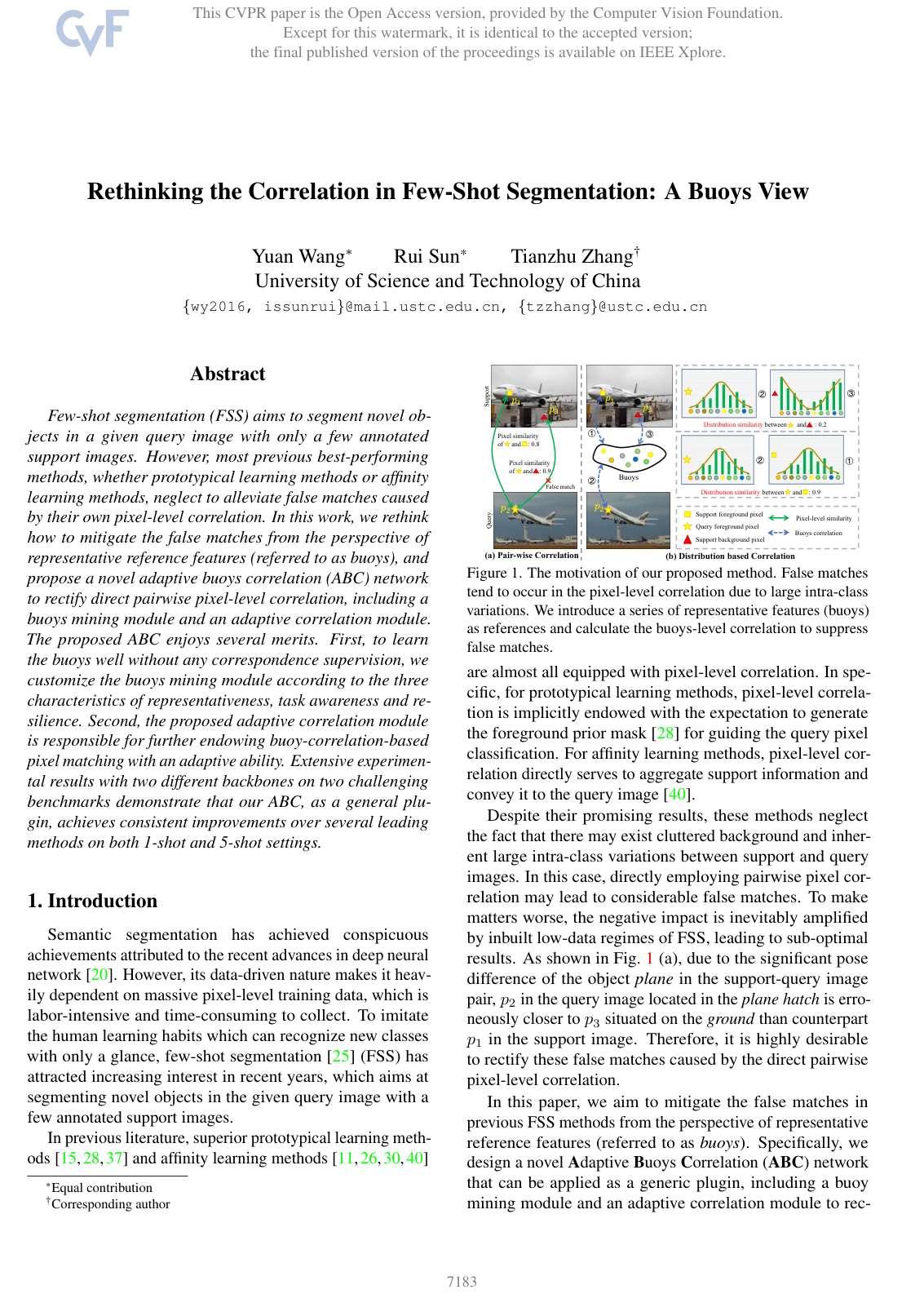
The main objective of the article is to demonstrate that introducing a set of representative reference features—termed buoys—can effectively suppress false matches and rectify the direct, pixel-level correlation commonly used in few-shot segmentation models.
To achieve this, the article introduces the Adaptive Buoys Correlation network, designed as a modular plug-in for existing segmentation frameworks. The method operates through two core components: a buoy mining module and an adaptive correlation module. The buoy mining module initializes reference points using matrix decomposition to retain primary visual information, followed by attention mechanisms that capture task-specific context and reconcile appearance discrepancies between image pairs. The adaptive correlation module then evaluates matches dynamically by applying an optimal transport algorithm that downweights irrelevant reference points and assesses the structural similarity of helpful features. The approach was systematically evaluated across two standard benchmarks (PASCAL-5i and COCO-20i) using both 1-shot and 5-shot learning configurations on standard ResNet architectures.
The experimental findings show consistent, broad-based improvements over established baseline models. First, incorporating the buoy network improved segmentation accuracy across all baselines, delivering gains of up to 1.7 percentage points in mean intersection-over-union on PASCAL-5i and up to 2.2 percentage points on the more complex COCO-20i dataset. Second, the performance lift was pronounced in both single-sample (1-shot) and multi-sample (5-shot) settings across different neural network backbones. Third, diagnostic ablation experiments revealed that each design component—including matrix-based initialization, contextual aggregation, and adaptive transport scoring—contributed cumulatively to suppressing false background-to-foreground matches. Fourth, the module achieved these gains with only a minor increase in parameters and computational overhead.
These results demonstrate that explicitly refining feature correlation via structured reference points substantially mitigates errors caused by visual ambiguity and background clutter. For organizations deploying computer vision systems, this approach enhances segmentation accuracy in data-constrained environments without necessitating expensive retraining or complete architectural overhauls, thereby reducing data annotation costs and operational risk.
Based on these findings, engineering teams should evaluate integrating this modular buoy network into existing segmentation pipelines that rely on attention or prior mask guidance. When implementing the system, practitioners should balance the number of reference buoys—setting roughly 24 buoys based on empirical tuning—to avoid either information loss or redundancy.
While the findings are supported by consistent empirical improvements across standard benchmark datasets, the evaluations remain focused on standard natural image datasets. Confidence in the underlying method is high, though teams deploying the framework in specialized domains, such as medical imaging or aerial photography, should conduct domain-specific pilot testing to verify performance under distinct visual conditions.
- Paper: PANet: Few-Shot Image Semantic Segmentation With Prototype Alignment, Kaixin Wang et al. (2019). PANet establishes the foundational prototype-matching and alignment paradigm for few-shot image segmentation that the source paper directly builds upon and modifies.
- Paper: Prototypical Networks for Few-shot Learning, Jake Snell et al. (2017). Prototypical Networks introduce metric-based nearest-prototype classification for few-shot learning, providing the fundamental theoretical basis for prototype representations in segmentation.
- Paper: Matching Networks for One Shot Learning, Oriol Vinyals et al. (2016). Matching Networks pioneer episodic metric learning and learned memory-based matching mechanisms that underpin modern few-shot vision architectures.
- Paper: Learning to Compare: Relation Network for Few-Shot Learning, Flood Sung et al. (2017). Relation Network introduces end-to-end learnable similarity and relation modules for few-shot comparisons, representing the affinity-learning branch analyzed and improved in the source.
- Paper: TADAM: Task dependent adaptive metric for improved few-shot learning, Boris N. Oreshkin et al. (2018). TADAM develops task-dependent adaptive metric scaling and feature conditioning for few-shot learning, motivating the adaptive correlation mechanisms in the source paper.
- Paper: Generalizing from a Few Examples, Yaqing Wang et al. (2019). This survey provides a comprehensive formal taxonomy of few-shot learning formulations, error sources, and prior-knowledge strategies necessary to contextualize few-shot segmentation challenges.
- Paper: Fully convolutional networks for semantic segmentation, Jonathan Long et al. (2015). Fully Convolutional Networks lay the foundational architecture for dense pixel-level prediction upon which deep semantic segmentation and few-shot segmentation networks operate.
- Paper: Revisiting Prototypical Network for Cross Domain Few-Shot Learning, Fei Zhou et al. (2023). This paper extends prototype-based few-shot representation learning to cross-domain generalization by combining local and global feature distillation.