Navigating the Metrics Maze: Reconciling Score Magnitudes and Accuracies
Tom KocmiVilém ZouharChristian FedermannMatt Post
Establishes practical score difference thresholds across modern machine translation metrics to determine when system-level score gains reflect perceivable translation quality improvements to human evaluators.
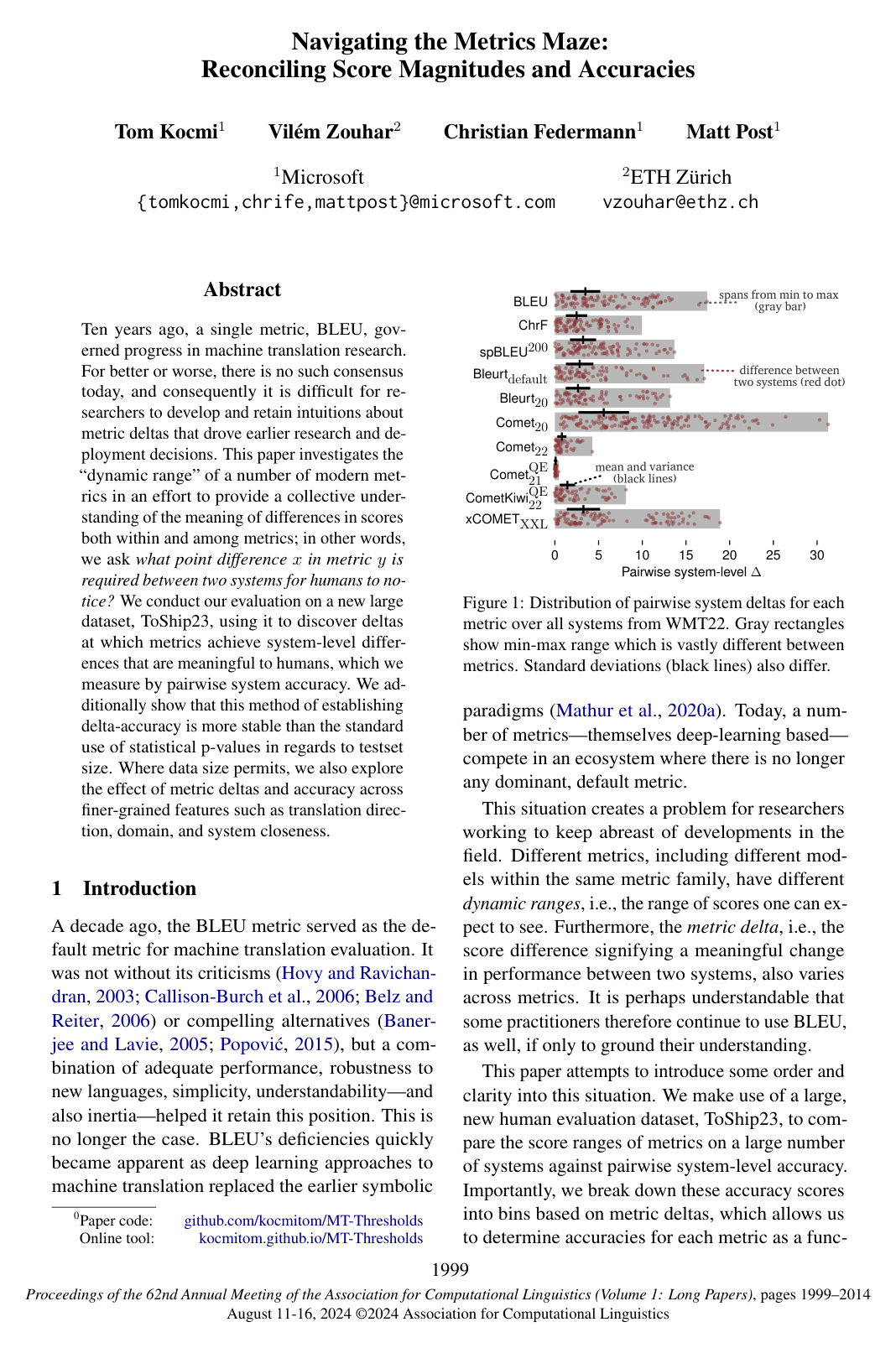
Modern machine translation research and deployment rely heavily on automated scoring metrics to evaluate model improvements. Historically, the field relied on a single standard metric, BLEU, but modern neural metrics have replaced it with a fragmented landscape of competing measurement tools. These newer metrics operate on vastly different numerical score scales, making it difficult for decision-makers and practitioners to understand what score difference constitutes a real, meaningful quality improvement that human users would notice.
The article aims to resolve this ambiguity by determining the score differences required for various metrics to achieve system-level improvements that align with human judgment. It establishes a unified framework that maps raw metric score differences directly to estimated human pairwise ranking accuracy.
To conduct this evaluation, the authors analyzed ToShip23, an extensive human evaluation dataset containing over 3 million segments and 6,530 system pairs across 94 languages and more than 10 domains. By grouping system score deltas into bins and fitting mathematical curves to the empirical data, the study established reliable thresholds of human agreement. Key findings were subsequently validated on public benchmark datasets from the annual Conference on Machine Translation (WMT).
The analysis reveals several critical findings. First, modern neural quality estimation metrics vastly outperform traditional string-matching metrics; CometKiwiQE22 achieved the highest overall pairwise accuracy with human judgment at 81.5%, closely followed by xCOMETXXL at 81.4%, while BLEU scored only 70.3%. Second, lexical string-matching metrics like BLEU never reach high levels of human agreement; while CometKiwiQE22 achieves 90% human agreement at a score gain of roughly 0.85 points, BLEU never reaches a 90% human agreement threshold even with large point gains. Third, string-based metrics fail completely when comparing unrelated translation systems developed by different teams; a 2-point BLEU gain yields approximately 90% agreement on iterated models but drops to roughly 55%—barely better than a coin toss—on unrelated models. Finally, the study demonstrated that metric delta accuracy remains stable across varying test set sizes, whereas traditional statistical significance testing (p-values) artificially deflates simply as test set size increases, risking false confidence in imperceptible gains.
These findings have direct operational and financial implications for machine translation workflows. Relying on legacy metrics or misinterpreting modern neural scores risks deploying models with no perceptible user benefit or rejecting genuine improvements. Furthermore, because p-values become arbitrarily small on large test sets, relying solely on statistical significance tests can lead teams to over-invest in models that do not deliver real-world quality gains.
The article recommends adopting CometKiwiQE22 as the primary evaluation metric because it avoids human reference bias while maintaining top-tier accuracy. Practitioners should pair it with a structurally distinct reference-based metric, such as BLEURT20, and report estimated human accuracy alongside raw score differences. In contrast, teams should strictly avoid using string-based metrics like BLEU or ChrF when comparing unrelated architectures, and avoid evaluating models with the same metrics used during system training or decoding.
These findings are supported with high confidence by an unprecedented volume of human judgment data across diverse domains. However, users should note that the underlying evaluation dataset primarily includes traditional translation architectures rather than large language model (LLM) translators, and human evaluators themselves exhibit natural noise and subjectivity. As a result, automated metric thresholds provide strong guidance for rapid assessment but cannot entirely replace direct human evaluation for high-stakes deployment decisions.
- Paper: COMET: A Neural Framework for MT Evaluation, Ricardo Rei et al. (2020). Introduces the COMET neural evaluation framework whose variants and score behaviors form the central empirical focus and recommendations of the source study.
- Paper: BLEURT: Learning Robust Metrics for Text Generation, Thibault Sellam et al. (2020). Presents BLEURT, the learned transformer-based evaluation metric that the source explicitly assesses and pairs with quality estimation models in its evaluation framework.
- Paper: Bleu: a Method for Automatic Evaluation of Machine Translation, Kishore Papineni et al. (2002). Introduces the standard n-gram overlap metric BLEU, establishing the traditional machine translation evaluation paradigm that the source critiques and benchmarks against neural metrics.
- Paper: Statistical Significance Tests for Machine Translation Evaluation, Philipp Koehn (2004). Establishes standard paired bootstrap significance testing for machine translation metrics, whose sample-size sensitivity and deflation issues are directly scrutinized in the source.
- Paper: On Some Pitfalls in Automatic Evaluation and Significance Testing for MT, Stefan Riezler et al. (2005). Examines structural pitfalls in automated evaluation metrics and significance tests, laying essential methodological groundwork for the source's investigation into score reliability.
- Paper: A Call for Clarity in Reporting BLEU Scores, Matt Post (2018). Highlights the inconsistencies and reporting discrepancies inherent to BLEU evaluations across benchmarks, motivating the source's push toward standardized metric interpretation.
- Paper: On the Limitations of Reference-Free Evaluations of Generated Text, Daniel Deutsch et al. (2022). Analyzes the limitations and potential vulnerabilities of reference-free evaluation metrics like COMET-QE, offering critical theoretical context for the source's metric selection guidelines.
- Paper: BERTScore: Evaluating Text Generation with BERT, Tianyi Zhang et al. (2019). Introduces contextual embedding similarity for evaluating text generation, representing a pivotal architectural precursor to modern neural reference-based metrics examined in the source.
- Paper: Repairing the Cracked Foundation: A Survey of Obstacles in Evaluation Practices for Generated Text, Sebastian Gehrmann et al. (2023). Surveys pervasive structural flaws across automated metrics and human evaluation practices in natural language generation, establishing the problem space addressed by the source.
- Paper: From Generation to Judgment: Opportunities and Challenges of LLM-as-a-judge, Dawei Li et al. (2025). Surveys the broader shift toward utilizing generative language models as evaluators, extending beyond the specialized neural and string-matching metrics analyzed in the source.
- Paper: Branch-Solve-Merge Improves Large Language Model Evaluation and Generation, Swarnadeep Saha et al. (2024). Applies modular task decomposition to reduce biases and improve human alignment when evaluating generated text with large language models, advancing beyond static automated metric scoring.
- Paper: tinyBenchmarks: evaluating LLMs with fewer examples, Felipe Maia Polo et al. (2024). Leverages Item Response Theory to drastically reduce test set sizes while maintaining accurate performance estimation, offering a complementary statistical solution to evaluation scalability.
- Paper: Language Ranker: A Metric for Quantifying LLM Performance Across High and Low-Resource Languages, Zihao Li et al. (2025). Develops internal representation similarity measures to quantify multilingual capabilities in large language models, addressing the low-resource and LLM-evaluator frontier noted in the source's future directions.