
Built independently by an author, for readers. Read the story and support ChapterPal

keyword

YOLO architecture

The YOLO architecture is a single-stage deep neural network design widely used in computer vision for real-time object detection and related visual recognition tasks. Unlike multi-stage detection frameworks that separate region proposal generation from classification, this framework frames object detection as a unified regression problem, predicting bounding box coordinates and class probabilities simultaneously in a single forward pass through the network. The structure typically comprises a convolutional backbone for extracting hierarchical visual features, a neck that aggregates and fuses features across multiple spatial scales, and a detection head that generates the final task-specific predictions. This streamlined design provides high computational efficiency and inference speed, allowing models based on the architecture to achieve strong accuracy-latency trade-offs across edge devices, servers, and diverse tasks including instance segmentation and pose estimation.

1 item
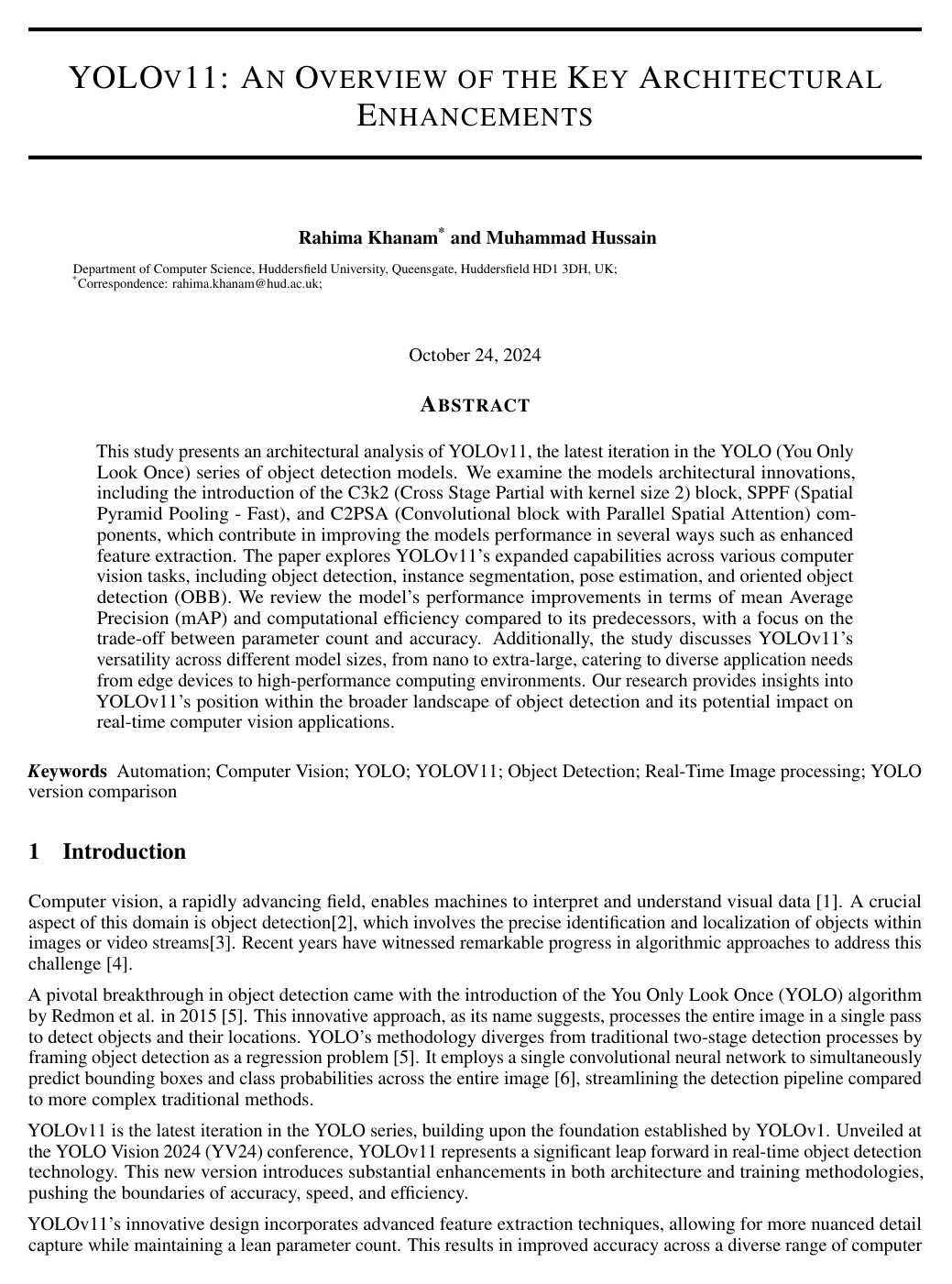
YOLOv11: An Overview of the Key Architectural Enhancements

YOLOv11: An Overview of the Key Architectural Enhancements

Rahima Khanam, Muhammad Hussain

OrganizationsUniversity of Huddersfield

Why you should read this

Presents an architectural breakdown of YOLOv11, detailing how components like C3k2 blocks and C2PSA attention mechanisms optimize feature extraction and speed-accuracy trade-offs across detection, segmentation, and pose estimation tasks.

This study presents an architectural analysis of YOLOv11, the latest iteration in the YOLO (You Only Look Once) series of object detection models. We examine the models architectural innovations, including the introduction of the C3k2 (Cross Stage Partial with kernel size 2) block, SPPF (Spatial Pyramid Pooling - Fast), and C2PSA (Convolutional block with Parallel Spatial Attention) components, which contribute in improving the models performance in several ways such as enhanced feature extraction. The paper explores YOLOv11's expanded capabilities across various computer vision tasks, including object detection, instance segmentation, pose estimation, and oriented object detection (OBB). We review the model's performance improvements in terms of mean Average Precision (mAP) and computational efficiency compared to its predecessors, with a focus on the trade-off between parameter count and accuracy. Additionally, the study discusses YOLOv11's versatility across different model sizes, from nano to extra-large, catering to diverse application needs from edge devices to high-performance computing environments. Our research provides insights into YOLOv11's position within the broader landscape of object detection and its potential impact on real-time computer vision applications.

Added

2026-09-24