
keyword
Word2Vec embeddings
Word2Vec embeddings are dense, low-dimensional numerical vector representations of words generated by shallow neural network models to capture semantic and syntactic relationships from large text corpora. Developed to model natural language efficiently, the Word2Vec framework learns continuous representations based on word co-occurrence patterns using two primary architectures: Continuous Bag-of-Words, which predicts a target word from its surrounding context, and Continuous Skip-Gram, which uses a target word to predict neighboring words. In the resulting vector space, words that appear in similar linguistic contexts are positioned geometrically close to one another, allowing vector arithmetic to preserve semantic relationships and word analogies. These representations are widely utilized as foundational, pretrained inputs in machine learning models for diverse natural language processing tasks.
2 items
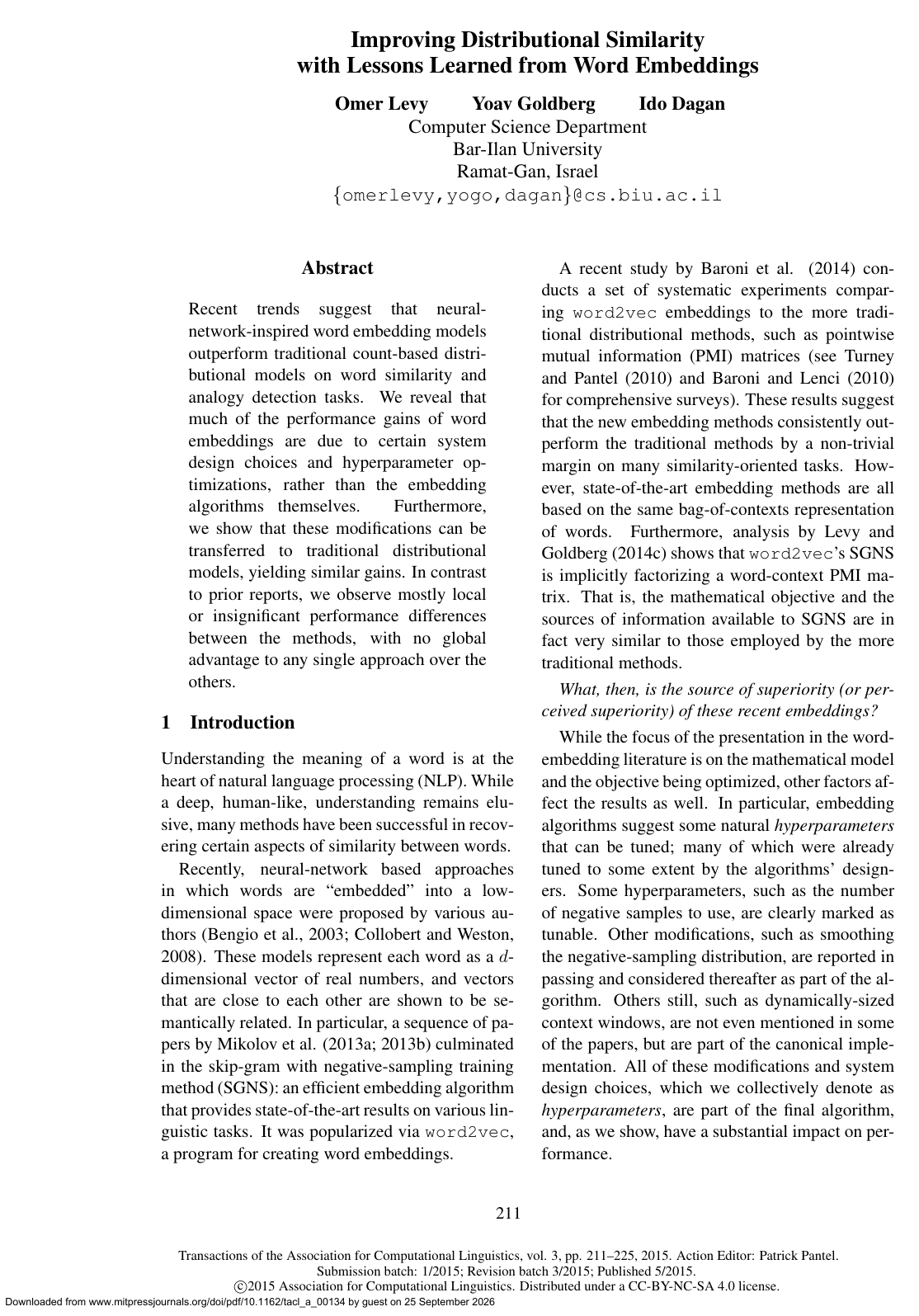
Improving Distributional Similarity with Lessons Learned from Word Embeddings
Omer Levy, Yoav Goldberg, Ido Dagan
Why you should read this
Demonstrates that the superior performance of neural word embeddings over traditional count-based models stems from hyperparameter optimizations rather than algorithmic differences, proving that applying these same tuning strategies to count-based methods eliminates the performance gap across semantic benchmarks.
Recent trends suggest that neural-network-inspired word embedding models outperform traditional count-based distributional models on word similarity and analogy detection tasks. We reveal that much of the performance gains of word embeddings are due to certain system design choices and hyperparameter optimizations, rather than the embedding algorithms themselves. Furthermore, we show that these modifications can be transferred to traditional distributional models, yielding similar gains. In contrast to prior reports, we observe mostly local or insignificant performance differences between the methods, with no global advantage to any single approach over the others.
Added
2026-09-25
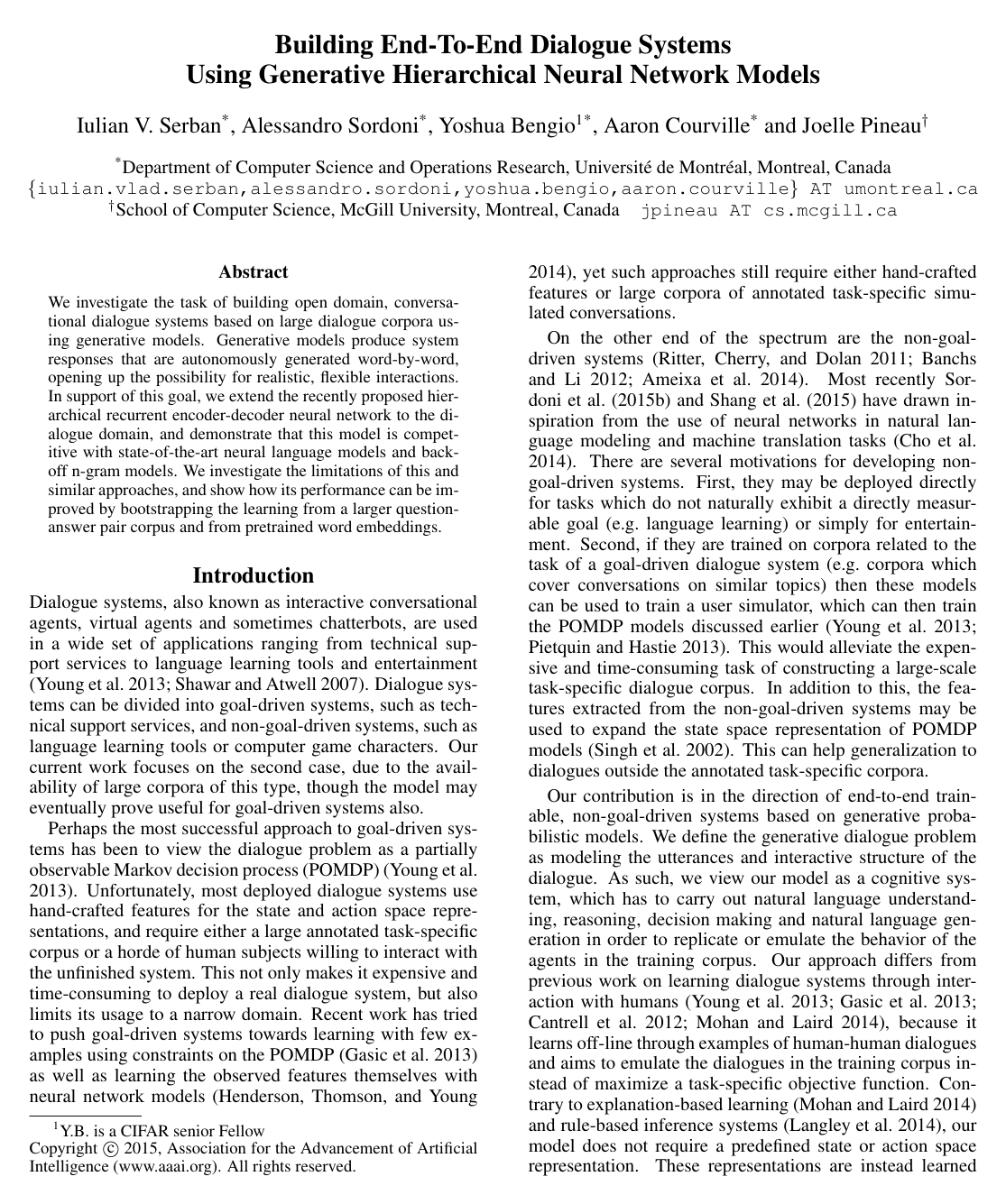
Building End-To-End Dialogue Systems Using Generative Hierarchical Neural Network Models
Iulian Serban, Alessandro Sordoni, Yoshua Bengio, Aaron C. Courville, Joelle Pineau
Why you should read this
Extends hierarchical recurrent encoder-decoder networks to conversational dialogue, providing a principled end-to-end framework for generating context-aware responses across multi-turn interactions.
We investigate the task of building open domain, conversational dialogue systems based on large dialogue corpora using generative models. Generative models produce system responses that are autonomously generated word-by-word, opening up the possibility for realistic, flexible interactions. In support of this goal, we extend the recently proposed hierarchical recurrent encoder-decoder neural network to the dialogue domain, and demonstrate that this model is competitive with state-of-the-art neural language models and back-off n-gram models. We investigate the limitations of this and similar approaches, and show how its performance can be improved by bootstrapping the learning from a larger question-answer pair corpus and from pretrained word embeddings.
Added
2026-09-19