
keyword
Word similarity measures
Word similarity measures are computational metrics used in natural language processing to determine and quantify the degree of semantic likeness or conceptual closeness between pairs of words. These measures generally fall into two primary categories: knowledge-based approaches, which assess taxonomic distance and structural relationships within curated lexical databases or ontologies, and corpus-based or distributional approaches, which evaluate statistical co-occurrences and vector proximity across large collections of text. By determining semantic closeness rather than relying solely on exact lexical matches, word similarity measures provide an essential foundation for various automated language tasks, including information retrieval, thesaurus construction, paraphrase detection, and word sense disambiguation.
2 items
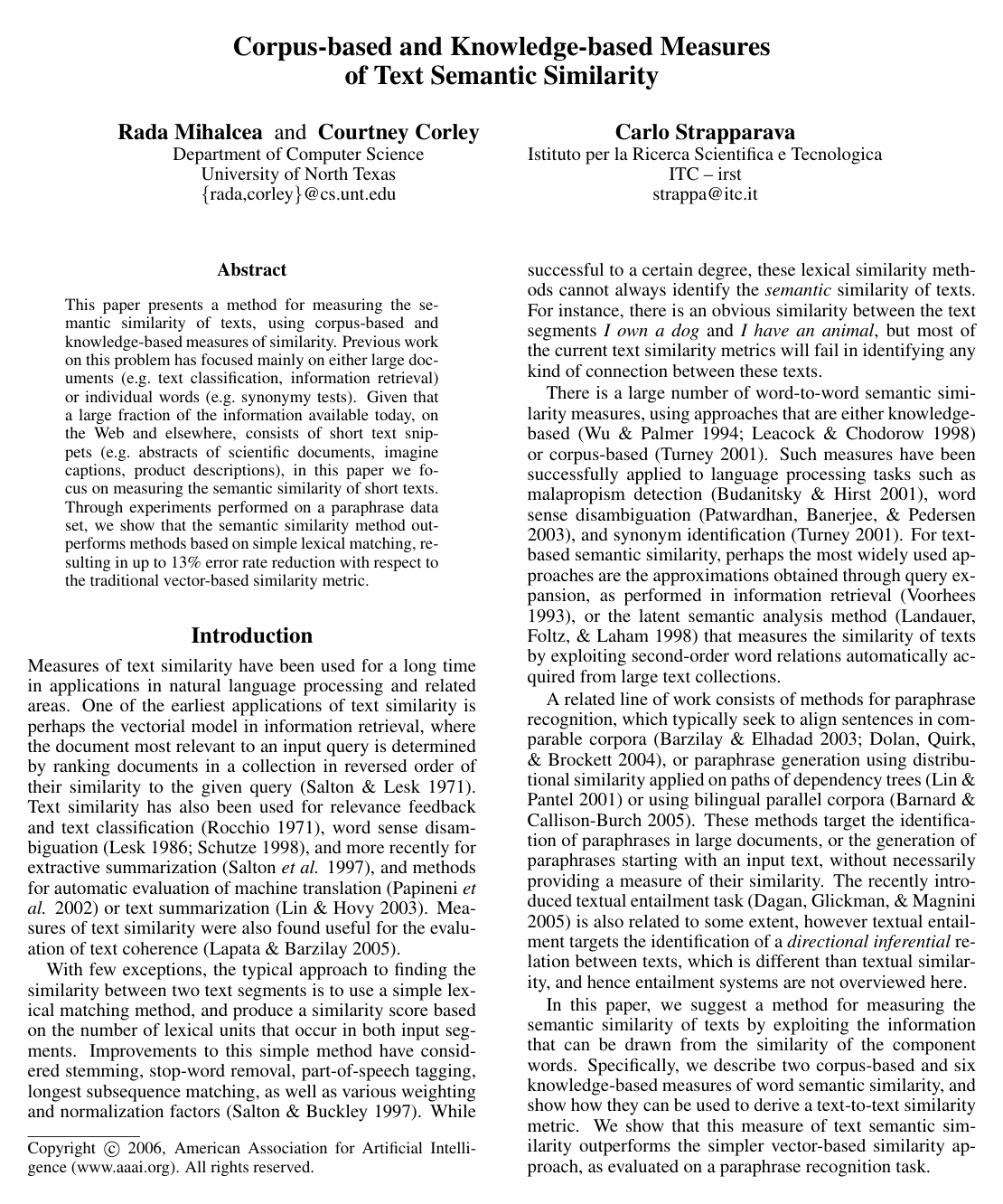
Corpus-based and Knowledge-based Measures of Text Semantic Similarity
Rada Mihalcea, Courtney Corley, Carlo Strapparava
Why you should read this
Proposes a framework for evaluating short text semantic similarity by combining word-level corpus and knowledge-based metrics with inverse document frequency weighting, significantly outperforming standard lexical and vector-space models on paraphrase recognition tasks.
This paper presents a method for measuring the semantic similarity of texts, using corpus-based and knowledge-based measures of similarity. Previous work on this problem has focused mainly on either large documents (e.g. text classification, information retrieval) or individual words (e.g. synonymy tests). Given that a large fraction of the information available today, on the Web and elsewhere, consists of short text snippets (e.g. abstracts of scientific documents, image captions, product descriptions), in this paper we focus on measuring the semantic similarity of short texts. Through experiments performed on a paraphrase data set, we show that the semantic similarity method outperforms methods based on simple lexical matching, resulting in up to 13% error rate reduction with respect to the traditional vector-based similarity metric.
Added
2026-09-25
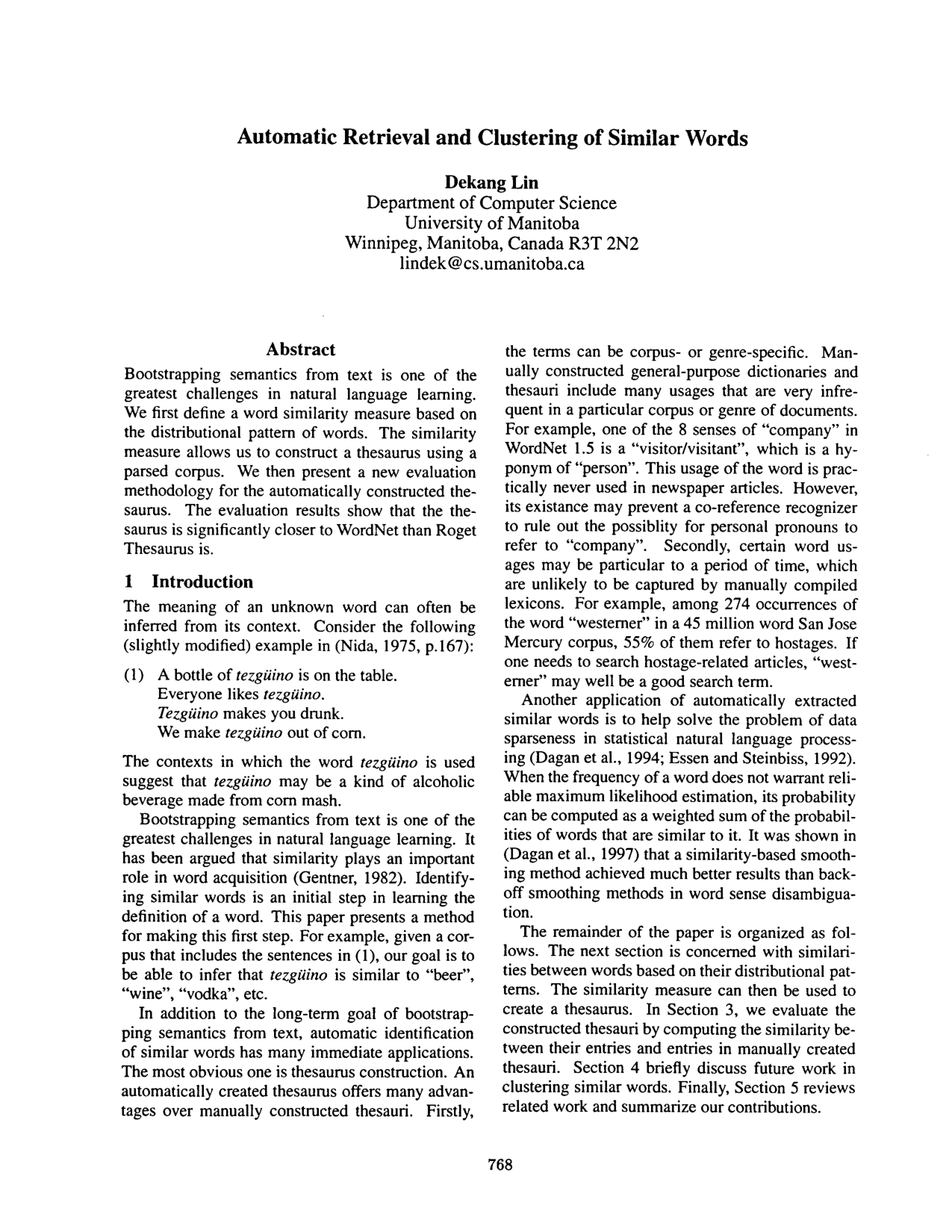
Automatic Retrieval and Clustering of Similar Words
Dekang Lin
Why you should read this
Proposes an information-theoretic distributional similarity measure based on dependency parse triples to automatically construct broad-coverage thesauri from unannotated text corpora.
Bootstrapping semantics from text is one of the greatest challenges in natural language learning. We first define a word similarity measure based on the distributional pattern of words. The similarity measure allows us to construct a thesaurus using a parsed corpus. We then present a new evaluation methodology for the automatically constructed thesaurus. The evaluation results show that the thesaurus is significantly closer to WordNet than Roget Thesaurus is.
Added
2026-09-18