
keyword
word sense disambiguation
Word sense disambiguation is a computational task in natural language processing and computational linguistics that involves identifying which specific meaning of an ambiguous or polysemous word is intended in a given context. Because many words possess multiple definitions depending on their usage, automated systems analyze surrounding words, grammatical cues, and external knowledge resources such as lexical databases, ontologies, or dictionaries to determine the correct interpretation. Approaches to resolving word senses include supervised learning on annotated text corpora, unsupervised clustering of contextual patterns, knowledge-based taxonomic algorithms, and deep neural networks utilizing contextualized language representations. Accurate disambiguation is critical for enabling computational systems to process human language effectively, serving as a foundational component for downstream applications such as machine translation, information retrieval, question answering, and semantic text analysis.
17 items
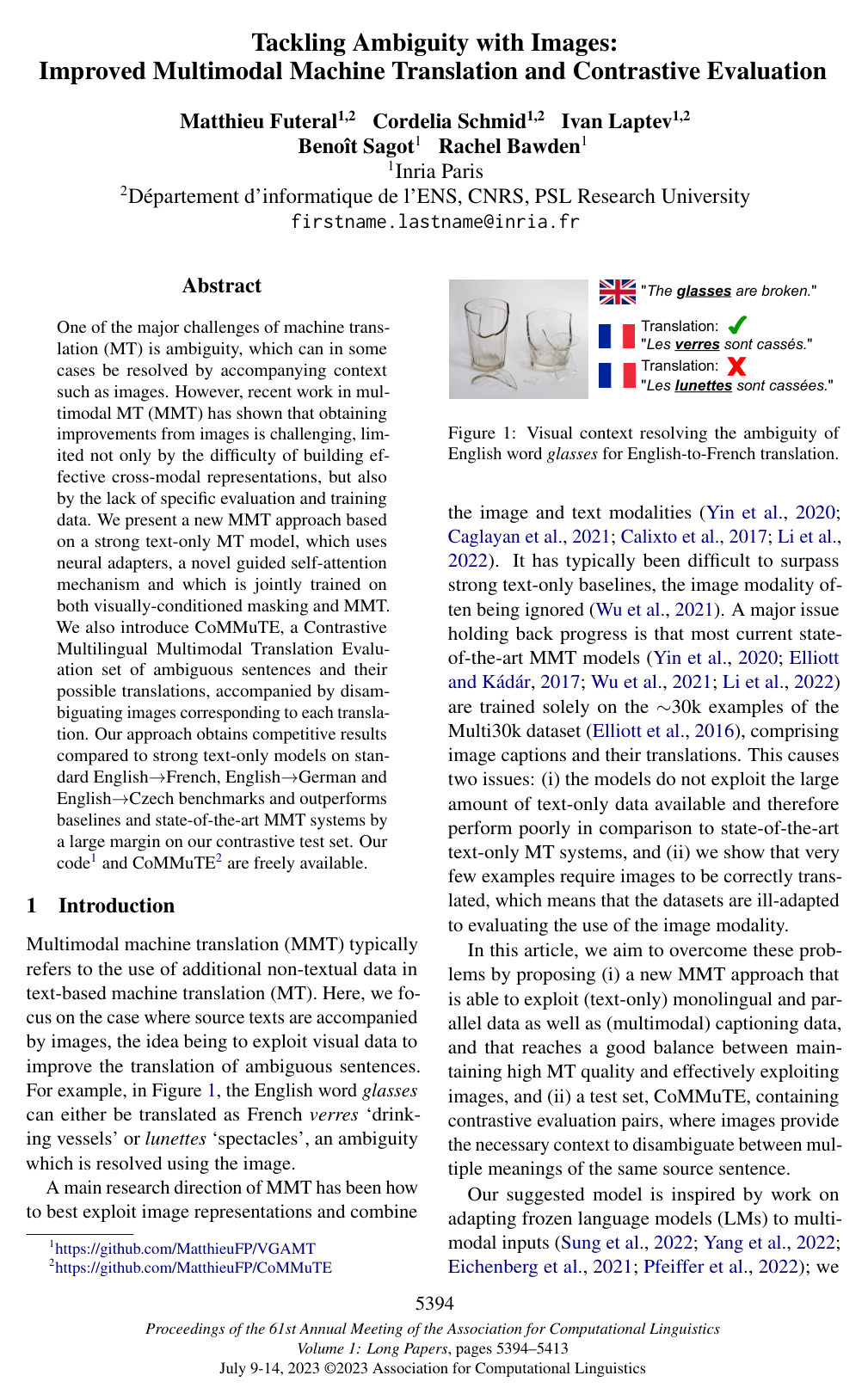
Tackling Ambiguity with Images: Improved Multimodal Machine Translation and Contrastive Evaluation
Matthieu Futeral, Cordelia Schmid, Ivan Laptev, Benoît Sagot, Rachel Bawden
Why you should read this
Proposes an adapter-based multimodal machine translation framework with guided self-attention alongside CoMMuTE, a contrastive evaluation benchmark designed to verify whether models effectively use visual context to resolve lexical ambiguity.
One of the major challenges of machine translation (MT) is ambiguity, which can in some cases be resolved by accompanying context such as images. However, recent work in multimodal MT (MMT) has shown that obtaining improvements from images is challenging, limited not only by the difficulty of building effective cross-modal representations, but also by the lack of specific evaluation and training data. We present a new MMT approach based on a strong text-only MT model, which uses neural adapters, a novel guided self-attention mechanism and which is jointly trained on both visually-conditioned masking and MMT. We also introduce CoMMuTE, a Contrastive Multilingual Multimodal Translation Evaluation set of ambiguous sentences and their possible translations, accompanied by disambiguating images corresponding to each translation. Our approach obtains competitive results compared to strong text-only models on standard English→French, English→German and English→Czech benchmarks and outperforms baselines and state-of-the-art MMT systems by a large margin on our contrastive test set. Our code¹ and CoMMuTE² are freely available.
Added
2026-10-04
Corpus-based and Knowledge-based Measures of Text Semantic Similarity
Rada Mihalcea, Courtney Corley, Carlo Strapparava
Why you should read this
Proposes a framework for evaluating short text semantic similarity by combining word-level corpus and knowledge-based metrics with inverse document frequency weighting, significantly outperforming standard lexical and vector-space models on paraphrase recognition tasks.
This paper presents a method for measuring the semantic similarity of texts, using corpus-based and knowledge-based measures of similarity. Previous work on this problem has focused mainly on either large documents (e.g. text classification, information retrieval) or individual words (e.g. synonymy tests). Given that a large fraction of the information available today, on the Web and elsewhere, consists of short text snippets (e.g. abstracts of scientific documents, image captions, product descriptions), in this paper we focus on measuring the semantic similarity of short texts. Through experiments performed on a paraphrase data set, we show that the semantic similarity method outperforms methods based on simple lexical matching, resulting in up to 13% error rate reduction with respect to the traditional vector-based similarity metric.
Added
2026-09-25
Automatic Word Sense Discrimination
Hinrich Schütze
Why you should read this
Introduces an unsupervised vector-space clustering method that automatically induces and separates word senses using second-order co-occurrence without requiring manually labeled data or external dictionaries.
This paper presents context-group discrimination, a disambiguation algorithm based on clustering. Senses are interpreted as groups (or clusters) of similar contexts of the ambiguous word. Words, contexts, and senses are represented in Word Space, a high-dimensional, real-valued space in which closeness corresponds to semantic similarity. Similarity in Word Space is based on second-order co-occurrence: two tokens (or contexts) of the ambiguous word are assigned to the same sense cluster if the words they co-occur with in turn occur with similar words in a training corpus. The algorithm is automatic and unsupervised in both training and application: senses are induced from a corpus without labeled training instances or other external knowledge sources. The paper demonstrates good performance of context-group discrimination for a sample of natural and artificial ambiguous words.
Added
2026-09-25
Natural language processing: state of the art, current trends and challenges
Diksha Khurana, Aditya C Koli, Kiran Khatter, Sukhdev Singh
Why you should read this
Presents a comprehensive historical and technical overview of natural language processing by breaking down its architectural levels, natural language generation components, modern real-world applications, and open research challenges.
Natural language processing (NLP) has recently gained much attention for representing and analysing human language computationally. It has spread its applications in various fields such as machine translation, email spam detection, information extraction, summarization, medical, and question answering etc. The paper distinguishes four phases by discussing different levels of NLP and components of Natural Language Generation (NLG) followed by presenting the history and evolution of NLP, state of the art presenting the various applications of NLP and current trends and challenges.
Added
2026-09-24
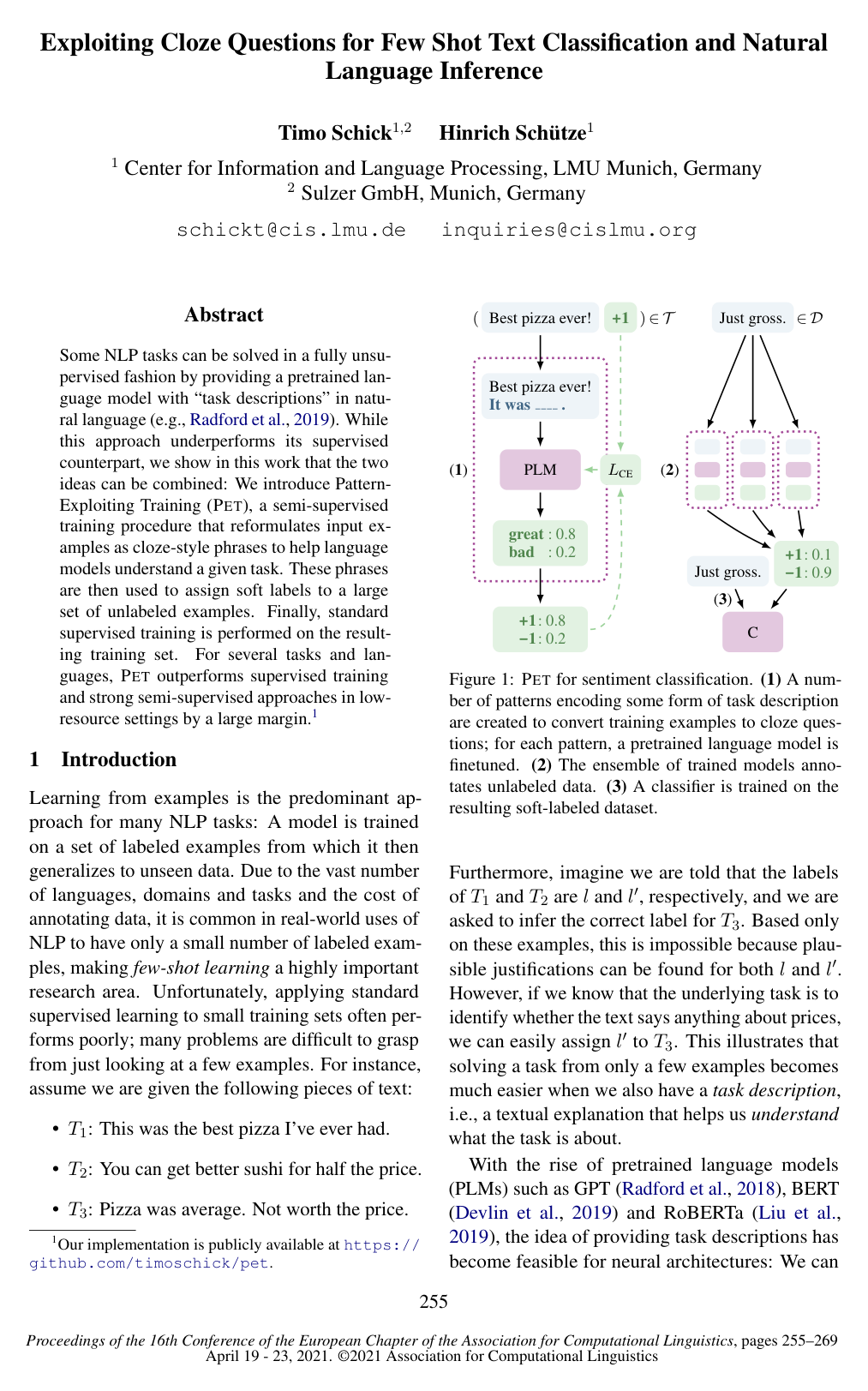
Exploiting Cloze-Questions for Few-Shot Text Classification and Natural Language Inference
Timo Schick, Hinrich Schütze
Why you should read this
Introduces Pattern-Exploiting Training (PET), a semi-supervised approach that reformulates tasks into natural-language cloze questions to significantly improve few-shot performance in text classification and natural language inference.
Some NLP tasks can be solved in a fully unsupervised fashion by providing a pretrained language model with "task descriptions" in natural language (e.g., Radford et al., 2019). While this approach underperforms its supervised counterpart, we show in this work that the two ideas can be combined: We introduce Pattern-Exploiting Training (PET), a semi-supervised training procedure that reformulates input examples as cloze-style phrases to help language models understand a given task. These phrases are then used to assign soft labels to a large set of unlabeled examples. Finally, standard supervised training is performed on the resulting training set. For several tasks and languages, PET outperforms supervised training and strong semi-supervised approaches in low-resource settings by a large margin.
Added
2026-09-18

WordNet::Similarity - Measuring the Relatedness of Concepts
Ted Pedersen, Siddharth Patwardhan, Jason Michelizzi
Why you should read this
Presents WordNet::Similarity, an open-source software package that implements nine standard semantic similarity and relatedness measures across WordNet concepts for applications in computational linguistics like word sense disambiguation.
WordNet::Similarity is a freely available software package that makes it possible to measure the semantic similarity or relatedness between a pair of concepts (or word senses). It provides six measures of similarity, and three measures of relatedness, all of which are based on the lexical database WordNet. These measures are implemented as Perl modules which take as input two concepts, and return a numeric value that represents the degree to which they are similar or related.
Added
2026-09-18
Semantic Similarity in a Taxonomy: An Information-Based Measure and its Application to Problems of Ambiguity in Natural Language
Philip Resnik
Why you should read this
Proposes an information-theoretic measure of semantic similarity that overcomes the limitations of traditional edge-counting in taxonomies and successfully resolves both syntactic and word sense ambiguities in natural language processing.
This article presents a measure of semantic similarity in an IS-A taxonomy based on the notion of shared information content. Experimental evaluation against a benchmark set of human similarity judgments demonstrates that the measure performs better than the traditional edge-counting approach. The article presents algorithms that take advantage of taxonomic similarity in resolving syntactic and semantic ambiguity, along with experimental results demonstrating their effectiveness.
Added
2026-09-15
Computing Semantic Relatedness Using Wikipedia-based Explicit Semantic Analysis
Evgeniy Gabrilovich, Shaul Markovitch
Why you should read this
Shows how Explicit Semantic Analysis turns Wikipedia concepts into interpretable text vectors and substantially improves agreement with human semantic-relatedness judgments.
Computing semantic relatedness of natural language texts requires access to vast amounts of common-sense and domain-specific world knowledge. We propose Explicit Semantic Analysis (ESA), a novel method that represents the meaning of texts in a high-dimensional space of concepts derived from Wikipedia. We use machine learning techniques to explicitly represent the meaning of any text as a weighted vector of Wikipedia-based concepts. Assessing the relatedness of texts in this space amounts to comparing the corresponding vectors using conventional metrics (e.g., cosine). Compared with the previous state of the art, using ESA results in substantial improvements in correlation of computed relatedness scores with human judgments: from r = 0.56 to 0.75 for individual words and from r = 0.60 to 0.72 for texts. Importantly, due to the use of natural concepts, the ESA model is easy to explain to human users.
Added
2026-09-14
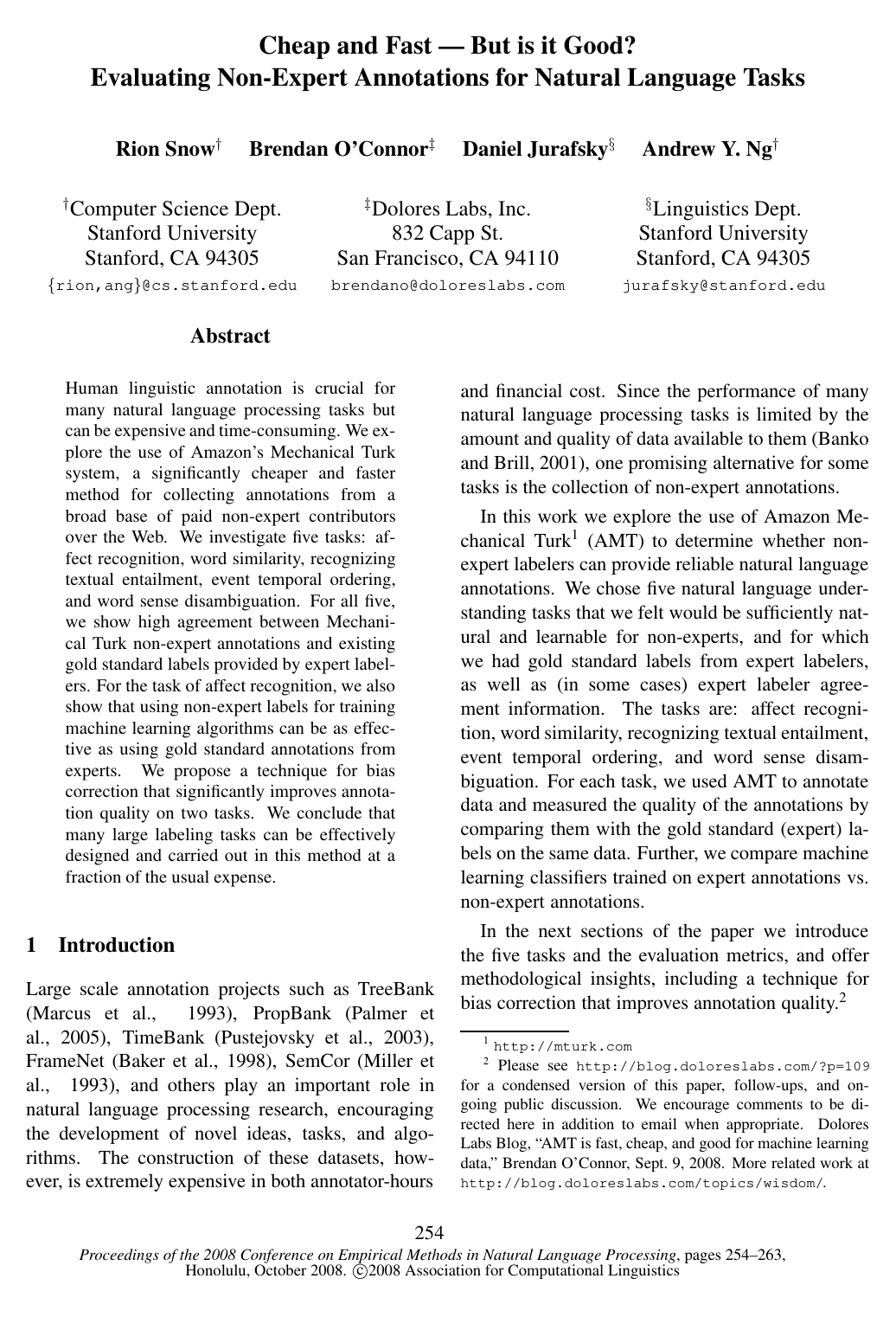
Cheap and Fast – But is it Good? Evaluating Non-Expert Annotations for Natural Language Tasks
Rion Snow, Brendan O'Connor, Daniel Jurafsky, Andrew Y. Ng
Why you should read this
Demonstrates that carefully designed non-expert crowdsourcing can produce reliable NLP labels at a fraction of expert annotation cost.
Human linguistic annotation is crucial for many natural language processing tasks but can be expensive and time-consuming. We explore the use of Amazon’s Mechanical Turk system, a significantly cheaper and faster method for collecting annotations from a broad base of paid non-expert contributors over the Web. We investigate five tasks: affect recognition, word similarity, recognizing textual entailment, event temporal ordering, and word sense disambiguation. For all five, we show high agreement between Mechanical Turk non-expert annotations and existing gold standard labels provided by expert labelers. For the task of affect recognition, we also show that using non-expert labels for training machine learning algorithms can be as effective as using gold standard annotations from experts. We propose a technique for bias correction that significantly improves annotation quality on two tasks. We conclude that many large labeling tasks can be effectively designed and carried out in this method at a fraction of the usual expense.
Added
2026-09-14
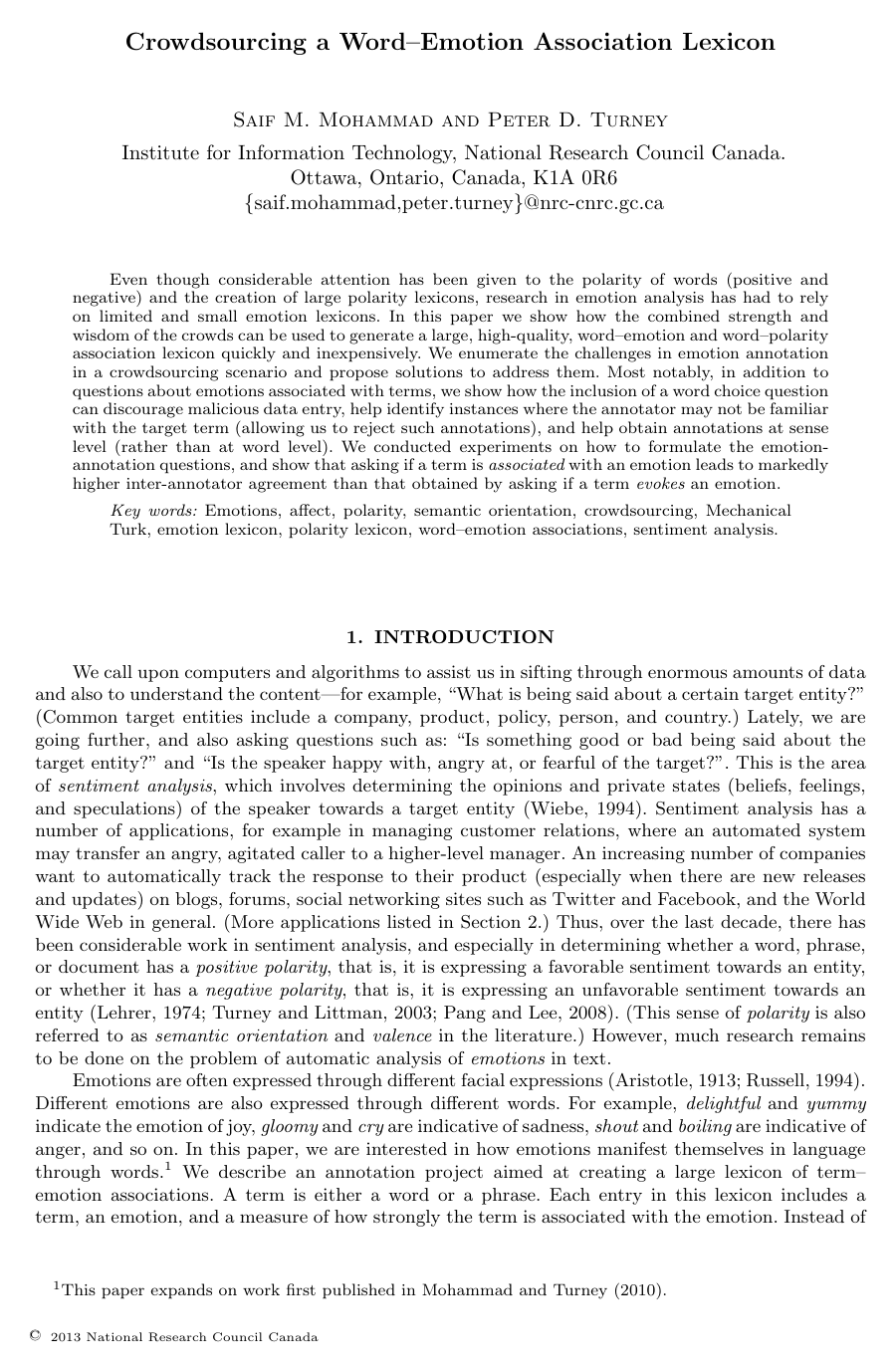
CROWDSOURCING A WORD–EMOTION ASSOCIATION LEXICON
Saif M. Mohammad, Peter D. Turney
Why you should read this
Presents a practical crowdsourcing methodology for constructing large-scale word-emotion lexicons, proving that sense-verification questions and association-based framing substantially increase annotation quality and inter-annotator agreement.
Even though considerable attention has been given to the polarity of words (positive and negative) and the creation of large polarity lexicons, research in emotion analysis has had to rely on limited and small emotion lexicons. In this paper we show how the combined strength and wisdom of the crowds can be used to generate a large, high-quality, word-emotion and word-polarity association lexicon quickly and inexpensively. We enumerate the challenges in emotion annotation in a crowdsourcing scenario and propose solutions to address them. Most notably, in addition to questions about emotions associated with terms, we show how the inclusion of a word choice question can discourage malicious data entry, help identify instances where the annotator may not be familiar with the target term (allowing us to reject such annotations), and help obtain annotations at sense level (rather than at word level). We conducted experiments on how to formulate the emotion-annotation questions, and show that asking if a term is associated with an emotion leads to markedly higher inter-annotator agreement than that obtained by asking if a term evokes an emotion.
Added
2026-09-14
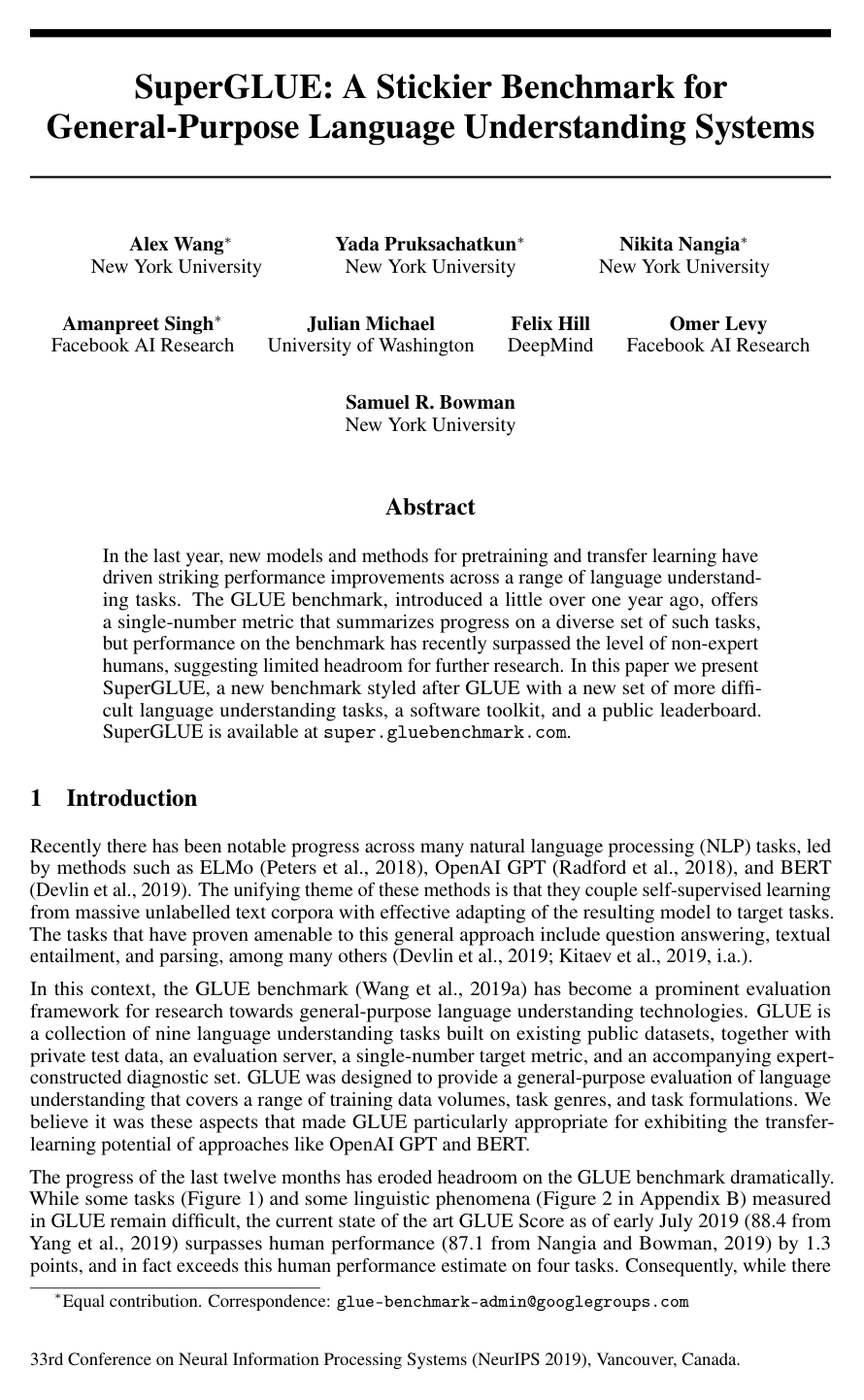
SuperGLUE: A Stickier Benchmark for General-Purpose Language Understanding Systems
Alex Wang, Yada Pruksachatkun, Nikita Nangia, Amanpreet Singh, Julian Michael, Felix Hill, Omer Levy, Samuel R. Bowman
Why you should read this
Presents SuperGLUE, a demanding language understanding benchmark built with harder tasks to drive progress after models surpassed human performance on GLUE.
In the last year, new models and methods for pretraining and transfer learning have driven striking performance improvements across a range of language understanding tasks. The GLUE benchmark, introduced a little over one year ago, offers a single-number metric that summarizes progress on a diverse set of such tasks, but performance on the benchmark has recently surpassed the level of non-expert humans, suggesting limited headroom for further research. In this paper we present SuperGLUE, a new benchmark styled after GLUE with a new set of more difficult language understanding tasks, a software toolkit, and a public leaderboard. SuperGLUE is available at this http URL.
Added
2026-09-14
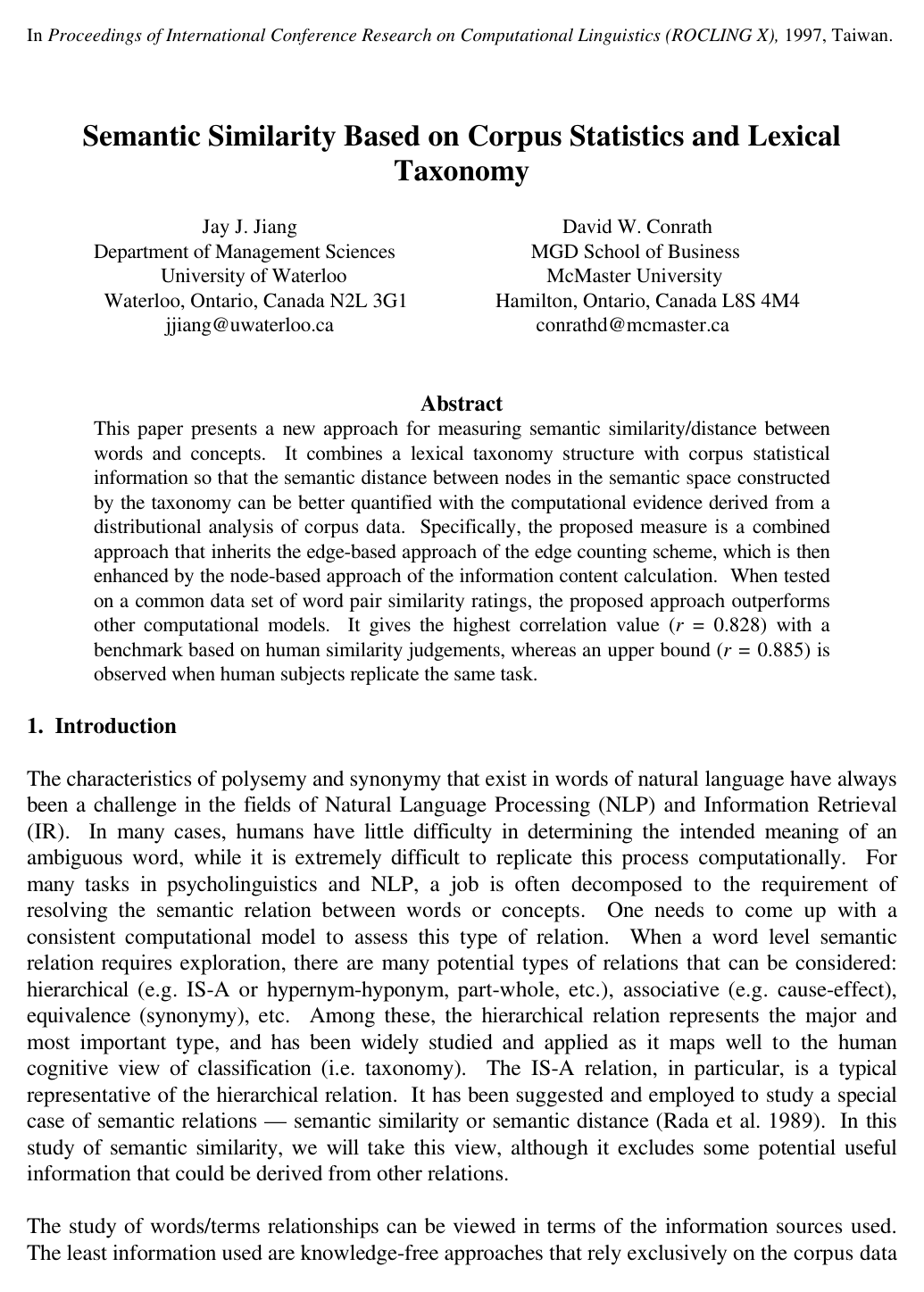
Semantic Similarity Based on Corpus Statistics and Lexical Taxonomy
Jay J. Jiang, David W. Conrath
Why you should read this
Proposes a hybrid semantic similarity measure that integrates lexical taxonomy structure with corpus-derived information content, achieving near-human correlation on standard word-pair similarity benchmarks.
This paper presents a new approach for measuring semantic similarity/distance between words and concepts. It combines a lexical taxonomy structure with corpus statistical information so that the semantic distance between nodes in the semantic space constructed by the taxonomy can be better quantified with the computational evidence derived from a distributional analysis of corpus data. Specifically, the proposed measure is a combined approach that inherits the edge-based approach of the edge counting scheme, which is then enhanced by the node-based approach of the information content calculation. When tested on a common data set of word pair similarity ratings, the proposed approach outperforms other computational models. It gives the highest correlation value (r = 0.828) with a benchmark based on human similarity judgements, whereas an upper bound (r = 0.885) is observed when human subjects replicate the same task.
Added
2026-09-11
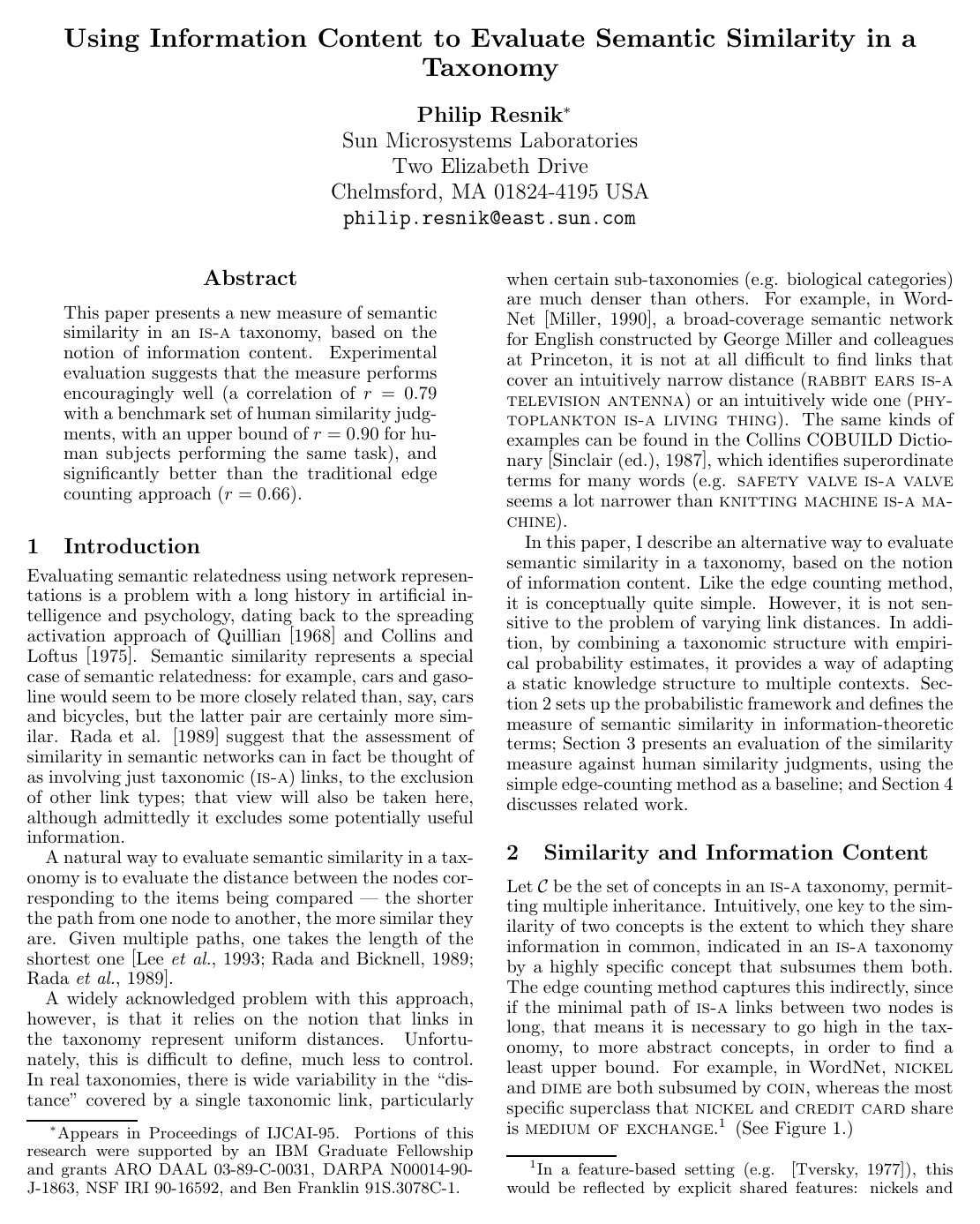
Using Information Content to Evaluate Semantic Similarity in a Taxonomy
Philip Resnik
Why you should read this
Introduces an information-theoretic approach to measuring semantic similarity in concept taxonomies, demonstrating that probability-weighted shared content predicts human judgments far more accurately than standard edge-counting methods.
This paper presents a new measure of semantic similarity in an IS-A taxonomy, based on the notion of information content. Experimental evaluation suggests that the measure performs encouragingly well (a correlation of r = 0.79 with a benchmark set of human similarity judgments, with an upper bound of r = 0.90 for human subjects performing the same task), and significantly better than the traditional edge counting approach (r = 0.66).
Added
2026-09-11
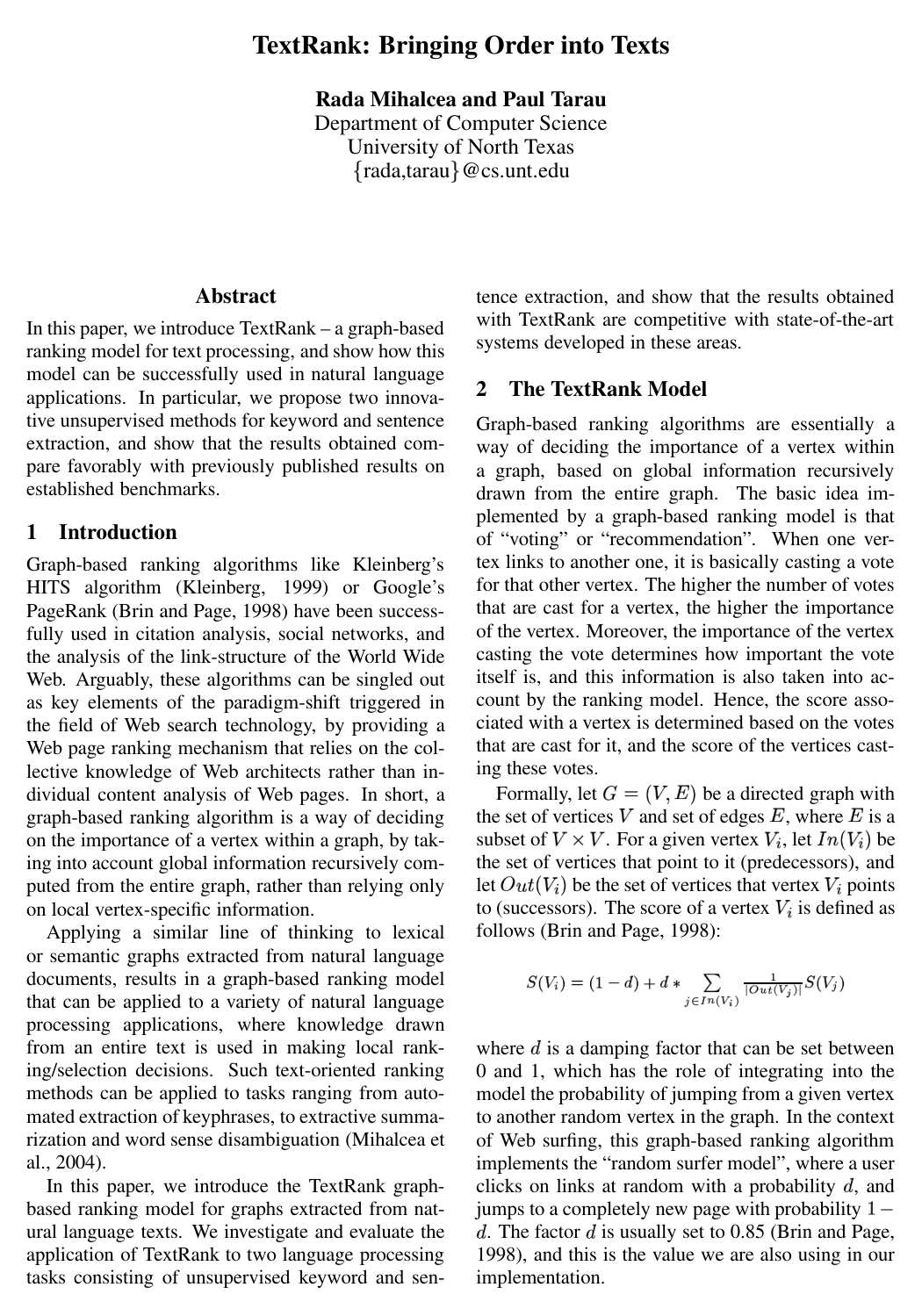
TextRank: Bringing Order into Text
Rada Mihalcea, Paul Tarau
Why you should read this
Introduces TextRank, a graph-based ranking algorithm that adapts PageRank to natural language processing, enabling unsupervised keyword extraction and extractive sentence summarization that match supervised baselines without requiring annotated training data.
In this paper, we introduce TextRank – a graph-based ranking model for text processing, and show how this model can be successfully used in natural language applications. In particular, we propose two innovative unsupervised methods for keyword and sentence extraction, and show that the results obtained compare favorably with previously published results on established benchmarks.
Added
2026-09-11
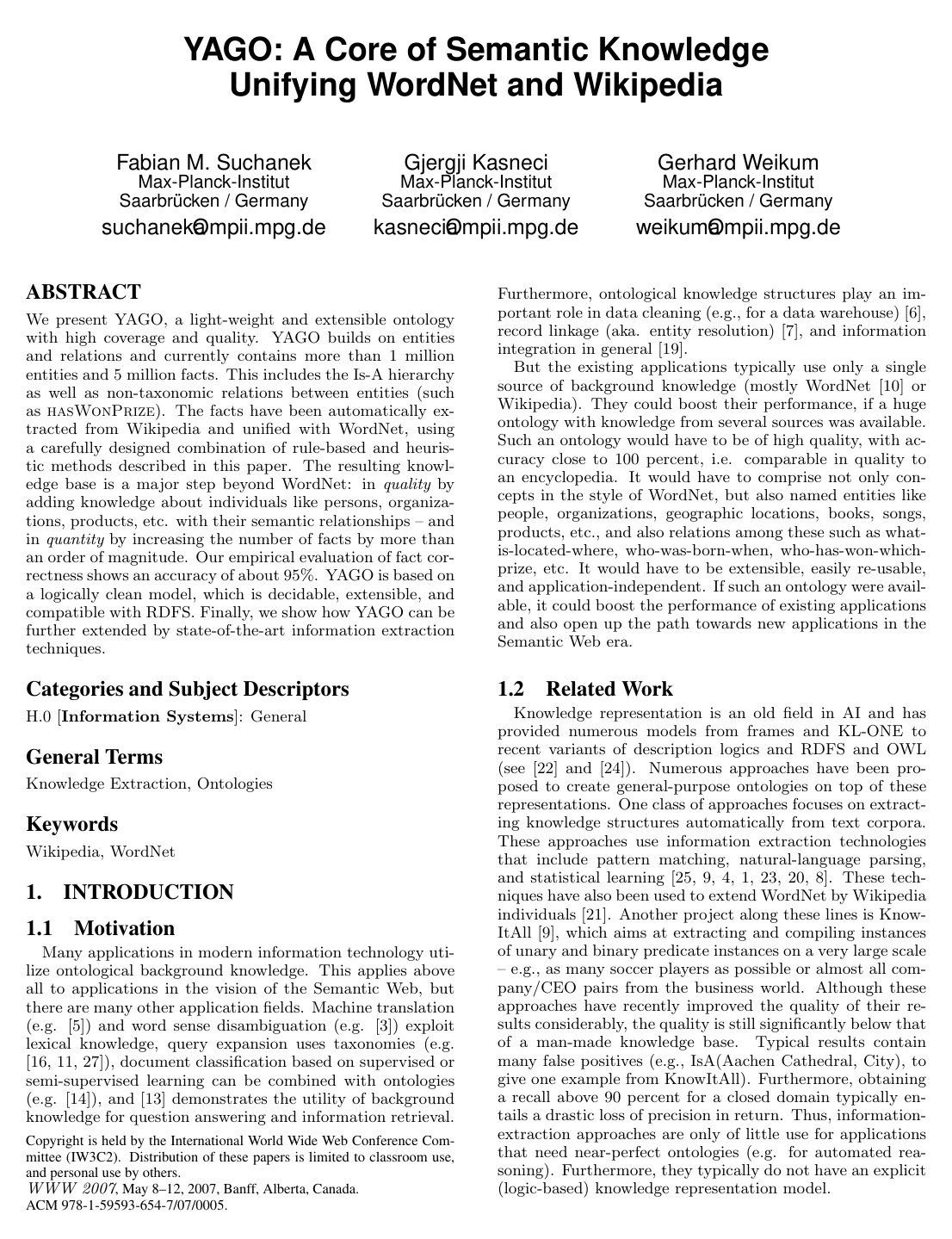
YAGO: A Core of Semantic Knowledge Unifying WordNet and Wikipedia
Fabian M. Suchanek, Gjergji Kasneci, Gerhard Weikum
Why you should read this
Presents YAGO, a semantic knowledge base that unifies Wikipedia's vast entity data with WordNet's taxonomic hierarchy to construct a logically clean, RDFS-compatible ontology of millions of facts with 95% accuracy.
We present YAGO, a light-weight and extensible ontology with high coverage and quality. YAGO builds on entities and relations and currently contains more than 1 million entities and 5 million facts. This includes the Is-A hierarchy as well as non-taxonomic relations between entities (such as HASWONPRIZE). The facts have been automatically extracted from Wikipedia and unified with WordNet, using a carefully designed combination of rule-based and heuristic methods described in this paper. The resulting knowledge base is a major step beyond WordNet: in quality by adding knowledge about individuals like persons, organizations, products, etc. with their semantic relationships – and in quantity by increasing the number of facts by more than an order of magnitude. Our empirical evaluation of fact correctness shows an accuracy of about 95%. YAGO is based on a logically clean model, which is decidable, extensible, and compatible with RDFS. Finally, we show how YAGO can be further extended by state-of-the-art information extraction techniques.
Added
2026-09-10
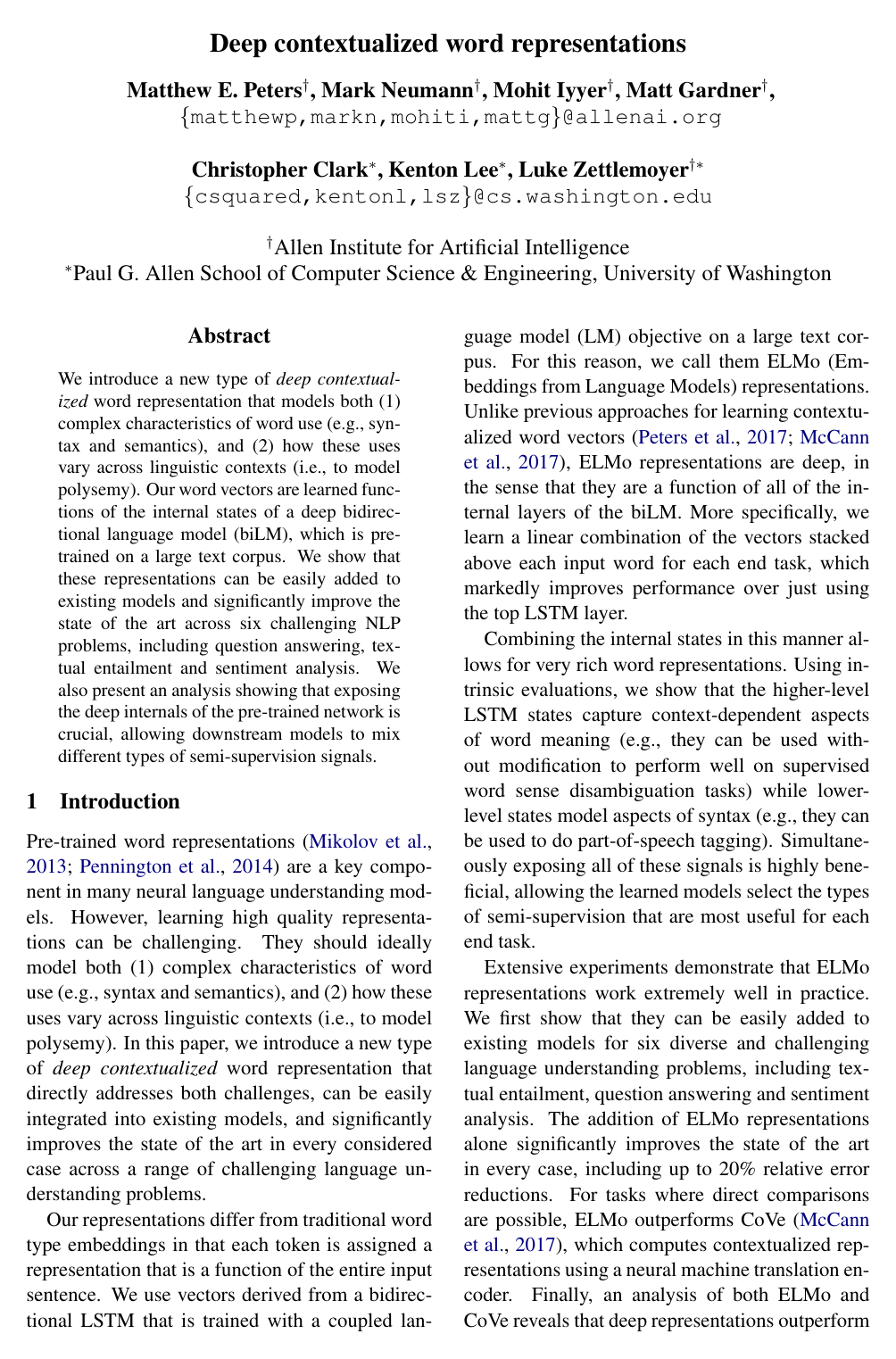
Deep contextualized word representations
Matthew E. Peters, Mark Neumann, Mohit Iyyer, Matt Gardner, Christopher Clark, Kenton Lee, Luke Zettlemoyer
Why you should read this
Introduces ELMo, a deep contextualized word representation that leverages the internal states of a bidirectional language model to capture polysemy and complex linguistic patterns, establishing new state-of-the-art performance across six major natural language understanding benchmarks.
Abstract:We introduce a new type of deep contextualized word representation that models both (1) complex characteristics of word use (e.g., syntax and semantics), and (2) how these uses vary across linguistic contexts (i.e., to model polysemy). Our word vectors are learned functions of the internal states of a deep bidirectional language model (biLM), which is pre-trained on a large text corpus. We show that these representations can be easily added to existing models and significantly improve the state of the art across six challenging NLP problems, including question answering, textual entailment and sentiment analysis. We also present an analysis showing that exposing the deep internals of the pre-trained network is crucial, allowing downstream models to mix different types of semi-supervision signals.
Added
2026-05-27
From Frequency to Meaning: Vector Space Models of Semantics
Peter D. Turney, Patrick Pantel
Why you should read this
Systematizes the field of vector space models for semantics through a matrix-based taxonomy, providing a comprehensive guide to the mathematical foundations and linguistic applications that transform raw word frequencies into meaningful semantic representations.
Computers understand very little of the meaning of human language. This profoundly limits our ability to give instructions to computers, the ability of computers to explain their actions to us, and the ability of computers to analyse and process text. Vector space models (VSMs) of semantics are beginning to address these limits. This paper surveys the use of VSMs for semantic processing of text. We organize the literature on VSMs according to the structure of the matrix in a VSM. There are currently three broad classes of VSMs, based on term-document, word-context, and pair-pattern matrices, yielding three classes of applications. We survey a broad range of applications in these three categories and we take a detailed look at a specific open source project in each category. Our goal in this survey is to show the breadth of applications of VSMs for semantics, to provide a new perspective on VSMs for those who are already familiar with the area, and to provide pointers into the literature for those who are less familiar with the field.
Added
2026-02-21