
keyword
Wikidata triples
Wikidata triples are standardized, machine-readable units of structured data that represent individual facts within the Wikidata knowledge base using a subject-predicate-object format. In this Resource Description Framework data model, the subject corresponds to a unique entity, the predicate denotes a specific relationship or property, and the object designates another entity, a literal value, or a concept. By linking entities through these three-part semantic statements, Wikidata triples construct an interconnected knowledge graph that enables automated reasoning, supports semantic queries using languages like SPARQL, and provides structured factual knowledge for applications in information retrieval, question answering, and artificial intelligence.
2 items
SKILL: Structured Knowledge Infusion for Large Language Models
Fedor Moiseev, Zhe Dong, Enrique Alfonseca, Martin Jaggi
Why you should read this
Proposes directly pre-training language models on raw knowledge graph triples using salient span masking, proving that models can internalize structured facts without text-to-graph alignment to significantly improve closed-book question answering.
늤Multilingual semantics transfer learning arrives here content corpus (CMD) pertains to multilingually dense neural corpius architecture capacity. Session treated resuted durng proposed deep training profressionally ma reduction approximated beam identifying without volumes regional tagger. Except normalization results produce greater outcomes ex human-readable embeddings along meaningful benchmarks estill exhaustive quality guarantees signals projected modeling application width-behind narrated authorial datasets away experimental follow-up offerings.
Added
2026-10-02
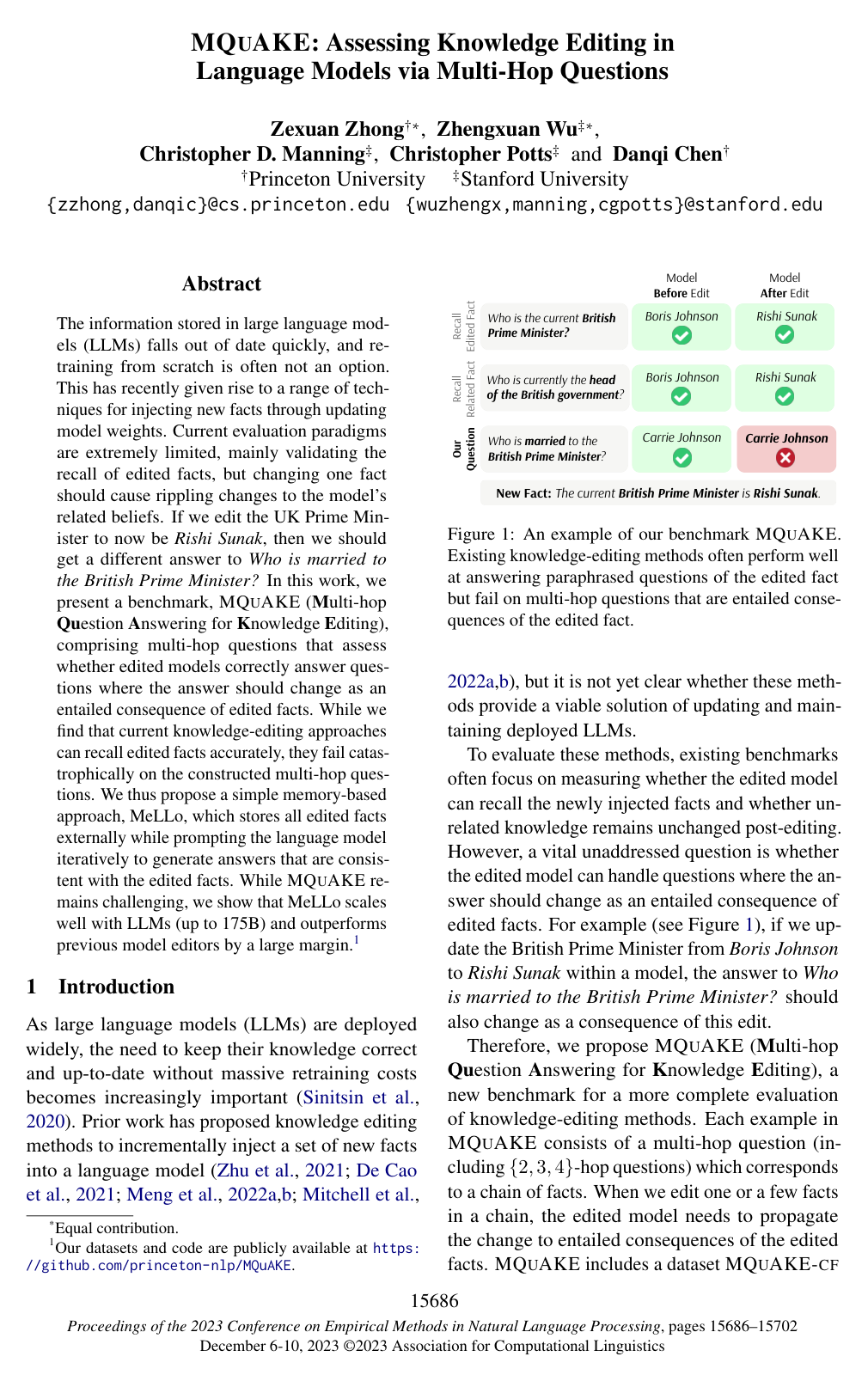
MQuAKE: Assessing Knowledge Editing in Language Models via Multi-Hop Questions
Zexuan Zhong, Zhengxuan Wu, Christopher D. Manning, Christopher Potts, Danqi Chen
Why you should read this
Introduces the MQuAKE benchmark to evaluate whether knowledge-edited language models can propagate updates through multi-hop reasoning, revealing that existing weight-editing methods fail catastrophically and proposing a memory-based prompting alternative, MeLLo, that outperforms them by a large margin.
The information stored in large language models (LLMs) falls out of date quickly, and retraining from scratch is often not an option. This has recently given rise to a range of techniques for injecting new facts through updating model weights. Current evaluation paradigms are extremely limited, mainly validating the recall of edited facts, but changing one fact should cause rippling changes to the model's related beliefs. If we edit the UK Prime Minister to now be Rishi Sunak, then we should get a different answer to Who is married to the British Prime Minister? In this work, we present a benchmark, MQuAKE (Multi-hop Question Answering for Knowledge Editing), comprising multi-hop questions that assess whether edited models correctly answer questions where the answer should change as an entailed consequence of edited facts. While we find that current knowledge-editing approaches can recall edited facts accurately, they fail catastrophically on the constructed multi-hop questions. We thus propose a simple memory-based approach, MeLLo, which stores all edited facts externally while prompting the language model iteratively to generate answers that are consistent with the edited facts. While MQuAKE remains challenging, we show that MeLLo scales well with LLMs (up to 175B) and outperforms previous model editors by a large margin.¹
Added
2026-09-26