
keyword
watermark detection
Watermark detection is the computational process of identifying, verifying, or decoding an intentionally embedded, imperceptible signal within digital content or model outputs to determine its origin, ownership, or authenticity. In the context of artificial intelligence and machine learning, it involves analyzing digital artifacts such as synthetic text, code, or images using statistical tests, specialized decoding algorithms, or secret cryptographic keys to establish whether the material was produced by a specific generative model. The detector evaluates whether observed patterns, token probability distributions, or subtle feature variations deviate significantly from natural or unwatermarked baselines. This capability enables copyright protection, safeguards intellectual property against unauthorized model extraction or distillation, and helps audit machine-generated content, maintaining detection reliability even after the content undergoes downstream modifications such as editing, compression, or paraphrasing.
7 items
WMAdapter: Adding WaterMark Control to Latent Diffusion Models
Hai Ci, Yiren Song, Pei Yang, Jinheng Xie, Mike Zheng Shou
Why you should read this
Proposes a lightweight plug-in architecture for latent diffusion models that embeds user-specified watermarks during generation without altering base model parameters, eliminating visual artifacts while maintaining high bit retrieval accuracy.
Watermarking is essential for protecting the copyright of AI-generated images. We propose WMAdapter, a diffusion model watermark plugin that embeds user-specified watermark information seamlessly during the diffusion generation process. Unlike previous methods that modify diffusion modules to incorporate watermarks, WMAdapter is designed to keep all diffusion components intact, resulting in sharp, artifact-free images. To achieve this, we introduce two key innovations: (1) We develop a contextual adapter that conditions on the content of the cover image to generate adaptive watermark embeddings. (2) We implement an additional finetuning step and a hybrid finetuning strategy that suppresses noticeable artifacts while preserving the integrity of the diffusion components. Empirical results show that WMAdapter provides strong flexibility, superior image quality, and competitive watermark robustness. Code: https://github.com/showlab/WMAdapter
Added
2026-10-05
A Resilient and Accessible Distribution-Preserving Watermark for Large Language Models
Yihan Wu, Zhengmian Hu, Junfeng Guo, Hongyang Zhang, Heng Huang
Why you should read this
Proposes DiPmark, a language model watermarking framework that maintains the original text generation distribution without quality loss while remaining provably resilient to text modifications and detectable without requiring model API or prompt access.
Watermarking techniques offer a promising way to identify machine-generated content via embedding covert information into the contents generated from language models. A challenge in the domain lies in preserving the distribution of original generated content after watermarking. Our research extends and improves upon existing watermarking framework, placing emphasis on the importance of a Distribution-Preserving (DiP) watermark. Contrary to the current strategies, our proposed DiPmark simultaneously preserves the original token distribution during watermarking (distribution-preserving), is detectable without access to the language model API and prompts (accessible), and is provably robust to moderate changes of tokens (resilient). DiPmark operates by selecting a random set of tokens prior to the generation of a word, then modifying the token distribution through a distribution-preserving reweight function to enhance the probability of these selected tokens during the sampling process. Extensive empirical evaluation on various language models and tasks demonstrates our approach’s distribution-preserving property, accessibility, and resilience, making it a effective solution for watermarking tasks that demand impeccable quality preservation. Code is available at¹.
Added
2026-10-04
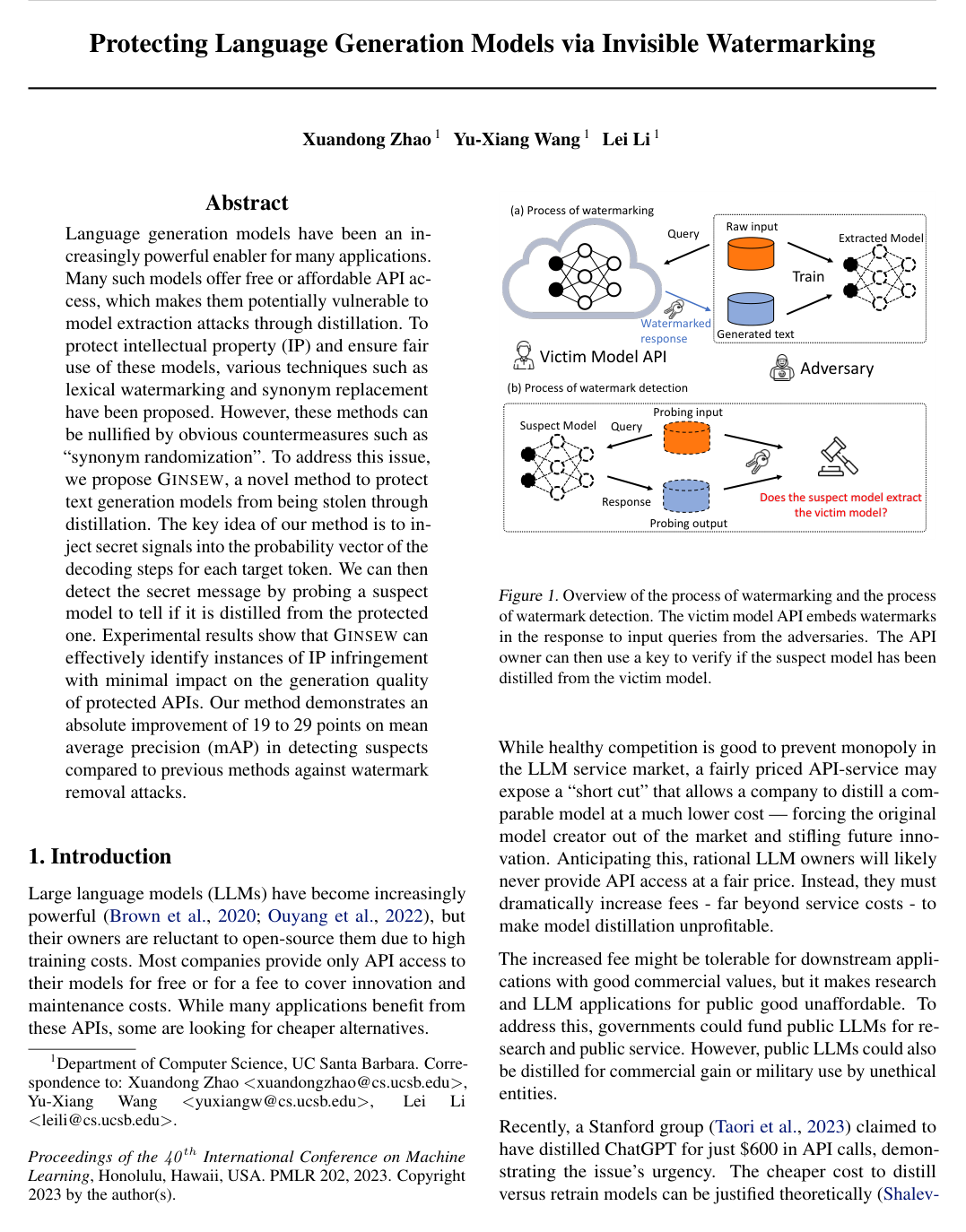
Protecting Language Generation Models via Invisible Watermarking
Xuandong Zhao, Yu-Xiang Wang, Lei Li
Why you should read this
Proposes an invisible watermarking framework, GINSEW, that embeds secret sinusoidal frequency signals directly into output probability distributions during decoding to reliably detect model extraction and distillation attacks without degrading text quality.
Language generation models have been an increasingly powerful enabler for many applications. Many such models offer free or affordable API access, which makes them potentially vulnerable to model extraction attacks through distillation. To protect intellectual property (IP) and ensure fair use of these models, various techniques such as lexical watermarking and synonym replacement have been proposed. However, these methods can be nullified by obvious countermeasures such as “synonym randomization”. To address this issue, we propose GINSEW, a novel method to protect text generation models from being stolen through distillation. The key idea of our method is to inject secret signals into the probability vector of the decoding steps for each target token. We can then detect the secret message by probing a suspect model to tell if it is distilled from the protected one. Experimental results show that GINSEW can effectively identify instances of IP infringement with minimal impact on the generation quality of protected APIs. Our method demonstrates an absolute improvement of 19 to 29 points on mean average precision (mAP) in detecting suspects compared to previous methods against watermark removal attacks.
Added
2026-10-01
SemStamp: A Semantic Watermark with Paraphrastic Robustness for Text Generation
Abe Bohan Hou, Jingyu Zhang, Tianxing He, Yichen Wang, Yung-Sung Chuang, Hongwei Wang, Lingfeng Shen, Benjamin Van Durme, Daniel Khashabi, Yulia Tsvetkov
Why you should read this
Proposes a sentence-level text watermarking framework that embeds signals into semantic embedding spaces using locality-sensitive hashing and rejection sampling, ensuring machine-generated text remains detectable even after heavy paraphrasing.
Existing watermarked generation algorithms employ token-level designs and therefore, are vulnerable to paraphrase attacks. To address this issue, we introduce watermarking on the semantic representation of sentences. We propose SemStamp, a robust sentence-level semantic watermarking algorithm that uses locality-sensitive hashing (LSH) to partition the semantic space of sentences. The algorithm encodes and LSH-hashes a candidate sentence generated by a language model, and conducts rejection sampling until the sampled sentence falls in watermarked partitions in the semantic embedding space. To test the paraphrastic robustness of watermarking algorithms, we propose a “bigram paraphrase” attack that produces paraphrases with small bigram overlap with the original sentence. This attack is shown to be effective against existing token-level watermark algorithms, while posing only minor degradations to SemStamp. Experimental results show that our novel semantic watermark algorithm is not only more robust than the previous state-of-the-art method on various paraphrasers and domains, but also better at preserving the quality of generation.
Added
2026-10-01
Who Wrote this Code? Watermarking for Code Generation
Taehyun Lee, Seokhee Hong, Jaewoo Ahn, Ilgee Hong, Hwaran Lee, Sangdoo Yun, Jamin Shin, Gunhee Kim
Why you should read this
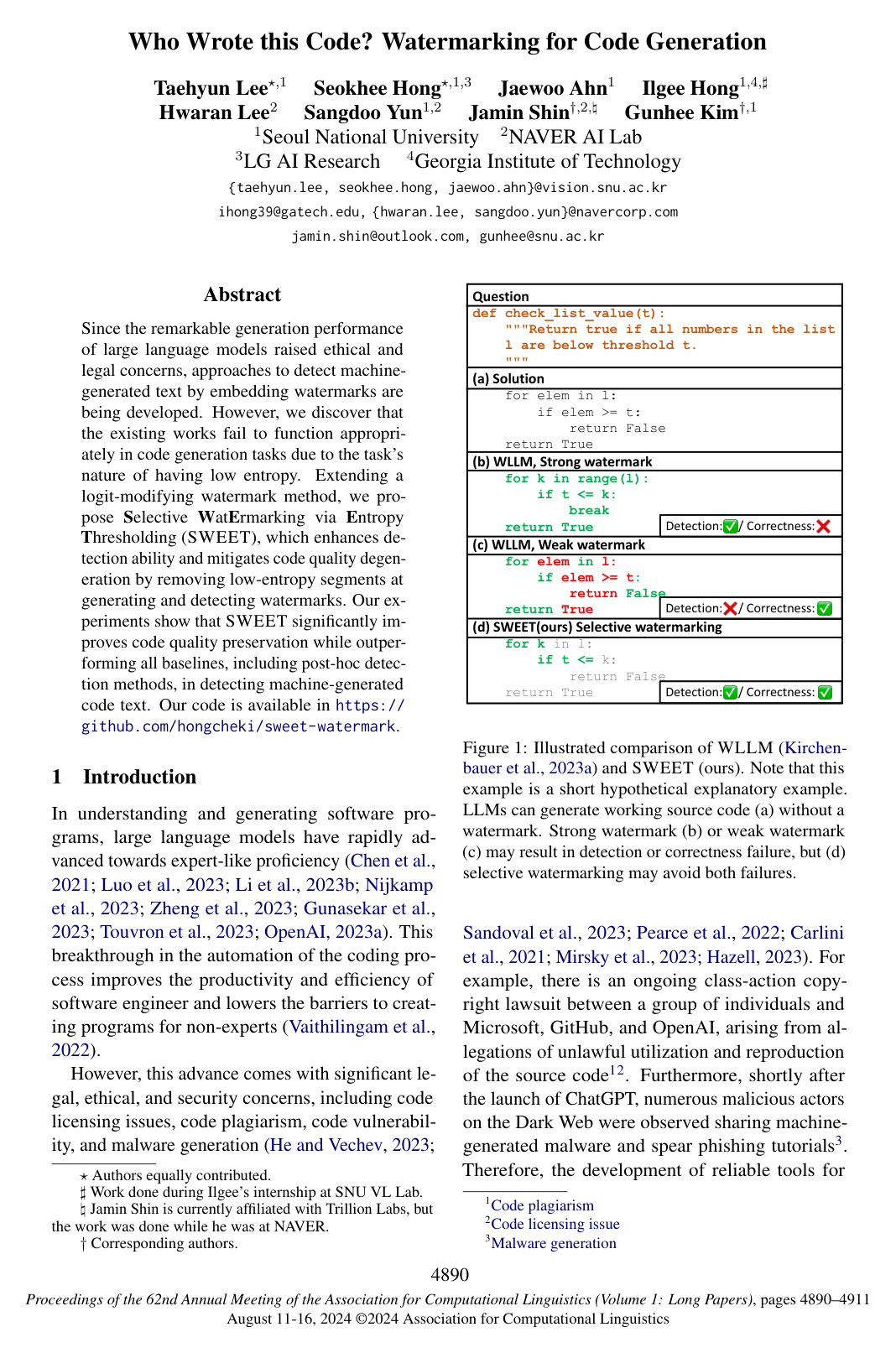
Proposes an entropy-thresholded watermarking technique that selectively embeds signals only in high-entropy tokens, enabling reliable detection of machine-generated code without corrupting program correctness.
Since the remarkable generation performance of large language models raised ethical and legal concerns, approaches to detect machine-generated text by embedding watermarks are being developed. However, we discover that the existing works fail to function appropriately in code generation tasks due to the task’s nature of having low entropy. Extending a logit-modifying watermark method, we propose Selective WatErmarking via Entropy Thresholding (SWEET), which enhances detection ability and mitigates code quality degeneration by removing low-entropy segments at generating and detecting watermarks. Our experiments show that SWEET significantly improves code quality preservation while outperforming all baselines, including post-hoc detection methods, in detecting machine-generated code text. Our code is available in https://github.com/hongcheki/sweet-watermark.
Added
2026-09-26
Watermark Stealing in Large Language Models
Nikola Jovanovic, Robin Staab, Martin T. Vechev
Why you should read this
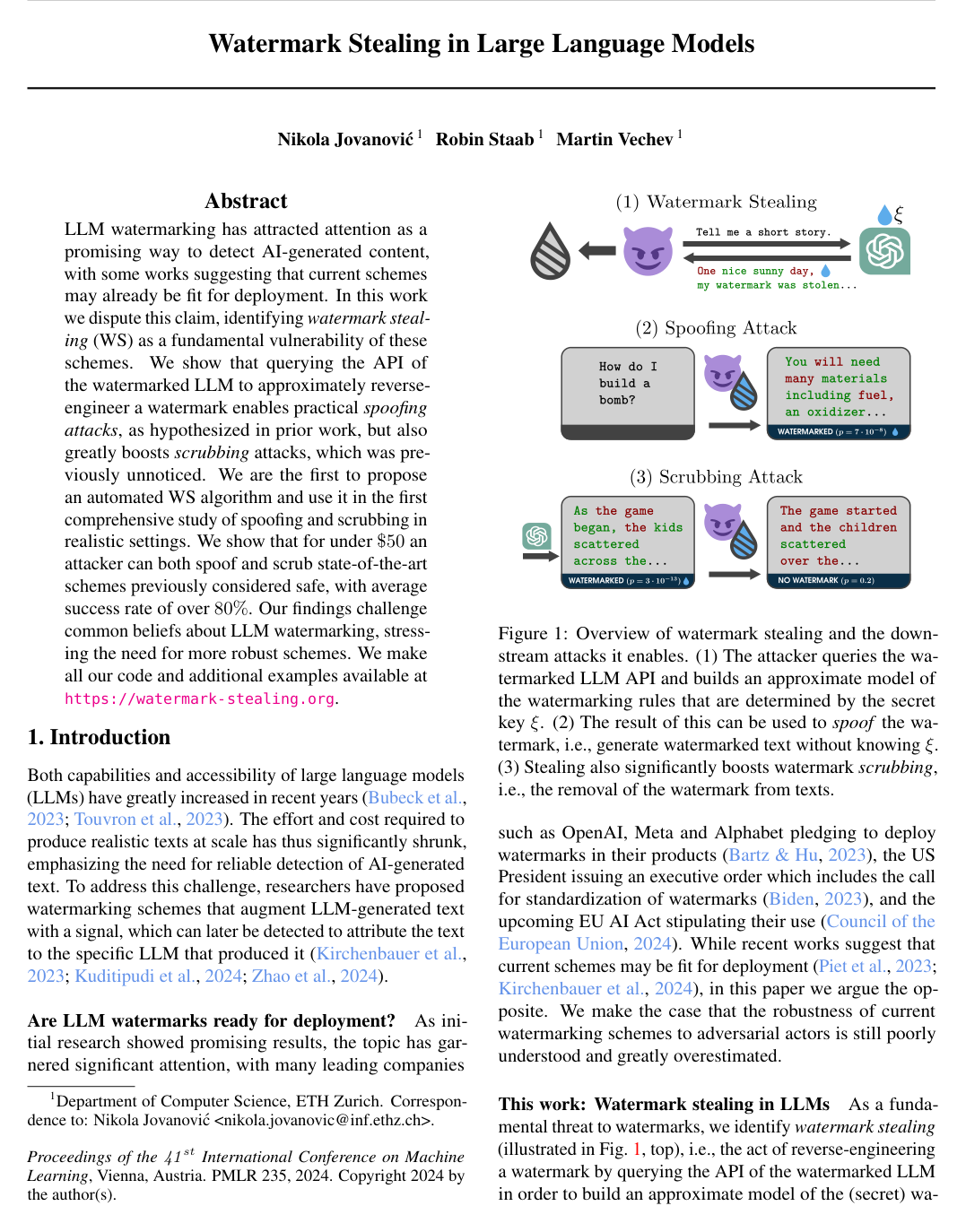
Demonstrates how an attacker can reverse-engineer language model watermarks via API queries for under $50, achieving over 80% success in both spoofing and removing state-of-the-art watermarks.
LLM watermarking has attracted attention as a promising way to detect AI-generated content, with some works suggesting that current schemes may already be fit for deployment. In this work we dispute this claim, identifying watermark stealing (WS) as a fundamental vulnerability of these schemes. We show that querying the API of the watermarked LLM to approximately reverse-engineer a watermark enables practical spoofing attacks, as hypothesized in prior work, but also greatly boosts scrubbing attacks, which was previously unnoticed. We are the first to propose an automated WS algorithm and use it in the first comprehensive study of spoofing and scrubbing in realistic settings. We show that for under $50 an attacker can both spoof and scrub state-of-the-art schemes previously considered safe, with average success rate of over 80%. Our findings challenge common beliefs about LLM watermarking, stressing the need for more robust schemes. We make all our code and additional examples available at https://watermark-stealing.org.
Added
2026-09-26
Watermarking Conditional Text Generation for AI Detection: Unveiling Challenges and a Semantic-Aware Watermark Remedy
Yu Fu, Deyi Xiong, Yue Dong
Why you should read this
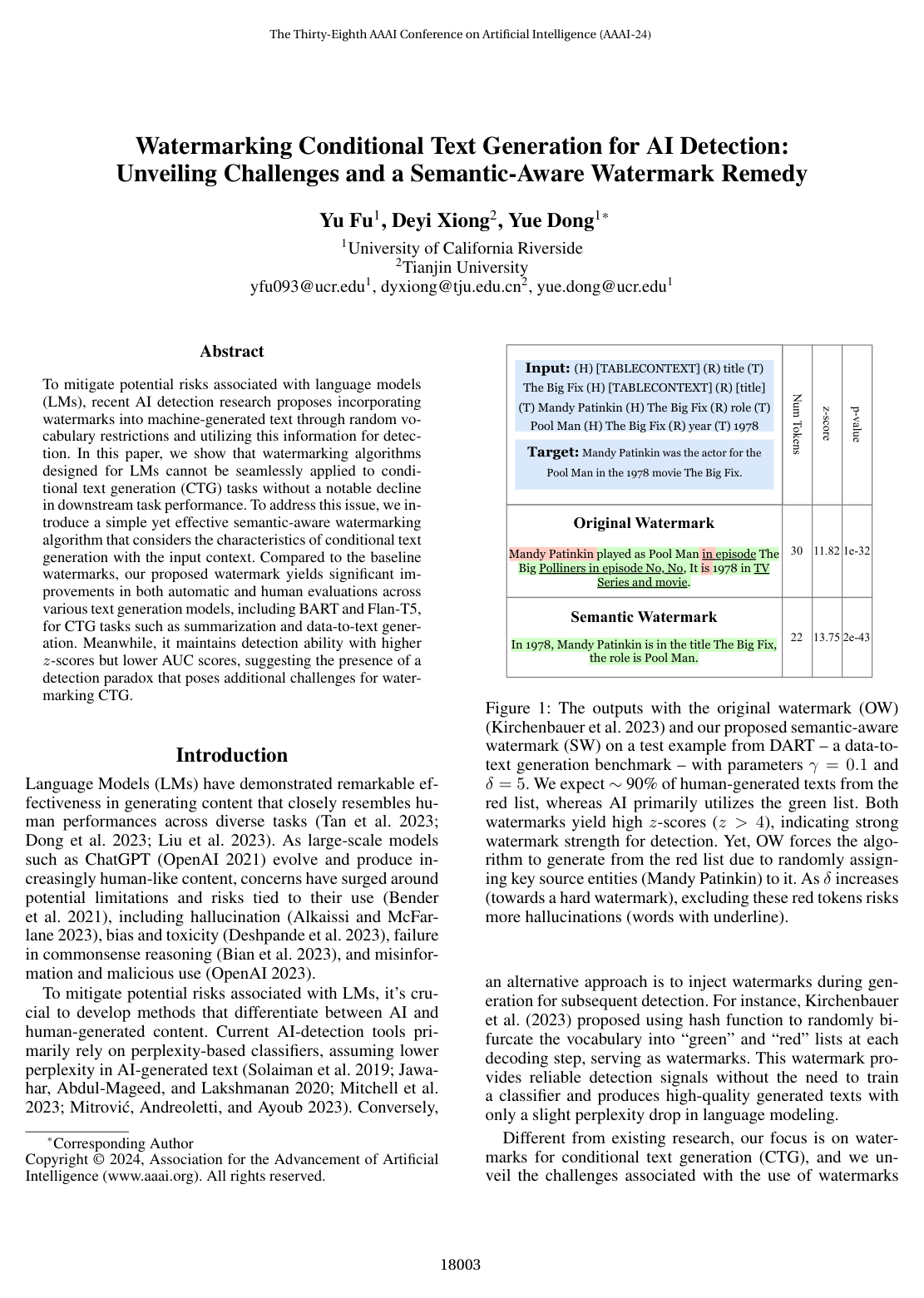
Presents a semantic-aware watermarking algorithm for conditional text generation that preserves output quality in summarization and data-to-text tasks by aligning green-list vocabulary partitions with input context embeddings.
To mitigate potential risks associated with language models (LMs), recent AI detection research proposes incorporating watermarks into machine-generated text through random vocabulary restrictions and utilizing this information for detection. In this paper, we show that watermarking algorithms designed for LMs cannot be seamlessly applied to conditional text generation (CTG) tasks without a notable decline in downstream task performance. To address this issue, we introduce a simple yet effective semantic-aware watermarking algorithm that considers the characteristics of conditional text generation with the input context. Compared to the baseline watermarks, our proposed watermark yields significant improvements in both automatic and human evaluations across various text generation models, including BART and Flan-T5, for CTG tasks such as summarization and data-to-text generation. Meanwhile, it maintains detection ability with higher z-scores but lower AUC scores, suggesting the presence of a detection paradox that poses additional challenges for watermarking CTG.
Added
2026-09-26