Built independently by an author, for readers. Read the story and support ChapterPal

keyword

VQA models

Visual question answering models are multimodal artificial intelligence systems designed to process visual inputs, such as images or videos, and generate accurate natural language answers to questions about that visual content. These models bridge computer vision and natural language processing by extracting visual features, parsing question semantics, and performing joint reasoning over both modalities. Depending on their architecture, VQA models can identify objects, analyze spatial relationships, recognize and interpret embedded text, and leverage contextual knowledge to answer a wide variety of queries.

1 item

Towards VQA Models That Can Read

Towards VQA Models That Can Read

Amanpreet Singh, Vivek Natarajan, Meet Shah, Yu Jiang, Xinlei Chen, Dhruv Batra, Devi Parikh, Marcus Rohrbach

OrganizationsGeorgia Institute of TechnologyMeta

Why you should read this

Introduces the TextVQA dataset and the LoRRA model to enable visual question answering systems to read and reason about text embedded in everyday images.

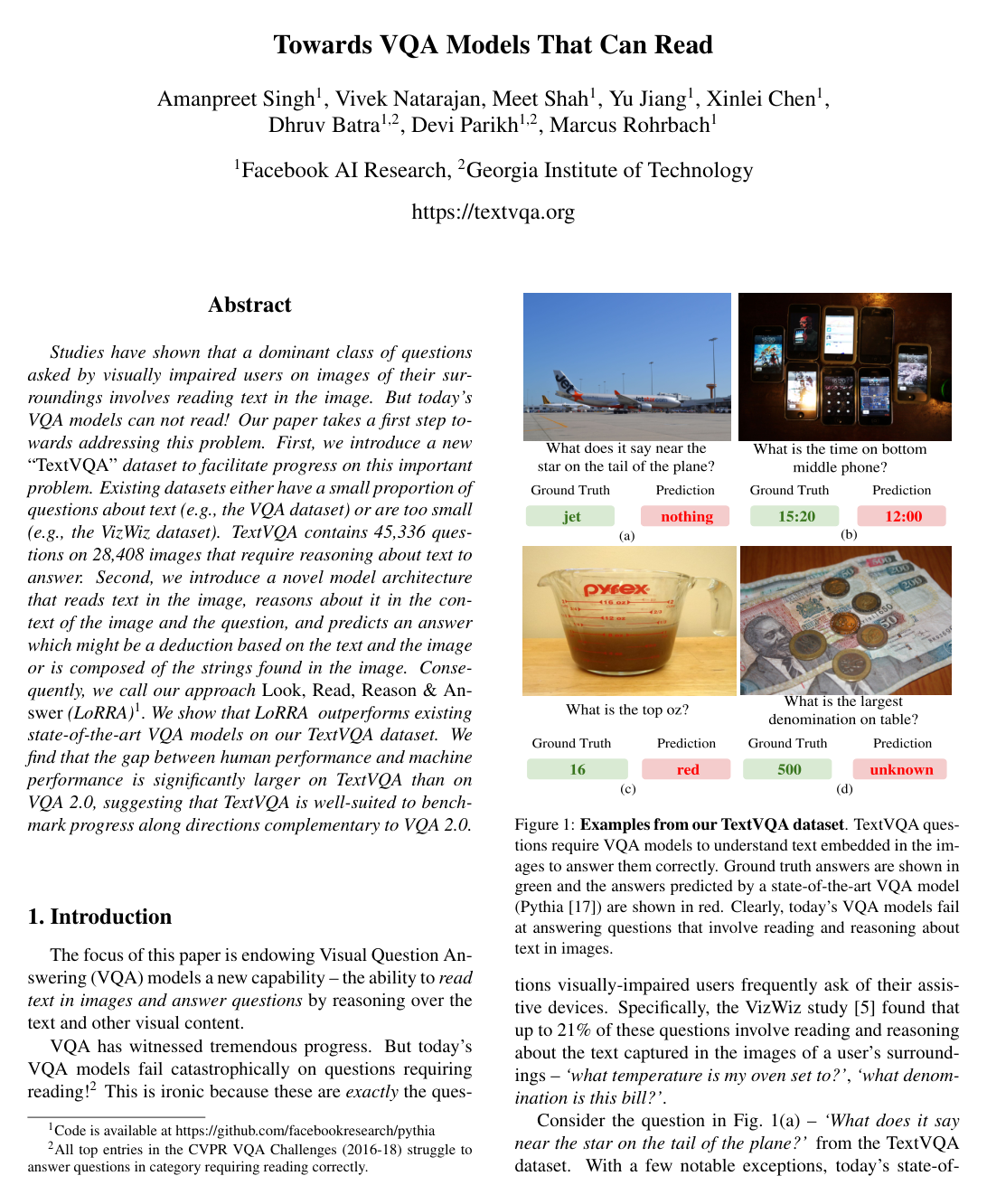
Studies have shown that a dominant class of questions asked by visually impaired users on images of their surroundings involves reading text in the image. But today's VQA models can not read! Our paper takes a first step towards addressing this problem. First, we introduce a new "TextVQA" dataset to facilitate progress on this important problem. Existing datasets either have a small proportion of questions about text (e.g., the VQA dataset) or are too small (e.g., the VizWiz dataset). TextVQA contains 45,336 questions on 28,408 images that require reasoning about text to answer. Second, we introduce a novel model architecture that reads text in the image, reasons about it in the context of the image and the question, and predicts an answer which might be a deduction based on the text and the image or composed of the strings found in the image. Consequently, we call our approach Look, Read, Reason & Answer (LoRRA). We show that LoRRA outperforms existing state-of-the-art VQA models on our TextVQA dataset. We find that the gap between human performance and machine performance is significantly larger on TextVQA than on VQA 2.0, suggesting that TextVQA is well-suited to benchmark progress along directions complementary to VQA 2.0.

Added

2026-09-16