
keyword
visual instruction
A visual instruction is a directive provided to an artificial intelligence system that pairs visual input, such as images, video, or spatial visual markers like bounding boxes and masks, with natural language prompts to specify a desired task. Operating within multimodal machine learning and embodied intelligence, visual instructions enable models to ground linguistic concepts directly in visual context to carry out complex perception, reasoning, planning, and control actions. Unlike conventional fixed-output computer vision objectives, visual instructions serve as flexible, general-purpose prompts used during training and inference—particularly in visual instruction tuning—allowing vision-language models and autonomous agents to follow open-ended human intent across diverse tasks such as scene description, visual question answering, and goal-oriented manipulation.
3 items
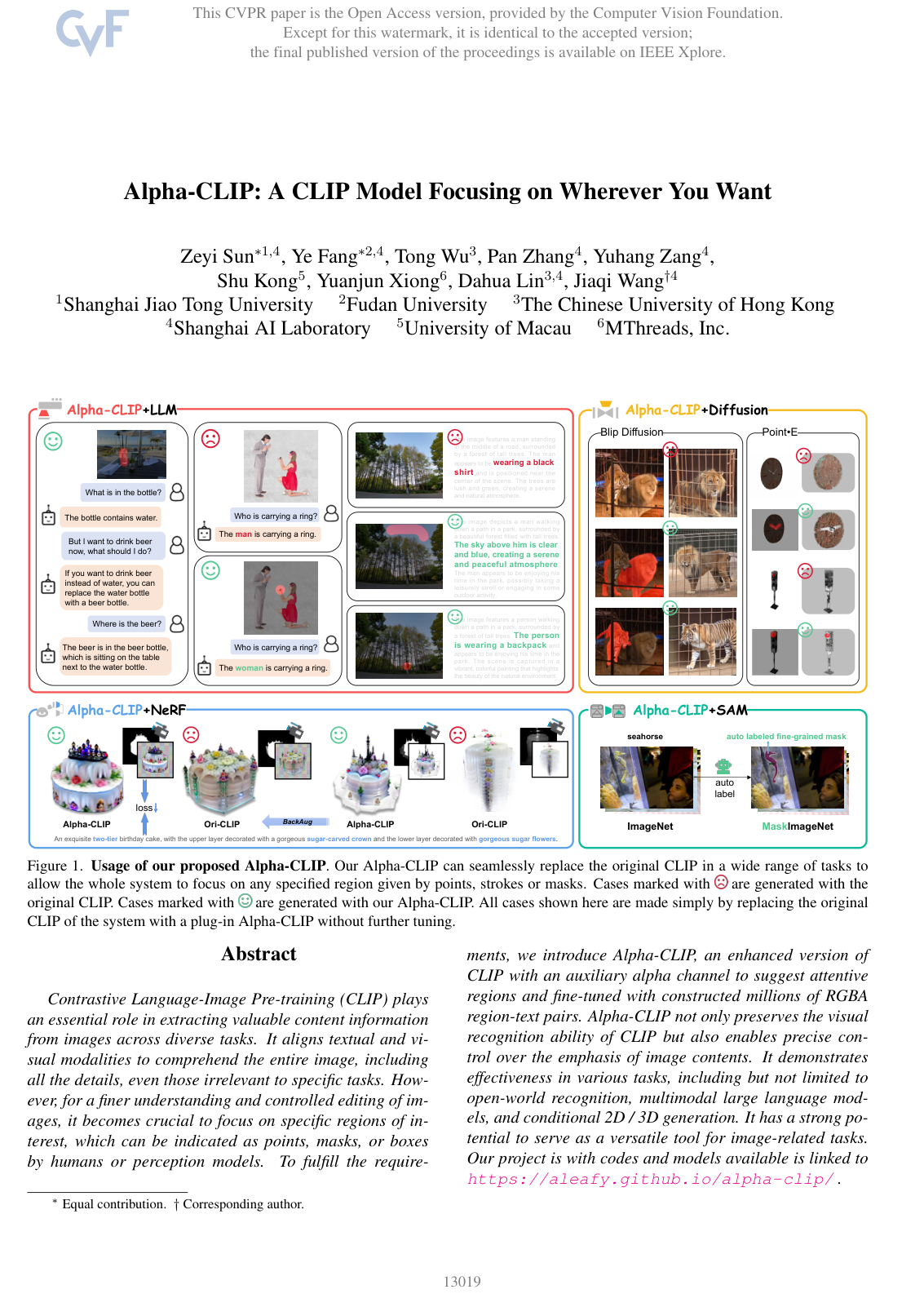
Alpha-CLIP: A CLIP Model Focusing on Wherever you Want
Zeyi Sun, Ye Fang, Tong Wu, Pan Zhang, Yuhang Zang, Shu Kong, Yuanjun Xiong, Dahua Lin, Jiaqi Wang
Why you should read this
Introduces Alpha-CLIP, an enhanced CLIP model with an auxiliary alpha channel that enables fine-grained, region-specific focus while preserving contextual awareness across open-world recognition, multimodal language models, and 2D/3D generation tasks.
Contrastive Language-Image Pre-training (CLIP) plays an essential role in extracting valuable content information from images across diverse tasks. It aligns textual and visual modalities to comprehend the entire image, including all the details, even those irrelevant to specific tasks. However, for a finer understanding and controlled editing of images, it becomes crucial to focus on specific regions of interest, which can be indicated as points, masks, or boxes by humans or perception models. To fulfill the requirements, we introduce Alpha-CLIP, an enhanced version of CLIP with an auxiliary alpha channel to suggest attentive regions and fine-tuned with constructed millions of RGBA region-text pairs. Alpha-CLIP not only preserves the visual recognition ability of CLIP but also enables precise control over the emphasis of image contents. It demonstrates effectiveness in various tasks, including but not limited to open-world recognition, multimodal large language models, and conditional 2D / 3D generation. It has a strong potential to serve as a versatile tool for image-related tasks. Our project is with codes and models available is linked to https://aleafy.github.io/alpha-clip/.
Added
2026-09-26
EmbodiedGPT: Vision-Language Pre-Training via Embodied Chain of Thought
Yao Mu, Qinglong Zhang, Mengkang Hu, Wenhai Wang, Mingyu Ding, Jun Jin, Bin Wang, Jifeng Dai, Yu Qiao, Ping Luo
Why you should read this
Presents EmbodiedGPT, a vision-language foundation model that connects high-level chain-of-thought task planning to low-level robot control to substantially increase manipulation success rates across benchmarks like Franka Kitchen and Meta-World.
Embodied AI is a crucial frontier in robotics, capable of planning and executing action sequences for robots to accomplish long-horizon tasks in physical environments. In this work, we introduce EmbodiedGPT, an end-to-end multi-modal foundation model for embodied AI, empowering embodied agents with multi-modal understanding and execution capabilities. To achieve this, we have made the following efforts: (i) We craft a large-scale embodied planning dataset, termed EgoCOT. The dataset consists of carefully selected videos from the Ego4D dataset, along with corresponding high-quality language instructions. Specifically, we generate a sequence of sub-goals with the "Chain of Thoughts" mode for effective embodied planning. (ii) We introduce an efficient training approach to EmbodiedGPT for high-quality plan generation, by adapting a 7B large language model (LLM) to the EgoCOT dataset via prefix tuning. (iii) We introduce a paradigm for extracting task-related features from LLM-generated planning queries to form a closed loop between high-level planning and low-level control. Extensive experiments show the effectiveness of EmbodiedGPT on embodied tasks, including embodied planning, embodied control, visual captioning, and visual question answering. Notably, EmbodiedGPT significantly enhances the success rate of the embodied control task by extracting more effective features. It has achieved a remarkable 1.6 times increase in success rate on the Franka Kitchen benchmark and a 1.3 times increase on the Meta-World benchmark, compared to the BLIP-2 baseline fine-tuned with the Ego4D dataset.
Added
2026-09-26
MME: A Comprehensive Evaluation Benchmark for Multimodal Large Language Models
Chaoyou Fu, Peixian Chen, Yunhang Shen, Yulei Qin, Mengdan Zhang, Xu Lin, Z. Qiu, Wei Lin, Jinrui Yang, Xiawu Zheng, Ke Li, Xing Sun, Rongrong Ji
Why you should read this
Presents MME, a comprehensive benchmark spanning 14 perception and cognition subtasks with manually designed prompts to avoid data leakage, offering a standardized evaluation across 30 multimodal large language models to identify current performance bottlenecks and future optimization directions.
Multimodal Large Language Model (MLLM) relies on the powerful LLM to perform multimodal tasks, showing amazing emergent abilities in recent studies, such as writing poems based on an image. However, it is difficult for these case studies to fully reflect the performance of MLLM, lacking a comprehensive evaluation. In this paper, we fill in this blank, presenting the first comprehensive MLLM Evaluation benchmark MME. It measures both perception and cognition abilities on a total of 14 subtasks. In order to avoid data leakage that may arise from direct use of public datasets for evaluation, the annotations of instruction-answer pairs are all manually designed. The concise instruction design allows us to fairly compare MLLMs, instead of struggling in prompt engineering. Besides, with such an instruction, we can also easily carry out quantitative statistics. A total of 30 advanced MLLMs are comprehensively evaluated on our MME, which not only suggests that existing MLLMs still have a large room for improvement, but also reveals the potential directions for the subsequent model optimization. The data are released at the project page this https URL.
Added
2026-09-24