
keyword
visual entailment
Visual entailment is a multimodal artificial intelligence task in which a computational model determines whether a natural language statement is logically supported by an accompanying image. Derived from the natural language inference task of textual entailment, visual entailment replaces the traditional text premise with visual evidence while maintaining a textual hypothesis. A model evaluates the relationship between the image and text to classify it into one of three categories: entailment, where the visual evidence confirms the statement is true; contradiction, where the visual evidence proves the statement is false; or neutral, where the visual evidence is insufficient to verify or refute the statement. This task serves as a standard benchmark for evaluating cross-modal reasoning, grounded language understanding, and semantic alignment in vision-language models.
8 items
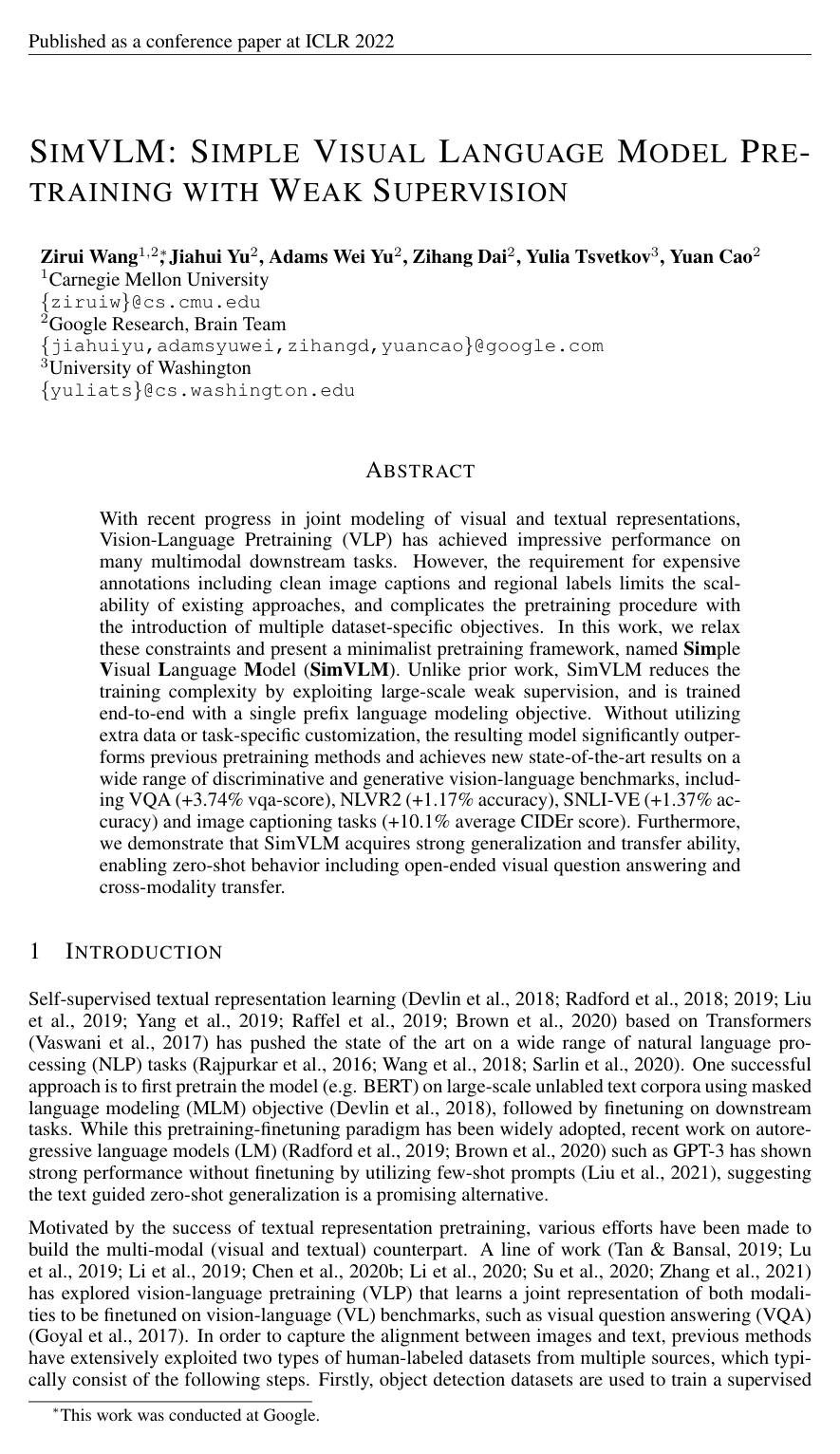
SimVLM: Simple Visual Language Model Pretraining with Weak Supervision
Zirui Wang, Jiahui Yu, Adams Wei Yu, Zihang Dai, Yulia Tsvetkov, Yuan Cao
Why you should read this
Introduces SimVLM, a simplified vision-language model trained end-to-end on weakly supervised data using a single prefix language modeling objective, achieving state-of-the-art benchmark performance and strong zero-shot multimodal capabilities without requiring expensive object-level annotations.
With recent progress in joint modeling of visual and textual representations, Vision-Language Pretraining (VLP) has achieved impressive performance on many multimodal downstream tasks. However, the requirement for expensive annotations including clean image captions and regional labels limits the scalability of existing approaches, and complicates the pretraining procedure with the introduction of multiple dataset-specific objectives. In this work, we relax these constraints and present a minimalist pretraining framework, named Simple Visual Language Model (SimVLM). Unlike prior work, SimVLM reduces the training complexity by exploiting large-scale weak supervision, and is trained end-to-end with a single prefix language modeling objective. Without utilizing extra data or task-specific customization, the resulting model significantly outperforms previous pretraining methods and achieves new state-of-the-art results on a wide range of discriminative and generative vision-language benchmarks, including VQA (+3.74% vqa-score), NLVR2 (+1.17% accuracy), SNLI-VE (+1.37% accuracy) and image captioning tasks (+10.1% average CIDEr score). Furthermore, we demonstrate that SimVLM acquires strong generalization and transfer ability, enabling zero-shot behavior including open-ended visual question answering and cross-modality transfer.
Added
2026-10-05
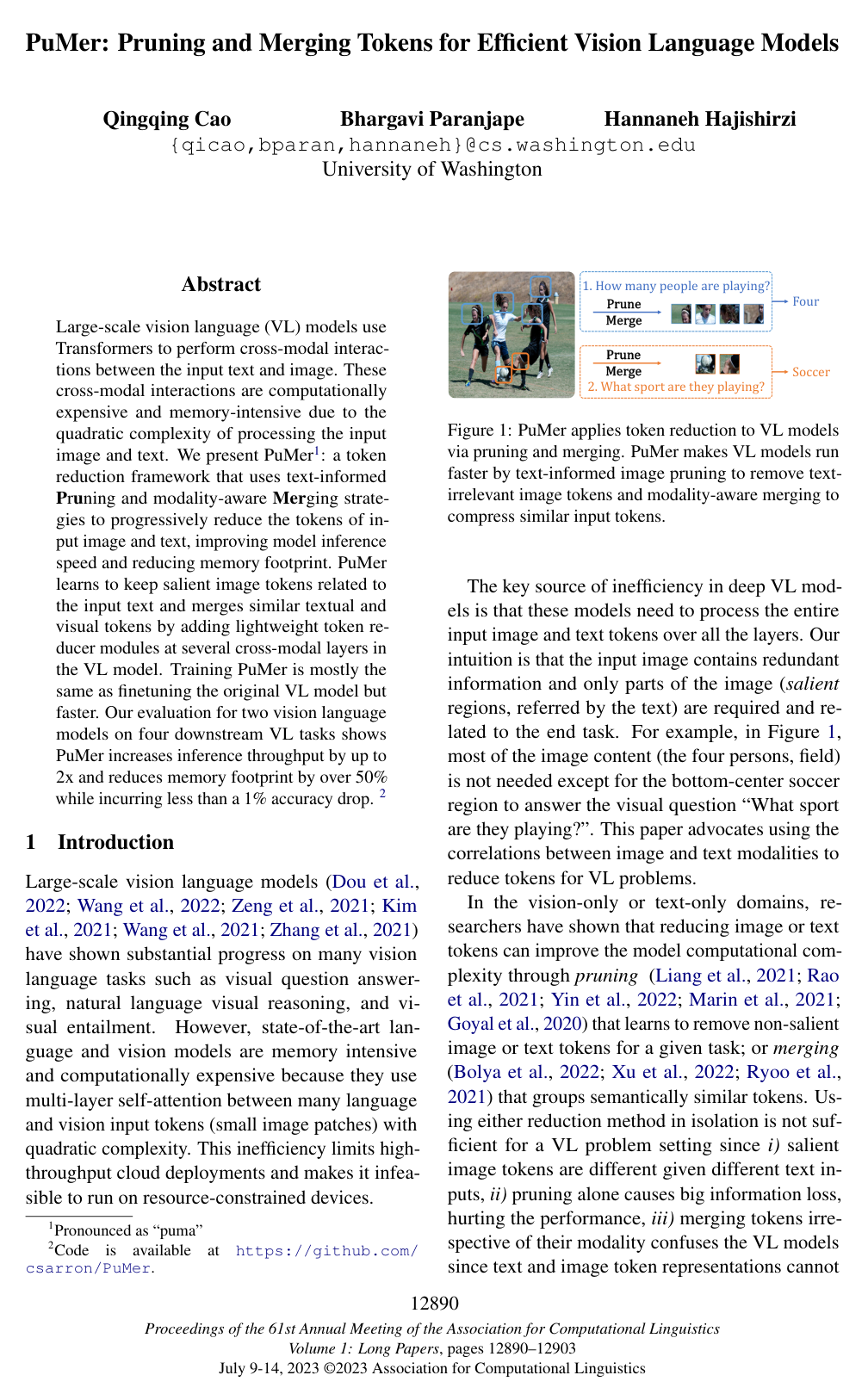
PuMer: Pruning and Merging Tokens for Efficient Vision Language Models
Qingqing Cao, Bhargavi Paranjape, Hannaneh Hajishirzi
Why you should read this
Introduces a token reduction framework combining text-guided pruning and modality-aware merging that doubles vision-language model inference throughput and cuts memory consumption in half with under a 1% loss in accuracy.
Large-scale vision language (VL) models use Transformers to perform cross-modal interactions between the input text and image. These cross-modal interactions are computationally expensive and memory-intensive due to the quadratic complexity of processing the input image and text. We present PuMer¹: a token reduction framework that uses text-informed Pruning and modality-aware Merging strategies to progressively reduce the tokens of input image and text, improving model inference speed and reducing memory footprint. PuMer learns to keep salient image tokens related to the input text and merges similar textual and visual tokens by adding lightweight token reducer modules at several cross-modal layers in the VL model. Training PuMer is mostly the same as finetuning the original VL model but faster. Our evaluation for two vision language models on four downstream VL tasks shows PuMer increases inference throughput by up to 2x and reduces memory footprint by over 50% while incurring less than a 1% accuracy drop.²
Added
2026-10-03
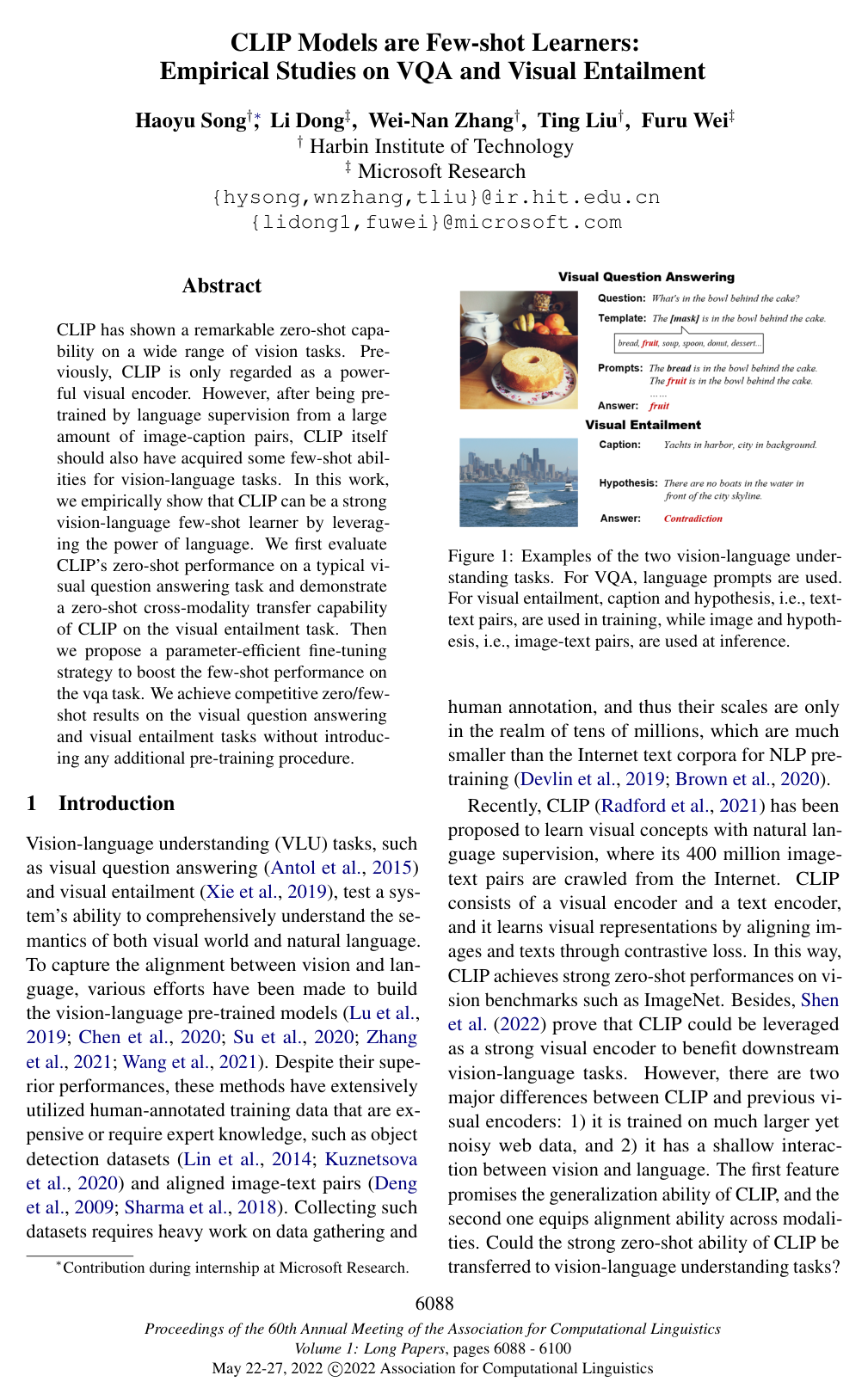
CLIP Models are Few-Shot Learners: Empirical Studies on VQA and Visual Entailment
Haoyu Song, Li Dong, Weinan Zhang, Ting Liu, Furu Wei
Why you should read this
Demonstrates that pretrained CLIP models can serve as strong zero- and few-shot vision-language learners on visual question answering and visual entailment through generative question-to-statement prompt conversion and parameter-efficient bias-and-normalization tuning.
CLIP has shown a remarkable zero-shot capability on a wide range of vision tasks. Previously, CLIP is only regarded as a powerful visual encoder. However, after being pretrained by language supervision from a large amount of image-caption pairs, CLIP itself should also have acquired some few-shot abilities for vision-language tasks. In this work, we empirically show that CLIP can be a strong vision-language few-shot learner by leveraging the power of language. We first evaluate CLIP’s zero-shot performance on a typical visual question answering task and demonstrate a zero-shot cross-modality transfer capability of CLIP on the visual entailment task. Then we propose a parameter-efficient fine-tuning strategy to boost the few-shot performance on the vqa task. We achieve competitive zero/few-shot results on the visual question answering and visual entailment tasks without introducing any additional pre-training procedure.
Added
2026-09-30
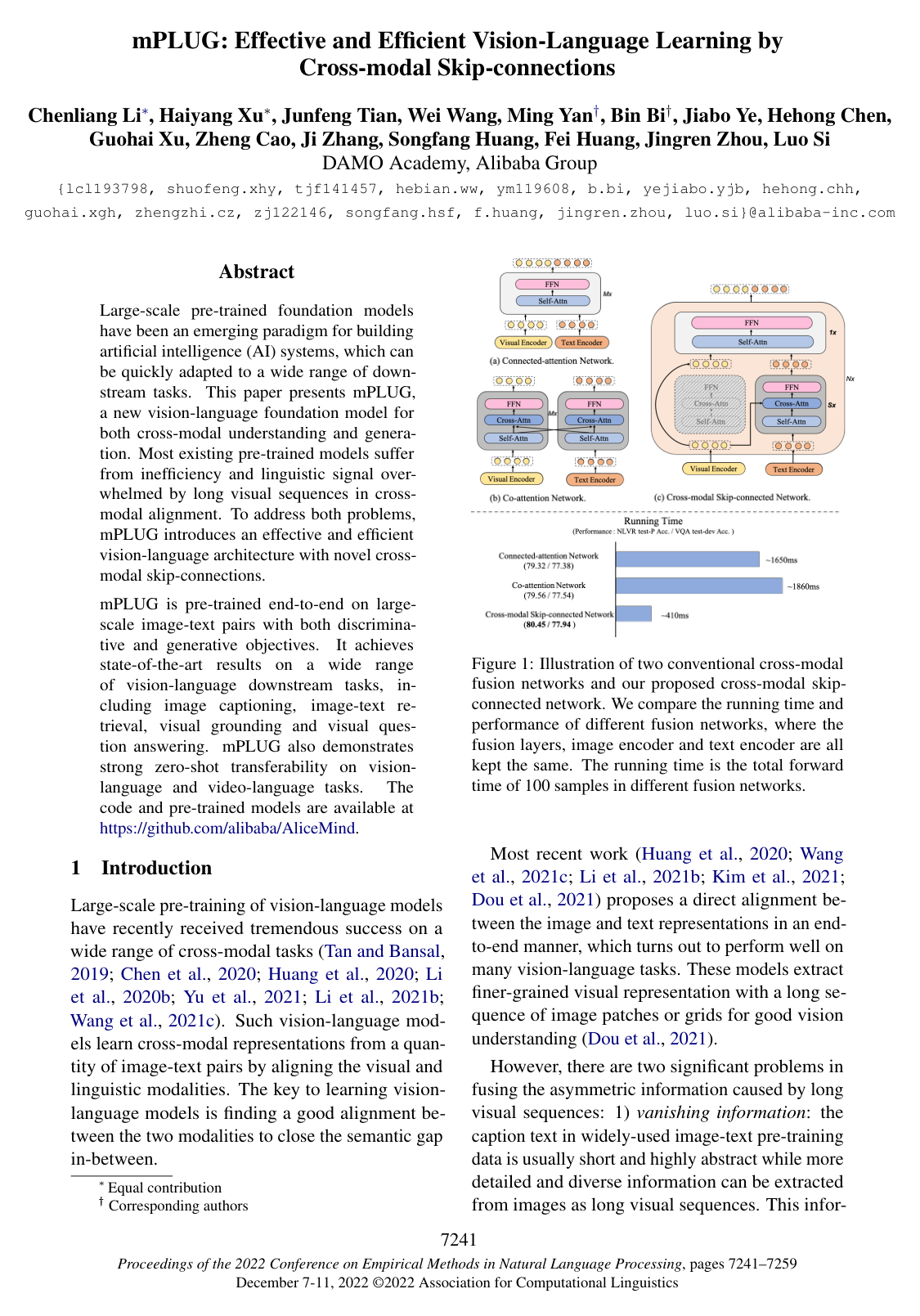
mPLUG: Effective and Efficient Vision-Language Learning by Cross-modal Skip-connections
Chenliang Li, Haiyang Xu, Junfeng Tian, Wei Wang, Ming Yan, Bin Bi, Jiabo Ye, He Chen, Guohai Xu, Zheng Cao, Ji Zhang, Songfang Huang, Fei Huang, Jingren Zhou, Luo Si
Why you should read this
Introduces a vision-language foundation model that uses cross-modal skip-connections to eliminate computational bottlenecks on long visual sequences and prevent image features from overwhelming linguistic signals during multi-modal fusion.
Large-scale pre-trained foundation models have been an emerging paradigm for building artificial intelligence (AI) systems, which can be quickly adapted to a wide range of downstream tasks. This paper presents mPLUG, a new vision-language foundation model for both cross-modal understanding and generation. Most existing pre-trained models suffer from inefficiency and linguistic signal overwhelmed by long visual sequences in cross-modal alignment. To address both problems, mPLUG introduces an effective and efficient vision-language architecture with novel cross-modal skip-connections. mPLUG is pre-trained end-to-end on large-scale image-text pairs with both discriminative and generative objectives. It achieves state-of-the-art results on a wide range of vision-language downstream tasks, including image captioning, image-text retrieval, visual grounding and visual question answering. mPLUG also demonstrates strong zero-shot transferability on vision-language and video-language tasks. The code and pre-trained models are available at https://github.com/alibaba/AliceMind.
Added
2026-09-28
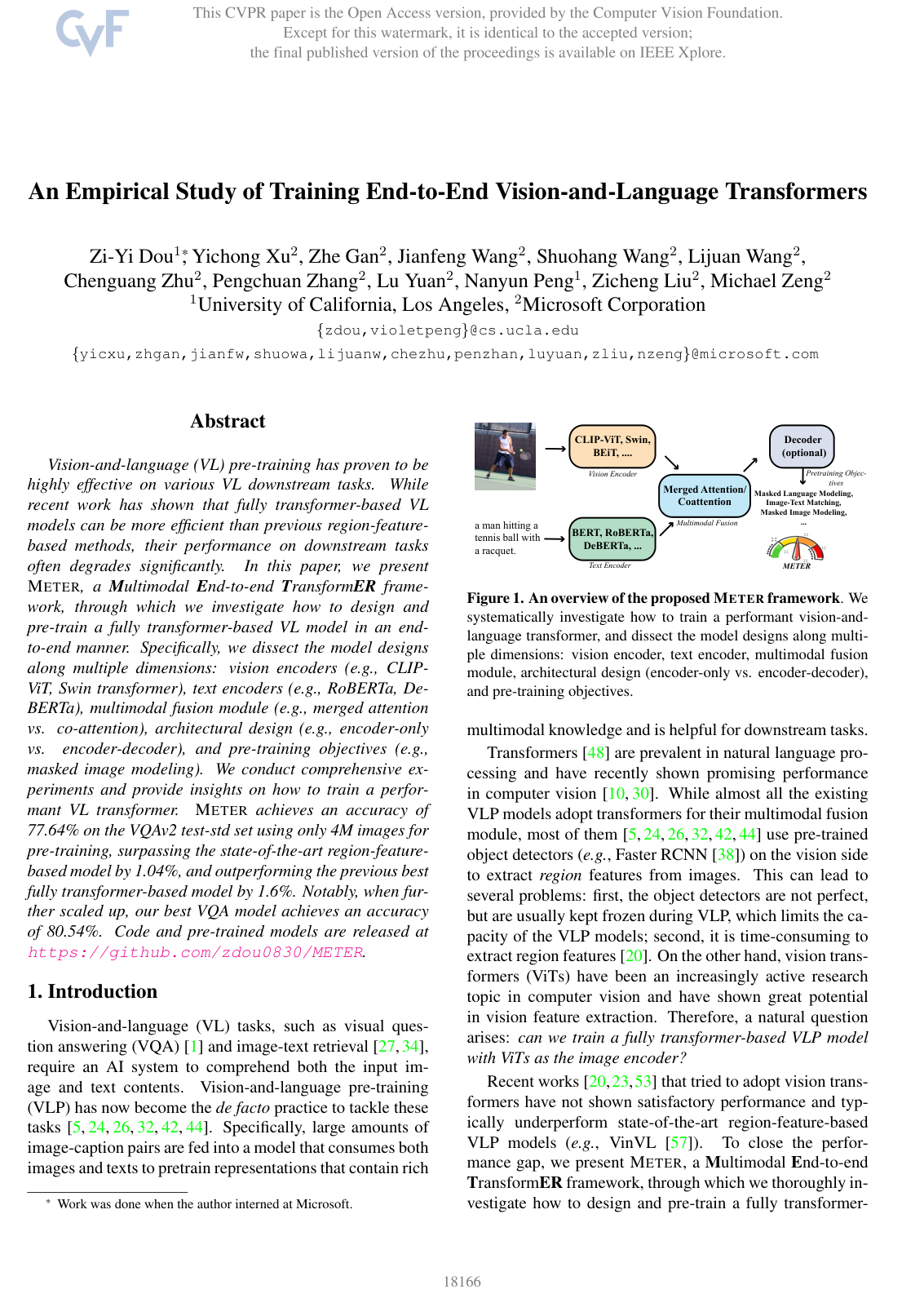
An Empirical Study of Training End-to-End Vision-and-Language Transformers
Zi-Yi Dou, Yichong Xu, Zhe Gan, Jianfeng Wang, Shuohang Wang, Lijuan Wang, Chenguang Zhu, Pengchuan Zhang, Lu Yuan, Nanyun Peng, Zicheng Liu, Michael Zeng
Why you should read this
Presents the METER framework to systematically analyze end-to-end vision-and-language transformer architectures and pre-training objectives, demonstrating how fully transformer-based models can outperform traditional region-based methods on downstream benchmarks.
Vision-and-language (VL) pre-training has proven to be highly effective on various VL downstream tasks. While recent work has shown that fully transformer-based VL models can be more efficient than previous region-feature-based methods, their performance on downstream tasks often degrades significantly. In this paper, we present METER, a Multimodal End-to-end TransformER framework, through which we investigate how to design and pre-train a fully transformer-based VL model in an end-to-end manner. Specifically, we dissect the model designs along multiple dimensions: vision encoders (e.g., CLIP-ViT, Swin transformer), text encoders (e.g., RoBERTa, DeBERTa), multimodal fusion module (e.g., merged attention vs. co-attention), architectural design (e.g., encoder-only vs. encoder-decoder), and pre-training objectives (e.g., masked image modeling). We conduct comprehensive experiments and provide insights on how to train a performant VL transformer. METER achieves an accuracy of 77.64% on the VQAv2 test-std set using only 4M images for pre-training, surpassing the state-of-the-art region-feature-based model by 1.04%, and outperforming the previous best fully transformer-based model by 1.6%. Notably, when further scaled up, our best VQA model achieves an accuracy of 80.54%. Code and pre-trained models are released at https://github.com/zou08030/METER.
Added
2026-09-26
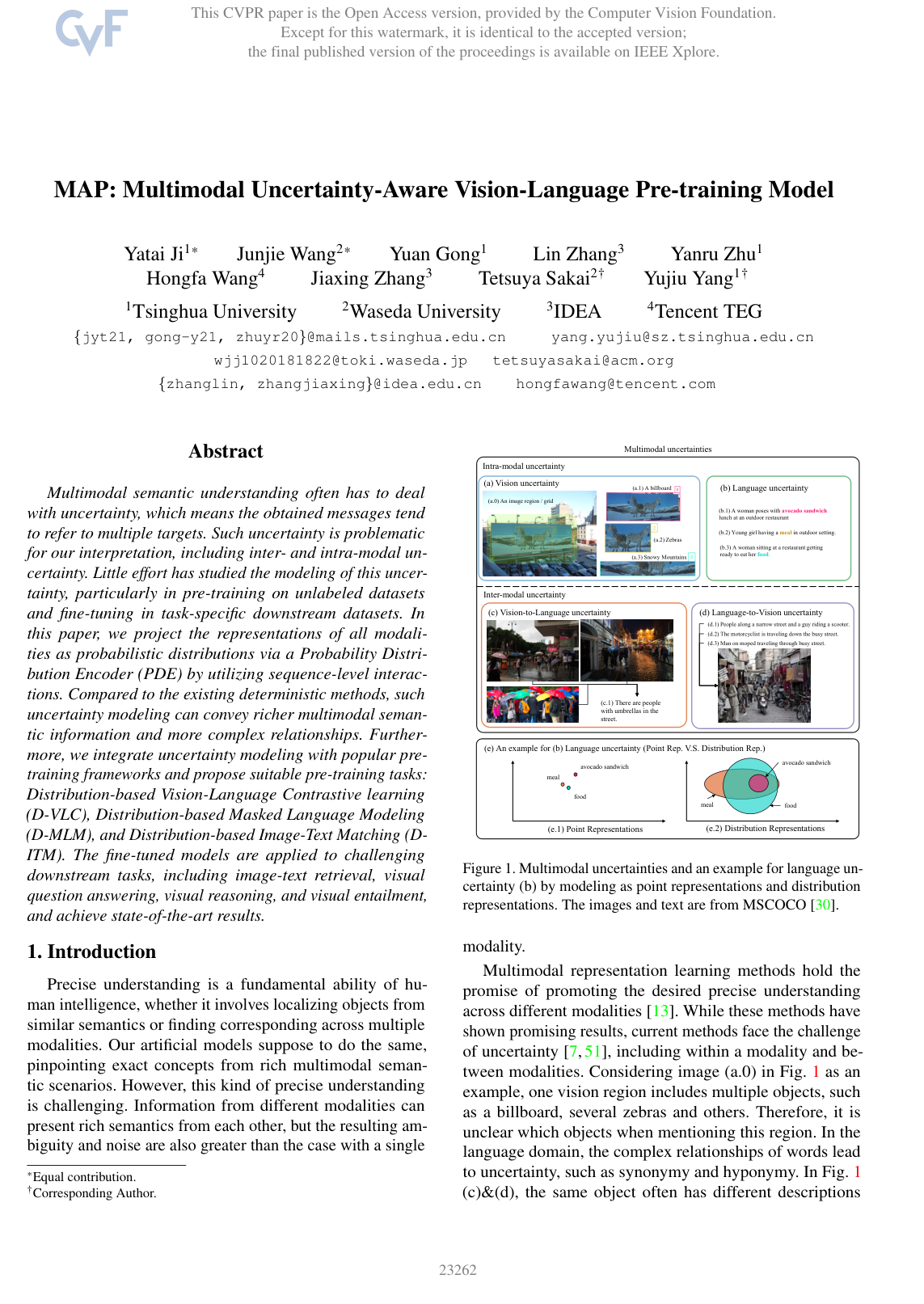
MAP: Multimodal Uncertainty-Aware Vision-Language Pre-training Model
Yatai Ji, Junjie Wang, Yuan Gong, Lin Zhang, Yanru Zhu, Hongfa Wang, Jiaxing Zhang, Tetsuya Sakai, Yujiu Yang
Why you should read this
Proposes a vision-language pre-training framework that models multimodal features as Gaussian distributions instead of deterministic points to capture inter- and intra-modal semantic uncertainty across downstream tasks like visual reasoning and image-text retrieval.
Multimodal semantic understanding often has to deal with uncertainty, which means the obtained messages tend to refer to multiple targets. Such uncertainty is problematic for our interpretation, including inter- and intra-modal uncertainty. Little effort has studied the modeling of this uncertainty, particularly in pre-training on unlabeled datasets and fine-tuning in task-specific downstream datasets. In this paper, we project the representations of all modalities as probabilistic distributions via a Probability Distribution Encoder (PDE) by utilizing sequence-level interactions. Compared to the existing deterministic methods, such uncertainty modeling can convey richer multimodal semantic information and more complex relationships. Furthermore, we integrate uncertainty modeling with popular pre-training frameworks and propose suitable pre-training tasks: Distribution-based Vision-Language Contrastive learning (D-VLC), Distribution-based Masked Language Modeling (D-MLM), and Distribution-based Image-Text Matching (D-ITM). The fine-tuned models are applied to challenging downstream tasks, including image-text retrieval, visual question answering, visual reasoning, and visual entailment, and achieve state-of-the-art results.
Added
2026-09-26
Align before Fuse: Vision and Language Representation Learning with Momentum Distillation
Junnan Li, Ramprasaath R. Selvaraju, Akhilesh Deepak Gotmare, Shafiq Joty, Caiming Xiong, Steven Hoi
Why you should read this
Presents a novel "Align before Fuse" (ALBEF) framework that achieves state-of-the-art performance in vision-language tasks with faster inference and without needing costly bounding box annotations, demonstrating a more efficient and effective approach to multimodal representation learning.
Large-scale vision and language representation learning has shown promising improvements on various vision-language tasks. Most existing methods employ a transformer-based multimodal encoder to jointly model visual tokens (region-based image features) and word tokens. Because the visual tokens and word tokens are unaligned, it is challenging for the multimodal encoder to learn image-text interactions. In this paper, we introduce a contrastive loss to ALign the image and text representations BEfore Fusing (ALBEF) them through cross-modal attention, which enables more grounded vision and language representation learning. Unlike most existing methods, our method does not require bounding box annotations nor high-resolution images. In order to improve learning from noisy web data, we propose momentum distillation, a self-training method which learns from pseudo-targets produced by a momentum model. We provide a theoretical analysis of ALBEF from a mutual information maximization perspective, showing that different training tasks can be interpreted as different ways to generate views for an image-text pair. ALBEF achieves state-of-the-art performance on multiple downstream vision-language tasks. On image-text retrieval, ALBEF outperforms methods that are pre-trained on orders of magnitude larger datasets. On VQA and NLVR, ALBEF achieves absolute improvements of 2.37% and 3.84% compared to the state-of-the-art, while enjoying faster inference speed. Code and pre-trained models are available at this https URL.
Added
2026-01-28

CoCa: Contrastive Captioners are Image-Text Foundation Models
Jiahui Yu, Zirui Wang, Vijay K. Vasudevan, Legg Yeung, Mojtaba Seyedhosseini, Yonghui Wu
Why you should read this
Unifies the two primary training objectives—contrastive learning and generative captioning—into a single foundation model architecture.
Exploring large-scale pretrained foundation models is of significant interest in computer vision because these models can be quickly transferred to many downstream tasks. This paper presents Contrastive Captioner (CoCa), a minimalist design to pretrain an image-text encoder-decoder foundation model jointly with contrastive loss and captioning loss, thereby subsuming model capabilities from contrastive approaches like CLIP and generative methods like SimVLM. In contrast to standard encoder-decoder transformers where all decoder layers attend to encoder outputs, CoCa omits cross-attention in the first half of decoder layers to encode unimodal text representations, and cascades the remaining decoder layers which cross-attend to the image encoder for multimodal image-text representations. We apply a contrastive loss between unimodal image and text embeddings, in addition to a captioning loss on the multimodal decoder outputs which predicts text tokens autoregressively. By sharing the same computational graph, the two training objectives are computed efficiently with minimal overhead. CoCa is pretrained end-to-end and from scratch on both web-scale alt-text data and annotated images by treating all labels simply as text, seamlessly unifying natural language supervision for representation learning. Empirically, CoCa achieves state-of-the-art performance with zero-shot transfer or minimal task-specific adaptation on a broad range of downstream tasks, spanning visual recognition (ImageNet, Kinetics-400/600/700, Moments-in-Time), crossmodal retrieval (MSCOCO, Flickr30K, MSR-VTT), multimodal understanding (VQA, SNLI-VE, NLVR2), and image captioning (MSCOCO, NoCaps). Notably on ImageNet classification, CoCa obtains 86.3% zero-shot top-1 accuracy, 90.6% with a frozen encoder and learned classification head, and new state-of-the-art 91.0% top-1 accuracy on ImageNet with a finetuned encoder.
Added
2026-01-28