
keyword
vision-language understanding
Vision-language understanding is an area of artificial intelligence focused on the ability of computational models to jointly process, interpret, and reason across visual content and natural language. Rather than treating visual data and text in isolation, this capability requires aligning visual features from images or videos with textual semantics in a shared multimodal representation space. It enables systems to perform complex multimodal tasks such as visual question answering, cross-modal retrieval, visual grounding, and document or scene analysis by connecting objects, attributes, and spatial relationships depicted in visual inputs with corresponding linguistic concepts. Modern implementations typically combine computer vision architectures, such as vision encoders, with large language models through cross-modal projection or attention mechanisms to comprehend and resolve tasks that inherently depend on both visual perception and textual comprehension.
8 items
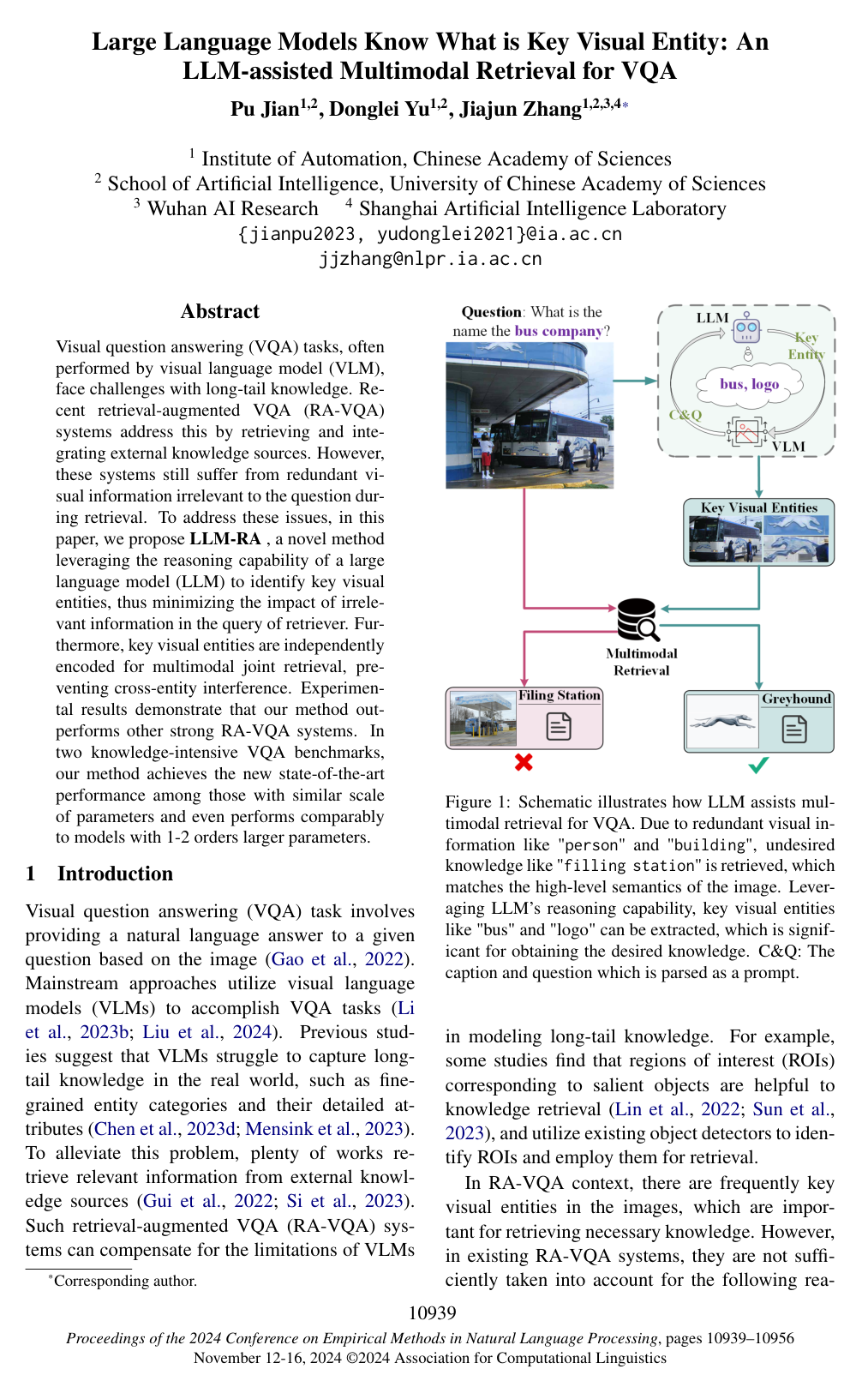
Large Language Models Know What is Key Visual Entity: An LLM-assisted Multimodal Retrieval for VQA
Pu Jian, Donglei Yu, Jiajun Zhang
Why you should read this
Proposes LLM-RA, a retrieval-augmented visual question answering framework that uses large language models to identify and independently encode question-critical visual entities, eliminating irrelevant visual noise to achieve state-of-the-art accuracy on knowledge-intensive benchmarks while matching models orders of magnitude larger.
Visual question answering (VQA) tasks, often performed by visual language model (VLM), face challenges with long-tail knowledge. Recent retrieval-augmented VQA (RA-VQA) systems address this by retrieving and integrating external knowledge sources. However, these systems still suffer from redundant visual information irrelevant to the question during retrieval. To address these issues, in this paper, we propose LLM-RA, a novel method leveraging the reasoning capability of a large language model (LLM) to identify key visual entities, thus minimizing the impact of irrelevant information in the query of retriever. Furthermore, key visual entities are independently encoded for multimodal joint retrieval, preventing cross-entity interference. Experimental results demonstrate that our method outperforms other strong RA-VQA systems. In two knowledge-intensive VQA benchmarks, our method achieves the new state-of-the-art performance among those with similar scale of parameters and even performs comparably to models with 1-2 orders larger parameters.
Added
2026-10-05
Are We on the Right Way for Evaluating Large Vision-Language Models?
Lin Chen, Jinsong Li, Xiaoyi Dong, Pan Zhang, Yuhang Zang, Zehui Chen, Haodong Duan, Jiaqi Wang, Yu Qiao, Dahua Lin, Feng Zhao
Why you should read this
Presents MMStar, a vision-indispensable benchmark of 1,500 verified samples, to solve critical evaluation flaws where vision-language models bypass visual reasoning through text shortcuts and training data leakage.
Large vision-language models (LVLMs) have recently achieved rapid progress, sparking numerous studies to evaluate their multi-modal capabilities. However, we dig into current evaluation works and identify two primary issues: 1) Visual content is unnecessary for many samples. The answers can be directly inferred from the questions and options, or the world knowledge embedded in LLMs. This phenomenon is prevalent across current benchmarks. For instance, GeminiPro achieves 42.9% on the MMMU benchmark without any visual input, and outperforms the random choice baseline across six benchmarks over 24% on average. 2) Unintentional data leakage exists in LLM and LVLM training. LLM and LVLM could still answer some visual-necessary questions without visual content, indicating the memorizing of these samples within large-scale training data. For example, Sphinx-X-MoE gets 43.6% on MMMU without accessing images, surpassing its LLM backbone with 17.9%. Both problems lead to misjudgments of actual multi-modal gains and potentially misguide the study of LVLM. To this end, we present MMStar, an elite vision-indispensable multi-modal benchmark comprising 1,500 samples meticulously selected by humans. MMStar benchmarks 6 core capabilities and 18 detailed axes, aiming to evaluate LVLMs' multi-modal capacities with carefully balanced and purified samples. These samples are first roughly selected from current benchmarks with an automated pipeline, human review is then involved to ensure each curated sample exhibits visual dependency, minimal data leakage, and requires advanced multi-modal capabilities. Moreover, two metrics are developed to measure data leakage and actual performance gain in multi-modal training. We evaluate 16 leading LVLMs on MMStar to assess their multi-modal capabilities, and on 7 benchmarks with the proposed metrics to investigate their data leakage and actual multi-modal gain.
Added
2026-10-05
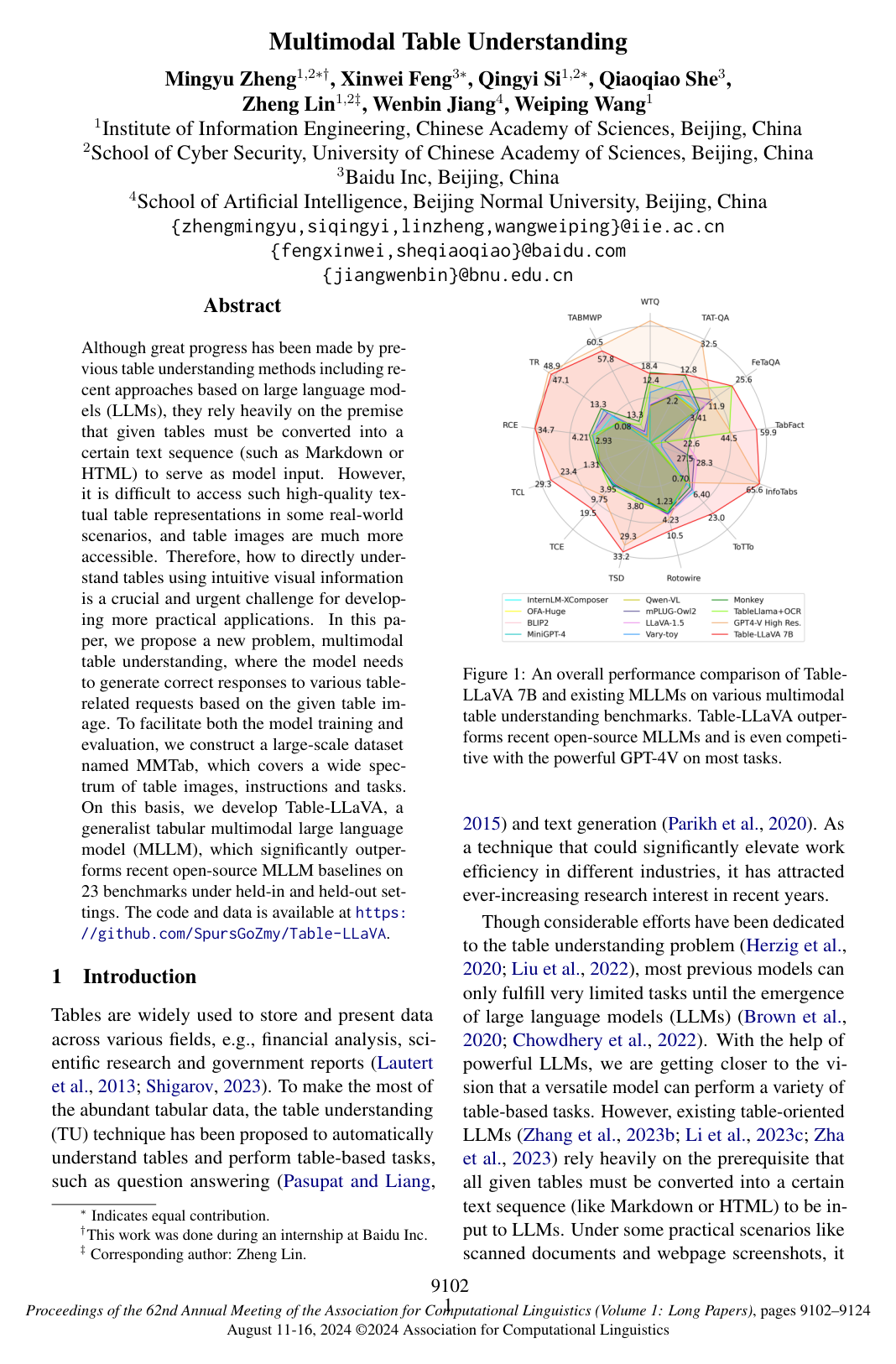
Multimodal Table Understanding
Mingyu Zheng, Xinwei Feng, Qingyi Si, Qiaoqiao She, Zheng Lin, Wenbin Jiang, Weiping Wang
Why you should read this
Presents the MMTab dataset and Table-LLaVA, an open-source multimodal model that directly interprets table images without requiring text serialization, outperforming existing vision-language baselines across 23 tabular benchmarks.
Although great progress has been made by previous table understanding methods including recent approaches based on large language models (LLMs), they rely heavily on the premise that given tables must be converted into a certain text sequence (such as Markdown or HTML) to serve as model input. However, it is difficult to access such high-quality textual table representations in some real-world scenarios, and table images are much more accessible. Therefore, how to directly understand tables using intuitive visual information is a crucial and urgent challenge for developing more practical applications. In this paper, we propose a new problem, multimodal table understanding, where the model needs to generate correct responses to various table-related requests based on the given table image. To facilitate both the model training and evaluation, we construct a large-scale dataset named MMTab, which covers a wide spectrum of table images, instructions and tasks. On this basis, we develop Table-LLaVA, a generalist tabular multimodal large language model (MLLM), which significantly outperforms recent open-source MLLM baselines on 23 benchmarks under held-in and held-out settings. The code and data is available at https://github.com/SpursGoZmy/Table-LLaVA.
Added
2026-10-03
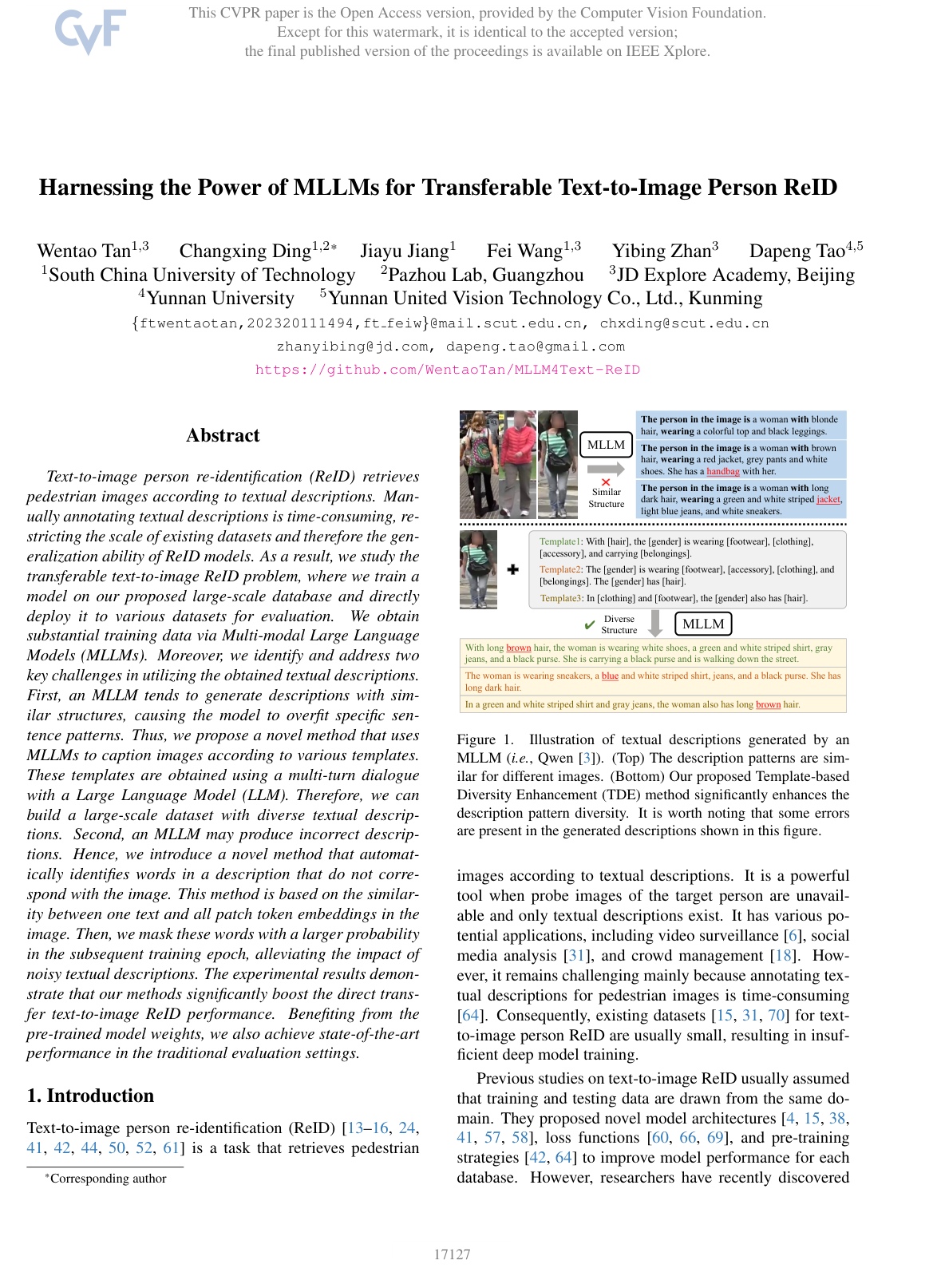
Harnessing the Power of MLLMs for Transferable Text-to-Image Person ReID
Wentao Tan, Changxing Ding, Jiayu Jiang, Fei Wang, Yibing Zhan, Dapeng Tao
Why you should read this
Proposes a scalable framework for transferable text-to-image person re-identification that uses multimodal large language models to generate diverse text annotations via dynamic templates while filtering out hallucinated descriptions with noise-aware masking.
Text-to-image person re-identification (ReID) retrieves pedestrian images according to textual descriptions. Manually annotating textual descriptions is time-consuming, restricting the scale of existing datasets and therefore the generalization ability of ReID models. As a result, we study the transferable text-to-image ReID problem, where we train a model on our proposed large-scale database and directly deploy it to various datasets for evaluation. We obtain substantial training data via Multi-modal Large Language Models (MLLMs). Moreover, we identify and address two key challenges in utilizing the obtained textual descriptions. First, an MLLM tends to generate descriptions with similar structures, causing the model to overfit specific sentence patterns. Thus, we propose a novel method that uses MLLMs to caption images according to various templates. These templates are obtained using a multi-turn dialogue with a Large Language Model (LLM). Therefore, we can build a large-scale dataset with diverse textual descriptions. Second, an MLLM may produce incorrect descriptions. Hence, we introduce a novel method that automatically identifies words in a description that do not correspond with the image. This method is based on the similarity between one text and all patch token embeddings in the image. Then, we mask these words with a larger probability in the subsequent training epoch, alleviating the impact of noisy textual descriptions. The experimental results demonstrate that our methods significantly boost the direct transfer text-to-image ReID performance. Benefiting from the pre-trained model weights, we also achieve state-of-the-art performance in the traditional evaluation settings.
Added
2026-09-26
T2I-CompBench: A Comprehensive Benchmark for Open-world Compositional Text-to-image Generation
Kaiyi Huang, Kaiyue Sun, Enze Xie, Zhenguo Li, Xihui Liu
Why you should read this
Proposes a 6,000-prompt benchmark with human-correlated evaluation metrics to systematically assess and improve attribute binding and object relationships in compositional text-to-image generation.
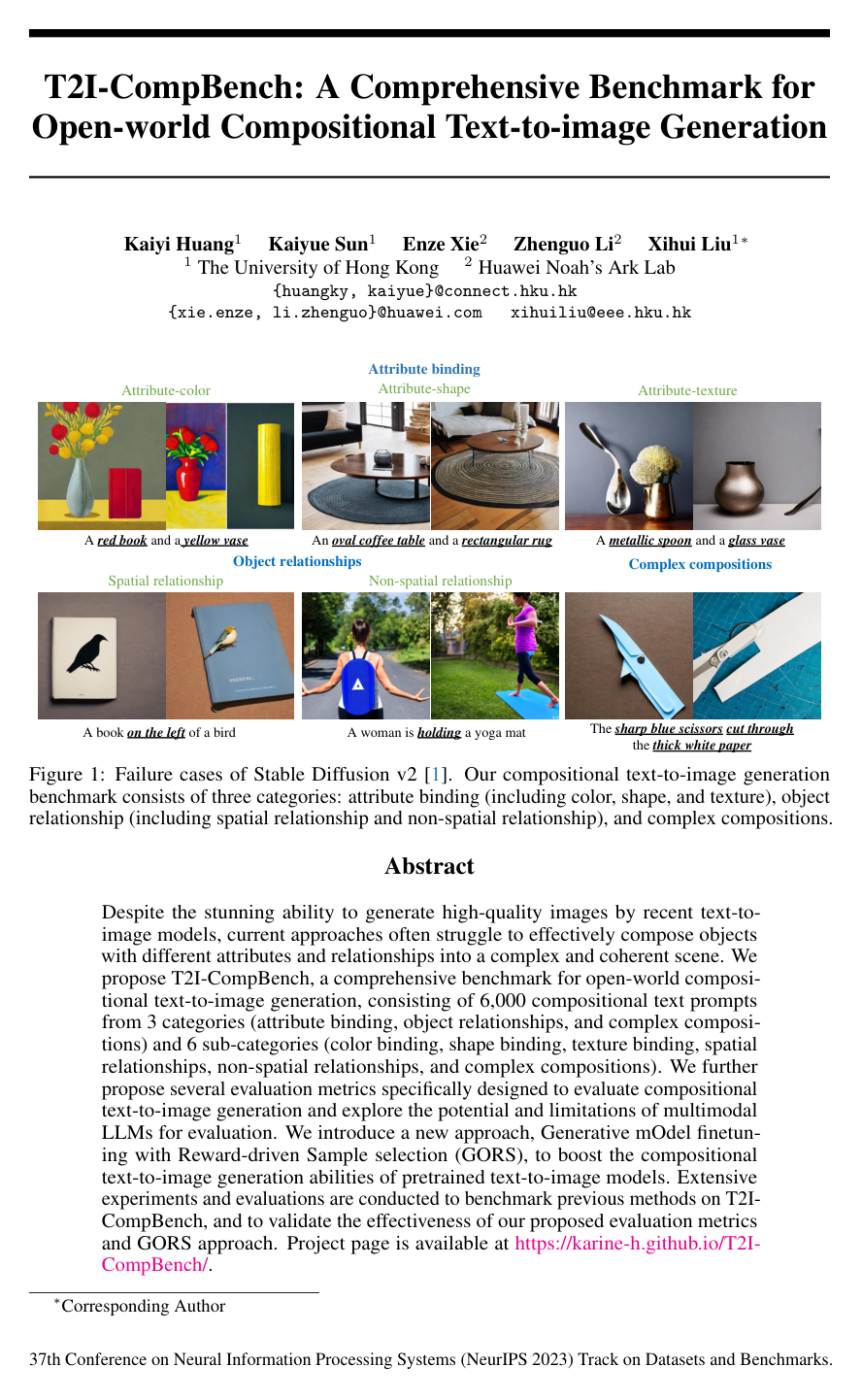
Despite the stunning ability to generate high-quality images by recent text-to-image models, current approaches often struggle to effectively compose objects with different attributes and relationships into a complex and coherent scene. We propose T2I-CompBench, a comprehensive benchmark for open-world compositional text-to-image generation, consisting of 6,000 compositional text prompts from 3 categories (attribute binding, object relationships, and complex compositions) and 6 sub-categories (color binding, shape binding, texture binding, spatial relationships, non-spatial relationships, and complex compositions). We further propose several evaluation metrics specifically designed to evaluate compositional text-to-image generation and explore the potential and limitations of multimodal LLMs for evaluation. We introduce a new approach, Generative mOdel finetuning with Reward-driven Sample selection (GORS), to boost the compositional text-to-image generation abilities of pretrained text-to-image models. Extensive experiments and evaluations are conducted to benchmark previous methods on T2I-CompBench, and to validate the effectiveness of our proposed evaluation metrics and GORS approach. Project page is available at https://karine-h.github.io/T2I-CompBench/.
Added
2026-09-26
A survey on multimodal large language models
Shukang Yin, Chaoyou Fu, Sirui Zhao, Ke Li, Xing Sun, Tong Xu, Enhong Chen
Why you should read this
Synthesizes the rapid progress in Multimodal Large Language Models by structuring their core architectures, training strategies, and evaluation protocols while detailing critical advanced topics such as multimodal hallucination, chain-of-thought reasoning, and cross-modal extensions.
Recently, Multimodal Large Language Model (MLLM) represented by GPT-4V has been a new rising research hotspot, which uses powerful Large Language Models (LLMs) as a brain to perform multimodal tasks. The surprising emergent capabilities of MLLM, such as writing stories based on images and OCR-free math reasoning, are rare in traditional multimodal methods, suggesting a potential path to artificial general intelligence. To this end, both academia and industry have endeavored to develop MLLMs that can compete with or even better than GPT-4V, pushing the limit of research at a surprising speed. In this paper, we aim to trace and summarize the recent progress of MLLMs. First of all, we present the basic formulation of MLLM and delineate its related concepts, including architecture, training strategy and data, as well as evaluation. Then, we introduce research topics about how MLLMs can be extended to support more granularity, modalities, languages, and scenarios. We continue with multimodal hallucination and extended techniques, including Multimodal ICL (M-ICL), Multimodal CoT (M-CoT), and LLM-Aided Visual Reasoning (LAVR). To conclude the paper, we discuss existing challenges and point out promising research directions. In light of the fact that the era of MLLM has only just begun, we will keep updating this survey and hope it can inspire more research. An associated GitHub link collecting the latest papers is available at this https URL.
Added
2026-09-24
MiniGPT-4: Enhancing Vision-Language Understanding with Advanced Large Language Models
Deyao Zhu, Jun Chen, Xiaoqian Shen, Xiang Li, Mohamed Elhoseiny
Why you should read this
Introduces MiniGPT-4, a model that achieves sophisticated GPT-4-like multi-modal capabilities, such as website generation from sketches and complex humor interpretation, by aligning a frozen visual encoder with an advanced large language model through a single linear projection layer.
The recent GPT-4 has demonstrated extraordinary multi-modal abilities, such as directly generating websites from handwritten text and identifying humorous elements within images. These features are rarely observed in previous vision-language models. However, the technical details behind GPT-4 continue to remain undisclosed. We believe that the enhanced multi-modal generation capabilities of GPT-4 stem from the utilization of sophisticated large language models (LLM). To examine this phenomenon, we present MiniGPT-4, which aligns a frozen visual encoder with a frozen advanced LLM, Vicuna, using one projection layer. Our work, for the first time, uncovers that properly aligning the visual features with an advanced large language model can possess numerous advanced multi-modal abilities demonstrated by GPT-4, such as detailed image description generation and website creation from hand-drawn drafts. Furthermore, we also observe other emerging capabilities in MiniGPT-4, including writing stories and poems inspired by given images, teaching users how to cook based on food photos, and so on. In our experiment, we found that the model trained on short image caption pairs could produce unnatural language outputs (e.g., repetition and fragmentation). To address this problem, we curate a detailed image description dataset in the second stage to finetune the model, which consequently improves the model's generation reliability and overall usability. Our code, pre-trained model, and collected dataset are available at https://minigpt-4.github.io/.
Added
2026-05-13
BLIP: Bootstrapping Language-Image Pre-training for Unified Vision-Language Understanding and Generation
Junnan Li, Dongxu Li, Caiming Xiong, Steven Hoi
Why you should read this
Introduces BLIP, a novel vision-language pre-training framework that unifies understanding and generation tasks and effectively leverages noisy web data through a unique caption bootstrapping mechanism, achieving state-of-the-art performance across diverse benchmarks.
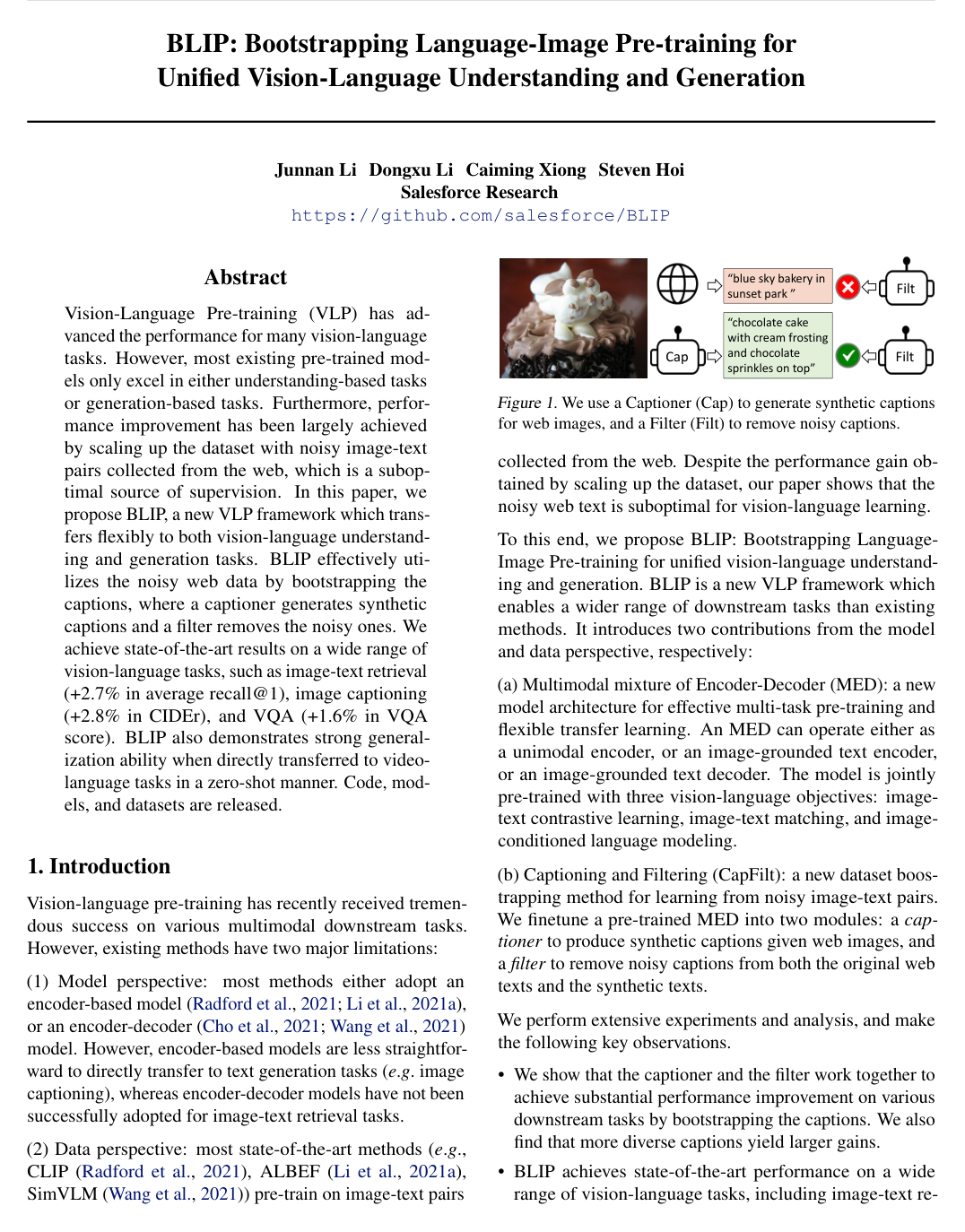
Vision-Language Pre-training (VLP) has advanced the performance for many vision-language tasks. However, most existing pre-trained models only excel in either understanding-based tasks or generation-based tasks. Furthermore, performance improvement has been largely achieved by scaling up the dataset with noisy image-text pairs collected from the web, which is a suboptimal source of supervision. In this paper, we propose BLIP, a new VLP framework which transfers flexibly to both vision-language understanding and generation tasks. BLIP effectively utilizes the noisy web data by bootstrapping the captions, where a captioner generates synthetic captions and a filter removes the noisy ones. We achieve state-of-the-art results on a wide range of vision-language tasks, such as image-text retrieval (+2.7% in average recall@1), image captioning (+2.8% in CIDEr), and VQA (+1.6% in VQA score). BLIP also demonstrates strong generalization ability when directly transferred to video-language tasks in a zero-shot manner. Code, models, and datasets are released at this https URL.
Added
2026-05-13
