
keyword
vision-language tasks
Vision-language tasks are tasks that require a system to interpret or connect visual information, such as images or video, with language. Examples include describing an image, answering questions about visual content, matching images with text, and locating in an image the object or region referred to by text.
12 items
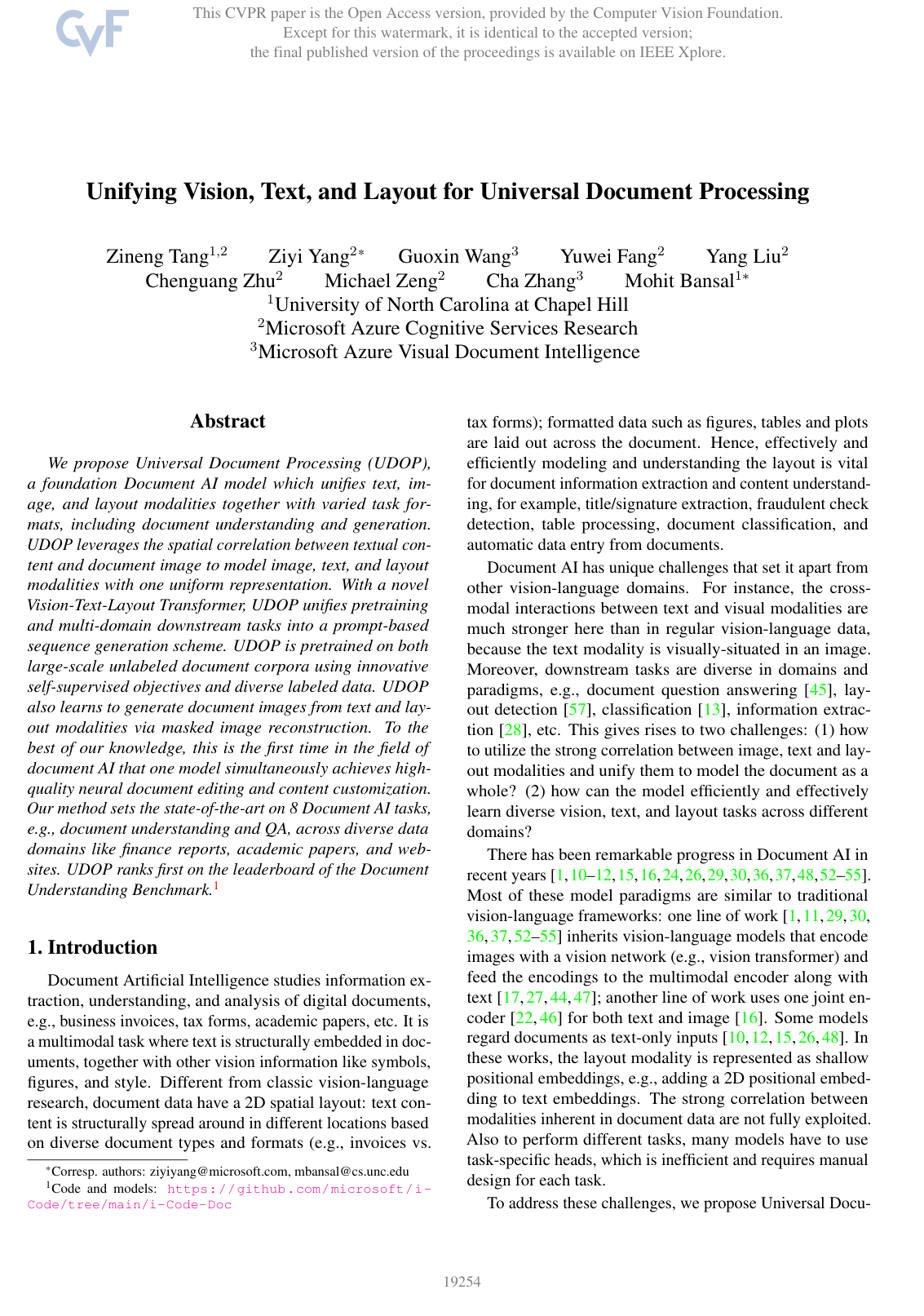
Unifying Vision, Text, and Layout for Universal Document Processing
Zineng Tang, Ziyi Yang, Guoxin Wang, Yuwei Fang, Yang Liu, Chenguang Zhu, Michael Zeng, Cha Zhang, Mohit Bansal
Why you should read this
Proposes UDOP, a unified foundation model that fuses text, layout, and visual modalities into a single sequence-to-sequence framework to achieve state-of-the-art results across diverse document understanding and generation tasks.
Added
2026-10-05
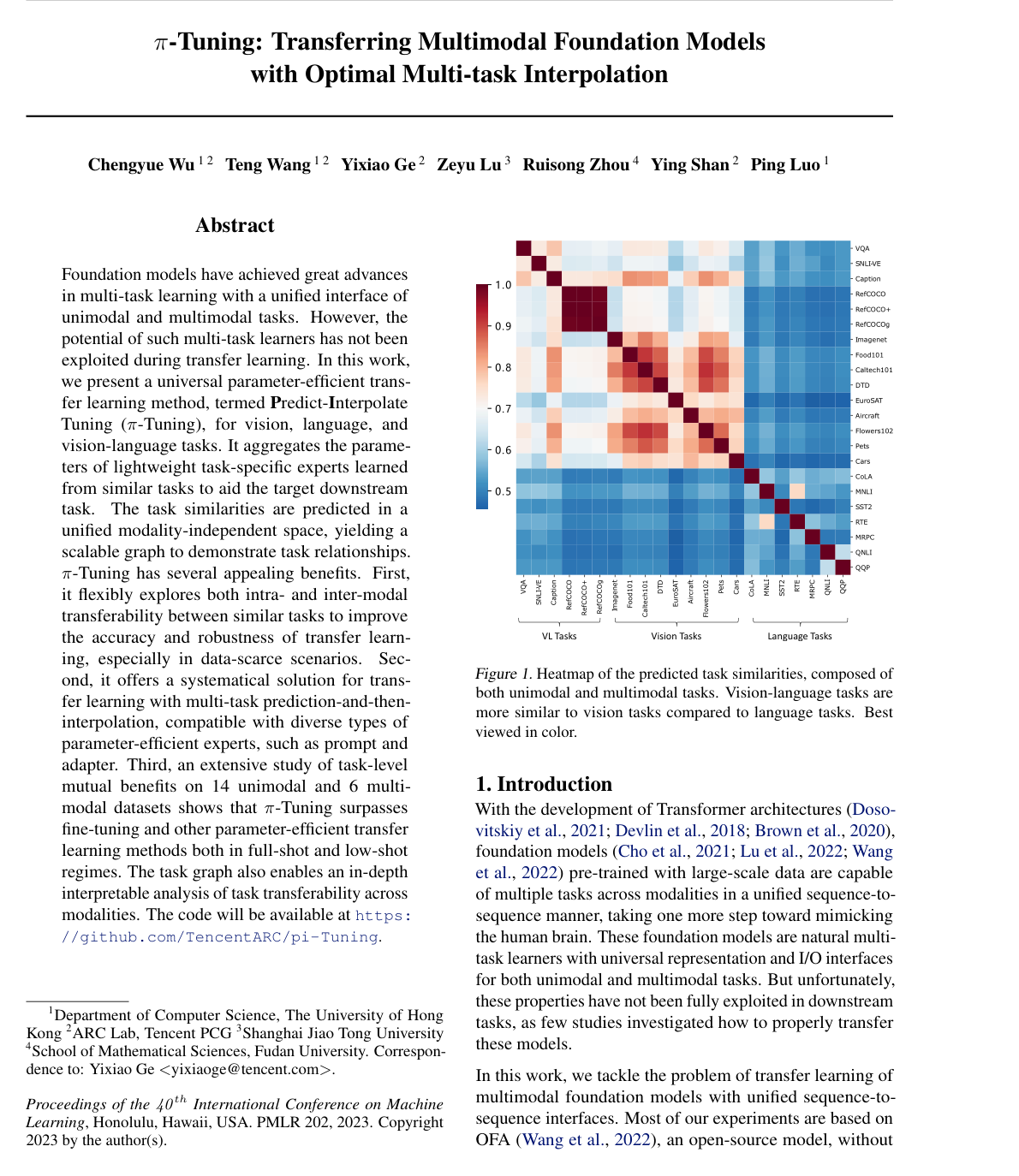
π-Tuning: Transferring Multimodal Foundation Models with Optimal Multi-task Interpolation
Chengyue Wu, Teng Wang, Yixiao Ge, Zeyu Lu, Ruisong Zhou, Ying Shan, Ping Luo
Why you should read this
Proposes -Tuning, a parameter-efficient transfer framework that maps cross-modal task similarities using Fisher information embeddings and interpolates lightweight task experts to improve downstream vision, language, and multimodal performance.
Foundation models have achieved great advances in multi-task learning with a unified interface of unimodal and multimodal tasks. However, the potential of such multi-task learners has not been exploited during transfer learning. In this work, we present a universal parameter-efficient transfer learning method, termed Predict-Interpolate Tuning (π-Tuning), for vision, language, and vision-language tasks. It aggregates the parameters of lightweight task-specific experts learned from similar tasks to aid the target downstream task. The task similarities are predicted in a unified modality-independent space, yielding a scalable graph to demonstrate task relationships. π-Tuning has several appealing benefits. First, it flexibly explores both intra- and inter-modal transferability between similar tasks to improve the accuracy and robustness of transfer learning, especially in data-scarce scenarios. Second, it offers a systematical solution for transfer learning with multi-task prediction-and-then-interpolation, compatible with diverse types of parameter-efficient experts, such as prompt and adapter. Third, an extensive study of task-level mutual benefits on 14 unimodal and 6 multimodal datasets shows that π-Tuning surpasses fine-tuning and other parameter-efficient transfer learning methods both in full-shot and low-shot regimes. The task graph also enables an in-depth interpretable analysis of task transferability across modalities. The code will be available at https://github.com/TencentARC/pi-Tuning.
Added
2026-10-03
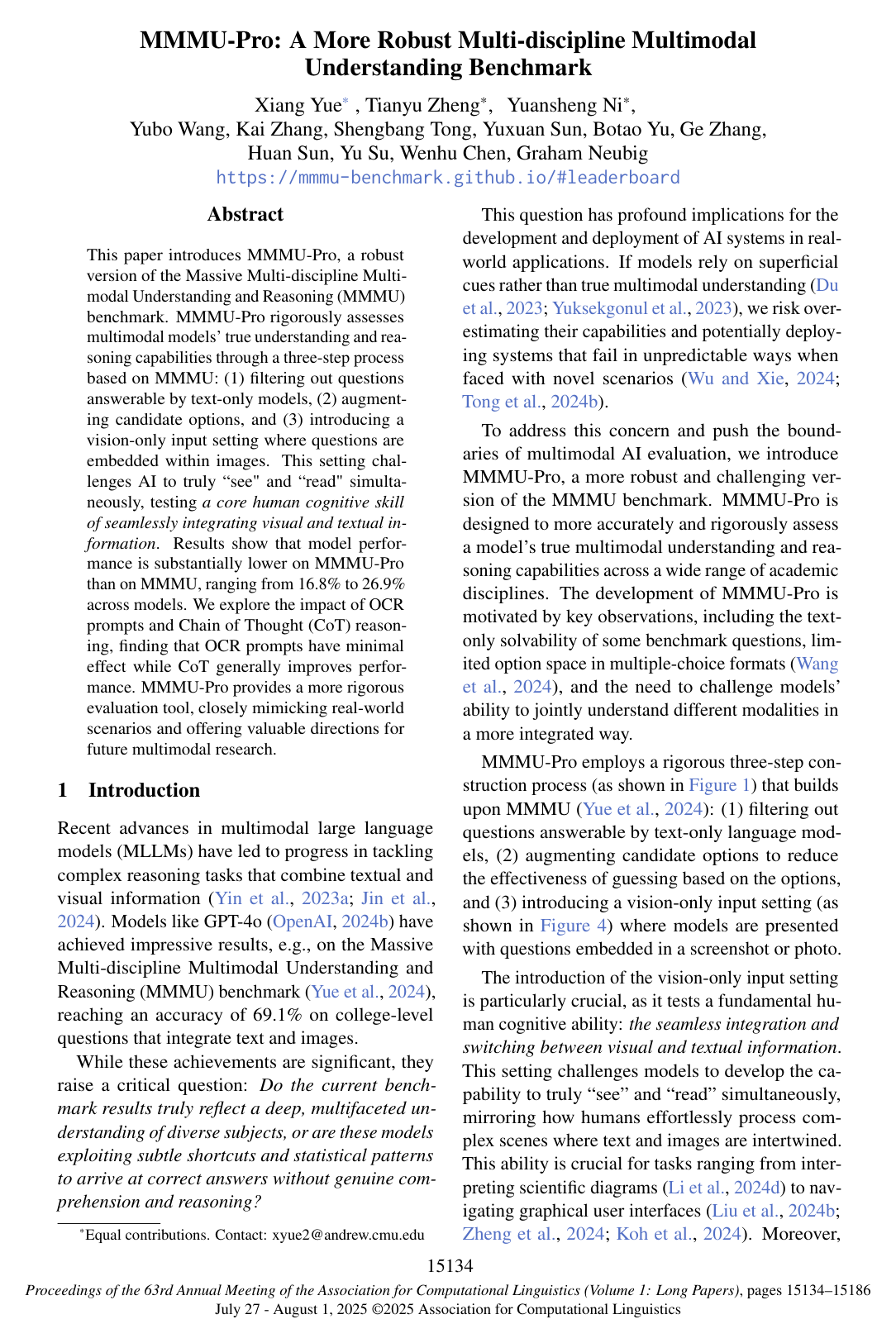
MMMU-Pro: A More Robust Multi-discipline Multimodal Understanding Benchmark
Xiang Yue, Tianyu Zheng, Yuansheng Ni, Yubo Wang, Kai Zhang, Shengbang Tong, Yuxuan Sun, Botao Yu, Ge Zhang, Huan Sun, Yu Su, Wenhu Chen, Graham Neubig
Why you should read this
Introduces MMMU-Pro, an advanced multimodal benchmark that eliminates text-only shortcuts, expands answer choices, and embeds text within images to expose severe performance drops in leading vision-language models.
This paper introduces MMMU-Pro, a robust version of the Massive Multi-discipline Multimodal Understanding and Reasoning (MMMU) benchmark. MMMU-Pro rigorously assesses multimodal models’ true understanding and reasoning capabilities through a three-step process based on MMMU: (1) filtering out questions answerable by text-only models, (2) augmenting candidate options, and (3) introducing a vision-only input setting where questions are embedded within images. This setting challenges AI to truly “see” and “read” simultaneously, testing a core human cognitive skill of seamlessly integrating visual and textual information. Results show that model performance is substantially lower on MMMU-Pro than on MMMU, ranging from 16.8% to 26.9% across models. We explore the impact of OCR prompts and Chain of Thought (CoT) reasoning, finding that OCR prompts have minimal effect while CoT generally improves performance. MMMU-Pro provides a more rigorous evaluation tool, closely mimicking real-world scenarios and offering valuable directions for future multimodal research.
Added
2026-09-28
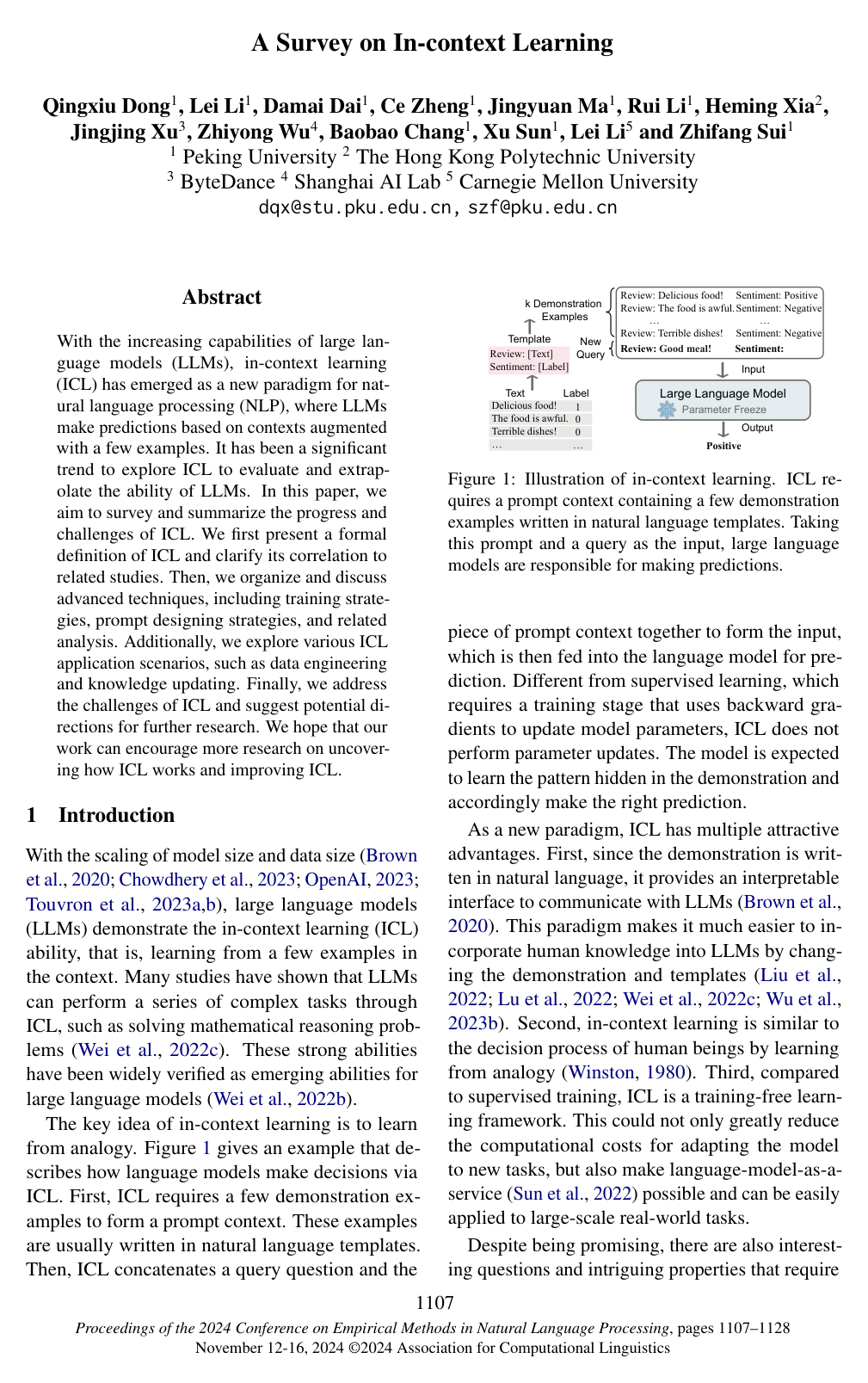
A Survey on In-context Learning
Qingxiu Dong, Lei Li, Damai Dai, Ce Zheng, Jingyuan Ma, Rui Li, Heming Xia, Jingjing Xu, Zhiyong Wu, Baobao Chang, Xu Sun, Lei Li, Zhifang Sui
Why you should read this
Presents a structured taxonomy of in-context learning techniques for large language models, covering model training, demonstration design, underlying mechanisms, and key challenges to guide future research.
With the increasing capabilities of large language models (LLMs), in-context learning (ICL) has emerged as a new paradigm for natural language processing (NLP), where LLMs make predictions based on contexts augmented with a few examples. It has been a significant trend to explore ICL to evaluate and extrapolate the ability of LLMs. In this paper, we aim to survey and summarize the progress and challenges of ICL. We first present a formal definition of ICL and clarify its correlation to related studies. Then, we organize and discuss advanced techniques, including training strategies, prompt designing strategies, and related analysis. Additionally, we explore various ICL application scenarios, such as data engineering and knowledge updating. Finally, we address the challenges of ICL and suggest potential directions for further research. We hope that our work can encourage more research on uncovering how ICL works and improving ICL.
Added
2026-09-28
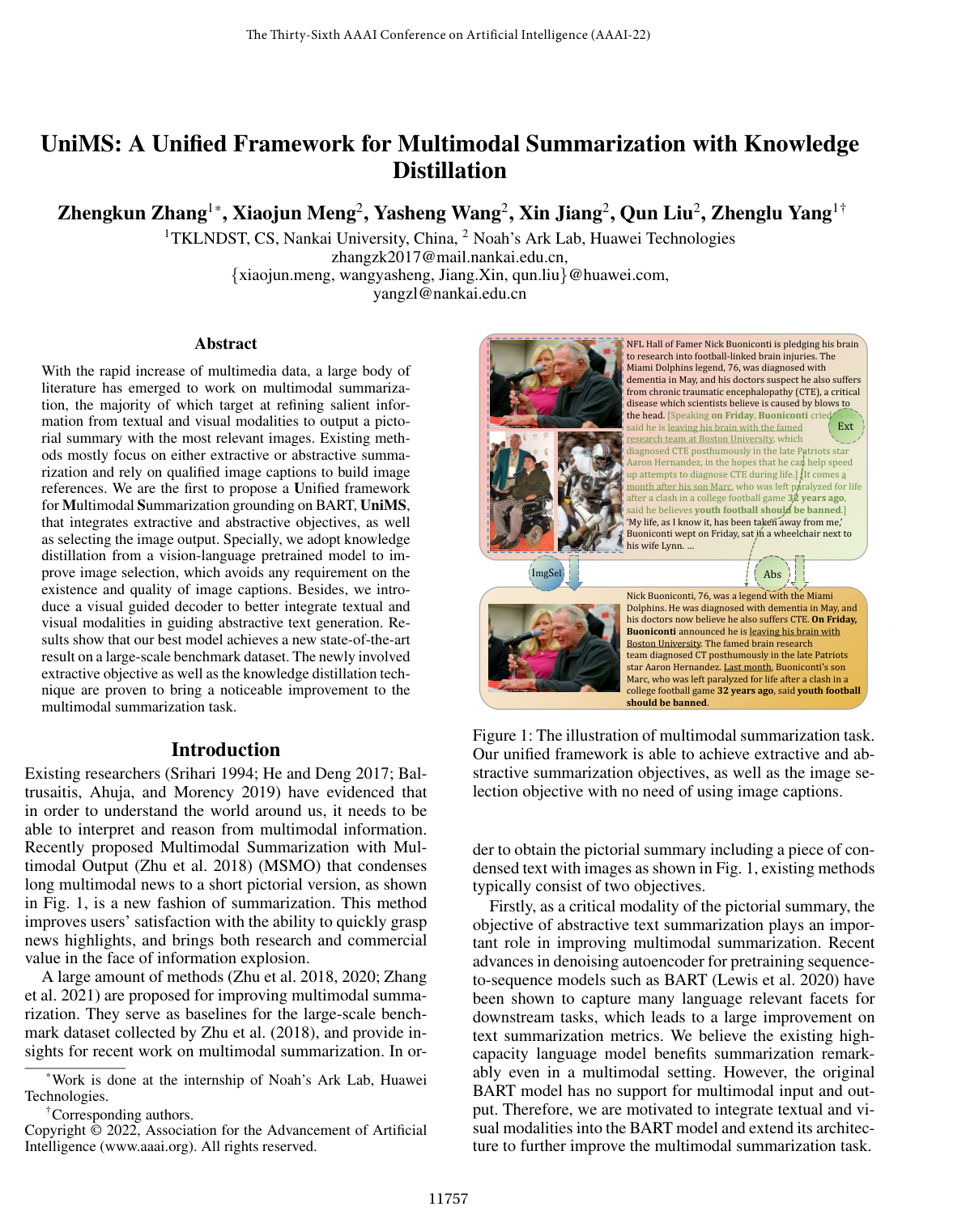
UniMS: A Unified Framework for Multimodal Summarization with Knowledge Distillation
Zhengkun Zhang, Xiaojun Meng, Yasheng Wang, Xin Jiang, Qun Liu, Zhenglu Yang
Why you should read this
Proposes a unified multimodal summarization framework extending BART that jointly handles extractive, abstractive, and image selection tasks while using CLIP-based knowledge distillation to eliminate the need for image captions.
With the rapid increase of multimedia data, a large body of literature has emerged to work on multimodal summarization, the majority of which target at refining salient information from textual and visual modalities to output a pictorial summary with the most relevant images. Existing methods mostly focus on either extractive or abstractive summarization and rely on qualified image captions to build image references. We are the first to propose a Unified framework for Multimodal Summarization grounding on BART, UniMS, that integrates extractive and abstractive objectives, as well as selecting the image output. Specially, we adopt knowledge distillation from a vision-language pretrained model to improve image selection, which avoids any requirement on the existence and quality of image captions. Besides, we introduce a visual guided decoder to better integrate textual and visual modalities in guiding abstractive text generation. Results show that our best model achieves a new state-of-the-art result on a large-scale benchmark dataset. The newly involved extractive objective as well as the knowledge distillation technique are proven to bring a noticeable improvement to the multimodal summarization task.
Added
2026-09-26
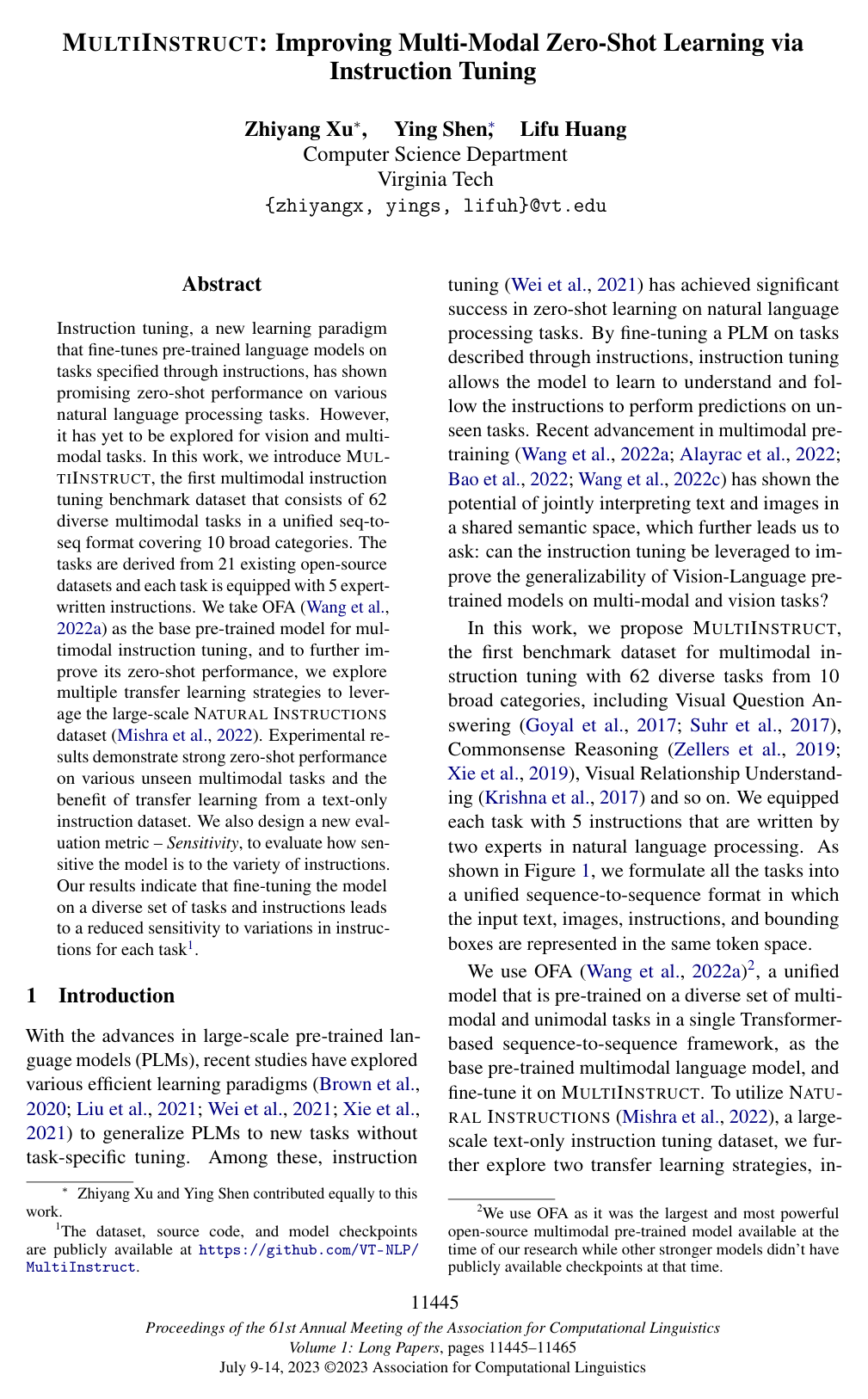
MultiInstruct: Improving Multi-Modal Zero-Shot Learning via Instruction Tuning
Zhiyang Xu, Ying Shen, Lifu Huang
Why you should read this
Introduces the first multimodal instruction tuning benchmark spanning 62 diverse tasks across 10 categories to boost zero-shot generalization and reduce sensitivity to prompt phrasing in vision-language models.
Instruction tuning, a new learning paradigm that fine-tunes pre-trained language models on tasks specified through instructions, has shown promising zero-shot performance on various natural language processing tasks. However, it has yet to be explored for vision and multimodal tasks. In this work, we introduce MULTIINSTRUCT, the first multimodal instruction tuning benchmark dataset that consists of 62 diverse multimodal tasks in a unified seq-to-seq format covering 10 broad categories. The tasks are derived from 21 existing open-source datasets and each task is equipped with 5 expert-written instructions. We take OFA (Wang et al., 2022a) as the base pre-trained model for multimodal instruction tuning, and to further improve its zero-shot performance, we explore multiple transfer learning strategies to leverage the large-scale NATURAL INSTRUCTIONS dataset (Mishra et al., 2022). Experimental results demonstrate strong zero-shot performance on various unseen multimodal tasks and the benefit of transfer learning from a text-only instruction dataset. We also design a new evaluation metric – Sensitivity, to evaluate how sensitive the model is to the variety of instructions. Our results indicate that fine-tuning the model on a diverse set of tasks and instructions leads to a reduced sensitivity to variations in instructions for each task1.
Added
2026-09-26
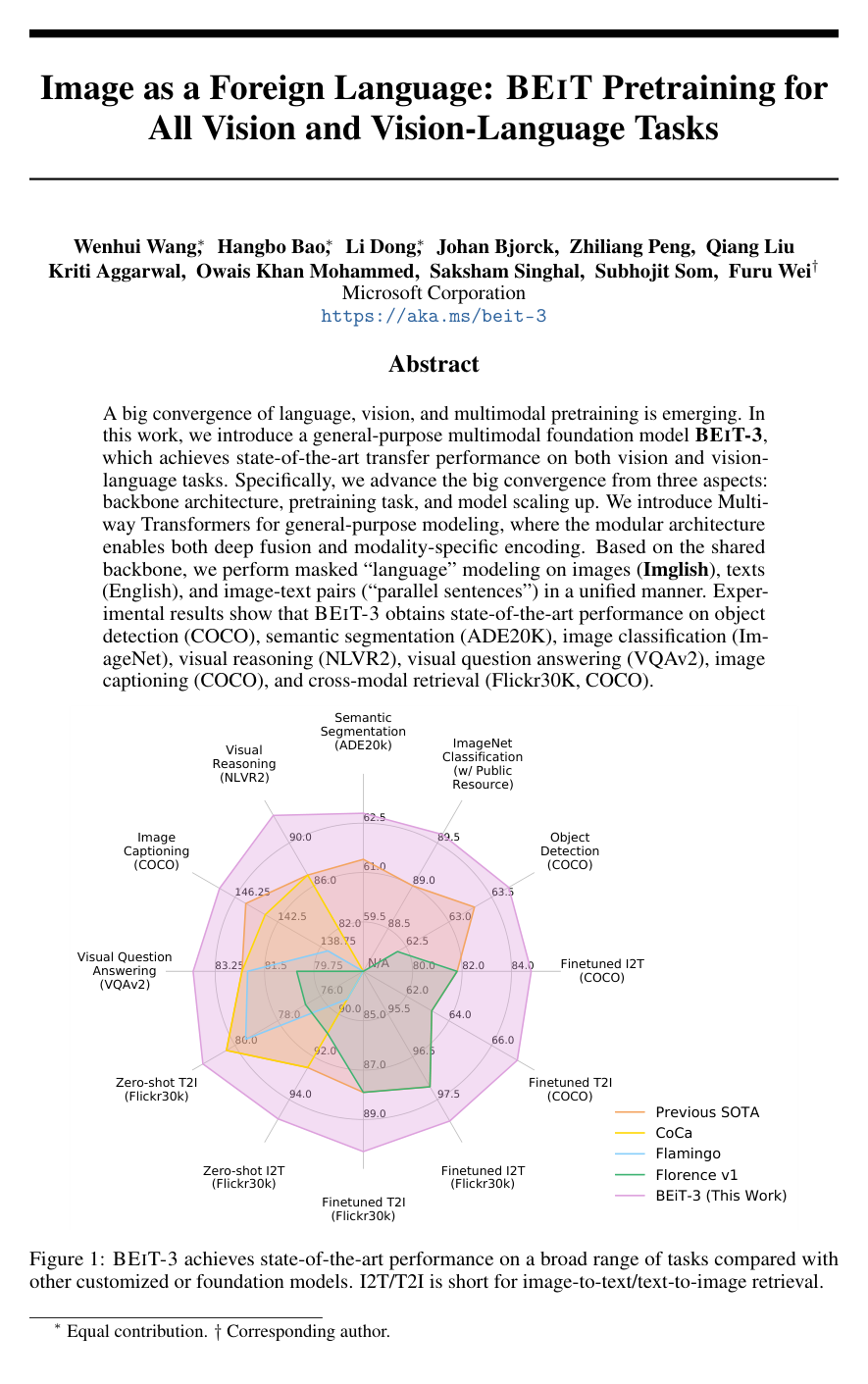
Image as a Foreign Language: BEIT Pretraining for Vision and Vision-Language Tasks
Wenhui Wang, Hangbo Bao, Li Dong, Johan Bjorck, Zhiliang Peng, Qiang Liu, Kriti Aggarwal, Owais Khan Mohammed, Saksham Singhal, Subhojit Som, Furu Wei
Why you should read this
Introduces BEiT-3, a unified multimodal foundation model that treats images as a foreign language and pretrains a Multiway Transformer via masked data modeling to achieve state-of-the-art transfer performance across major vision and vision-language benchmarks.
A big convergence of language, vision, and multimodal pretraining is emerging. In this work, we introduce a general-purpose multimodal foundation model BEiT-3, which achieves state-of-the-art transfer performance on both vision and vision-language tasks. Specifically, we advance the big convergence from three aspects: backbone architecture, pretraining task, and model scaling up. We introduce Multiway Transformers for general-purpose modeling, where the modular architecture enables both deep fusion and modality-specific encoding. Based on the shared backbone, we perform masked "language" modeling on images (Imglish), texts (English), and image-text pairs ("parallel sentences") in a unified manner. Experimental results show that BEiT-3 obtains state-of-the-art performance on object detection (COCO), semantic segmentation (ADE20K), image classification (ImageNet), visual reasoning (NLVR2), visual question answering (VQAv2), image captioning (COCO), and cross-modal retrieval (Flickr30K, COCO).
Added
2026-09-26
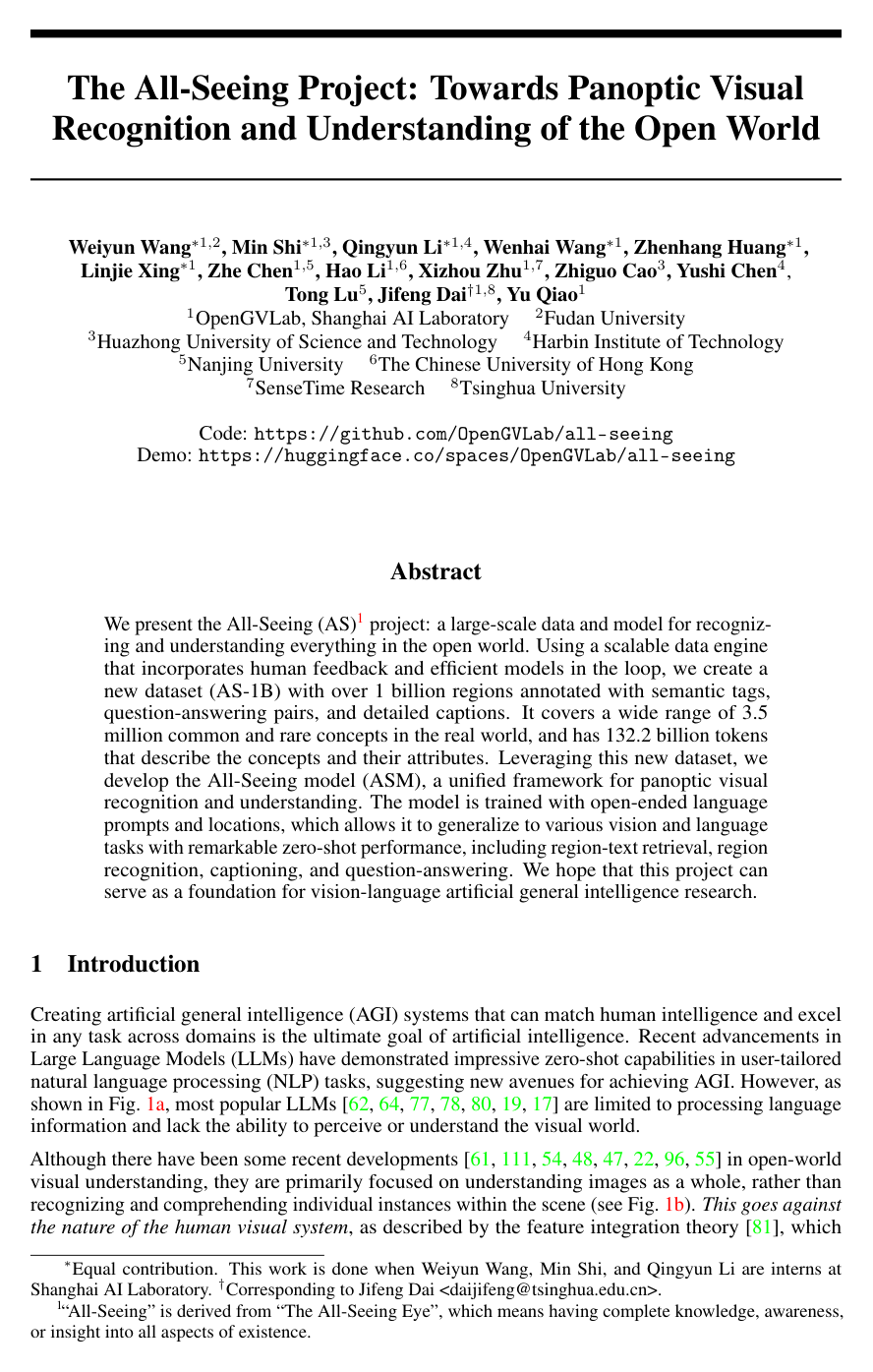
The All-Seeing Project: Towards Panoptic Visual Recognition and Understanding of the Open World
Weiyun Wang, Min Shi, Qingyun Li, Wenhai Wang, Zhenhang Huang, Linjie Xing, Zhe Chen, Hao Li, Xizhou Zhu, Zhiguo Cao, Yushi Chen, Tong Lu, Jifeng Dai, Yu Qiao
Why you should read this
Introduces a billion-region dataset covering 3.5 million concepts alongside a unified vision-language model that achieves strong zero-shot performance across region-level recognition, captioning, and question answering in the open world.
We present the All-Seeing (AS) project: a large-scale data and model for recognizing and understanding everything in the open world. Using a scalable data engine that incorporates human feedback and efficient models in the loop, we create a new dataset (AS-1B) with over 1 billion regions annotated with semantic tags, question-answering pairs, and detailed captions. It covers a wide range of 3.5 million common and rare concepts in the real world, and has 132.2 billion tokens that describe the concepts and their attributes. Leveraging this new dataset, we develop the All-Seeing model (ASM), a unified framework for panoptic visual recognition and understanding. The model is trained with open-ended language prompts and locations, which allows it to generalize to various vision and language tasks with remarkable zero-shot performance, including region-text retrieval, region recognition, captioning, and question-answering. We hope that this project can serve as a foundation for vision-language artificial general intelligence research. Models and the dataset shall be released at this https URL, and demo can be seen at this https URL.
Added
2026-09-26
Evaluating Object Hallucination in Large Vision-Language Models
Yifan Li, Yifan Du, Kun Zhou, Jinpeng Wang, Wayne Xin Zhao, Ji-Rong Wen
Why you should read this
Presents POPE, a polling-based evaluation method that reliably measures object hallucination in large vision-language models while identifying how visual instruction biases trigger these generative errors.
Inspired by the superior language abilities of large language models (LLM), large vision-language models (LVLM) have been recently explored by integrating powerful LLMs for improving the performance on complex multimodal tasks. Despite the promising progress on LVLMs, we find that LVLMs suffer from the hallucination problem, i.e. they tend to generate objects that are inconsistent with the target images in the descriptions. To investigate it, this work presents the first systematic study on object hallucination of LVLMs. We conduct the evaluation experiments on several representative LVLMs, and show that they mostly suffer from severe object hallucination issue. We further discuss that the visual instructions may influence the hallucination, and find that: objects that frequently occur in the visual instructions or co-occur with the image objects, are obviously prone to be hallucinated by LVLMs. Besides, we find that existing evaluation methods might be affected by the input instructions and generation styles of LVLMs. Thus, we further design an improved evaluation method for object hallucination by proposing a polling-based query method called POPE. Experiment results demonstrate that our POPE can evaluate the object hallucination in a more stable and flexible way. Our codes and data are publicly available at this https URL.
Added
2026-09-18
Oscar: Object-Semantics Aligned Pre-training for Vision-Language Tasks
Xiujun Li, Xi Yin, Chunyuan Li, Xiaowei Hu, Pengchuan Zhang, Lei Zhang, Lijuan Wang, Houdong Hu, Li Dong, Furu Wei, Yejin Choi, Jianfeng Gao
Why you should read this
Proposes Oscar, a vision-language pre-training framework that uses detected object tags as semantic anchor points to improve cross-modal alignment and establish new state-of-the-art results across six understanding and generation benchmarks.
Large-scale pre-training methods of learning cross-modal representations on image-text pairs are becoming popular for vision-language tasks. While existing methods simply concatenate image region features and text features as input to the model to be pre-trained and use self-attention to learn image-text semantic alignments in a brute force manner, in this paper, we propose a new learning method Oscar (Object-Semantics Aligned Pre-training), which uses object tags detected in images as anchor points to significantly ease the learning of alignments. Our method is motivated by the observation that the salient objects in an image can be accurately detected, and are often mentioned in the paired text. We pre-train an Oscar model on the public corpus of 6.5 million text-image pairs, and fine-tune it on downstream tasks, creating new state-of-the-arts on six well-established vision-language understanding and generation tasks.
Added
2026-09-16
DoRA: Weight-Decomposed Low-Rank Adaptation
Shih-Yang Liu, Chien-Yi Wang, Hongxu Yin, Pavlo Molchanov, Yu-Chiang Frank Wang, Kwang‐Ting Cheng, Min-Hung Chen
Why you should read this
Decomposes pre-trained weights into magnitude and directional components to apply low-rank updates solely to the direction for superior mathematical properties and training stability.
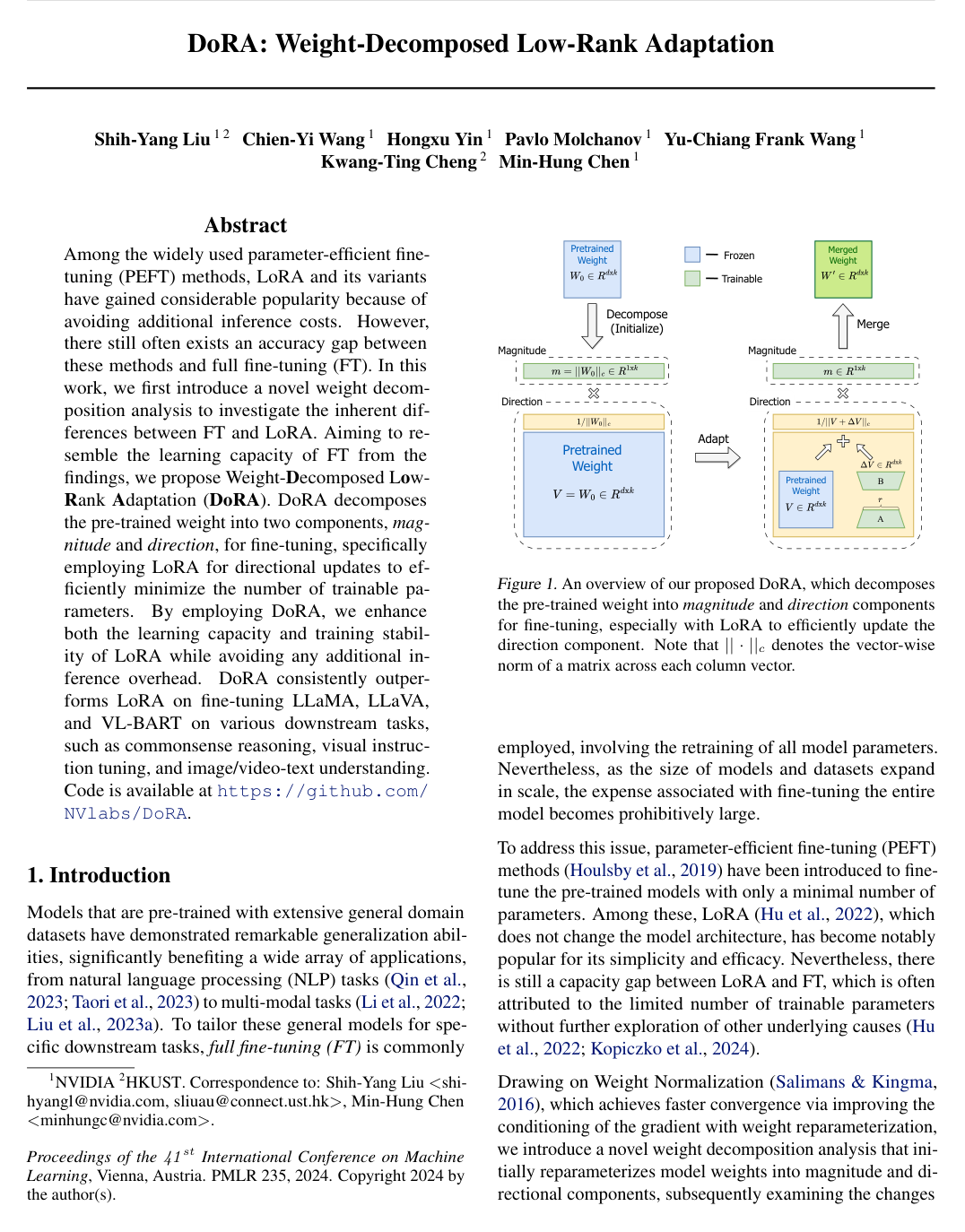
Among the widely used parameter-efficient fine-tuning (PEFT) methods, LoRA and its variants have gained considerable popularity because of avoiding additional inference costs. However, there still often exists an accuracy gap between these methods and full fine-tuning (FT). In this work, we first introduce a novel weight decomposition analysis to investigate the inherent differences between FT and LoRA. Aiming to resemble the learning capacity of FT from the findings, we propose Weight-Decomposed Low-Rank Adaptation (DoRA). DoRA decomposes the pre-trained weight into two components, magnitude and direction, for fine-tuning, specifically employing LoRA for directional updates to efficiently minimize the number of trainable parameters. By employing \ours, we enhance both the learning capacity and training stability of LoRA while avoiding any additional inference overhead. \ours~consistently outperforms LoRA on fine-tuning LLaMA, LLaVA, and VL-BART on various downstream tasks, such as commonsense reasoning, visual instruction tuning, and image/video-text understanding. Code is available at https://github.com/NVlabs/DoRA.
Added
2026-06-22
PaLM-E: An Embodied Multimodal Language Model
Danny Driess, Fei Xia, Mehdi S. M. Sajjadi, Corey Lynch, Aakanksha Chowdhery, Brian Ichter, Ayzaan Wahid, Jonathan Tompson, Quan Vuong, Tianhe Yu, Wenlong Huang, Yevgen Chebotar, Pierre Sermanet, Daniel Duckworth, Sergey Levine, Vincent Vanhoucke, Karol Hausman, Marc Toussaint, Klaus Greff, Andy Zeng, Igor Mordatch, Pete Florence
Why you should read this
Integrates real-world continuous sensor data into a language model, allowing the AI to reason about and act upon the physical world.
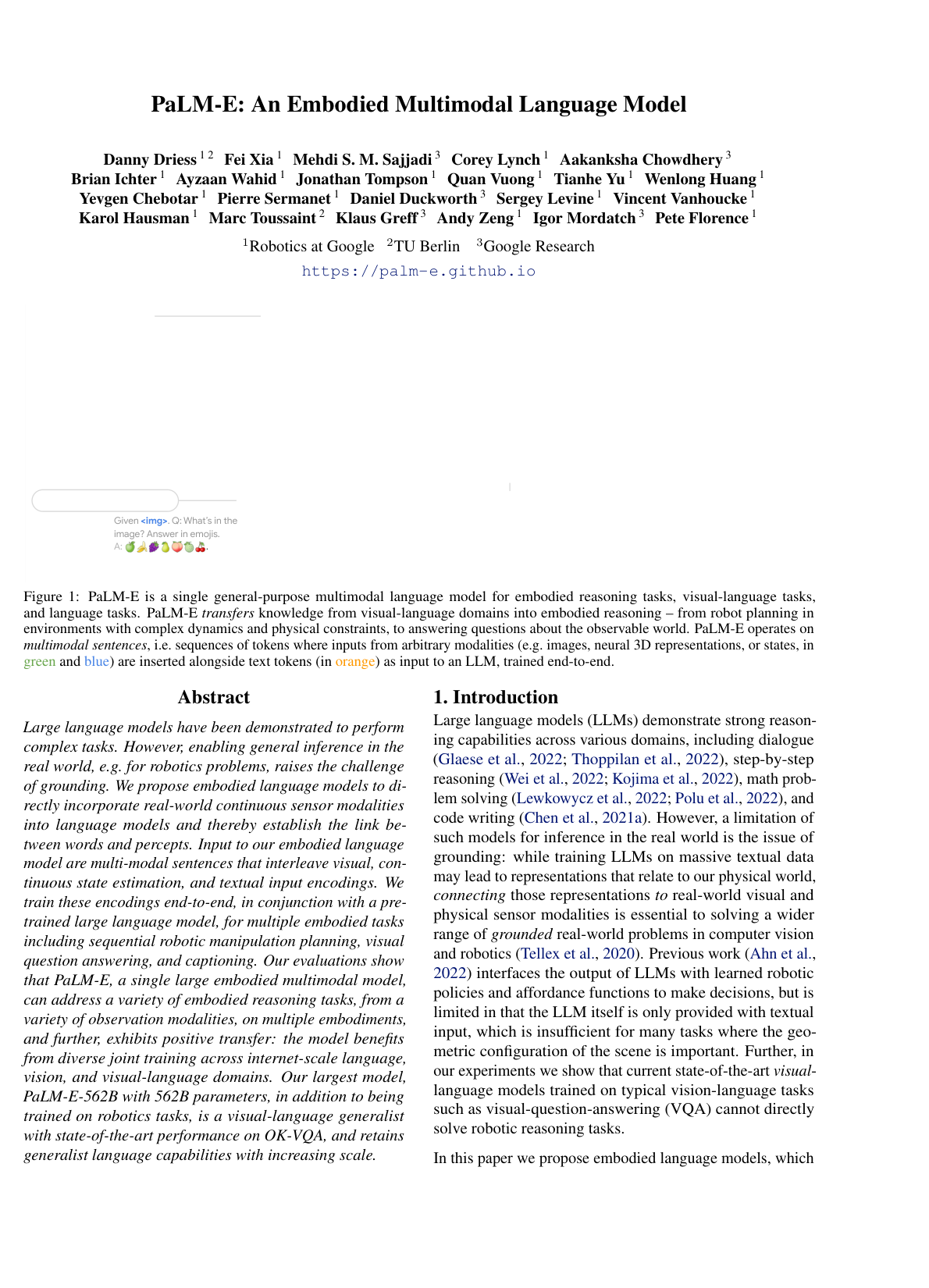
Large language models excel at a wide range of complex tasks. However, enabling general inference in the real world, e.g., for robotics problems, raises the challenge of grounding. We propose embodied language models to directly incorporate real-world continuous sensor modalities into language models and thereby establish the link between words and percepts. Input to our embodied language model are multi-modal sentences that interleave visual, continuous state estimation, and textual input encodings. We train these encodings end-to-end, in conjunction with a pre-trained large language model, for multiple embodied tasks including sequential robotic manipulation planning, visual question answering, and captioning. Our evaluations show that PaLM-E, a single large embodied multimodal model, can address a variety of embodied reasoning tasks, from a variety of observation modalities, on multiple embodiments, and further, exhibits positive transfer: the model benefits from diverse joint training across internet-scale language, vision, and visual-language domains. Our largest model, PaLM-E-562B with 562B parameters, in addition to being trained on robotics tasks, is a visual-language generalist with state-of-the-art performance on OK-VQA, and retains generalist language capabilities with increasing scale.
Added
2026-01-28