
keyword
video transformer
A video transformer is a deep learning neural network architecture based on self-attention mechanisms designed to process, analyze, or generate video data. Extending traditional vision transformers, which operate on static two-dimensional image patches, a video transformer captures both spatial features within individual frames and temporal dependencies across consecutive frames. These architectures typically divide video sequences into spatio-temporal tokens or discrete latent representations and employ joint, factorized, or axial self-attention to model dynamic motion and context over time. Video transformers are widely applied across computer vision and multimodal artificial intelligence tasks, including action recognition, video classification, temporal localization, and generative video synthesis.
2 items
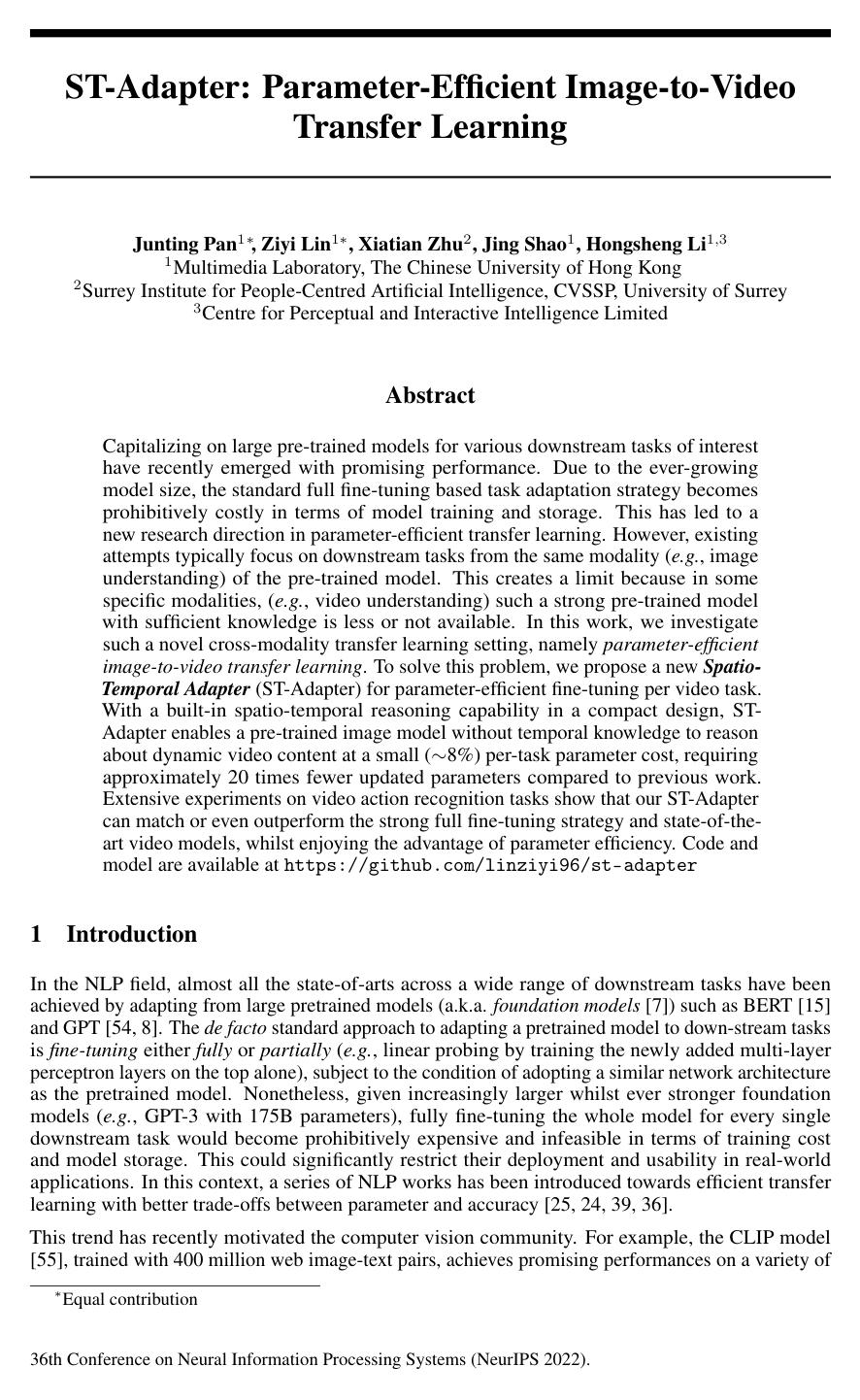
ST-Adapter: Parameter-Efficient Image-to-Video Transfer Learning
Junting Pan, Ziyi Lin, Xiatian Zhu, Jing Shao, Hongsheng Li
Why you should read this
Proposes a lightweight Spatio-Temporal Adapter that enables frozen pre-trained image vision transformers to perform video action recognition by updating only about eight percent of parameters while matching or exceeding full fine-tuning performance.
Capitalizing on large pre-trained models for various downstream tasks of interest have recently emerged with promising performance. Due to the ever-growing model size, the standard full fine-tuning based task adaptation strategy becomes prohibitively costly in terms of model training and storage. This has led to a new research direction in parameter-efficient transfer learning. However, existing attempts typically focus on downstream tasks from the same modality (e.g., image understanding) of the pre-trained model. This creates a limit because in some specific modalities, (e.g., video understanding) such a strong pre-trained model with sufficient knowledge is less or not available. In this work, we investigate such a novel cross-modality transfer learning setting, namely parameter-efficient image-to-video transfer learning. To solve this problem, we propose a new Spatio-Temporal Adapter (ST-Adapter) for parameter-efficient fine-tuning per video task. With a built-in spatio-temporal reasoning capability in a compact design, ST-Adapter enables a pre-trained image model without temporal knowledge to reason about dynamic video content at a small (~8%) per-task parameter cost, requiring approximately 20 times fewer updated parameters compared to previous work. Extensive experiments on video action recognition tasks show that our ST-Adapter can match or even outperform the strong full fine-tuning strategy and state-of-the-art video models, whilst enjoying the advantage of parameter efficiency. Code and model are available at https://github.com/linziyi96/st-adapter
Added
2026-09-26
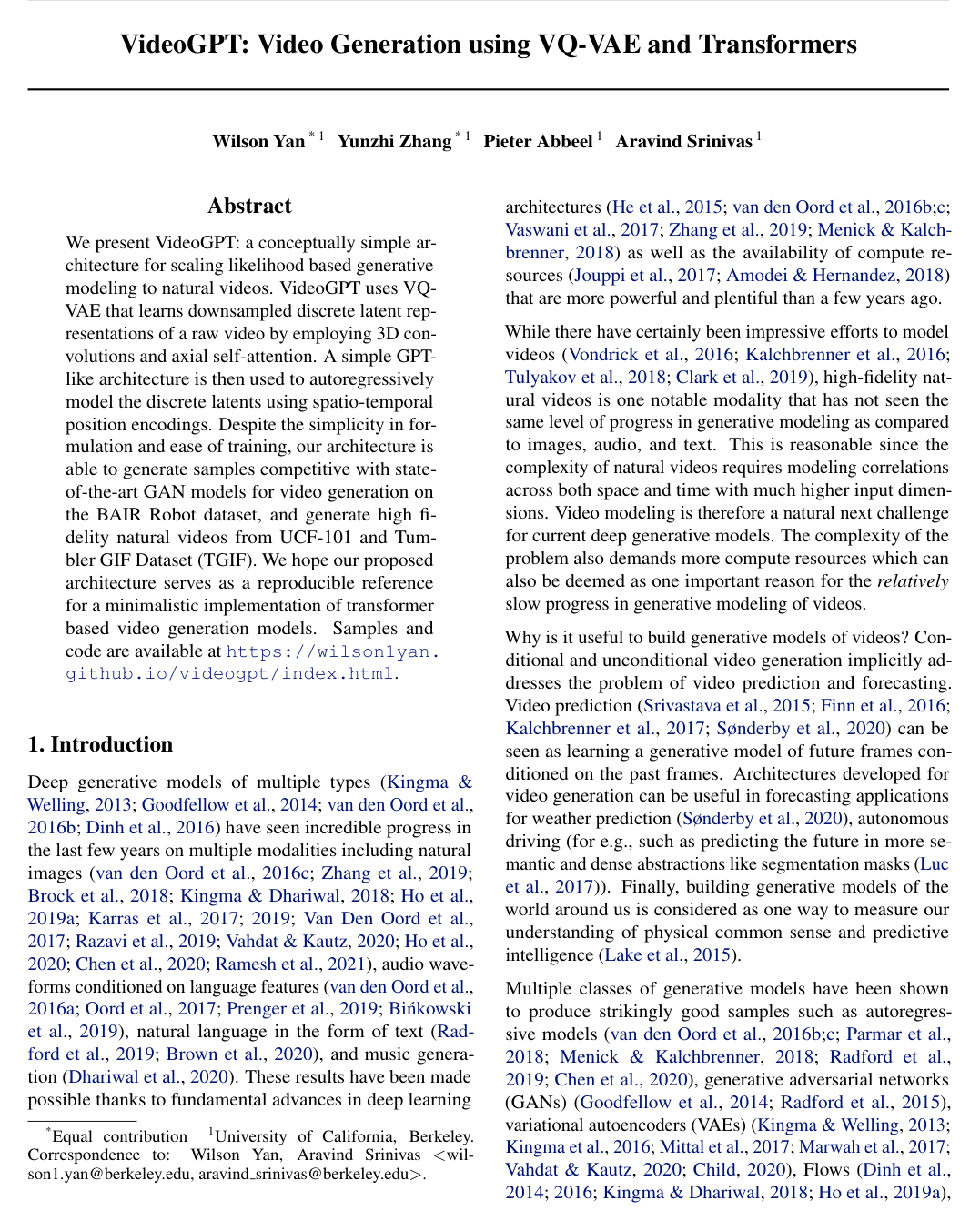
VideoGPT: Video Generation using VQ-VAE and Transformers
Wilson Yan, Yunzhi Zhang, Pieter Abbeel, Aravind Srinivas
Why you should read this
Presents a conceptually simple, transformer-based architecture called VideoGPT that generates high-fidelity natural videos competitively with state-of-the-art GANs, offering a reproducible and minimalistic framework for video generation.
We present VideoGPT: a conceptually simple architecture for scaling likelihood based generative modeling to natural videos. VideoGPT uses VQ-VAE that learns downsampled discrete latent representations of a raw video by employing 3D convolutions and axial self-attention. A simple GPT-like architecture is then used to autoregressively model the discrete latents using spatio-temporal position encodings. Despite the simplicity in formulation and ease of training, our architecture is able to generate samples competitive with state-of-the-art GAN models for video generation on the BAIR Robot dataset, and generate high fidelity natural videos from UCF-101 and Tumbler GIF Dataset (TGIF). We hope our proposed architecture serves as a reproducible reference for a minimalistic implementation of transformer based video generation models. Samples and code are available at this https URL
Added
2026-03-11
