
keyword
video summarization
Video summarization is an automated computer vision and multimedia process that creates a short, informative synopsis of a longer video by identifying and condensing its most essential content. It is primarily implemented either as a static summary, which selects a sequence of representative still images known as keyframes, or as a dynamic video skim, which concatenates the most salient and non-redundant video clips into a shorter continuous video. Approaches may operate in a generic manner to capture the overarching narrative and key events of the entire footage, or in a query-dependent manner, where saliency scoring, highlight detection, and temporal moment localization are guided by natural language prompts or specific user criteria. By reducing temporal redundancy while preserving semantic integrity and narrative coherence, video summarization facilitates efficient video indexing, retrieval, browsing, and consumption across large-scale video collections.
6 items
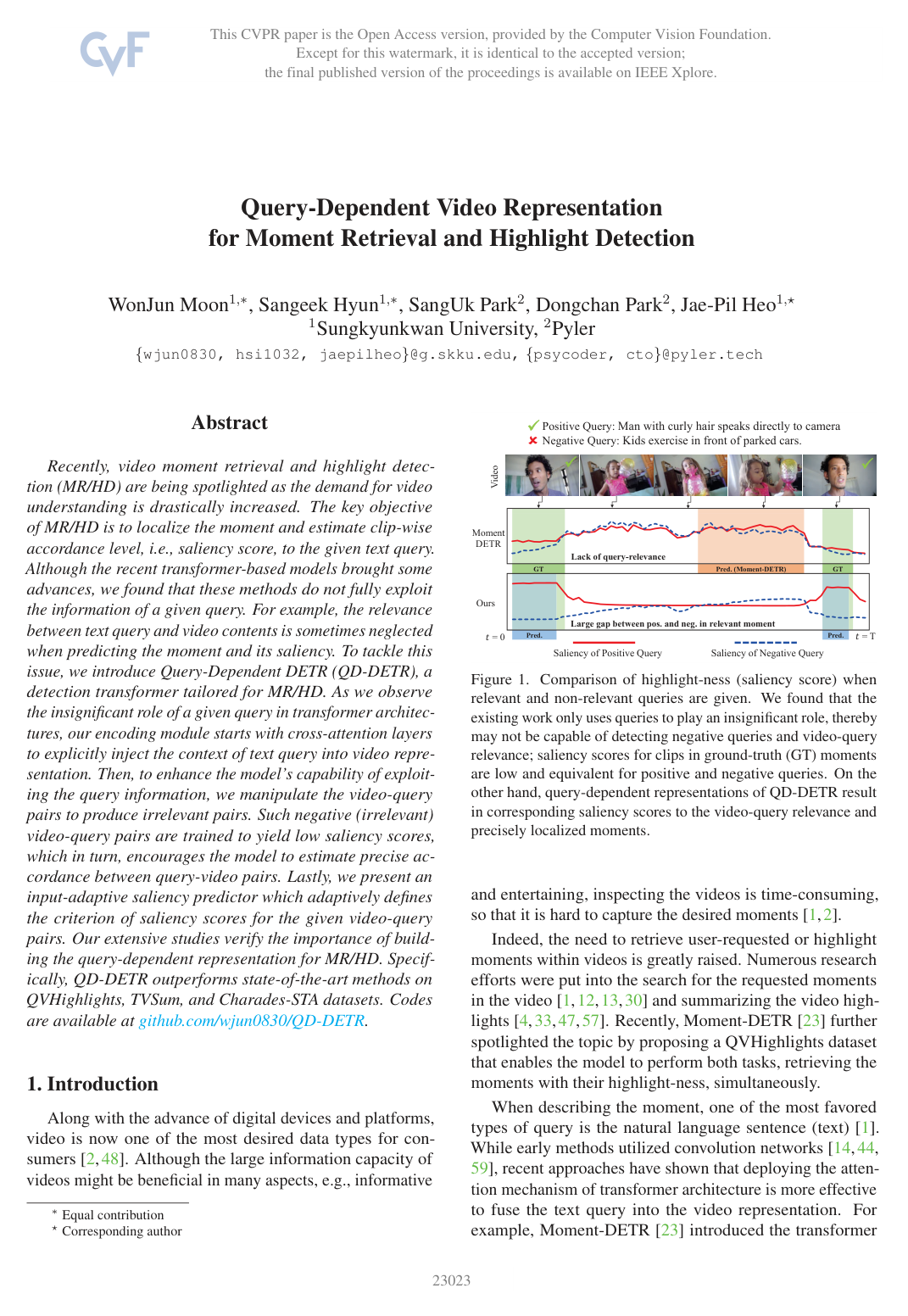
Query - Dependent Video Representation for Moment Retrieval and Highlight Detection
WonJun Moon, Sangeek Hyun, Sanguk Park, Dongchan Park, Jae-Pil Heo
Why you should read this
Proposes QD-DETR, a detection transformer architecture that couples early cross-attention encoding, negative pair training, and an input-adaptive saliency predictor to generate query-conditioned video representations for moment retrieval and highlight detection.
Recently, video moment retrieval and highlight detection (MR/HD) are being spotlighted as the demand for video understanding is drastically increased. The key objective of MR/HD is to localize the moment and estimate clip-wise accordance level, i.e., saliency score, to the given text query. Although the recent transformer-based models brought some advances, we found that these methods do not fully exploit the information of a given query. For example, the relevance between text query and video contents is sometimes neglected when predicting the moment and its saliency. To tackle this issue, we introduce Query-Dependent DETR (QD-DETR), a detection transformer tailored for MR/HD. As we observe the insignificant role of a given query in transformer architectures, our encoding module starts with cross-attention layers to explicitly inject the context of text query into video representation. Then, to enhance the model's capability of exploiting the query information, we manipulate the video-query pairs to produce irrelevant pairs. Such negative (irrelevant) video-query pairs are trained to yield low saliency scores, which in turn, encourages the model to estimate precise accordance between query-video pairs. Lastly, we present an input-adaptive saliency predictor which adaptively defines the criterion of saliency scores for the given video-query pairs. Our extensive studies verify the importance of building the query-dependent representation for MR/HD. Specifically, QD-DETR outperforms state-of-the-art methods on QVHighlights, TVSum, and Charades-STA datasets. Codes are available at github.com/wjun0830/QD-DETR.
Added
2026-10-05
TimeSuite: Improving MLLMs for Long Video Understanding via Grounded Tuning
Xiangyu Zeng, Kunchang Li, Chenting Wang, Xinhao Li, Tianxiang Jiang, Ziang Yan, Songze Li, Yansong Shi, Zhengrong Yue, Yi Wang, Yali Wang, Yu Qiao, Limin Wang
Why you should read this
Presents TimeSuite, a grounded instruction-tuning framework that adapts multimodal language models for long-form video comprehension by pairing efficient token compression with explicit timestamp generation to curb hallucinations.
Multimodal Large Language Models (MLLMs) have demonstrated impressive performance in short video understanding. However, understanding long-form videos still remains challenging for MLLMs. This paper proposes TimeSuite, a collection of new designs to adapt the existing short-form video MLLMs for long video understanding, including a simple yet efficient framework to process long video sequence, a high-quality video dataset for grounded tuning of MLLMs, and a carefully-designed instruction tuning task to explicitly incorporate the grounding supervision in the traditional QA format. Specifically, based on VideoChat, we propose our long-video MLLM, coined as VideoChat-T, by implementing a token shuffling to compress long video tokens and introducing Temporal Adaptive Position Encoding (TAPE) to enhance the temporal awareness of visual representation. Meanwhile, we introduce the TimePro, a comprehensive grounding-centric instruction tuning dataset composed of 9 tasks and 349k high-quality grounded annotations. Notably, we design a new instruction tuning task type, called Temporal Grounded Caption, to peform detailed video descriptions with the corresponding time stamps prediction. This explicit temporal location prediction will guide MLLM to correctly attend on the visual content when generating description, and thus reduce the hallucination risk caused by the LLMs. Experimental results demonstrate that our TimeSuite provides a successful solution to enhance the long video understanding capability of short-form MLLM, achieving improvement of 5.6% and 6.8% on the benchmarks of Egoschema and VideoMME, respectively. In addition, VideoChat-T exhibits robust zero-shot temporal grounding capabilities, significantly outperforming the existing state-of-the-art MLLMs. After fine-tuning, it performs on par with the traditional supervised expert models.
Added
2026-09-26
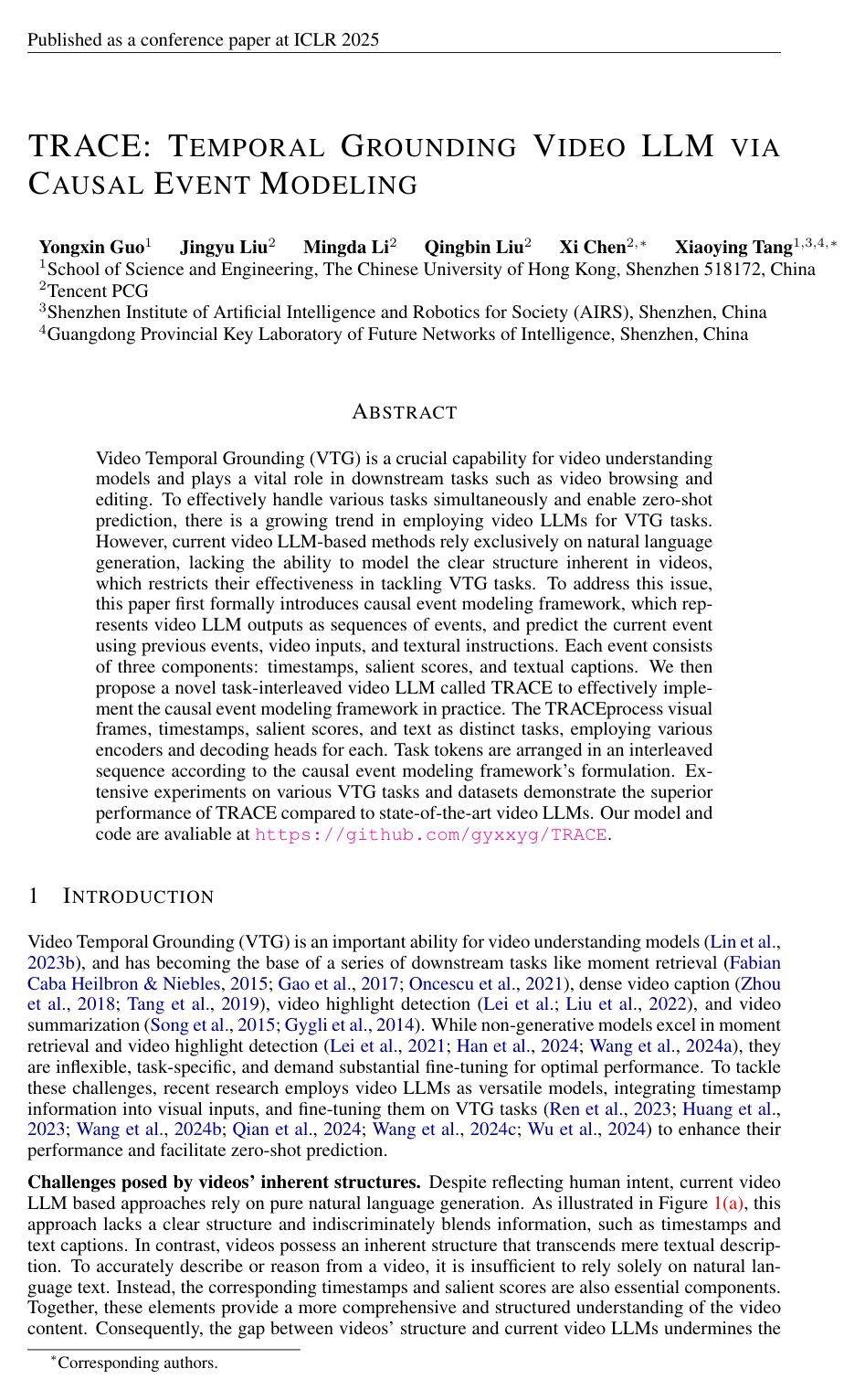
TRACE: Temporal Grounding Video LLM via Causal Event Modeling
Yongxin Guo, Jingyu Liu, Mingda Li, Qingbin Liu, Xi Chen, Xiaoying Tang
Why you should read this
Proposes TRACE, a task-interleaved video language model that advances video temporal grounding by formulating predictions as causal event sequences combining timestamps, saliency scores, and captions rather than relying solely on text generation.
Video Temporal Grounding (VTG) is a crucial capability for video understanding models and plays a vital role in downstream tasks such as video browsing and editing. To effectively handle various tasks simultaneously and enable zero-shot prediction, there is a growing trend in employing video LLMs for VTG tasks. However, current video LLM-based methods rely exclusively on natural language generation, lacking the ability to model the clear structure inherent in videos, which restricts their effectiveness in tackling VTG tasks. To address this issue, this paper first formally introduces causal event modeling framework, which represents video LLM outputs as sequences of events, and predict the current event using previous events, video inputs, and textural instructions. Each event consists of three components: timestamps, salient scores, and textual captions. We then propose a novel task-interleaved video LLM called TRACE to effectively implement the causal event modeling framework in practice. The TRACE process visual frames, timestamps, salient scores, and text as distinct tasks, employing various encoders and decoding heads for each. Task tokens are arranged in an interleaved sequence according to the causal event modeling framework's formulation. Extensive experiments on various VTG tasks and datasets demonstrate the superior performance of TRACE compared to state-of-the-art video LLMs. Our model and code are available at this https URL.
Added
2026-09-26
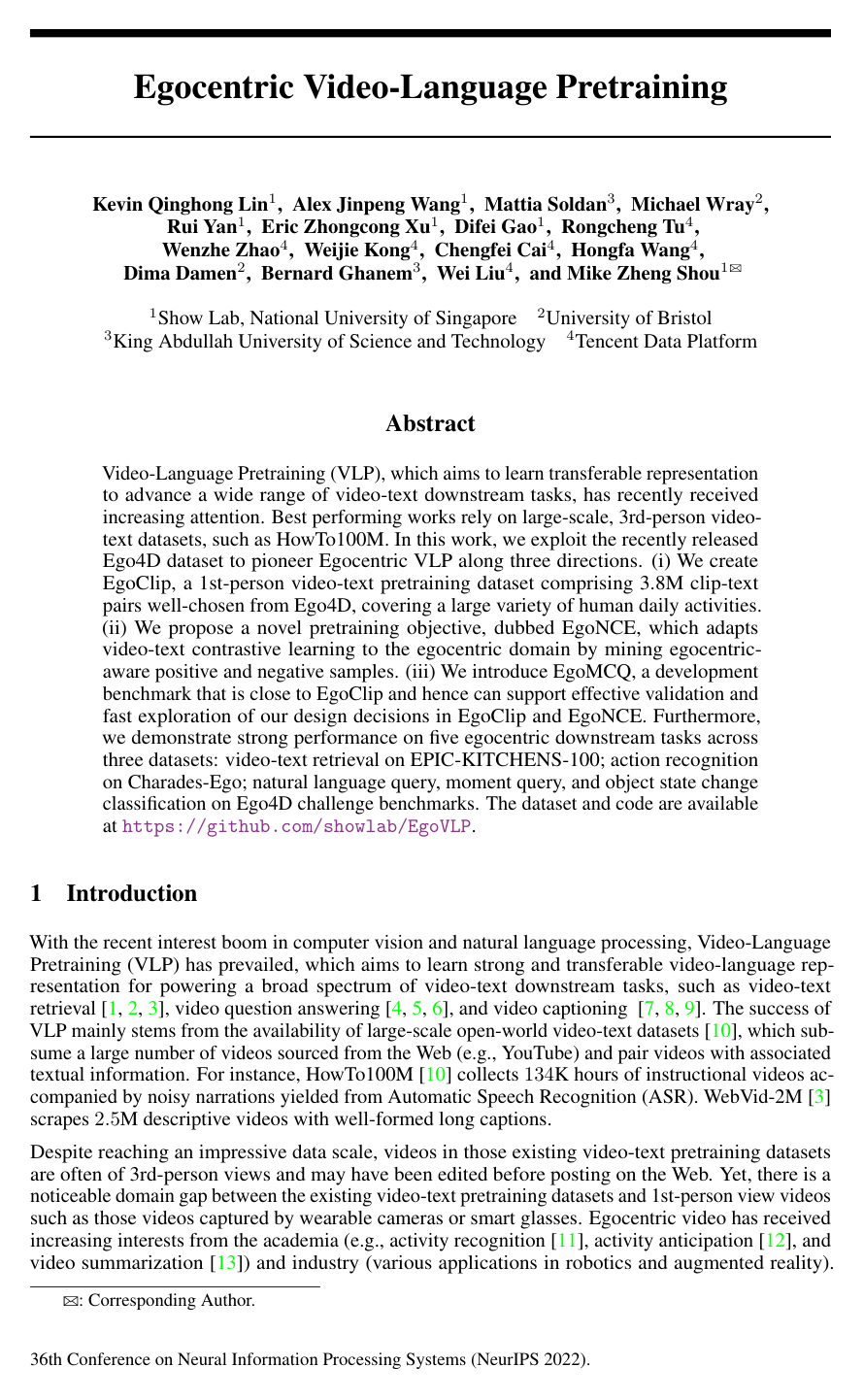
Egocentric Video-Language Pretraining
Kevin Qinghong Lin, Jinpeng Wang, Mattia Soldan, Michael Wray, Rui Yan, Eric Zhongcong Xu, Difei Gao, Rong-Cheng Tu, Wenzhe Zhao, Weijie Kong, Chengfei Cai, Hongfa Wang, Dima Damen, Bernard Ghanem, Wei Liu, Mike Zheng Shou
Why you should read this
Presents an egocentric video-language pretraining framework featuring a 3.8-million clip dataset (EgoClip), an egocentric-aware contrastive objective (EgoNCE), and a targeted benchmark (EgoMCQ) that achieve state-of-the-art results across diverse first-person video understanding tasks.
Video-Language Pretraining (VLP), which aims to learn transferable representation to advance a wide range of video-text downstream tasks, has recently received increasing attention. Best performing works rely on large-scale, 3rd-person video-text datasets, such as HowTo100M. In this work, we exploit the recently released Ego4D dataset to pioneer Egocentric VLP along three directions. (i) We create EgoClip, a 1st-person video-text pretraining dataset comprising 3.8M clip-text pairs well-chosen from Ego4D, covering a large variety of human daily activities. (ii) We propose a novel pretraining objective, dubbed EgoNCE, which adapts video-text contrastive learning to the egocentric domain by mining egocentric-aware positive and negative samples. (iii) We introduce EgoMCQ, a development benchmark that is close to EgoClip and hence can support effective validation and fast exploration of our design decisions in EgoClip and EgoNCE. Furthermore, we demonstrate strong performance on five egocentric downstream tasks across three datasets: video-text retrieval on EPIC-KITCHENS-100; action recognition on Charades-Ego; natural language query, moment query, and object state change classification on Ego4D challenge benchmarks. The dataset and code are available at https://github.com/showlab/EgoVLP.
Added
2026-09-26
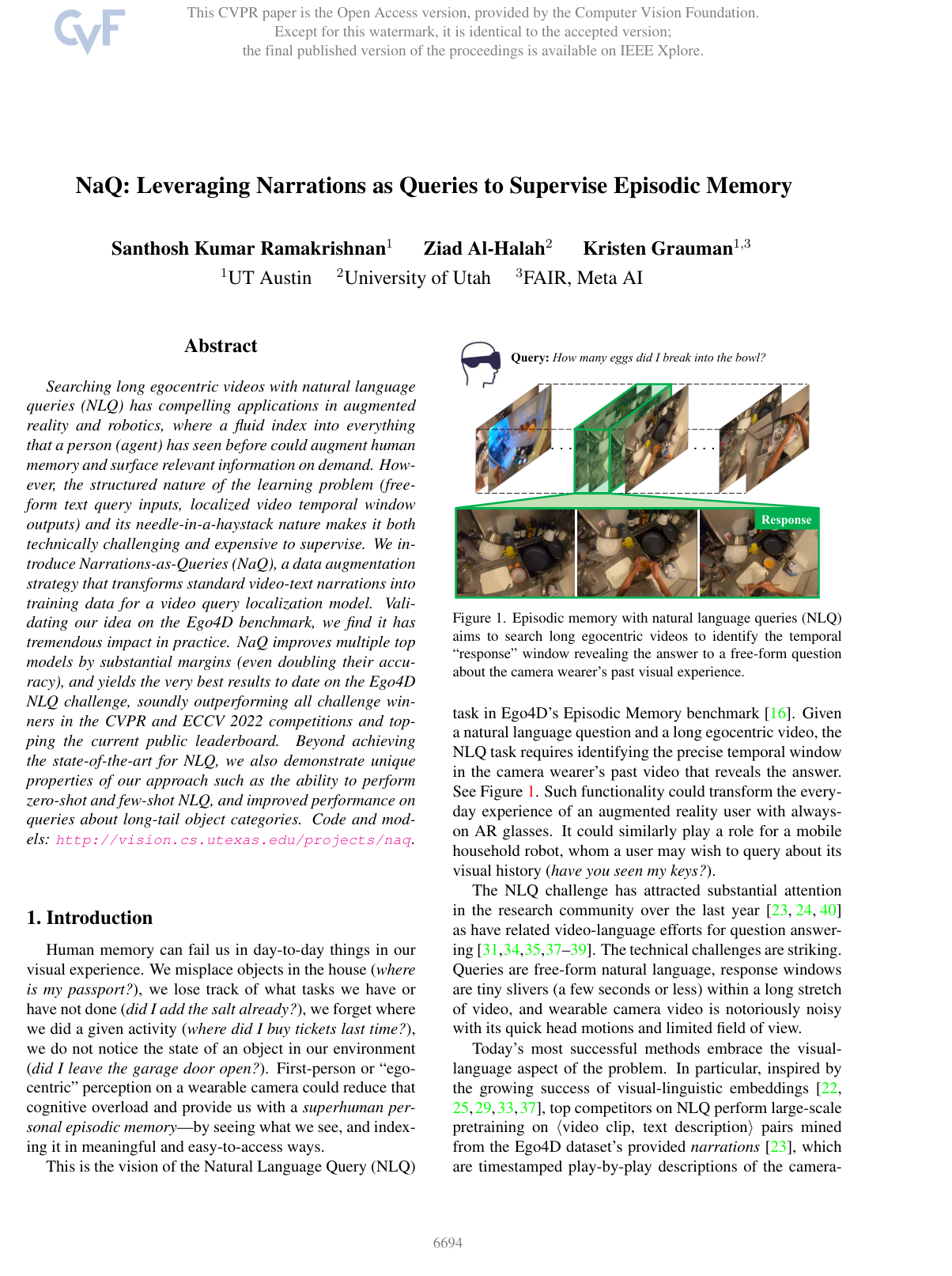
NaQ: Leveraging Narrations as Queries to Supervise Episodic Memory
Santhosh Kumar Ramakrishnan, Ziad Al-Halah, Kristen Grauman
Why you should read this
Proposes an effective data augmentation strategy that converts dense video narrations into query-response supervision, substantially improving temporal localization accuracy for natural language queries in long egocentric video.
Searching long egocentric videos with natural language queries (NLQ) has compelling applications in augmented reality and robotics, where a fluid index into everything that a person (agent) has seen before could augment human memory and surface relevant information on demand. How-ever, the structured nature of the learning problem (free-form text query inputs, localized video temporal window outputs) and its needle-in-a-haystack nature makes it both technically challenging and expensive to supervise. We introduce Narrations-as-Queries (NaQ), a data augmentation strategy that transforms standard video-text narrations into training data for a video query localization model. Validating our idea on the Ego4D benchmark, we find it has tremendous impact in practice. NaQ improves multiple top models by substantial margins (even doubling their accuracy), and yields the very best results to date on the Ego4D NLQ challenge, soundly outperforming all challenge winners in the CVPR and ECCV 2022 competitions and topping the current public leaderboard. Beyond achieving the state-of-the-art for NLQ, we also demonstrate unique properties of our approach such as the ability to perform zero-shot and few-shot NLQ, and improved performance on queries about long-tail object categories. Code and mod-els: http://vision.cs.utexas.edu/projects/naq.
Added
2026-09-26
TR-DETR: Task-Reciprocal Transformer for Joint Moment Retrieval and Highlight Detection
Hao Sun, Mingyao Zhou, Wenjing Chen, Wei Xie
Why you should read this
Proposes a DETR-based transformer architecture that improves joint video moment retrieval and highlight detection by directly utilizing task reciprocity through multi-modal feature alignment, visual refinement, and cooperative score exchange across prediction heads.
Video moment retrieval (MR) and highlight detection (HD) based on natural language queries are two highly related tasks, which aim to obtain relevant moments within videos and highlight scores of each video clip. Recently, several methods have been devoted to building DETR-based networks to solve both MR and HD jointly. These methods simply add two separate task heads after multi-modal feature extraction and feature interaction, achieving good performance. Nevertheless, these approaches underutilize the reciprocal relationship between two tasks. In this paper, we propose a task-reciprocal transformer based on DETR (TR-DETR) that focuses on exploring the inherent reciprocity between MR and HD. Specifically, a local-global multi-modal alignment module is first built to align features from diverse modalities into a shared latent space. Subsequently, a visual feature refinement is designed to eliminate query-irrelevant information from visual features for modal interaction. Finally, a task cooperation module is constructed to refine the retrieval pipeline and the highlight score prediction process by utilizing the reciprocity between MR and HD. Comprehensive experiments on QVHighlights, Charades-STA and TVSum datasets demonstrate that TR-DETR outperforms existing state-of-the-art methods. Codes are available at https://github.com/mingyao1120/TR-DETR.
Added
2026-09-26