
keyword
video representation learning
Video representation learning is a subfield of computer vision and machine learning focused on training models to automatically extract compact, structured, and informative feature representations from raw video sequences. Unlike static image analysis, it requires capturing both spatial visual appearances and temporal dynamics, such as movement, continuity, and event transitions across consecutive frames. These representations are typically acquired through supervised training on large annotated video benchmarks, vision-language alignment, or self-supervised pre-training techniques such as masked visual prediction and contrastive learning. Once learned, the resulting spatiotemporal feature embeddings serve as foundational representations that can be effectively transferred and adapted to diverse downstream video understanding tasks, including action recognition, video classification, object tracking, and video-text retrieval.
4 items
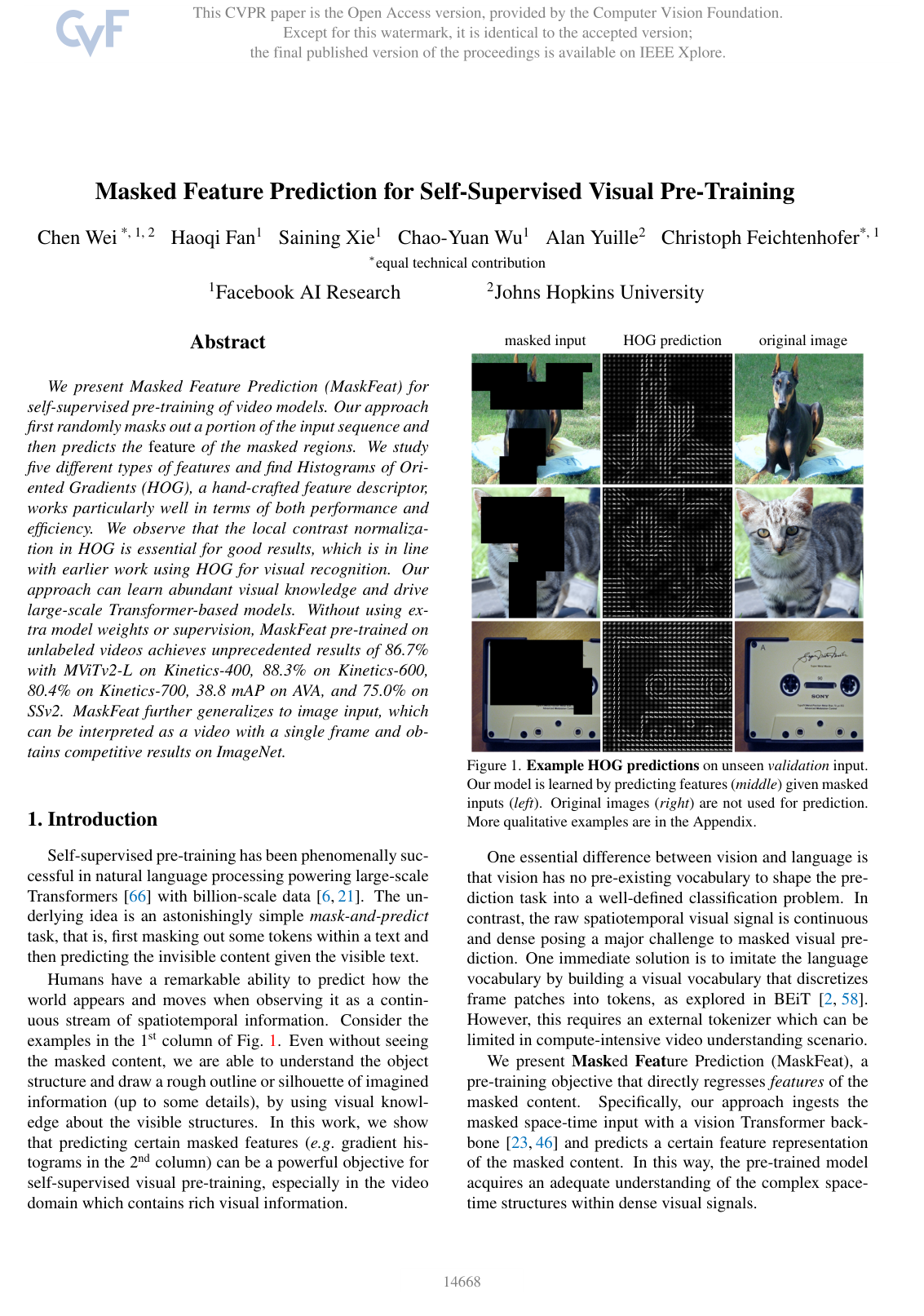
Masked Feature Prediction for Self-Supervised Visual Pre-Training
Chen Wei, Haoqi Fan, Saining Xie, Chao-Yuan Wu, Alan L. Yuille, Christoph Feichtenhofer
Why you should read this
Demonstrates that regressing simple Histograms of Oriented Gradients for masked video patches provides an efficient, highly effective self-supervised pre-training objective that sets state-of-the-art performance across major video action recognition benchmarks without relying on external tokenizers or extra supervision.
We present Masked Feature Prediction (MaskFeat) for self-supervised pre-training of video models. Our approach first randomly masks out a portion of the input sequence and then predicts the feature of the masked regions. We study five different types of features and find Histograms of Oriented Gradients (HOG), a hand-crafted feature descriptor, works particularly well in terms of both performance and efficiency. We observe that the local contrast normalization in HOG is essential for good results, which is in line with earlier work using HOG for visual recognition. Our approach can learn abundant visual knowledge and drive large-scale Transformer-based models. Without using extra model weights or supervision, MaskFeat pre-trained on unlabeled videos achieves unprecedented results of 86.7% with MViTv2-L on Kinetics-400, 88.3% on Kinetics-600, 80.4% on Kinetics-700, 38.8 mAP on AVA, and 75.0% on SSv2. MaskFeat further generalizes to image input, which can be interpreted as a video with a single frame and obtains competitive results on ImageNet.
Added
2026-10-05
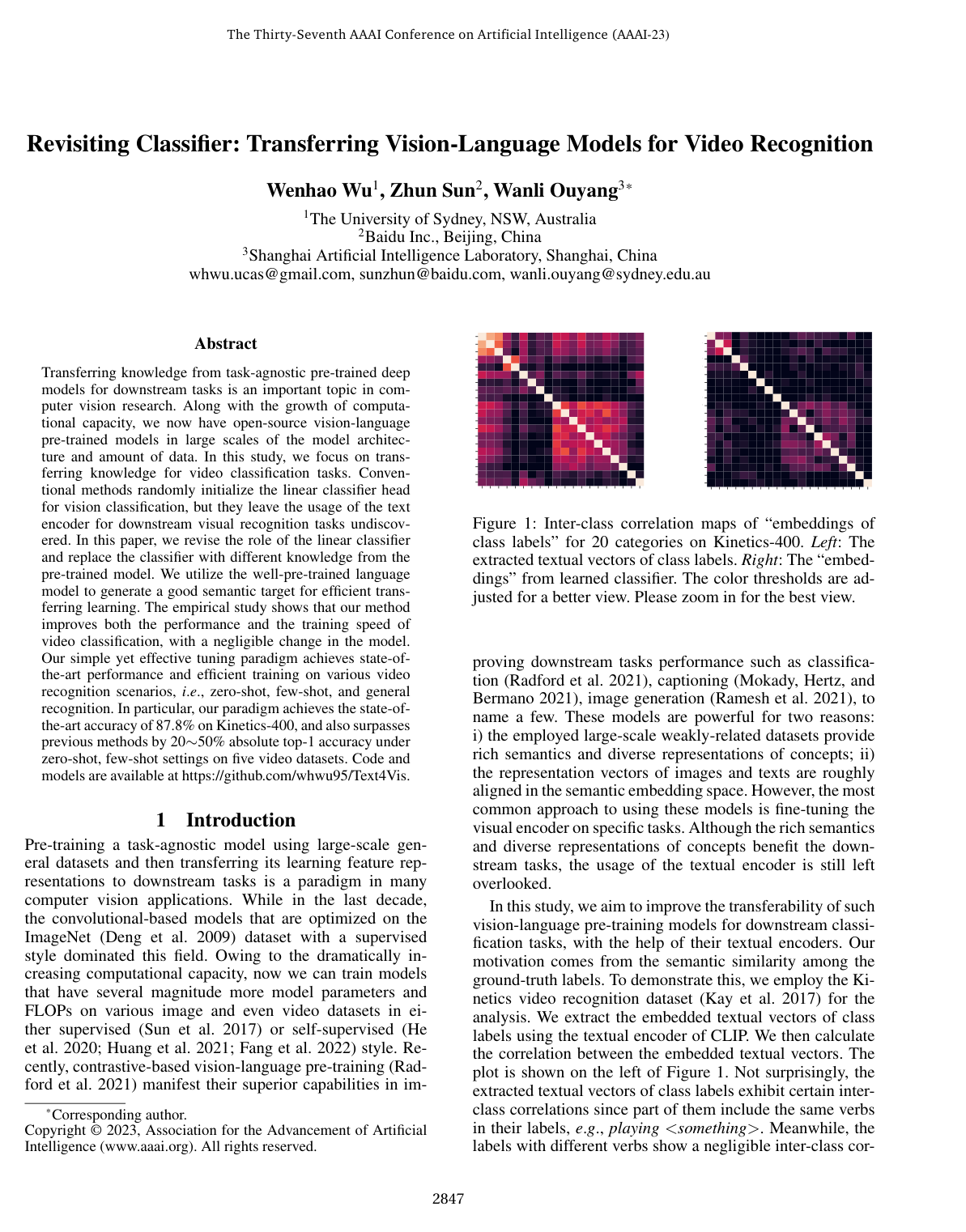
Revisiting Classifier: Transferring Vision-Language Models for Video Recognition
Wenhao Wu, Zhun Sun, Wanli Ouyang
Why you should read this
Proposes replacing the traditional randomly initialized visual classifier with frozen text embeddings from pre-trained vision-language models, drastically boosting video recognition accuracy and convergence speed across zero-shot, few-shot, and fully supervised benchmarks.
Transferring knowledge from task-agnostic pre-trained deep models for downstream tasks is an important topic in computer vision research. Along with the growth of computational capacity, we now have open-source vision-language pre-trained models in large scales of the model architecture and amount of data. In this study, we focus on transferring knowledge for video classification tasks. Conventional methods randomly initialize the linear classifier head for vision classification, but they leave the usage of the text encoder for downstream visual recognition tasks undiscovered. In this paper, we revise the role of the linear classifier and replace the classifier with different knowledge from the pre-trained model. We utilize the well-pre-trained language model to generate a good semantic target for efficient transferring learning. The empirical study shows that our method improves both the performance and the training speed of video classification, with a negligible change in the model. Our simple yet effective tuning paradigm achieves state-of-the-art performance and efficient training on various video recognition scenarios, i.e., zero-shot, few-shot, and general recognition. In particular, our paradigm achieves the state-of-the-art accuracy of 87.8% on Kinetics-400, and also surpasses previous methods by 20~50% absolute top-1 accuracy under zero-shot, few-shot settings on five video datasets. Code and models are available at https://github.com/whwu95/Text4Vis.
Added
2026-09-26
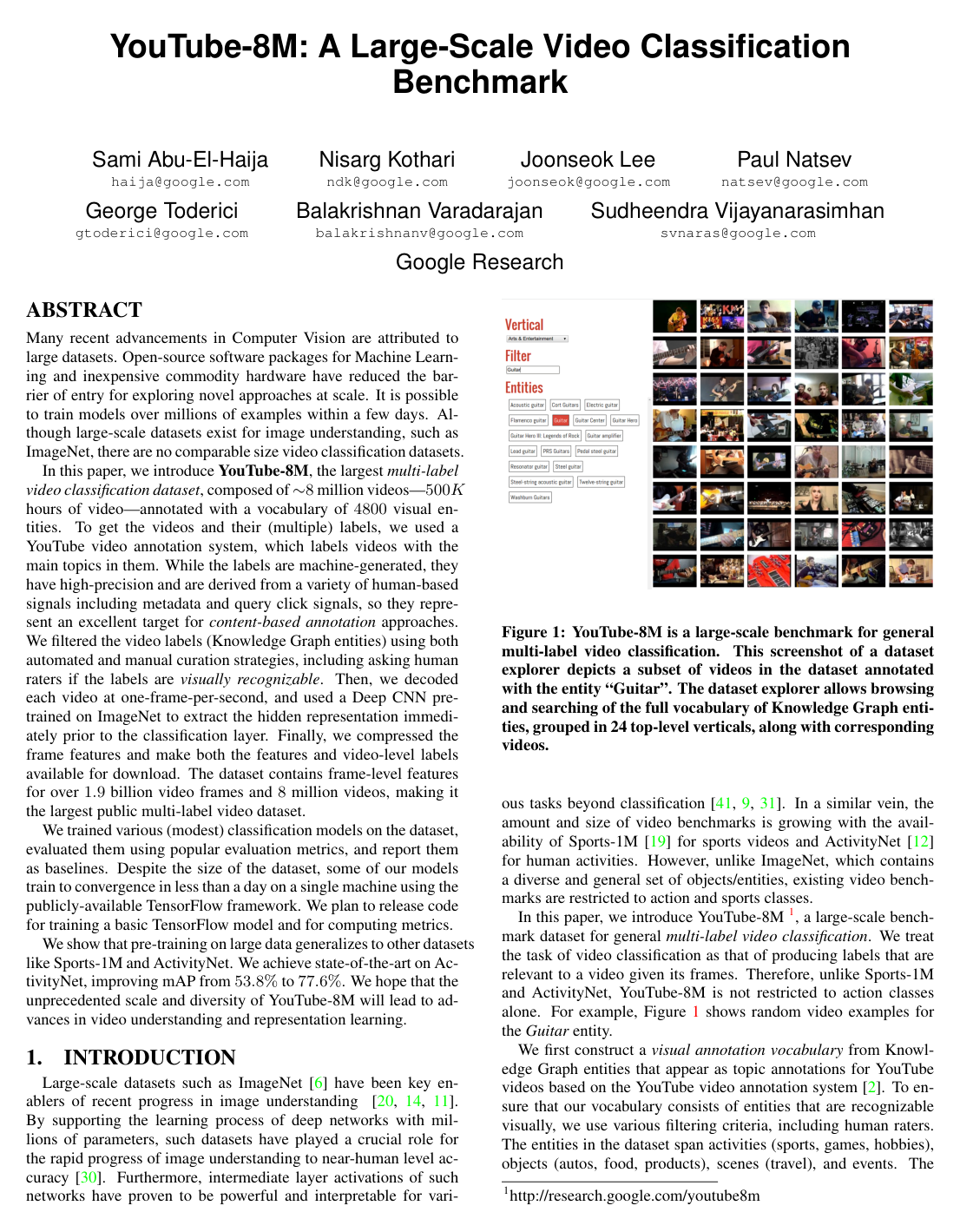
YouTube-8M: A Large-Scale Video Classification Benchmark
Sami Abu-El-Haija, Nisarg Kothari, Joonseok Lee, Paul Natsev, George Toderici, Balakrishnan Varadarajan, Sudheendra Vijayanarasimhan
Why you should read this
Introduces YouTube-8M, a massive multi-label benchmark spanning eight million videos and 4,800 visual entities, providing precomputed deep frame features and standard baselines to lower the barrier for large-scale video classification research.
Many recent advancements in Computer Vision are attributed to large datasets. Open-source software packages for Machine Learning and inexpensive commodity hardware have reduced the barrier of entry for exploring novel approaches at scale. It is possible to train models over millions of examples within a few days. Although large-scale datasets exist for image understanding, such as ImageNet, there are no comparable size video classification datasets. In this paper, we introduce YouTube-8M, the largest multi-label video classification dataset, composed of ~8 million videos (500K hours of video), annotated with a vocabulary of 4800 visual entities. To get the videos and their labels, we used a YouTube video annotation system, which labels videos with their main topics. While the labels are machine-generated, they have high-precision and are derived from a variety of human-based signals including metadata and query click signals. We filtered the video labels (Knowledge Graph entities) using both automated and manual curation strategies, including asking human raters if the labels are visually recognizable. Then, we decoded each video at one-frame-per-second, and used a Deep CNN pre-trained on ImageNet to extract the hidden representation immediately prior to the classification layer. Finally, we compressed the frame features and make both the features and video-level labels available for download. We trained various (modest) classification models on the dataset, evaluated them using popular evaluation metrics, and report them as baselines. Despite the size of the dataset, some of our models train to convergence in less than a day on a single machine using TensorFlow. We plan to release code for training a TensorFlow model and for computing metrics.
Added
2026-09-25
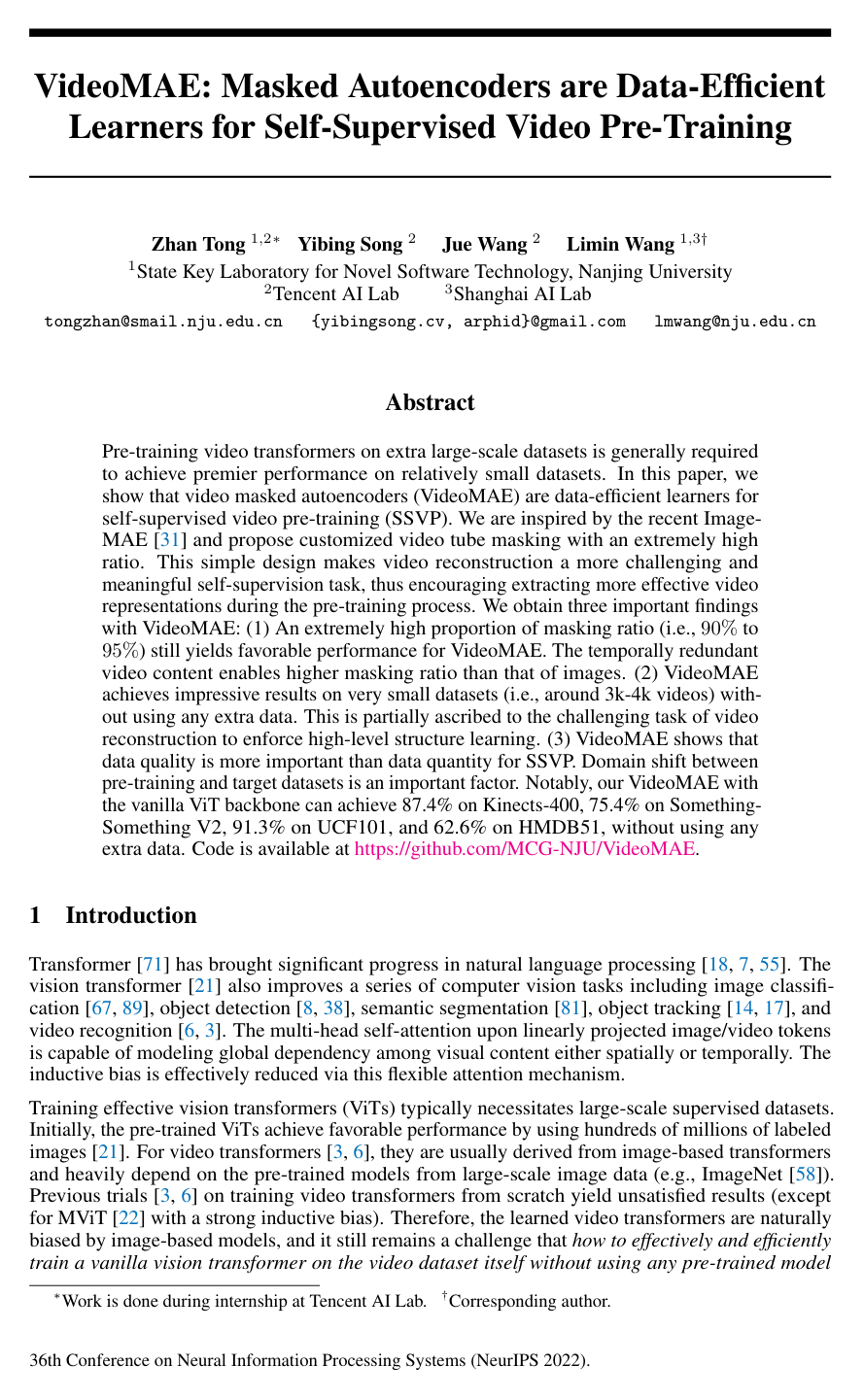
VideoMAE: Masked Autoencoders are Data-Efficient Learners for Self-Supervised Video Pre-Training
Zhan Tong, Yibing Song, Jue Wang, Limin Wang
Why you should read this
Demonstrates that VideoMAE can achieve state-of-the-art performance on video recognition benchmarks with significantly less data, even on small datasets, by utilizing a novel masked autoencoder approach.
Pre-training video transformers on extra large-scale datasets is generally required to achieve premier performance on relatively small datasets. In this paper, we show that video masked autoencoders (VideoMAE) are data-efficient learners for self-supervised video pre-training (SSVP). We are inspired by the recent ImageMAE and propose customized video tube masking with an extremely high ratio. This simple design makes video reconstruction a more challenging self-supervision task, thus encouraging extracting more effective video representations during this pre-training process. We obtain three important findings on SSVP: (1) An extremely high proportion of masking ratio (i.e., 90% to 95%) still yields favorable performance of VideoMAE. The temporally redundant video content enables a higher masking ratio than that of images. (2) VideoMAE achieves impressive results on very small datasets (i.e., around 3k-4k videos) without using any extra data. (3) VideoMAE shows that data quality is more important than data quantity for SSVP. Domain shift between pre-training and target datasets is an important issue. Notably, our VideoMAE with the vanilla ViT can achieve 87.4% on Kinetics-400, 75.4% on Something-Something V2, 91.3% on UCF101, and 62.6% on HMDB51, without using any extra data. Code is available at this https URL.
Added
2026-01-30
