
keyword
video reconstruction
Video reconstruction is the computational process of recovering, decoding, or synthesizing a sequence of video frames from a compact, latent, or partially observed representation. In computer vision and machine learning, the process requires modeling both spatial visual details within individual frames and temporal coherence across consecutive frames. It functions as a foundational task in neural network architectures such as variational autoencoders and masked autoencoders, where models decode spatio-temporal latent codes or predict missing, masked video patches. Through this process, models learn robust representations of motion and visual content, enabling applications in video compression, self-supervised pre-training, and video generation.
4 items
Bitrate-Controlled Diffusion for Disentangling Motion and Content in Video
Xiao Li, Qi Chen, Xiulian Peng, Kai Yu, Xie Chen, Yan Lu
Why you should read this
Proposes a self-supervised diffusion framework that uses low-bitrate vector quantization as an information bottleneck to cleanly separate dynamic motion from static video content for motion transfer and generation.
We propose a novel and general framework to disentangle video data into its dynamic motion and static content components. Our proposed method is a self-supervised pipeline with less assumptions and inductive biases than previous works: it utilizes a transformer-based architecture to jointly generate flexible implicit features for frame-wise motion and clip-wise content, and incorporates a low-bitrate vector quantization as an information bottleneck to promote disentanglement and form a meaningful discrete motion space. The bitrate-controlled latent motion and content are used as conditional inputs to a denoising diffusion model to facilitate self-supervised representation learning. We validate our disentangled representation learning framework on real-world talking head videos with motion transfer and auto-regressive motion generation tasks. Furthermore, we also show that our method can generalize to other types of video data, such as pixel sprites of 2D cartoon characters. Our work presents a new perspective on self-supervised learning of disentangled video representations, contributing to the broader field of video analysis and generation.
Added
2026-09-30
CV-VAE: A Compatible Video VAE for Latent Generative Video Models
Sijie Zhao, Yong Zhang, Xiaodong Cun, Shaoshu Yang, Muyao Niu, Xiaoyu Li, Wenbo Hu, Ying Shan
Why you should read this
Proposes a compatible 3D video VAE using latent space regularization that aligns with pretrained 2D image models like Stable Diffusion, enabling existing diffusion models to generate four times more frames with smooth spatio-temporal compression and minimal finetuning.
Spatio-temporal compression of videos, utilizing networks such as Variational Autoencoders (VAE), plays a crucial role in OpenAI’s SORA and numerous other video generative models. For instance, many LLM-like video models learn the distribution of discrete tokens derived from 3D VAEs within the VQVAE framework, while most diffusion-based video models capture the distribution of continuous latent extracted by 2D VAEs without quantization. The temporal compression is simply realized by uniform frame sampling which results in unsmooth motion between consecutive frames. Currently, there lacks of a commonly used continuous video (3D) VAE for latent diffusion-based video models in the research community. Moreover, since current diffusion-based approaches are often implemented using pre-trained text-to-image (T2I) models, directly training a video VAE without considering the compatibility with existing T2I models will result in a latent space gap between them, which will take huge computational resources for training to bridge the gap even with the T2I models as initialization. To address this issue, we propose a method for training a video VAE of latent video models, namely CV-VAE, whose latent space is compatible with that of a given image VAE, e.g., image VAE of Stable Diffusion (SD). The compatibility is achieved by the proposed novel latent space regularization, which involves formulating a regularization loss using the image VAE. Benefiting from the latent space compatibility, video models can be trained seamlessly from pre-trained T2I or video models in a truly spatio-temporally compressed latent space, rather than simply sampling video frames at equal intervals. To improve the training efficiency, we also design a novel architecture for the video VAE. With our CV-VAE, existing video models can generate four times more frames with minimal finetuning. Extensive experiments are conducted to demonstrate the effectiveness of the proposed video VAE.
Added
2026-09-26
Wan: Open and Advanced Large-Scale Video Generative Models
Ang Wang, Baole Ai, Bin Wen, Chaojie Mao, Chen-Wei Xie, Di Chen, Feiwu Yu, Haiming Zhao, Jianxiao Yang, Jianyuan Zeng, Jiayu Wang, Jingfeng Zhang, Jingren Zhou, Jinkai Wang, Jixuan Chen, Kai Zhu, Kang Zhao, Keyu Yan, Lianghua Huang, Xiaofeng Meng, Ningying Zhang, Pandeng Li, Ping Wu, Ruihang Chu, Rui Feng, Shiwei Zhang, Siyang Sun, Tao Fang, Tianxing Wang, T. Gui, Tingyu Weng, Tong Shen, Wei Lin, Wei Wang, Wen-Chao Zhou, Wente Wang, Wen Shen, Wenyuan Yu, Xianzhong Shi, Xiaomin Huang, Xin Xu, Yan Kou, Yan-Mei Lv, Yifei Li, Yi-Jing Liu, Yiming Wang, Yingya Zhang, Yitong Huang, Yong Li, You Wu, Yu Liu, Yulin Pan, Yun Zheng, Yuntao Hong, Yupeng Shi, Yutong Feng, Zeyinzi Jiang, Zhen Han, Zhi-Fan Wu, Ziyu Liu
Why you should read this
Presents an open-source suite of diffusion transformer video foundation models scaling up to 14 billion parameters that outperforms leading commercial systems while providing a lightweight variant that runs on consumer GPUs with under 8.2 GB of VRAM.
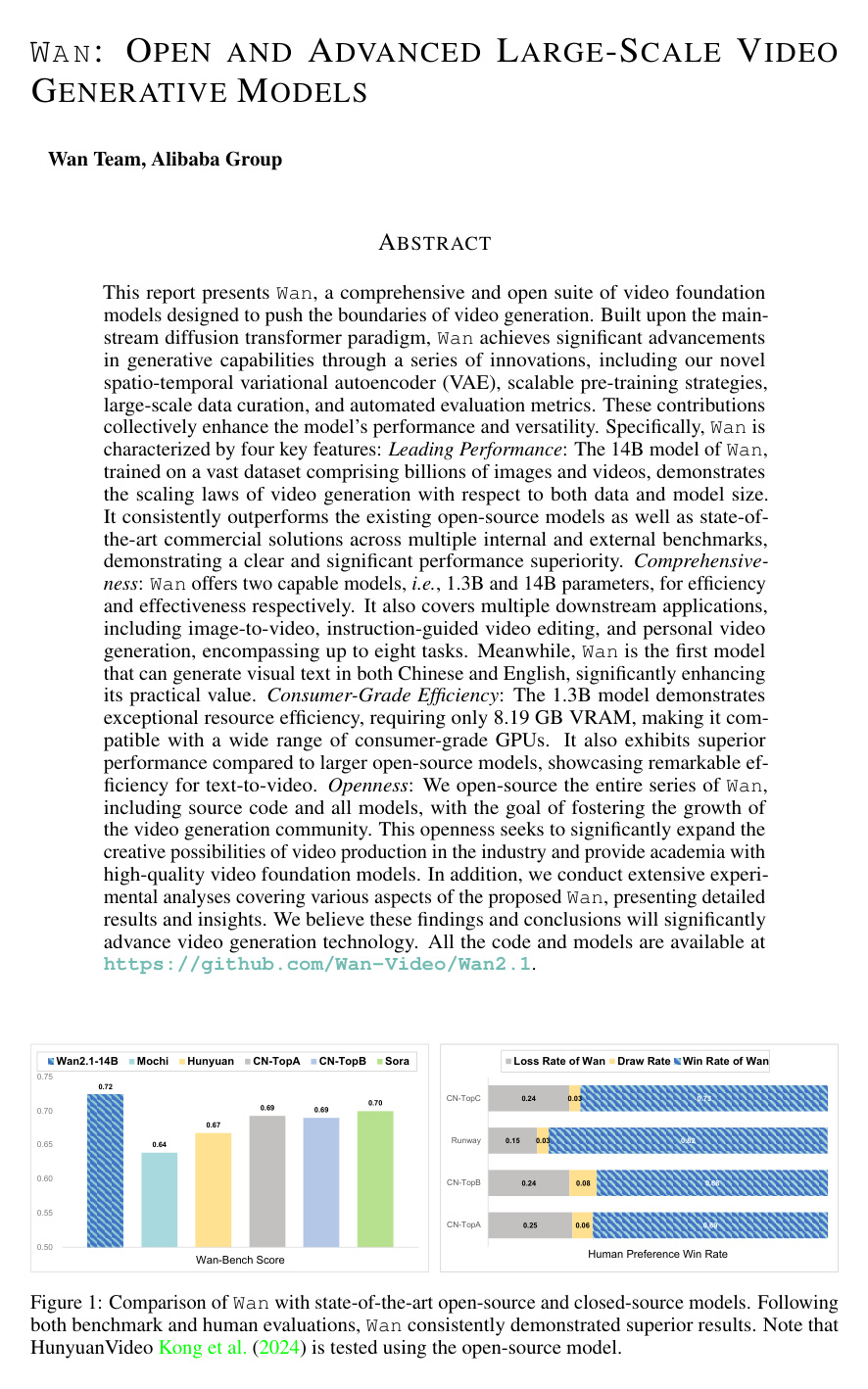
This report presents Wan, a comprehensive and open suite of video foundation models designed to push the boundaries of video generation. Built upon the mainstream diffusion transformer paradigm, Wan achieves significant advancements in generative capabilities through a series of innovations, including our novel VAE, scalable pre-training strategies, large-scale data curation, and automated evaluation metrics. These contributions collectively enhance the model's performance and versatility. Specifically, Wan is characterized by four key features: Leading Performance: The 14B model of Wan, trained on a vast dataset comprising billions of images and videos, demonstrates the scaling laws of video generation with respect to both data and model size. It consistently outperforms the existing open-source models as well as state-of-the-art commercial solutions across multiple internal and external benchmarks, demonstrating a clear and significant performance superiority. Comprehensiveness: Wan offers two capable models, i.e., 1.3B and 14B parameters, for efficiency and effectiveness respectively. It also covers multiple downstream applications, including image-to-video, instruction-guided video editing, and personal video generation, encompassing up to eight tasks. Consumer-Grade Efficiency: The 1.3B model demonstrates exceptional resource efficiency, requiring only 8.19 GB VRAM, making it compatible with a wide range of consumer-grade GPUs. Openness: We open-source the entire series of Wan, including source code and all models, with the goal of fostering the growth of the video generation community. This openness seeks to significantly expand the creative possibilities of video production in the industry and provide academia with high-quality video foundation models. All the code and models are available at this https URL.
Added
2026-09-24
VideoMAE: Masked Autoencoders are Data-Efficient Learners for Self-Supervised Video Pre-Training
Zhan Tong, Yibing Song, Jue Wang, Limin Wang
Why you should read this
Demonstrates that VideoMAE can achieve state-of-the-art performance on video recognition benchmarks with significantly less data, even on small datasets, by utilizing a novel masked autoencoder approach.
Pre-training video transformers on extra large-scale datasets is generally required to achieve premier performance on relatively small datasets. In this paper, we show that video masked autoencoders (VideoMAE) are data-efficient learners for self-supervised video pre-training (SSVP). We are inspired by the recent ImageMAE and propose customized video tube masking with an extremely high ratio. This simple design makes video reconstruction a more challenging self-supervision task, thus encouraging extracting more effective video representations during this pre-training process. We obtain three important findings on SSVP: (1) An extremely high proportion of masking ratio (i.e., 90% to 95%) still yields favorable performance of VideoMAE. The temporally redundant video content enables a higher masking ratio than that of images. (2) VideoMAE achieves impressive results on very small datasets (i.e., around 3k-4k videos) without using any extra data. (3) VideoMAE shows that data quality is more important than data quantity for SSVP. Domain shift between pre-training and target datasets is an important issue. Notably, our VideoMAE with the vanilla ViT can achieve 87.4% on Kinetics-400, 75.4% on Something-Something V2, 91.3% on UCF101, and 62.6% on HMDB51, without using any extra data. Code is available at this https URL.
Added
2026-01-30
