
keyword
video recognition
Video recognition is a subfield of computer vision and artificial intelligence that focuses on automatically identifying, classifying, and interpreting actions, objects, scenes, or events within video sequences. Unlike static image recognition, which evaluates only two-dimensional spatial features, video recognition processes both spatial context and temporal dynamics to understand motion, scene progression, and behavioral changes across successive frames. Common applications include human action recognition, event detection, video classification, and surveillance monitoring. Modern video recognition systems typically rely on deep learning architectures such as spatiotemporal vision transformers, multi-stream neural networks, and vision-language foundation models to effectively capture and reason about visual movement over time.
8 items
EVA: Exploring the Limits of Masked Visual Representation Learning at Scale
Yuxin Fang, Wen Wang, Binhui Xie, Quan Sun, Ledell Wu, Xinggang Wang, Tiejun Huang, Xinlong Wang, Yue Cao
Why you should read this
Demonstrates that pre-training a one-billion-parameter Vision Transformer to reconstruct image-text aligned features using only public data establishes state-of-the-art transfer performance across major vision tasks and efficiently stabilizes the training of large multimodal models.
We launch EVA, a vision-centric foundation model to explore the limits of Visual representation at scAle using only publicly accessible data. EVA is a vanilla ViT pre-trained to reconstruct the masked out image-text aligned vision features conditioned on visible image patches. Via this pretext task, we can efficiently scale up EVA to one billion parameters, and sets new records on a broad range of representative vision downstream tasks, such as image recognition, video action recognition, object detection, instance segmentation and semantic segmentation without heavy supervised training. Moreover, we observe quantitative changes in scaling EVA result in qualitative changes in transfer learning performance that are not present in other models. For instance, EVA takes a great leap in the challenging large vocabulary instance segmentation task: our model achieves almost the same state-of-the-art performance on LVIS dataset with over a thousand categories and COCO dataset with only eighty categories. Beyond a pure vision encoder, EVA can also serve as a vision-centric, multi-modal pivot to connect images and text. We find initializing the vision tower of a giant CLIP from EVA can greatly stabilize the training and outperform the training from scratch counterpart with much fewer samples and less compute, providing a new direction for scaling up and accelerating the costly training of multi-modal foundation models.
Added
2026-10-04
ST-Adapter: Parameter-Efficient Image-to-Video Transfer Learning
Junting Pan, Ziyi Lin, Xiatian Zhu, Jing Shao, Hongsheng Li
Why you should read this
Proposes a lightweight Spatio-Temporal Adapter that enables frozen pre-trained image vision transformers to perform video action recognition by updating only about eight percent of parameters while matching or exceeding full fine-tuning performance.
Capitalizing on large pre-trained models for various downstream tasks of interest have recently emerged with promising performance. Due to the ever-growing model size, the standard full fine-tuning based task adaptation strategy becomes prohibitively costly in terms of model training and storage. This has led to a new research direction in parameter-efficient transfer learning. However, existing attempts typically focus on downstream tasks from the same modality (e.g., image understanding) of the pre-trained model. This creates a limit because in some specific modalities, (e.g., video understanding) such a strong pre-trained model with sufficient knowledge is less or not available. In this work, we investigate such a novel cross-modality transfer learning setting, namely parameter-efficient image-to-video transfer learning. To solve this problem, we propose a new Spatio-Temporal Adapter (ST-Adapter) for parameter-efficient fine-tuning per video task. With a built-in spatio-temporal reasoning capability in a compact design, ST-Adapter enables a pre-trained image model without temporal knowledge to reason about dynamic video content at a small (~8%) per-task parameter cost, requiring approximately 20 times fewer updated parameters compared to previous work. Extensive experiments on video action recognition tasks show that our ST-Adapter can match or even outperform the strong full fine-tuning strategy and state-of-the-art video models, whilst enjoying the advantage of parameter efficiency. Code and model are available at https://github.com/linziyi96/st-adapter
Added
2026-09-26
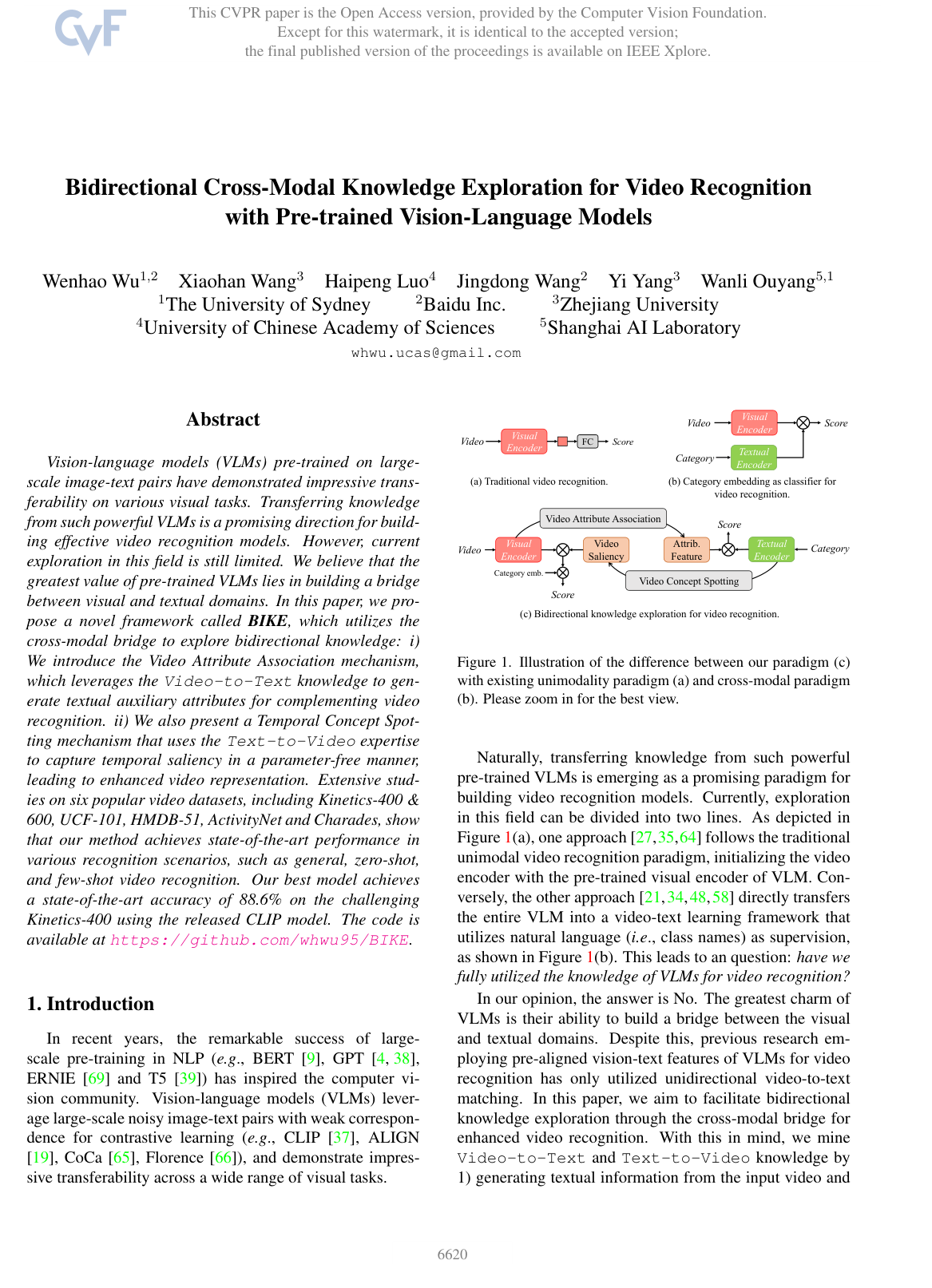
Bidirectional Cross-Modal Knowledge Exploration for Video Recognition with Pre-trained Vision-Language Models
Wenhao Wu, Xiaohan Wang, Haipeng Luo, Jingdong Wang, Yi Yang, Wanli Ouyang
Why you should read this
Proposes a bidirectional framework called BIKE that transfers pre-trained vision-language knowledge into video recognition by retrieving complementary textual attributes and using category concepts to capture frame-level temporal saliency.
Vision-language models (VLMs) pre-trained on large-scale image-text pairs have demonstrated impressive transferability on various visual tasks. Transferring knowledge from such powerful VLMs is a promising direction for building effective video recognition models. However, current exploration in this field is still limited. We believe that the greatest value of pre-trained VLMs lies in building a bridge between visual and textual domains. In this paper, we propose a novel framework called BIKE, which utilizes the cross-modal bridge to explore bidirectional knowledge: i) We introduce the Video Attribute Association mechanism, which leverages the Video-to-Text knowledge to generate textual auxiliary attributes for complementing video recognition. ii) We also present a Temporal Concept Spotting mechanism that uses the Text-to-Video expertise to capture temporal saliency in a parameter-free manner, leading to enhanced video representation. Extensive studies on six popular video datasets, including Kinetics-400 & 600, UCF-101, HMDB-51, ActivityNet and Charades, show that our method achieves state-of-the-art performance in various recognition scenarios, such as general, zero-shot, and few-shot video recognition. Our best model achieves a state-of-the-art accuracy of 88.6% on the challenging Kinetics-400 using the released CLIP model. The code is available at https://github.com/whwu95/BIKE.
Added
2026-09-26
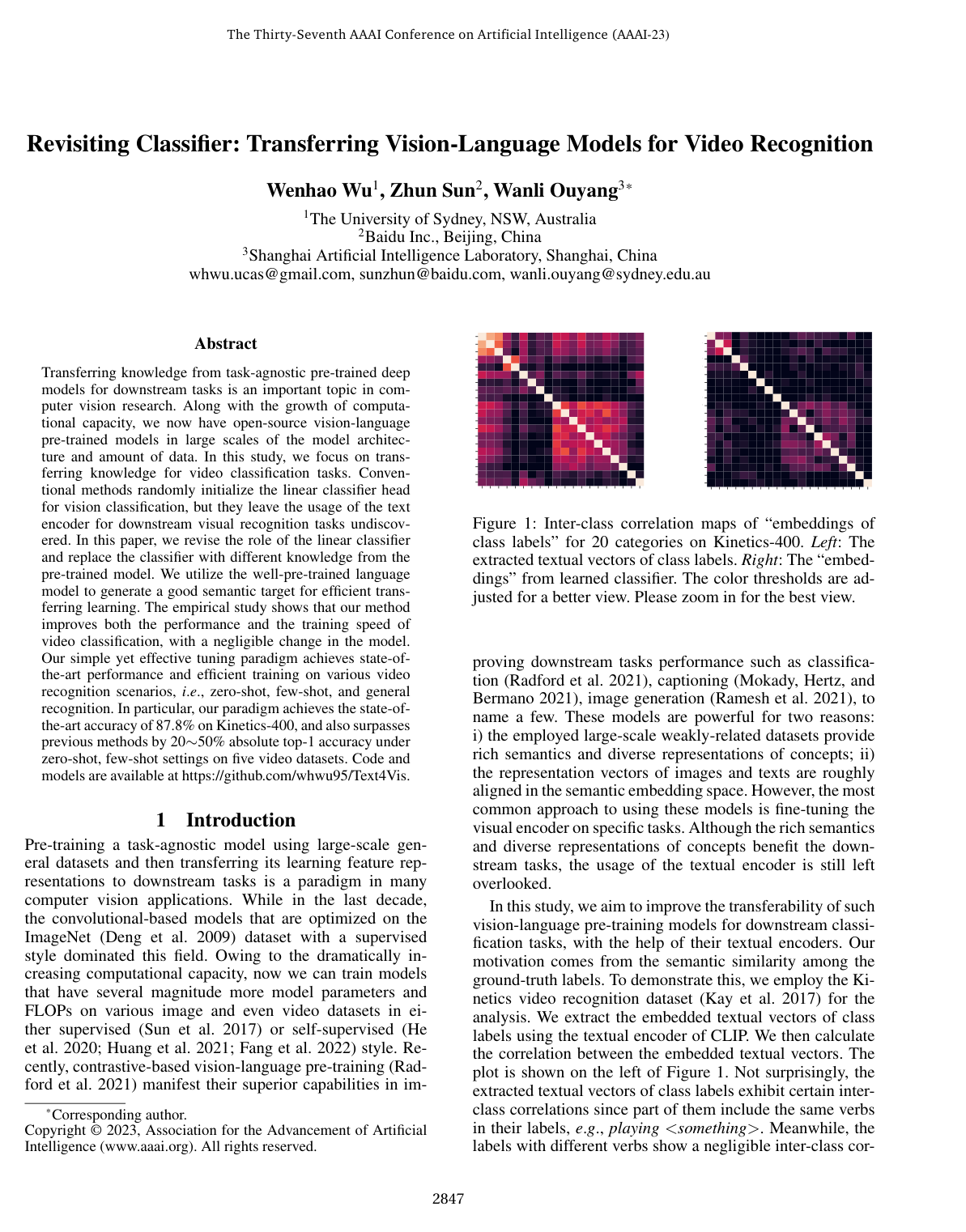
Revisiting Classifier: Transferring Vision-Language Models for Video Recognition
Wenhao Wu, Zhun Sun, Wanli Ouyang
Why you should read this
Proposes replacing the traditional randomly initialized visual classifier with frozen text embeddings from pre-trained vision-language models, drastically boosting video recognition accuracy and convergence speed across zero-shot, few-shot, and fully supervised benchmarks.
Transferring knowledge from task-agnostic pre-trained deep models for downstream tasks is an important topic in computer vision research. Along with the growth of computational capacity, we now have open-source vision-language pre-trained models in large scales of the model architecture and amount of data. In this study, we focus on transferring knowledge for video classification tasks. Conventional methods randomly initialize the linear classifier head for vision classification, but they leave the usage of the text encoder for downstream visual recognition tasks undiscovered. In this paper, we revise the role of the linear classifier and replace the classifier with different knowledge from the pre-trained model. We utilize the well-pre-trained language model to generate a good semantic target for efficient transferring learning. The empirical study shows that our method improves both the performance and the training speed of video classification, with a negligible change in the model. Our simple yet effective tuning paradigm achieves state-of-the-art performance and efficient training on various video recognition scenarios, i.e., zero-shot, few-shot, and general recognition. In particular, our paradigm achieves the state-of-the-art accuracy of 87.8% on Kinetics-400, and also surpasses previous methods by 20~50% absolute top-1 accuracy under zero-shot, few-shot settings on five video datasets. Code and models are available at https://github.com/whwu95/Text4Vis.
Added
2026-09-26
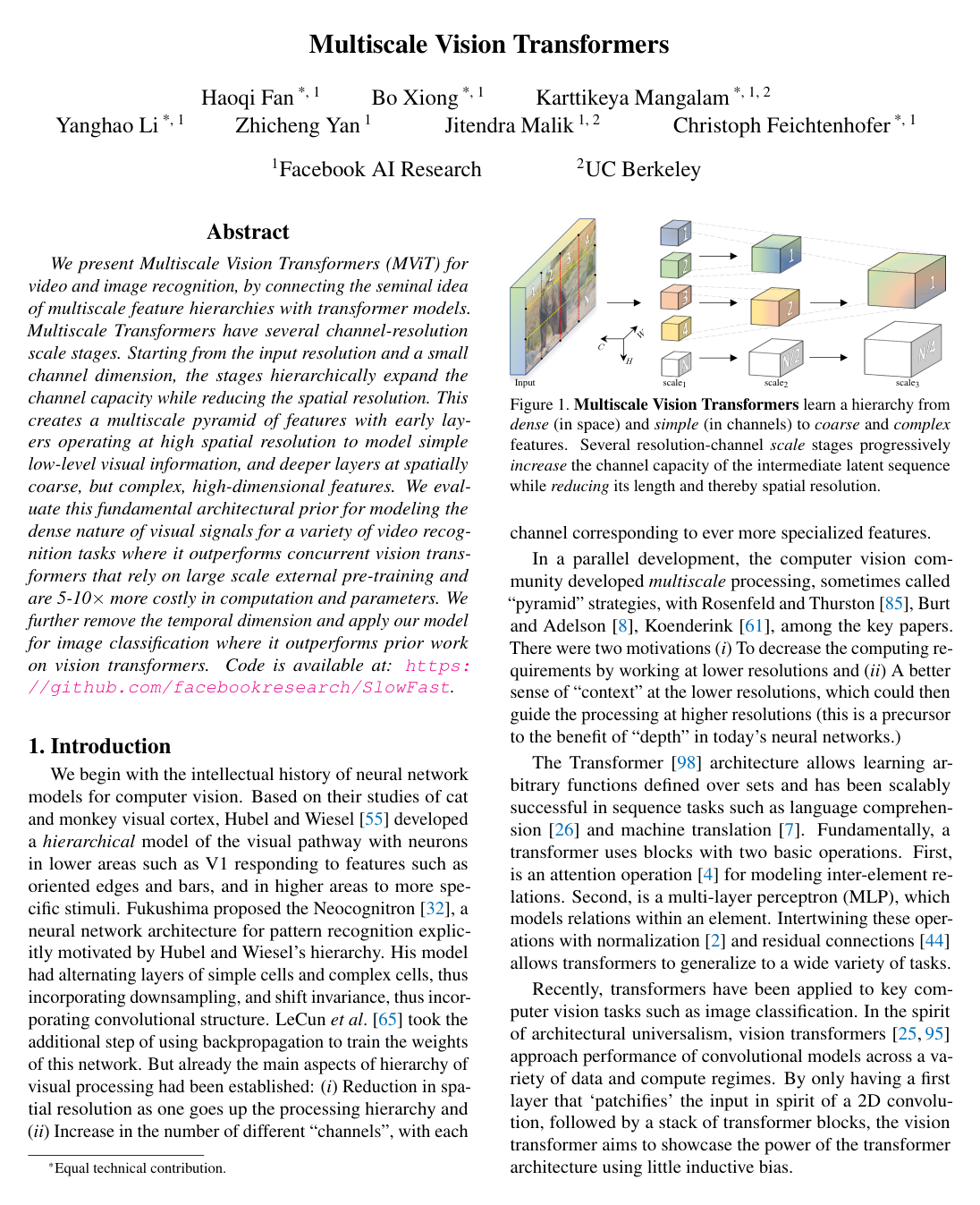
Multiscale Vision Transformers
Haoqi Fan, Bo Xiong, Karttikeya Mangalam, Yanghao Li, Zhicheng Yan, Jitendra Malik, Christoph Feichtenhofer
Why you should read this
Develops Multiscale Vision Transformers, a hierarchical architecture that incorporates multiscale feature pyramids into visual attention to achieve superior video and image recognition performance with up to ten times less computation and without requiring massive external pre-training.
We present Multiscale Vision Transformers (MViT) for video and image recognition, by connecting the seminal idea of multiscale feature hierarchies with transformer models. Multiscale Transformers have several channel-resolution scale stages. Starting from the input resolution and a small channel dimension, the stages hierarchically expand the channel capacity while reducing the spatial resolution. This creates a multiscale pyramid of features with early layers operating at high spatial resolution to model simple low-level visual information, and deeper layers at spatially coarse, but complex, high-dimensional features. We evaluate this fundamental architectural prior for modeling the dense nature of visual signals for a variety of video recognition tasks where it outperforms concurrent vision transformers that rely on large scale external pre-training and are 5-10x more costly in computation and parameters. We further remove the temporal dimension and apply our model for image classification where it outperforms prior work on vision transformers. Code is available at: this https URL
Added
2026-09-24
Is Space-Time Attention All You Need for Video Understanding?
Gedas Bertasius, Heng Wang, Lorenzo Torresani
Why you should read this
Introduces TimeSformer, a pure transformer architecture using divided space-time self-attention that achieves state-of-the-art video action recognition while training faster and processing much longer clips than standard 3D convolutional networks.
We present a convolution-free approach to video classification built exclusively on self-attention over space and time. Our method, named "TimeSformer," adapts the standard Transformer architecture to video by enabling spatiotemporal feature learning directly from a sequence of frame-level patches. Our experimental study compares different self-attention schemes and suggests that "divided attention," where temporal attention and spatial attention are separately applied within each block, leads to the best video classification accuracy among the design choices considered. Despite the radically new design, TimeSformer achieves state-of-the-art results on several action recognition benchmarks, including the best reported accuracy on Kinetics-400 and Kinetics-600. Finally, compared to 3D convolutional networks, our model is faster to train, it can achieve dramatically higher test efficiency (at a small drop in accuracy), and it can also be applied to much longer video clips (over one minute long). Code and models are available at: this https URL.
Added
2026-09-11

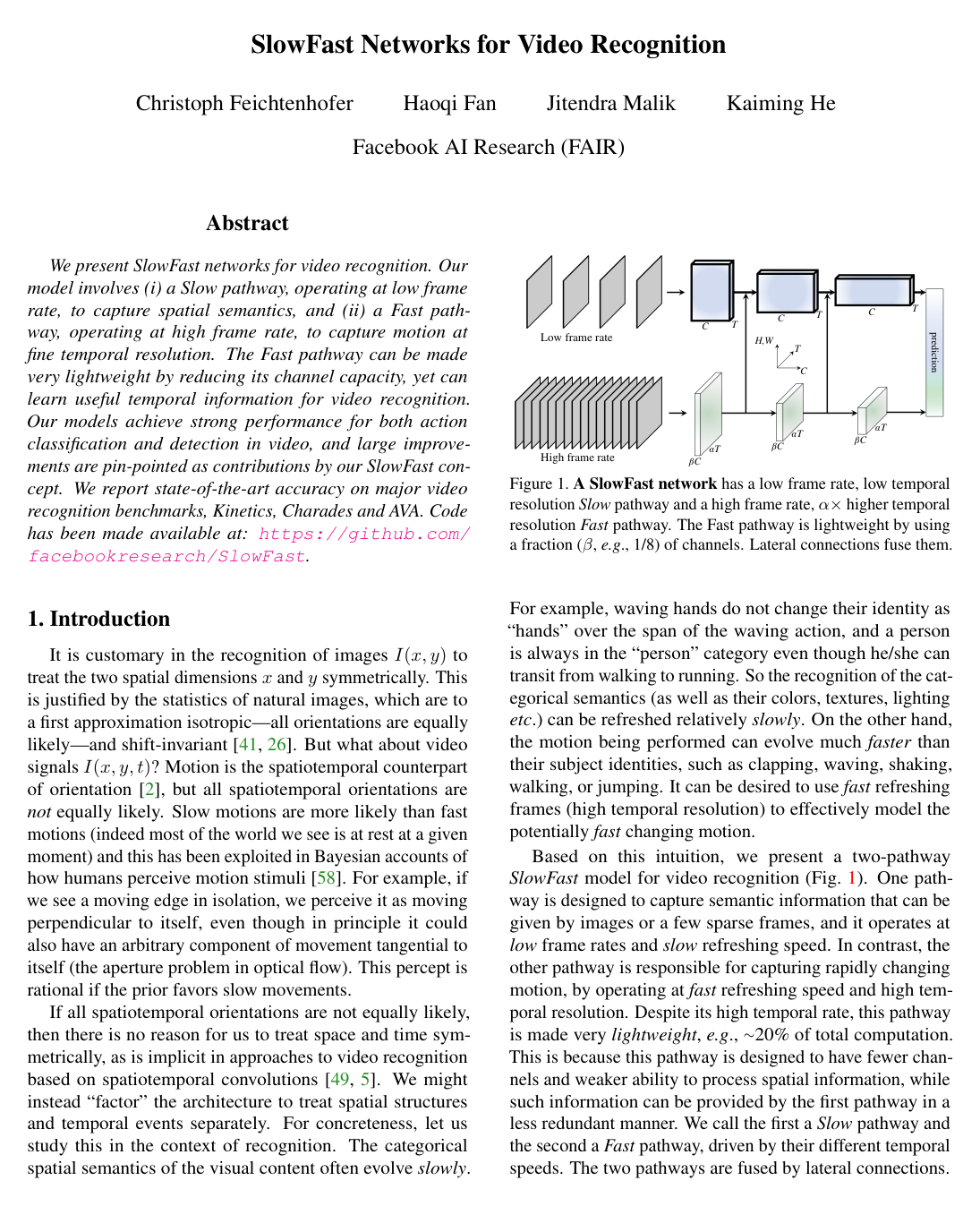
SlowFast Networks for Video Recognition
Christoph Feichtenhofer, Haoqi Fan, Jitendra Malik, Kaiming He
Why you should read this
Proposes a dual-pathway video architecture that processes spatial semantics at a low frame rate and rapid motion through a lightweight, high-frame-rate stream to achieve state-of-the-art action classification and detection performance.
We present SlowFast networks for video recognition. Our model involves (i) a Slow pathway, operating at low frame rate, to capture spatial semantics, and (ii) a Fast pathway, operating at high frame rate, to capture motion at fine temporal resolution. The Fast pathway can be made very lightweight by reducing its channel capacity, yet can learn useful temporal information for video recognition. Our models achieve strong performance for both action classification and detection in video, and large improvements are pin-pointed as contributions by our SlowFast concept. We report state-of-the-art accuracy on major video recognition benchmarks, Kinetics, Charades and AVA. Code has been made available at: this https URL
Added
2026-09-10
VideoMAE: Masked Autoencoders are Data-Efficient Learners for Self-Supervised Video Pre-Training
Zhan Tong, Yibing Song, Jue Wang, Limin Wang
Why you should read this
Demonstrates that VideoMAE can achieve state-of-the-art performance on video recognition benchmarks with significantly less data, even on small datasets, by utilizing a novel masked autoencoder approach.
Pre-training video transformers on extra large-scale datasets is generally required to achieve premier performance on relatively small datasets. In this paper, we show that video masked autoencoders (VideoMAE) are data-efficient learners for self-supervised video pre-training (SSVP). We are inspired by the recent ImageMAE and propose customized video tube masking with an extremely high ratio. This simple design makes video reconstruction a more challenging self-supervision task, thus encouraging extracting more effective video representations during this pre-training process. We obtain three important findings on SSVP: (1) An extremely high proportion of masking ratio (i.e., 90% to 95%) still yields favorable performance of VideoMAE. The temporally redundant video content enables a higher masking ratio than that of images. (2) VideoMAE achieves impressive results on very small datasets (i.e., around 3k-4k videos) without using any extra data. (3) VideoMAE shows that data quality is more important than data quantity for SSVP. Domain shift between pre-training and target datasets is an important issue. Notably, our VideoMAE with the vanilla ViT can achieve 87.4% on Kinetics-400, 75.4% on Something-Something V2, 91.3% on UCF101, and 62.6% on HMDB51, without using any extra data. Code is available at this https URL.
Added
2026-01-30