
Built independently by an author, for readers. Read the story and support ChapterPal

keyword

video prompt engineering

Video prompt engineering is the practice of designing, structuring, and refining natural language descriptions to guide text-to-video artificial intelligence models in generating desired video sequences. Unlike prompt engineering for static images, it focuses heavily on temporal dynamics, requiring precise descriptions of camera movement, subject actions, motion pacing, scene transitions, and visual consistency across successive frames. By strategically combining details about subject matter, cinematic style, lighting, and sequential progression, video prompt engineering aims to optimize the fidelity, narrative coherence, and overall quality of synthesized video content.

1 item
VidProM: A Million-scale Real Prompt-Gallery Dataset for Text-to-Video Diffusion Models

VidProM: A Million-scale Real Prompt-Gallery Dataset for Text-to-Video Diffusion Models

Wenhao Wang, Yi Yang

OrganizationsUniversity of Technology SydneyZhejiang University

Why you should read this

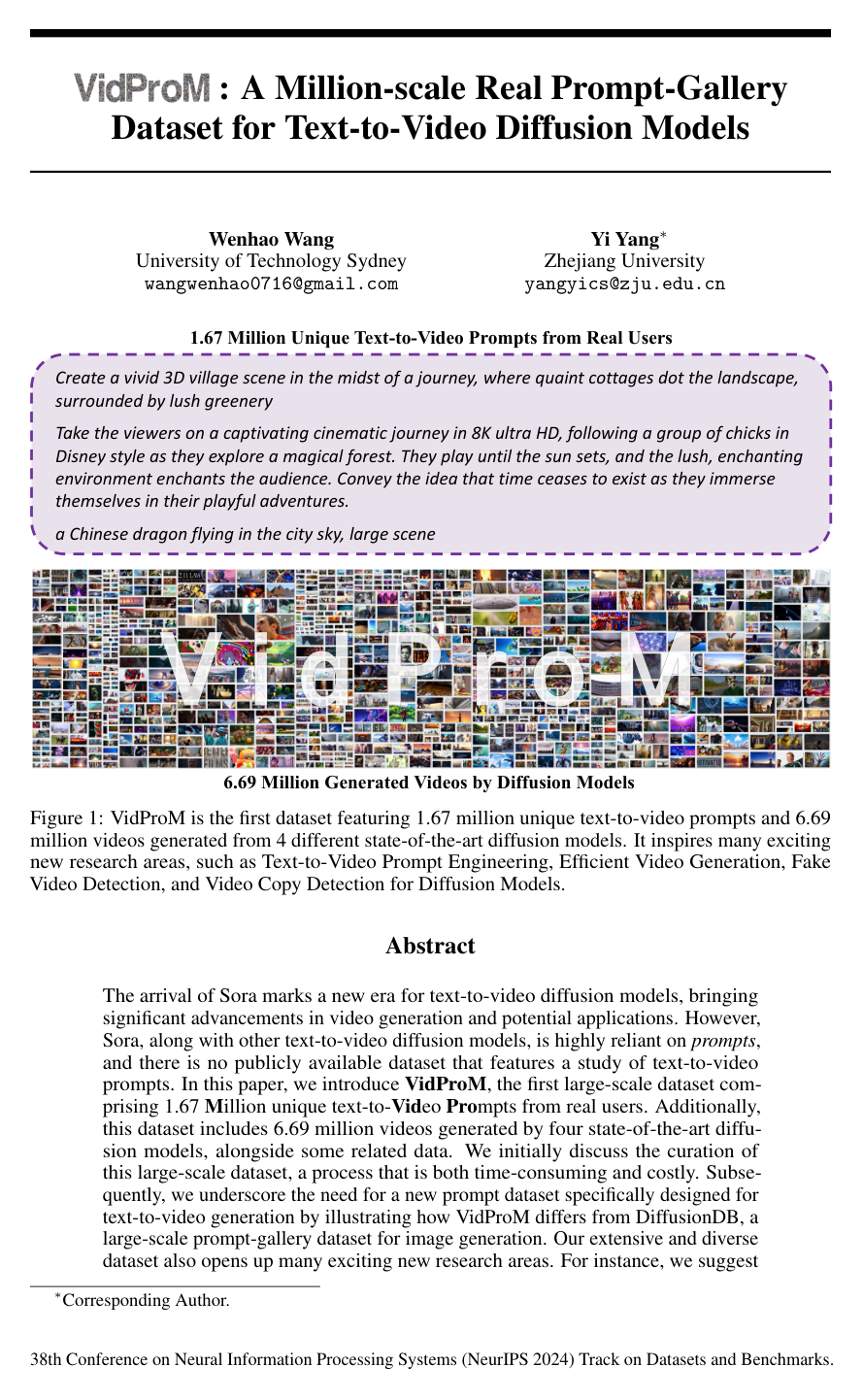
Introduces VidProM, the first large-scale prompt-gallery dataset containing 1.67 million real-user text-to-video prompts paired with 6.69 million synthesized videos from four diffusion models to advance research in video prompt engineering, efficient generation, and synthetic video detection.

The arrival of Sora marks a new era for text-to-video diffusion models, bringing significant advancements in video generation and potential applications. However, Sora, along with other text-to-video diffusion models, is highly reliant on prompts, and there is no publicly available dataset that features a study of text-to-video prompts. In this paper, we introduce VidProM, the first large-scale dataset comprising 1.67 Million unique text-to-Video Prompts from real users. Additionally, this dataset includes 6.69 million videos generated by four state-of-the-art diffusion models, alongside some related data. We initially discuss the curation of this large-scale dataset, a process that is both time-consuming and costly. Subsequently, we underscore the need for a new prompt dataset specifically designed for text-to-video generation by illustrating how VidProM differs from DiffusionDB, a large-scale prompt-gallery dataset for image generation. Our extensive and diverse dataset also opens up many exciting new research areas. For instance, we suggest

Added

2026-09-26