
keyword
video-language representation
A video-language representation is a multimodal computational feature or embedding space that jointly encodes and aligns semantic information from video inputs with natural language text. By projecting sequential visual frames, temporal motion, and associated signals such as audio or subtitles alongside textual semantics into a unified or interconnected framework, it captures the relationships between dynamic video content and descriptive language. These representations enable machine learning models to bridge the gap between multimodal visual data and text, facilitating downstream tasks such as text-to-video retrieval, automated video captioning, and video question answering.
2 items
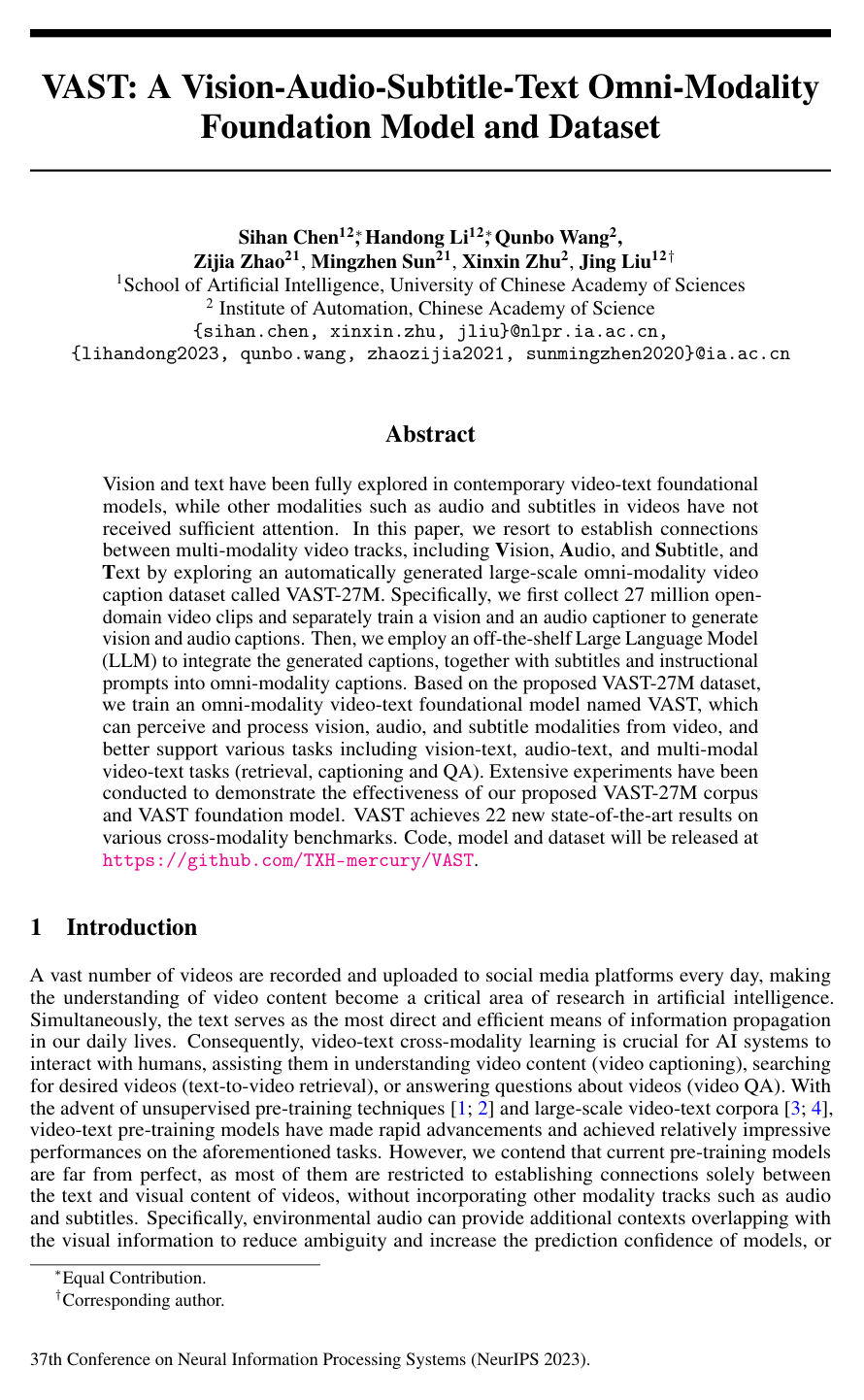
VAST: A Vision-Audio-Subtitle-Text Omni-Modality Foundation Model and Dataset
Sihan Chen, Handong Li, Qunbo Wang, Zijia Zhao, Mingzhen Sun, Xinxin Zhu, Jing Liu
Why you should read this
Presents VAST-27M, an automatically generated 27-million-clip omni-modality video caption dataset, along with a unified foundation model capable of processing vision, audio, subtitles, and text across diverse retrieval, captioning, and question-answering tasks.
Vision and text have been fully explored in contemporary video-text foudational models, while other modalities such as audio and subtitles in videos have not received sufficient attention. In this paper, we resort to establish connections between multi-modality video tracks, including Vision, Audio, and Subtitle, and Text by exploring an automatically generated large-scale omni-modality video caption dataset called VAST-27M. Specifically, we first collect 27 million open-domain video clips and separately train a vision and an audio captioner to generate vision and audio captions. Then, we employ an off-the-shelf Large Language Model (LLM) to integrate the generated captions, together with subtitles and instructional prompts into omni-modality captions. Based on the proposed VAST-27M dataset, we train an omni-modality video-text foundational model named VAST, which can perceive and process vision, audio, and subtitle modalities from video, and better support various tasks including vision-text, audio-text, and multi-modal video-text tasks (retrieval, captioning and QA). Extensive experiments have been conducted to demonstrate the effectiveness of our proposed VAST-27M corpus and VAST foundation model. VAST achieves 22 new state-of-the-art results on various cross-modality benchmarks. Code, model and dataset will be released at https://github.com/TXH-mercury/VAST.
Added
2026-09-26
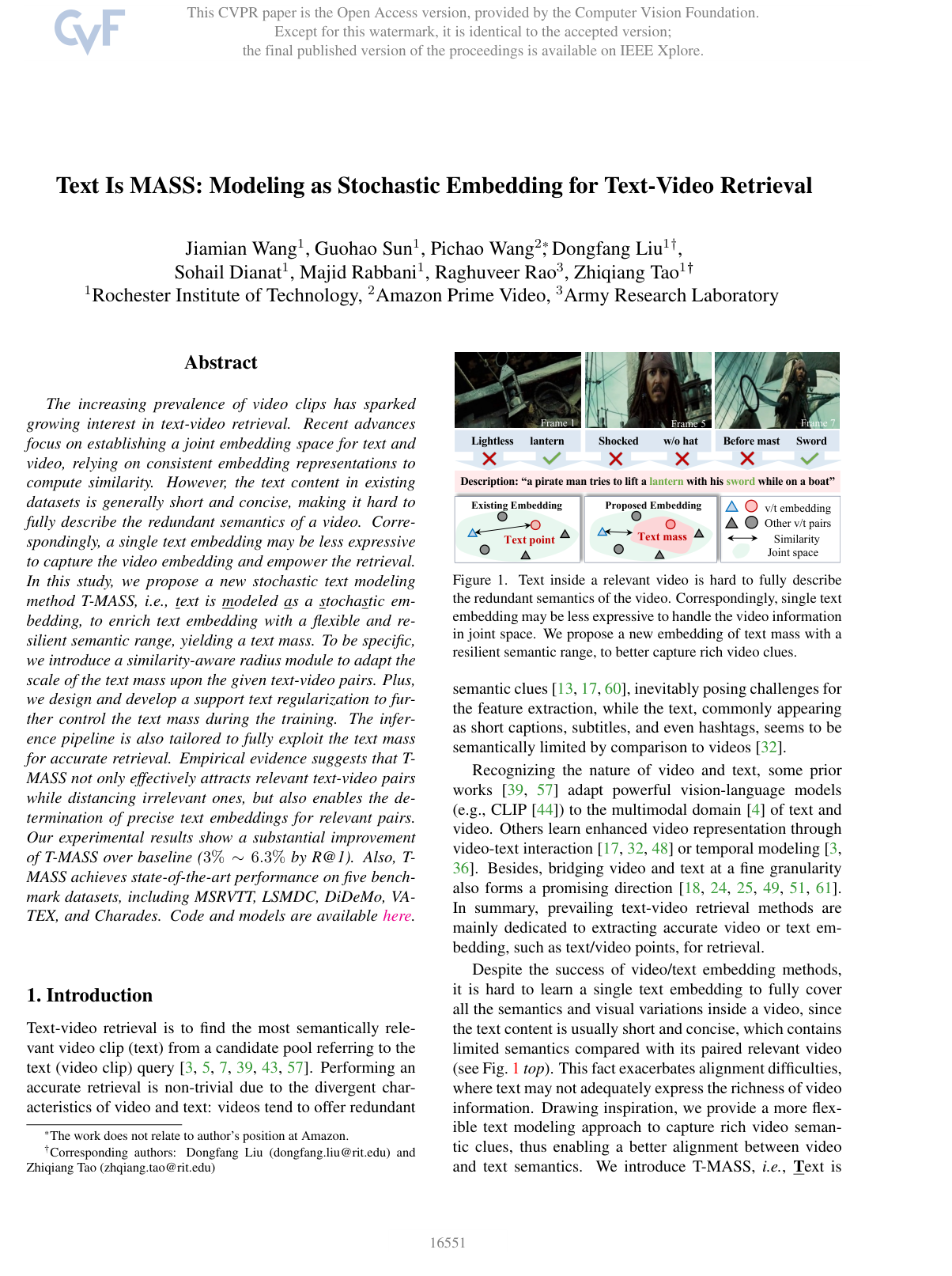
Text Is MASS: Modeling as Stochastic Embedding for Text-Video Retrieval
Jiamian Wang, Pichao Wang, Guohao Sun, Dongfang Liu, Sohail A. Dianat, Raghuveer Rao, Majid Rabbani, Zhiqiang Tao
Why you should read this
Proposes T-MASS, a text-video retrieval framework that models concise text queries as stochastic embeddings with adaptive radii to capture the broad semantic scope of rich video content and achieve state-of-the-art retrieval accuracy across multiple benchmark datasets.
The increasing prevalence of video clips has sparked growing interest in text-video retrieval. Recent advances focus on establishing a joint embedding space for text and video, relying on consistent embedding representations to compute similarity. However, the text content in existing datasets is generally short and concise, making it hard to fully describe the redundant semantics of a video. Correspondingly, a single text embedding may be less expressive to capture the video embedding and empower the retrieval. In this study, we propose a new stochastic text modeling method T-MASS, i.e., text is modeled as a stochastic embedding, to enrich text embedding with a flexible and resilient semantic range, yielding a text mass. To be specific, we introduce a similarity-aware radius module to adapt the scale of the text mass upon the given text-video pairs. Plus, we design and develop a support text regularization to further control the text mass during the training. The inference pipeline is also tailored to fully exploit the text mass for accurate retrieval. Empirical evidence suggests that T-MASS not only effectively attracts relevant text-video pairs while distancing irrelevant ones, but also enables the determination of precise text embeddings for relevant pairs. Our experimental results show a substantial improvement of T-MASS over baseline (3% ∼ 6.3% by R@1). Also, T-MASS achieves state-of-the-art performance on five benchmark datasets, including MSRVTT, LSMDC, DiDeMo, VATEX, and Charades. Code and models are available here.
Added
2026-09-26