
keyword
video language models
Video language models are artificial intelligence systems designed to jointly process, interpret, and generate both video content and natural language text. These multimodal models typically integrate visual encoders or video tokenizers with large language model architectures, allowing them to comprehend temporal dynamics, spatial relationships, and motion across continuous sequences of visual frames alongside textual context. By learning cross-modal representations that align visual and linguistic data across time, video language models support diverse applications, including video question answering, video captioning, spatio-temporal reasoning, long-form content summarization, and text-conditioned video generation.
4 items
VideoPrism: A Foundational Visual Encoder for Video Understanding
Long Zhao, Nitesh Bharadwaj Gundavarapu, Liangzhe Yuan, Hao Zhou, Shen Yan, Jennifer J. Sun, Luke Friedman, Rui Qian, Tobias Weyand, Yue Zhao, Rachel Hornung, Florian Schroff, Ming-Hsuan Yang, David A. Ross, Huisheng Wang, Hartwig Adam, Mikhail Sirotenko, Ting Liu, Boqing Gong
Why you should read this
Presents VideoPrism, a foundational visual encoder pretrained via a two-stage contrastive and masked modeling pipeline that achieves state-of-the-art results across 31 video understanding benchmarks using a single frozen model.
Added
2026-10-02
VideoPoet: A Large Language Model for Zero-Shot Video Generation
Dan Kondratyuk, Lijun Yu, Xiuye Gu, José Lezama, Jonathan Huang, Grant Schindler, Rachel Hornung, Vighnesh Birodkar, Jimmy Yan, Ming-Chang Chiu, Krishna Somandepalli, Hassan Akbari, Yair Alon, Yong Cheng, Joshua V. Dillon, Agrim Gupta, Meera Hahn, Anja Hauth, David Hendon, Alonso Martinez, David Minnen, Mikhail Sirotenko, Kihyuk Sohn, Xuan Yang, Hartwig Adam, Ming-Hsuan Yang, Irfan Essa, Huisheng Wang, David A. Ross, Bryan Seybold, Lu Jiang
Why you should read this
Demonstrates that a unified decoder-only language model trained on discrete multimodal tokens can match or outperform diffusion approaches across diverse video generation and editing tasks without task-specific architectural changes.
We present VideoPoet, a model for synthesizing high-quality videos from a large variety of conditioning signals. VideoPoet employs a decoder-only transformer architecture that processes multimodal inputs – including images, videos, text, and audio. The training protocol follows that of Large Language Models (LLMs), consisting of two stages: pretraining and task-specific adaptation. During pretraining, VideoPoet incorporates a mixture of multimodal generative objectives within an autoregressive Transformer framework. The pretrained LLM serves as a foundation that is adapted to a range of video generation tasks. We present results demonstrating the model’s state-of-the-art capabilities in zero-shot video generation, specifically highlighting the generation of high-fidelity motions. Project page: https://sites.research.google/videopoet/.
Added
2026-09-28
HourVideo: 1-Hour Video-Language Understanding
Keshigeyan Chandrasegaran, Agrim Gupta, Lea M. Hadzic, Taran Kota, Jimming He, Cristóbal Eyzaguirre, Zane Durante, Manling Li, Jiajun Wu, Li Fei-Fei
Why you should read this
Presents a benchmark of nearly thirteen thousand questions across five hundred hour-long egocentric videos to expose the critical performance gap between state-of-the-art multimodal models and human-level long-form video comprehension.
We present HourVideo, a benchmark dataset for hour-long video-language understanding. Our dataset consists of a novel task suite comprising summarization, perception (recall, tracking), visual reasoning (spatial, temporal, predictive, causal, counterfactual), and navigation (room-to-room, object retrieval) tasks. HourVideo includes 500 manually curated egocentric videos from the Ego4D dataset, spanning durations of 20 to 120 minutes, and features 12,976 high-quality, five-way multiple-choice questions. Benchmarking results reveal that multimodal models, including GPT-4 and LLaVA-NeXT, achieve marginal improvements over random chance. In stark contrast, human experts significantly outperform the state-of-the-art long-context multimodal model, Gemini Pro 1.5 (85.0% vs. 37.3%), highlighting a substantial gap in multimodal capabilities. Our benchmark, evaluation toolkit, prompts, and documentation are available at hourvideo.stanford.edu.
Added
2026-09-26
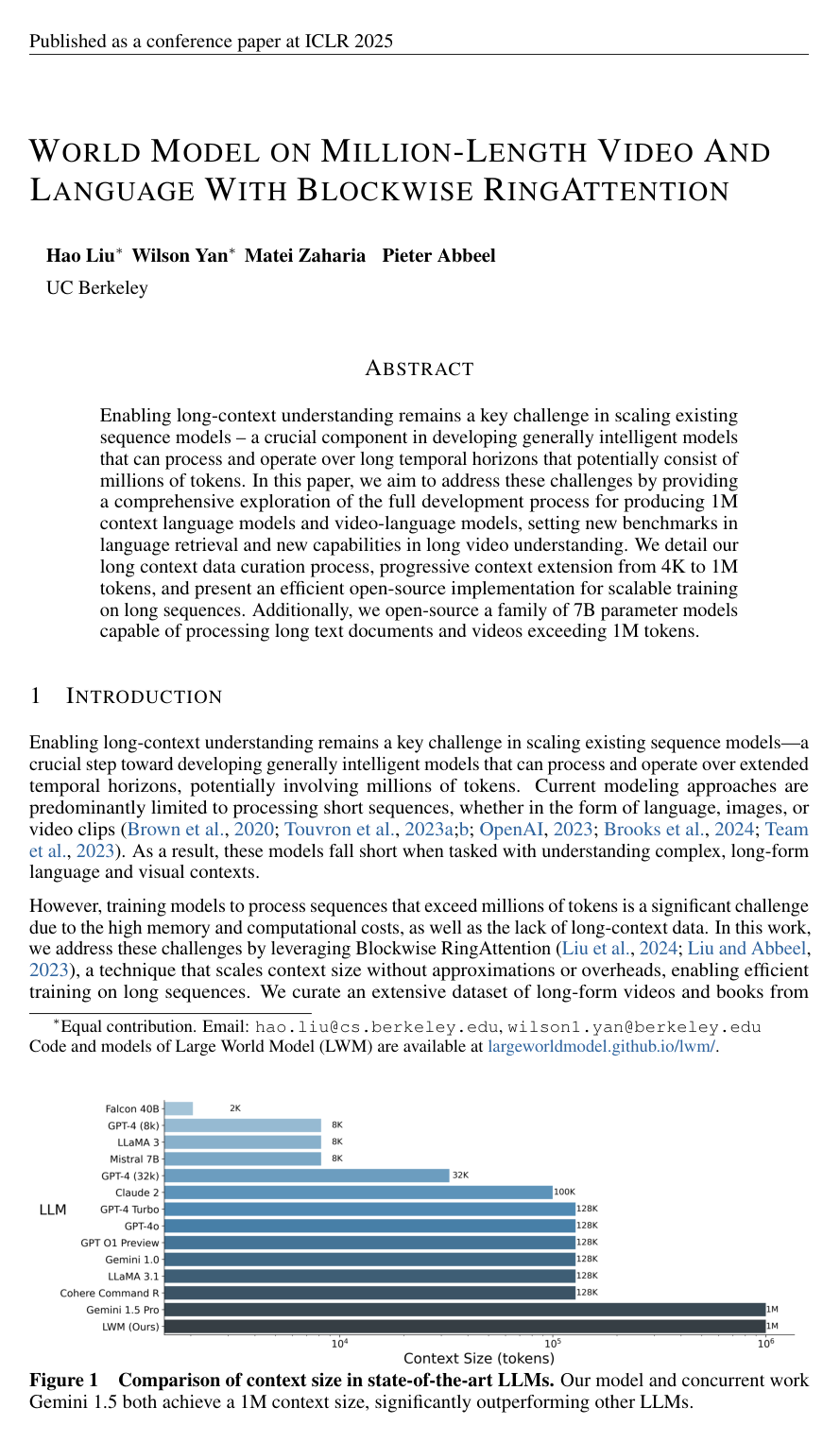
World Model on Million-Length Video And Language With Blockwise RingAttention
Hao Liu, Wilson Yan, Matei Zaharia, Pieter Abbeel
Why you should read this
Presents an open-source training method and 7B parameter model family that scales multimodal context to one million tokens using Blockwise RingAttention, enabling the processing of hour-long videos and massive text sequences.
Enabling long-context understanding remains a key challenge in scaling existing sequence models -- a crucial component in developing generally intelligent models that can process and operate over long temporal horizons that potentially consist of millions of tokens. In this paper, we aim to address these challenges by providing a comprehensive exploration of the full development process for producing 1M context language models and video-language models, setting new benchmarks in language retrieval and new capabilities in long video understanding. We detail our long context data curation process, progressive context extension from 4K to 1M tokens, and present an efficient open-source implementation for scalable training on long sequences. Additionally, we open-source a family of 7B parameter models capable of processing long text documents and videos exceeding 1M tokens.
Added
2026-09-26