
keyword
video diffusion models
Video diffusion models are generative deep learning models that synthesize coherent video sequences by learning to iteratively remove noise from a random distribution. Building upon the principles of image diffusion architectures, these models incorporate temporal mechanisms, such as spatio-temporal attention layers or three-dimensional convolutions, to capture motion dynamics and preserve visual continuity across consecutive frames. Operating either directly on raw pixel data or within compressed latent spaces, video diffusion models can be conditioned on diverse modalities such as text descriptions, static images, or context frames. This architecture facilitates a wide range of visual generative tasks, including text-to-video generation, image animation, video-to-video editing, and frame prediction.
14 items
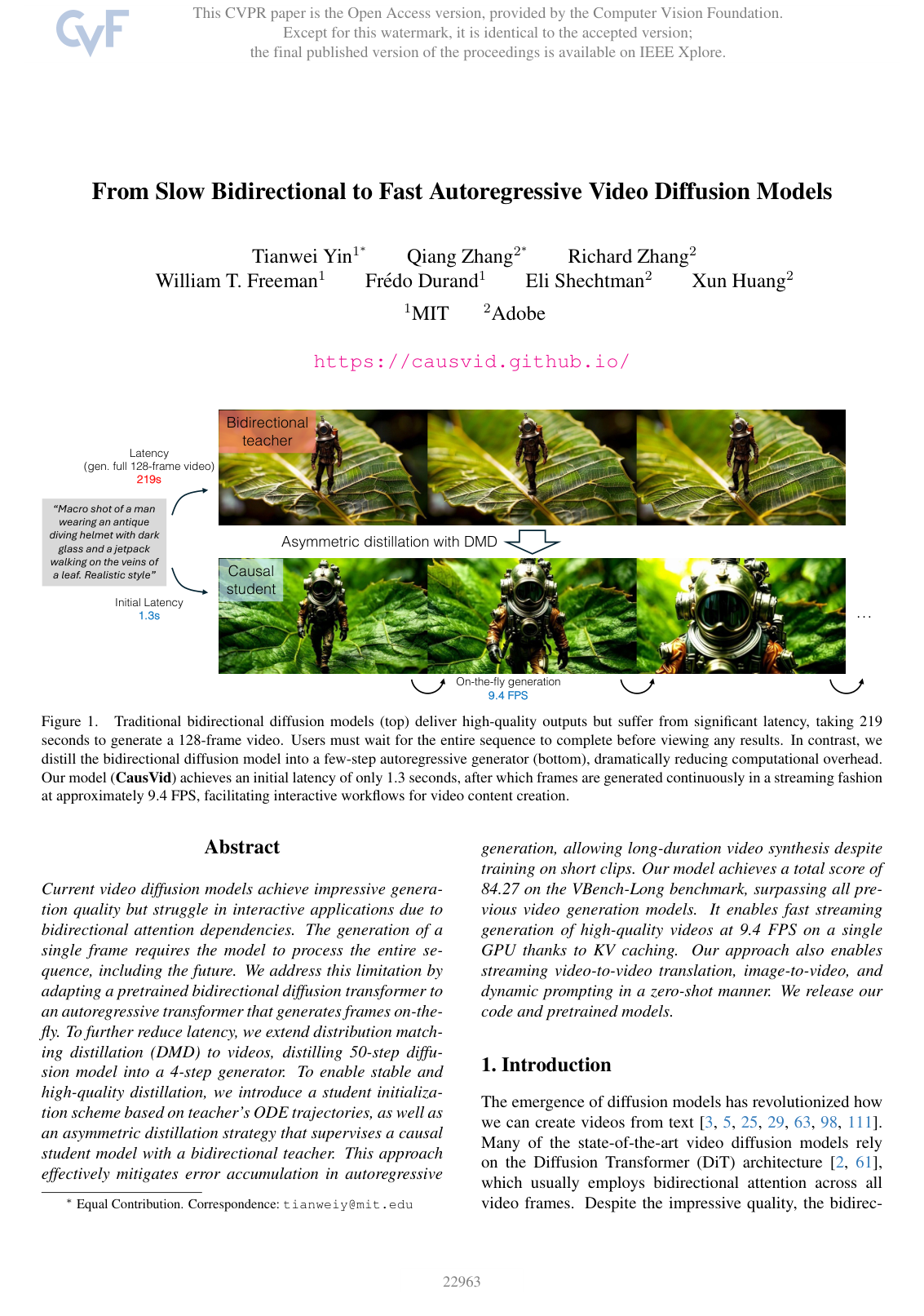
From Slow Bidirectional to Fast Autoregressive Video Diffusion Models
Tianwei Yin, Qiang Zhang, Richard Zhang, William T. Freeman, Frdo Durand, Eli Shechtman, Xun Huang
Why you should read this
Presents CausVid, a framework that distills bidirectional video diffusion transformers into a four-step causal autoregressive generator via asymmetric distribution matching distillation, enabling interactive streaming video synthesis at 9.4 frames per second on a single GPU.
Current video diffusion models achieve impressive generation quality but struggle in interactive applications due to bidirectional attention dependencies. The generation of a single frame requires the model to process the entire sequence, including the future. We address this limitation by adapting a pretrained bidirectional diffusion transformer to an autoregressive transformer that generates frames on-the-fly. To further reduce latency, we extend distribution matching distillation (DMD) to videos, distilling 50-step diffusion model into a 4-step generator. To enable stable and high-quality distillation, we introduce a student initialization scheme based on teacher's ODE trajectories, as well as an asymmetric distillation strategy that supervises a causal student model with a bidirectional teacher. This approach effectively mitigates error accumulation in autoregressive generation, allowing long-duration video synthesis despite training on short clips. Our model achieves a total score of 84.27 on the VBench-Long benchmark, surpassing all previous video generation models. It enables fast streaming generation of high-quality videos at 9.4 FPS on a single GPU thanks to KV caching. Our approach also enables streaming video-to-video translation, image-to-video, and dynamic prompting in a zero-shot manner. We release our code and pretrained models.
Added
2026-10-05
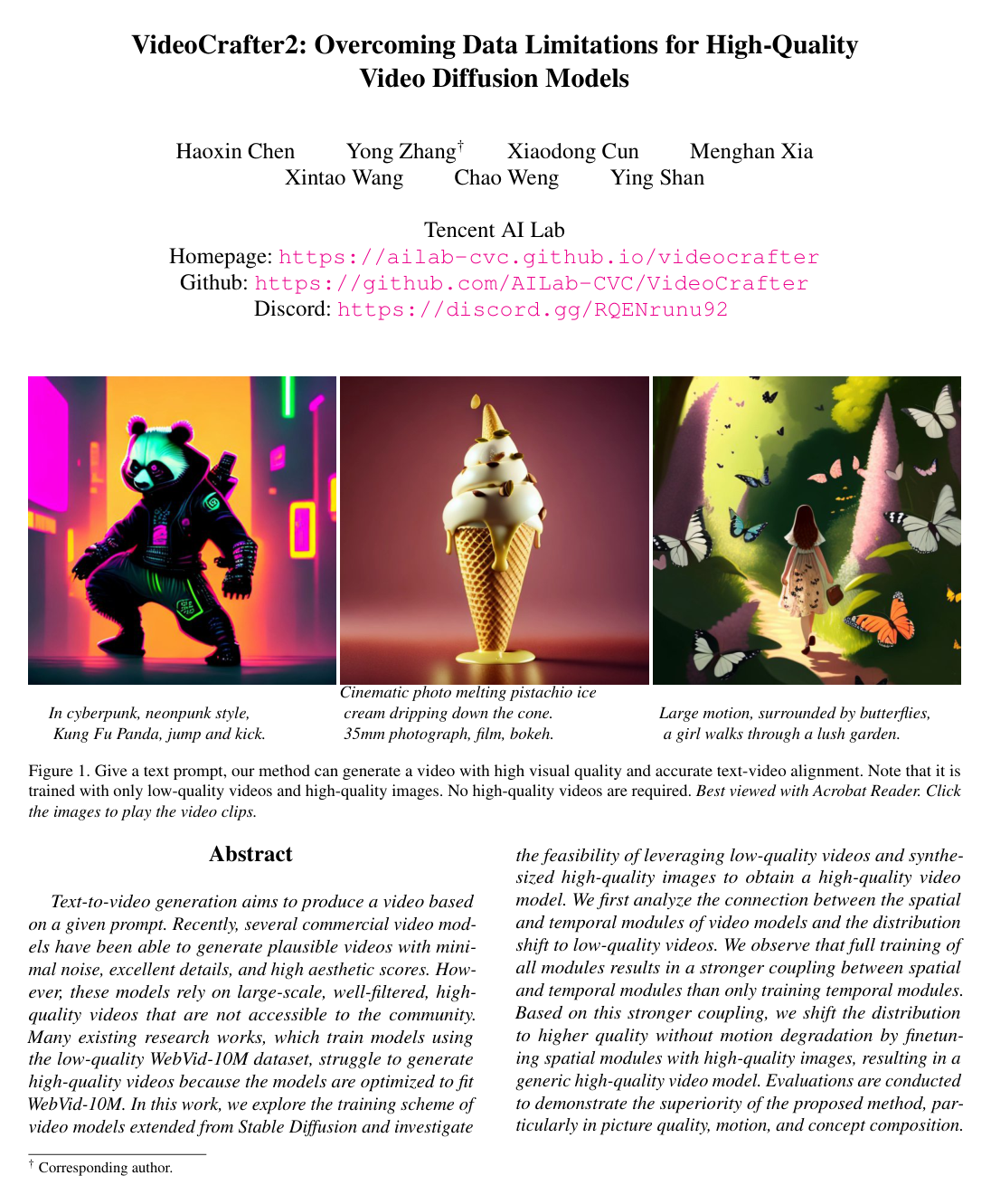
VideoCrafter2: Overcoming Data Limitations for High-Quality Video Diffusion Models
Haoxin Chen, Yong Zhang, Xiaodong Cun, Menghan Xia, Xintao Wang, Chao Weng, Ying Shan
Why you should read this
Presents a training strategy that enables text-to-video diffusion models to overcome low-quality video datasets by finetuning spatial modules with high-quality images without sacrificing motion dynamics.
Text-to-video generation aims to produce a video based on a given prompt. Recently, several commercial video models have been able to generate plausible videos with minimal noise, excellent details, and high aesthetic scores. However, these models rely on large-scale, well-filtered, high-quality videos that are not accessible to the community. Many existing research works, which train models using the low-quality WebVid-10M dataset, struggle to generate high-quality videos because the models are optimized to fit WebVid-10M. In this work, we explore the training scheme of video models extended from Stable Diffusion and investigate the feasibility of leveraging low-quality videos and synthesized high-quality images to obtain a high-quality video model. We first analyze the connection between the spatial and temporal modules of video models and the distribution shift to low-quality videos. We observe that full training of all modules results in a stronger coupling between spatial and temporal modules than only training temporal modules. Based on this stronger coupling, we shift the distribution to higher quality without motion degradation by finetuning spatial modules with high-quality images, resulting in a generic high-quality video model. Evaluations are conducted to demonstrate the superiority of the proposed method, particularly in picture quality, motion, and concept composition.
Added
2026-10-05
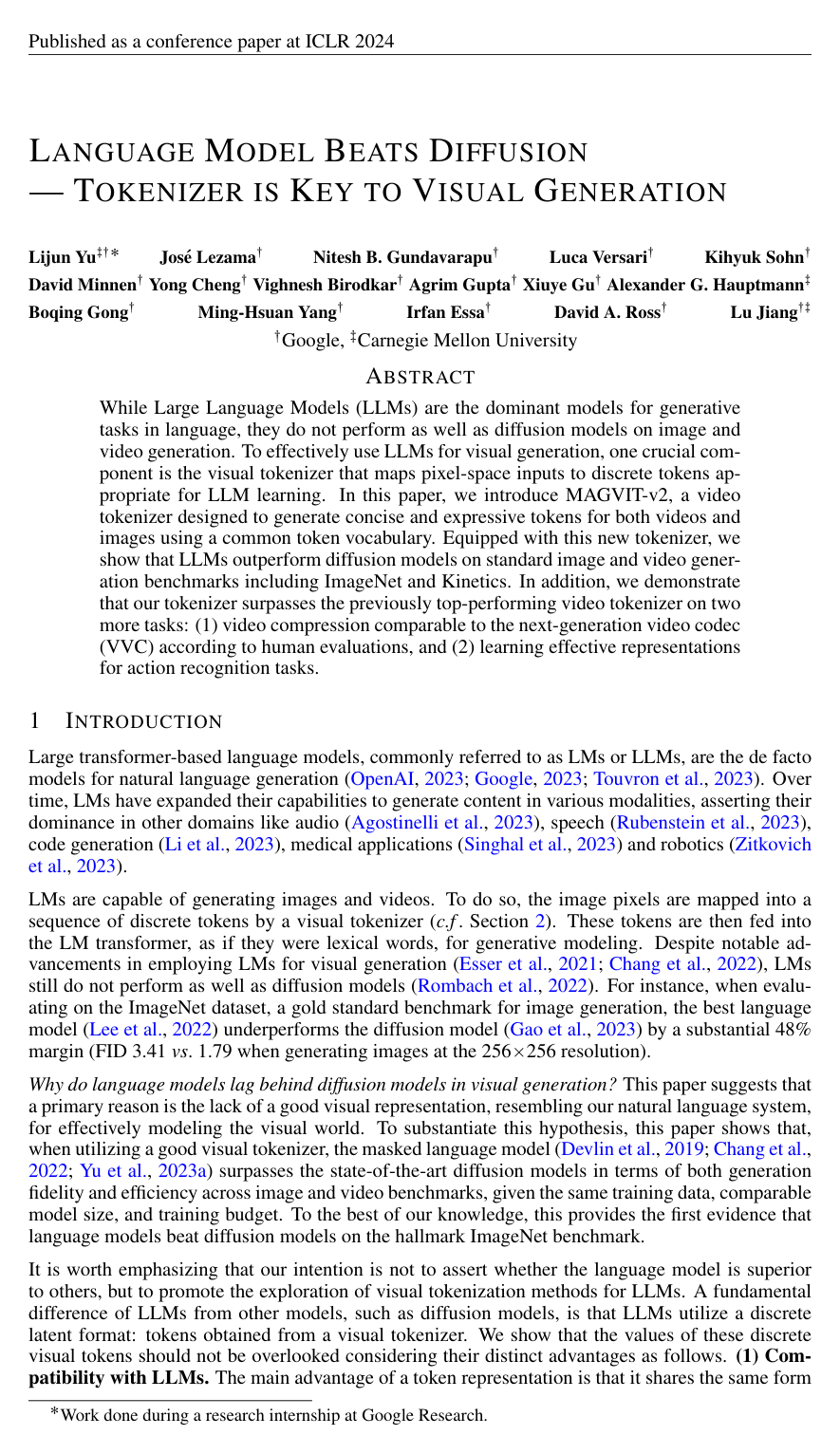
Language Model Beats Diffusion -- Tokenizer is Key to Visual Generation
Lijun Yu, José Lezama, N. B. Gundavarapu, Luca Versari, Kihyuk Sohn, David C. Minnen, Yong Cheng, Agrim Gupta, Xiuye Gu, Alexander G. Hauptmann, Boqing Gong, Ming-Hsuan Yang, Irfan Essa, David A. Ross, Lu Jiang
Why you should read this
Introduces MAGVIT-v2, a unified visual tokenizer that enables autoregressive language models to outperform diffusion models on standard image and video generation benchmarks while achieving competitive video compression.
While Large Language Models (LLMs) are the dominant models for generative tasks in language, they do not perform as well as diffusion models on image and video generation. To effectively use LLMs for visual generation, one crucial component is the visual tokenizer that maps pixel-space inputs to discrete tokens appropriate for LLM learning. In this paper, we introduce MAGVIT-v2, a video tokenizer designed to generate concise and expressive tokens for both videos and images using a common token vocabulary. Equipped with this new tokenizer, we show that LLMs outperform diffusion models on standard image and video generation benchmarks including ImageNet and Kinetics. In addition, we demonstrate that our tokenizer surpasses the previously top-performing video tokenizer on two more tasks: (1) video compression comparable to the next-generation video codec (VCC) according to human evaluations, and (2) learning effective representations for action recognition tasks.
Added
2026-10-05
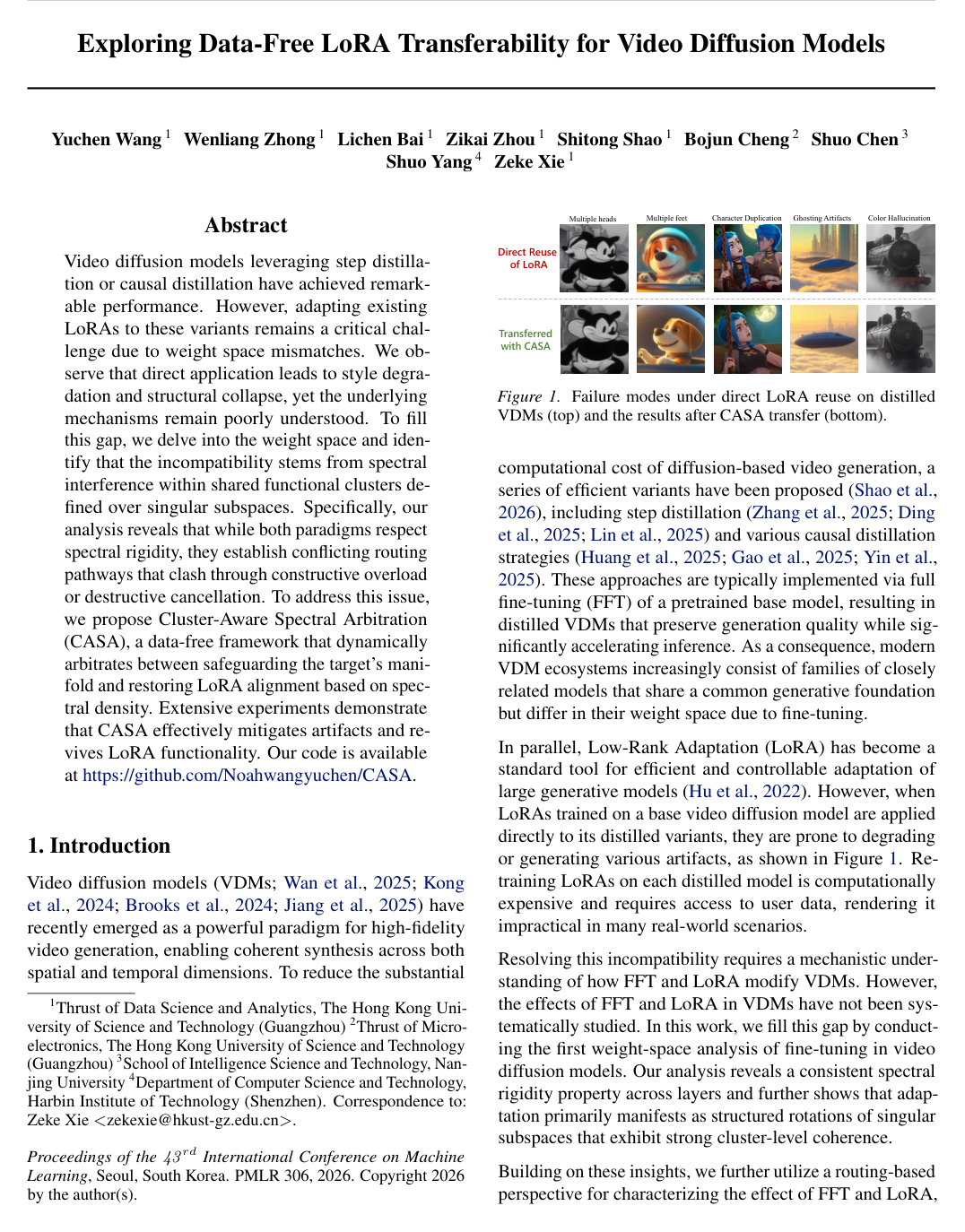
Exploring Data-Free LoRA Transferability for Video Diffusion Models
Yuchen Wang, Wenliang Zhong, Lichen Bai, Zikai Zhou, Shitong Shao, Bo-Xun Cheng, Shuo Chen, Shuo Yang, Zeke Xie
Why you should read this
Proposes Cluster-Aware Spectral Arbitration (CASA), a data-free framework that resolves weight-space spectral interference to enable the direct reuse of pretrained LoRAs across distilled video diffusion models without retraining.
Video diffusion models leveraging step distillation or causal distillation have achieved remarkable performance. However, adapting existing LoRAs to these variants remains a critical challenge due to weight space mismatches. We observe that direct application leads to style degradation and structural collapse, yet the underlying mechanisms remain poorly understood. To fill this gap, we delve into the weight space and identify that the incompatibility stems from spectral interference within shared functional clusters defined over singular subspaces. Specifically, our analysis reveals that while both paradigms respect spectral rigidity, they establish conflicting routing pathways that clash through constructive overload or destructive cancellation. To address this issue, we propose Cluster-Aware Spectral Arbitration (CASA), a data-free framework that dynamically arbitrates between safeguarding the target's manifold and restoring LoRA alignment based on spectral density. Extensive experiments demonstrate that CASA effectively mitigates artifacts and revives LoRA functionality. Our code is available at this https URL
Added
2026-09-30

CV-VAE: A Compatible Video VAE for Latent Generative Video Models
Sijie Zhao, Yong Zhang, Xiaodong Cun, Shaoshu Yang, Muyao Niu, Xiaoyu Li, Wenbo Hu, Ying Shan
Why you should read this
Proposes a compatible 3D video VAE using latent space regularization that aligns with pretrained 2D image models like Stable Diffusion, enabling existing diffusion models to generate four times more frames with smooth spatio-temporal compression and minimal finetuning.
Spatio-temporal compression of videos, utilizing networks such as Variational Autoencoders (VAE), plays a crucial role in OpenAI’s SORA and numerous other video generative models. For instance, many LLM-like video models learn the distribution of discrete tokens derived from 3D VAEs within the VQVAE framework, while most diffusion-based video models capture the distribution of continuous latent extracted by 2D VAEs without quantization. The temporal compression is simply realized by uniform frame sampling which results in unsmooth motion between consecutive frames. Currently, there lacks of a commonly used continuous video (3D) VAE for latent diffusion-based video models in the research community. Moreover, since current diffusion-based approaches are often implemented using pre-trained text-to-image (T2I) models, directly training a video VAE without considering the compatibility with existing T2I models will result in a latent space gap between them, which will take huge computational resources for training to bridge the gap even with the T2I models as initialization. To address this issue, we propose a method for training a video VAE of latent video models, namely CV-VAE, whose latent space is compatible with that of a given image VAE, e.g., image VAE of Stable Diffusion (SD). The compatibility is achieved by the proposed novel latent space regularization, which involves formulating a regularization loss using the image VAE. Benefiting from the latent space compatibility, video models can be trained seamlessly from pre-trained T2I or video models in a truly spatio-temporally compressed latent space, rather than simply sampling video frames at equal intervals. To improve the training efficiency, we also design a novel architecture for the video VAE. With our CV-VAE, existing video models can generate four times more frames with minimal finetuning. Extensive experiments are conducted to demonstrate the effectiveness of the proposed video VAE.
Added
2026-09-26
VideoBooth: Diffusion-based Video Generation with Image Prompts
Yuming Jiang, Tianxing Wu, Shuai Yang, Chenyang Si, Dahua Lin, Yu Qiao, Chen Change Loy, Ziwei Liu
Why you should read this
Proposes VideoBooth, a tuning-free feed-forward diffusion framework that generates customized, temporally consistent videos from image prompts by combining coarse semantic embeddings with multi-scale attention injection.
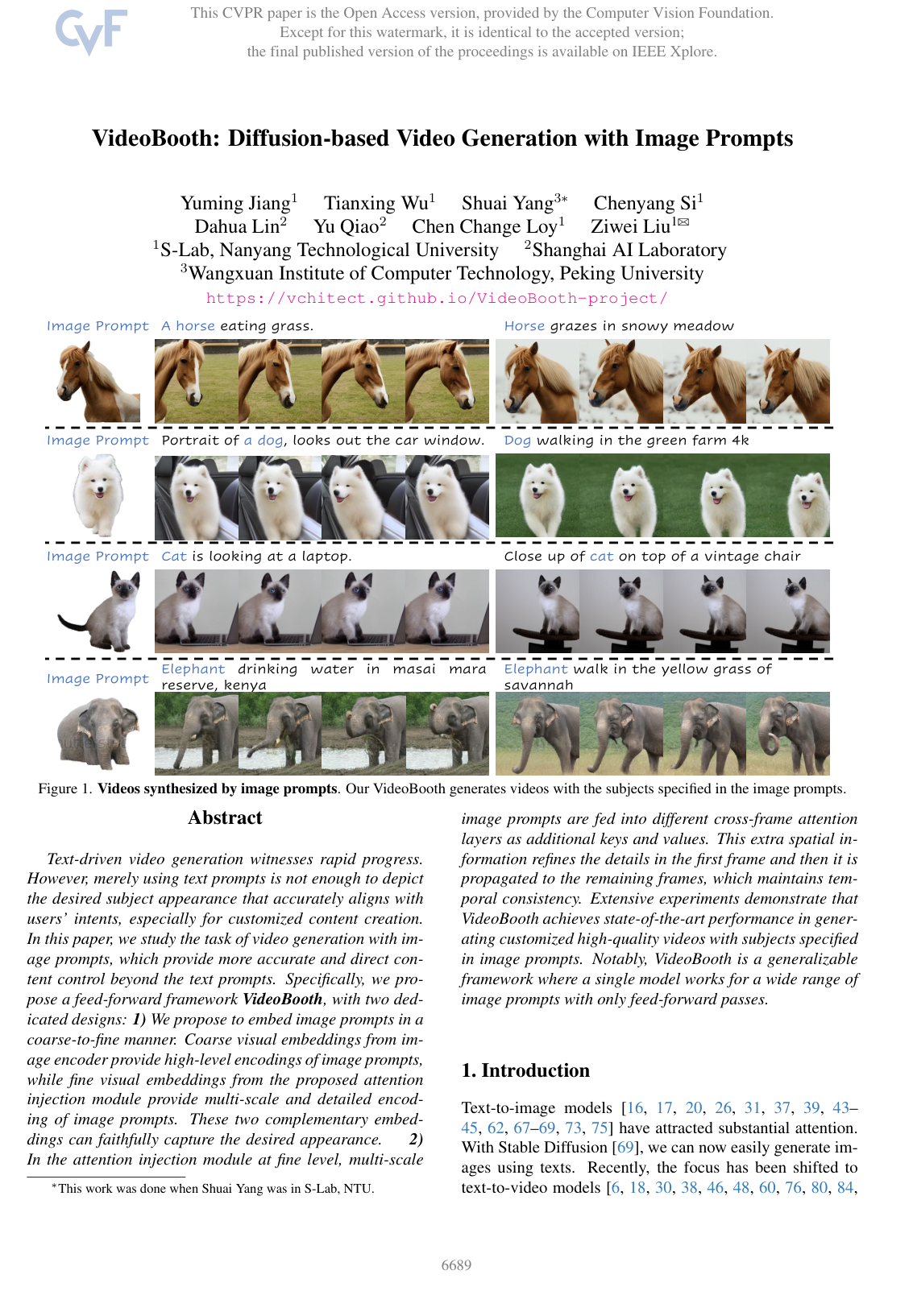
Text-driven video generation witnesses rapid progress. However, merely using text prompts is not enough to depict the desired subject appearance that accurately aligns with users' intents, especially for customized content creation. In this paper, we study the task of video generation with image prompts, which provide more accurate and direct content control beyond the text prompts. Specifically, we propose a feed-forward framework VideoBooth, with two dedicated designs: 1) We propose to embed image prompts in a coarse-to-fine manner. Coarse visual embeddings from image encoder provide high-level encodings of image prompts, while fine visual embeddings from the proposed attention injection module provide multi-scale and detailed encoding of image prompts. These two complementary embeddings can faithfully capture the desired appearance. 2) In the attention injection module at fine level, multi-scale image prompts are fed into different cross-frame attention layers as additional keys and values. This extra spatial in-formation refines the details in the first frame and then it is propagated to the remaining frames, which maintains temporal consistency. Extensive experiments demonstrate that VideoBooth achieves state-of-the-art performance in generating customized high-quality videos with subjects specified in image prompts. Notably, VideoBooth is a generalizable framework where a single model works for a wide range of image prompts with only feed-forward passes.
Added
2026-09-26
Dysen-VDM: Empowering Dynamics-Aware Text-to-Video Diffusion with LLMs
Hao Fei, Shengqiong Wu, Wei Ji, Hanwang Zhang, Tat-Seng Chua
Why you should read this
Proposes a dynamic scene manager that uses large language models to construct detailed dynamic scene graphs, guiding text-to-video diffusion models to generate temporally coherent videos with complex action sequences.
Text-to-video (T2V) synthesis has gained increasing attention in the community, in which the recently emerged diffusion models (DMs) have promisingly shown stronger performance than the past approaches. While existing state-of-the-art DMs are competent to achieve high-resolution video generation, they may largely suffer from key limitations (e.g., action occurrence disorders, crude video motions) with respect to the intricate temporal dynamics modeling, one of the crux of video synthesis. In this work, we investigate strengthening the awareness of video dynamics for DMs, for high-quality T2V generation. Inspired by human intuition, we design an innovative dynamic scene manager (dubbed as Dysen) module, which includes (step-1) extracting from input text the key actions with proper time-order arrangement, (step-2) transforming the action schedules into the dynamic scene graph (DSG) representations, and (step-3) enriching the scenes in the DSG with sufficient and reasonable details. Taking advantage of the existing powerful LLMs (e.g., ChatGPT) via in-context learning, Dysen realizes (nearly) human-level temporal dynamics understanding. Finally, the resulting video DSG with rich action scene details is encoded as fine-grained spatio-temporal features, integrated into the backbone T2V DM for video generating. Experiments on popular T2V datasets suggest that our Dysen-VDM consistently outperforms prior arts with significant margins, especially in scenarios with complex actions. Codes at http://haofei.vip/Dysen-VDM/.
Added
2026-09-26
T2V-CompBench: A Comprehensive Benchmark for Compositional Text-to-video Generation
Kaiyue Sun, Kaiyi Huang, Xian Liu, Yue Wu, Zihan Xu, Zhenguo Li, Xihui Liu
Why you should read this
Presents the first systematic benchmark and multi-modal evaluation suite for compositional text-to-video generation across seven spatial and temporal categories, revealing critical limitations in current video generation models.
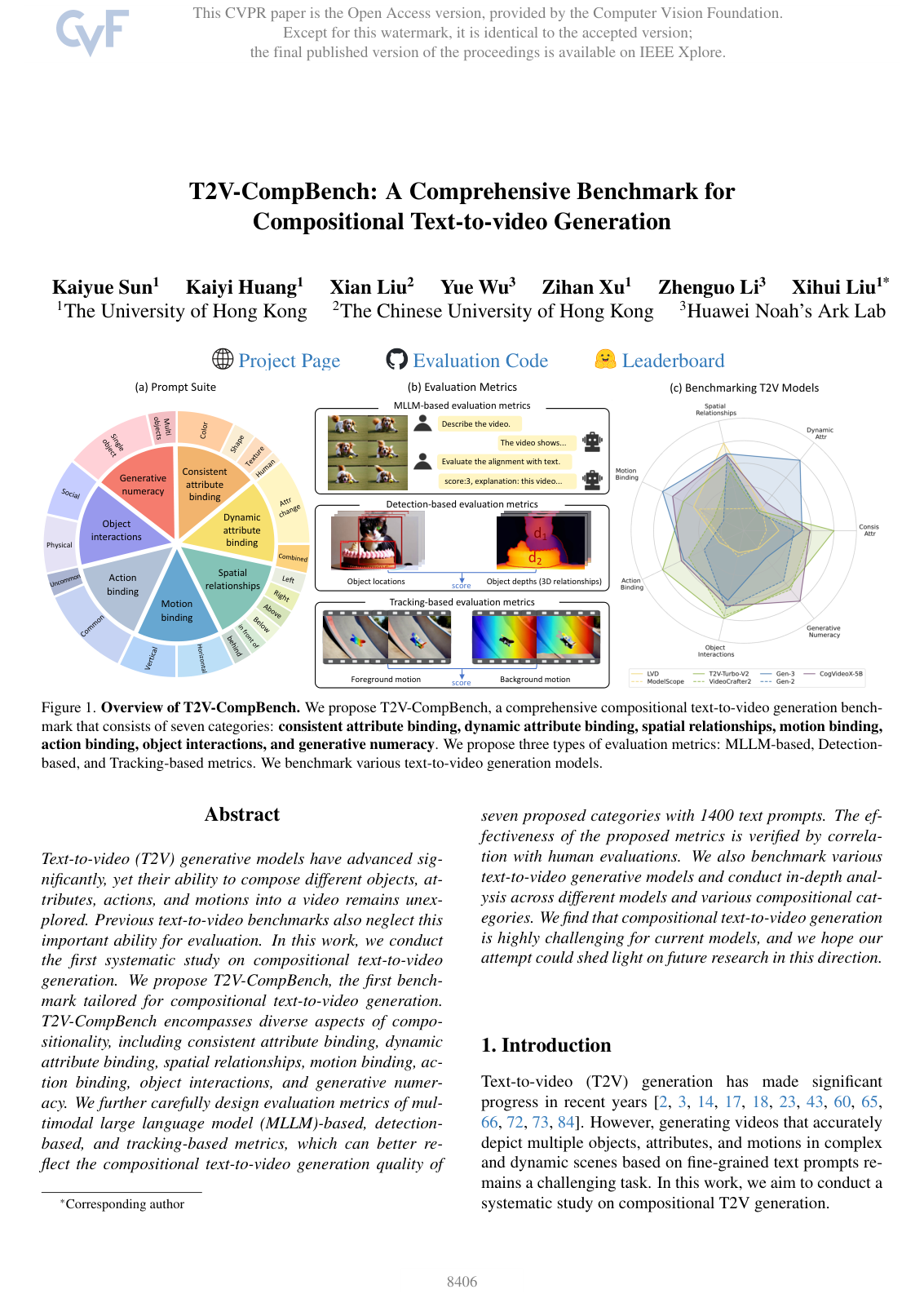
Text-to-video (T2V) generative models have advanced significantly, yet their ability to compose different objects, attributes, actions, and motions into a video remains unexplored. Previous text-to-video benchmarks also neglect this important ability for evaluation. In this work, we conduct the first systematic study on compositional text-to-video generation. We propose T2V-CompBench, the first benchmark tailored for compositional text-to-video generation. T2V-CompBench encompasses diverse aspects of compositionality, including consistent attribute binding, dynamic attribute binding, spatial relationships, motion binding, action binding, object interactions, and generative numeracy. We further carefully design evaluation metrics of multimodal large language model (MLLM)-based, detection-based, and tracking-based metrics, which can better reflect the compositional text-to-video generation quality of seven proposed categories with 1400 text prompts. The effectiveness of the proposed metrics is verified by correlation with human evaluations. We also benchmark various text-to-video generative models and conduct in-depth analysis across different models and various compositional categories. We find that compositional text-to-video generation is highly challenging for current models, and we hope our attempt could shed light on future research in this direction.
Added
2026-09-26
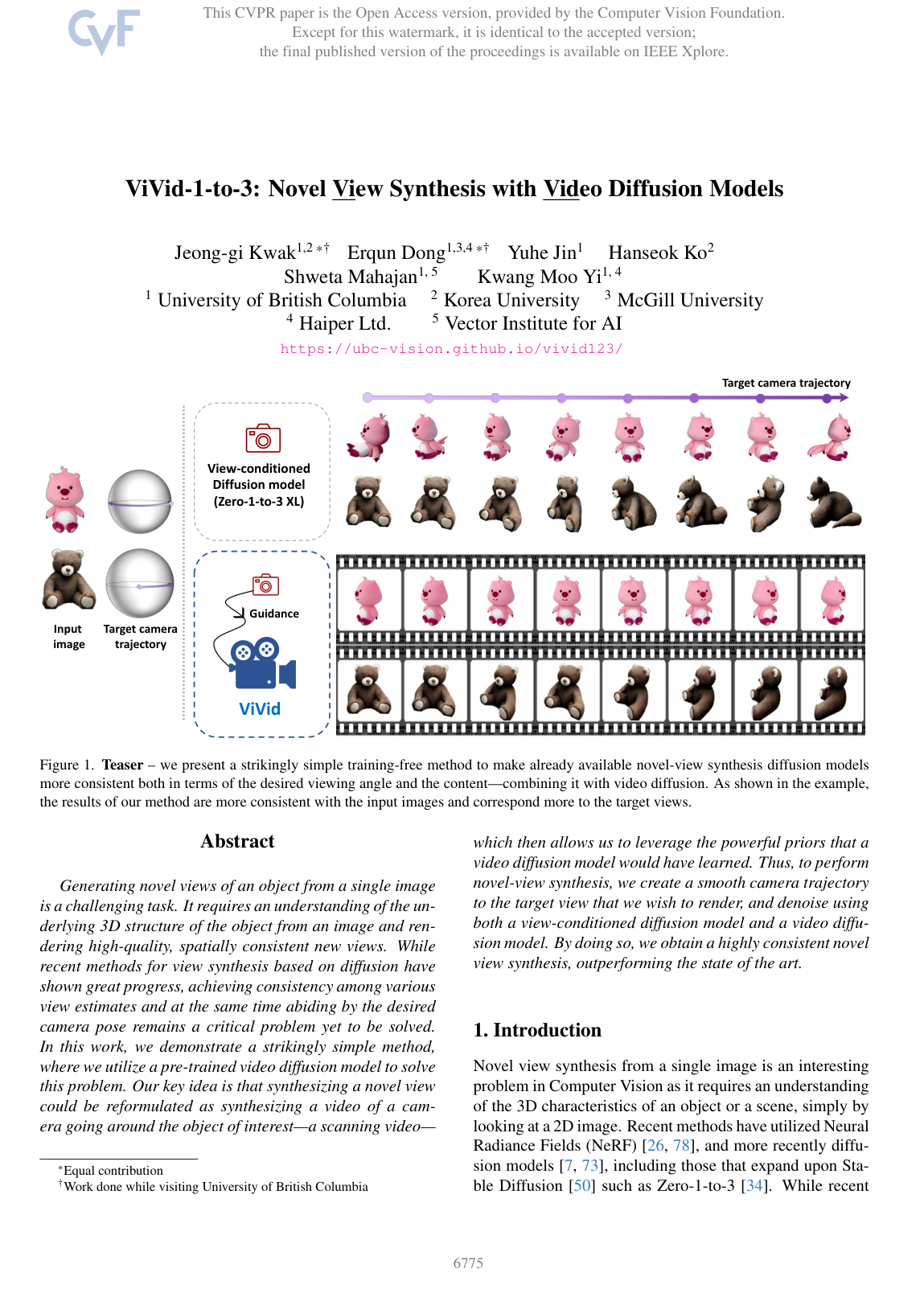
ViVid-1-to-3: Novel View Synthesis with Video Diffusion Models
Jeong-gi Kwak, Erqun Dong, Yuhe Jin, Hanseok Ko, Shweta Mahajan, Kwang Moo Yi
Why you should read this
Proposes a training-free framework that combines pre-trained view-conditioned diffusion and video diffusion models to generate spatially consistent novel views along a camera trajectory from a single image.
Generating novel views of an object from a single image is a challenging task. It requires an understanding of the underlying 3D structure of the object from an image and rendering high-quality, spatially consistent new views. While recent methods for view synthesis based on diffusion have shown great progress, achieving consistency among various view estimates and at the same time abiding by the desired camera pose remains a critical problem yet to be solved. In this work, we demonstrate a strikingly simple method, where we utilize a pre-trained video diffusion model to solve this problem. Our key idea is that synthesizing a novel view could be reformulated as synthesizing a video of a camera going around the object of interest—a scanning video—which then allows us to leverage the powerful priors that a video diffusion model would have learned. Thus, to perform novel-view synthesis, we create a smooth camera trajectory to the target view that we wish to render, and denoise using both a view-conditioned diffusion model and a video diffusion model. By doing so, we obtain a highly consistent novel view synthesis, outperforming the state of the art.
Added
2026-09-26
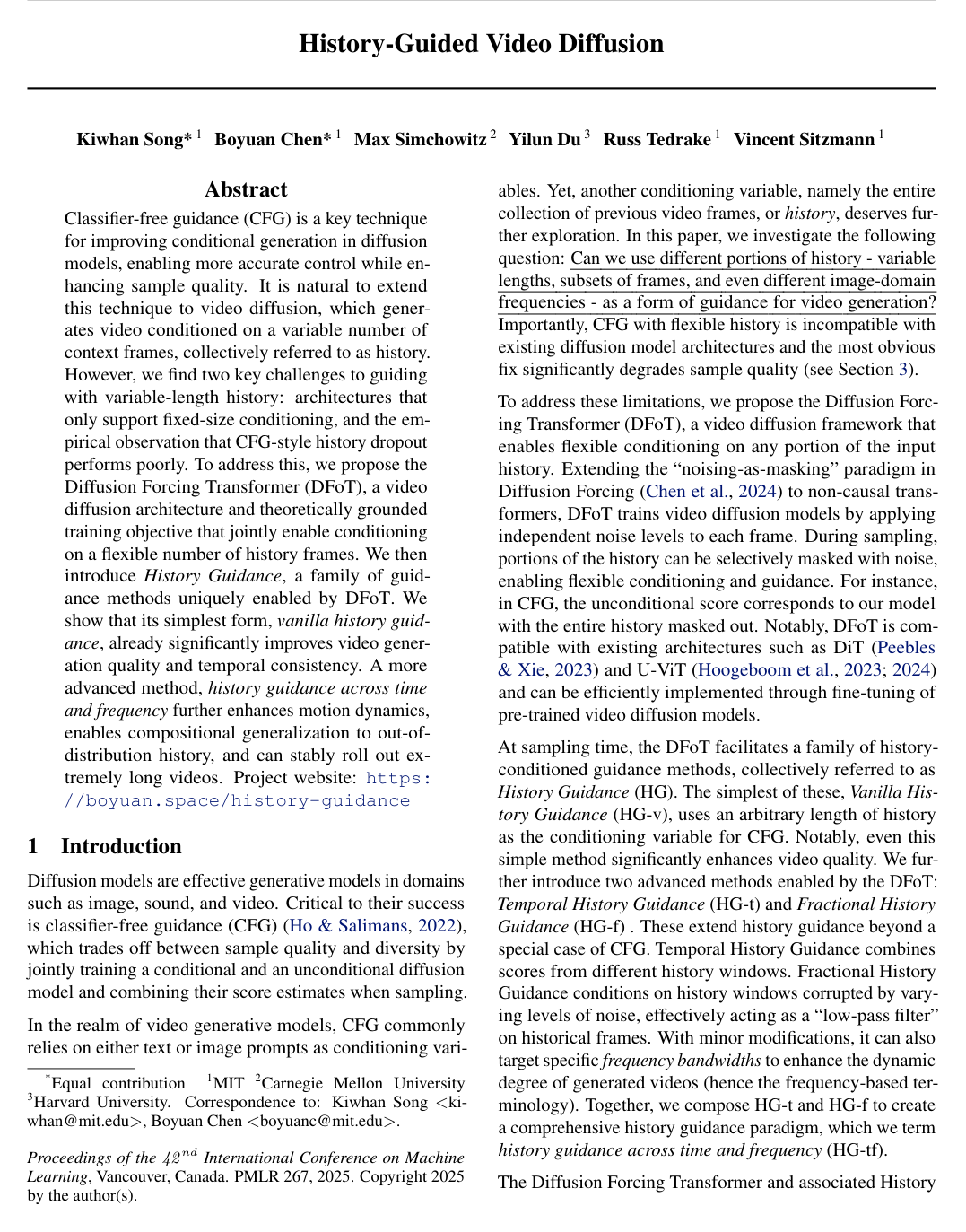
History-Guided Video Diffusion
Kiwhan Song, Boyuan Chen, Max Simchowitz, Yilun Du, Russ Tedrake, Vincent Sitzmann
Why you should read this
Proposes the Diffusion Forcing Transformer and History Guidance framework, enabling video diffusion models to condition on flexible, variable-length history frames across time and frequency bands to achieve stable, high-quality long-video generation.
Classifier-free guidance (CFG) is a key technique for improving conditional generation in diffusion models, enabling more accurate control while enhancing sample quality. It is natural to extend this technique to video diffusion, which generates video conditioned on a variable number of context frames, collectively referred to as history. However, we find two key challenges to guiding with variable-length history: architectures that only support fixed-size conditioning, and the empirical observation that CFG-style history dropout performs poorly. To address this, we propose the Diffusion Forcing Transformer (DFoT), a video diffusion architecture and theoretically grounded training objective that jointly enable conditioning on a flexible number of history frames. We then introduce History Guidance, a family of guidance methods uniquely enabled by DFoT. We show that its simplest form, vanilla history guidance, already significantly improves video generation quality and temporal consistency. A more advanced method, history guidance across time and frequency further enhances motion dynamics, enables compositional generalization to out-of-distribution history, and can stably roll out extremely long videos. Project website: https://boyuan.space/history-guidance
Added
2026-09-26
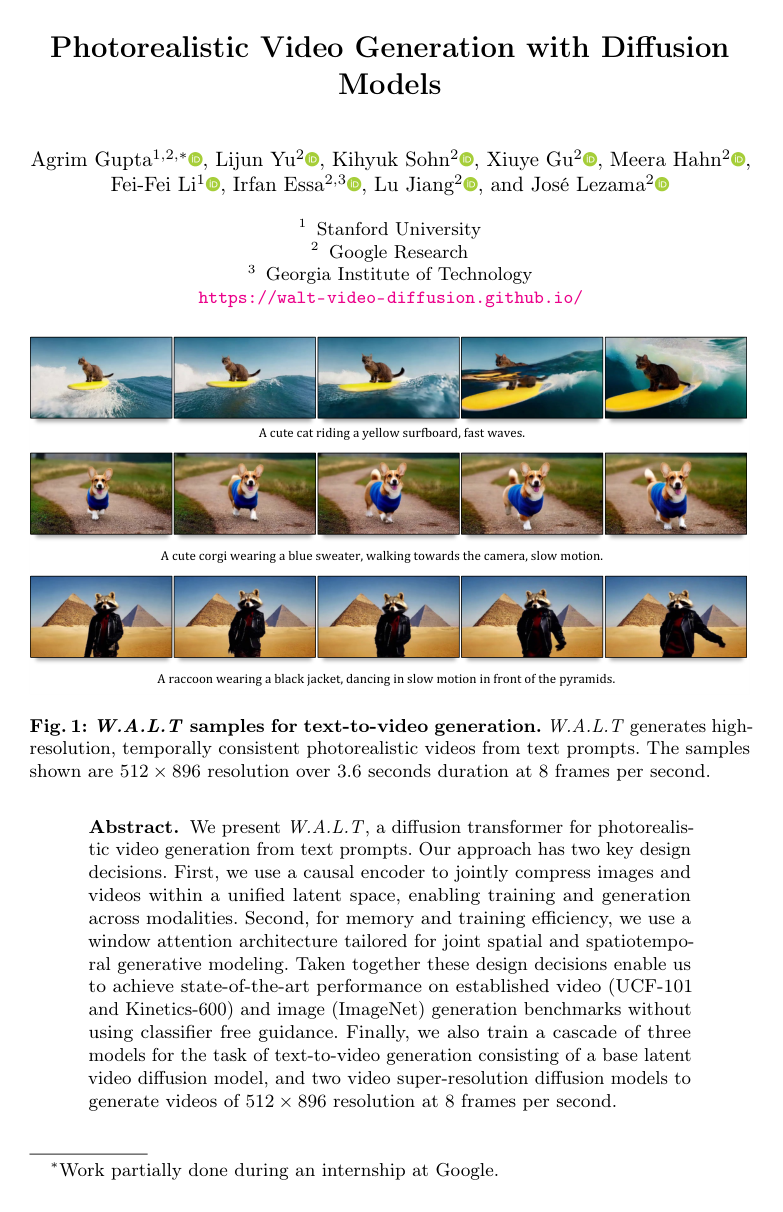
Photorealistic Video Generation with Diffusion Models
Agrim Gupta, Lijun Yu, Kihyuk Sohn, Xiuye Gu, Meera Hahn, Li Fei-Fei, Irfan Essa, Lu Jiang, José Lezama
Why you should read this
Employs a transformer-based backbone with windowed attention to process latent video patches, proving that scalable diffusion transformers can outperform traditional U-Nets for video.
We present W.A.L.T, a diffusion transformer for photorealistic video generation from text prompts. Our approach has two key design decisions. First, we use a causal encoder to jointly compress images and videos within a unified latent space, enabling training and generation across modalities. Second, for memory and training efficiency, we use a window attention architecture tailored for joint spatial and spatiotemporal generative modeling. Taken together these design decisions enable us to achieve state-of-the-art performance on established video (UCF-101 and Kinetics-600) and image (ImageNet) generation benchmarks without using classifier free guidance. Finally, we also train a cascade of three models for the task of text-to-video generation consisting of a base latent video diffusion model, and two video super-resolution diffusion models to generate videos of 512 × 896 resolution at 8 frames per second.
Added
2026-03-11
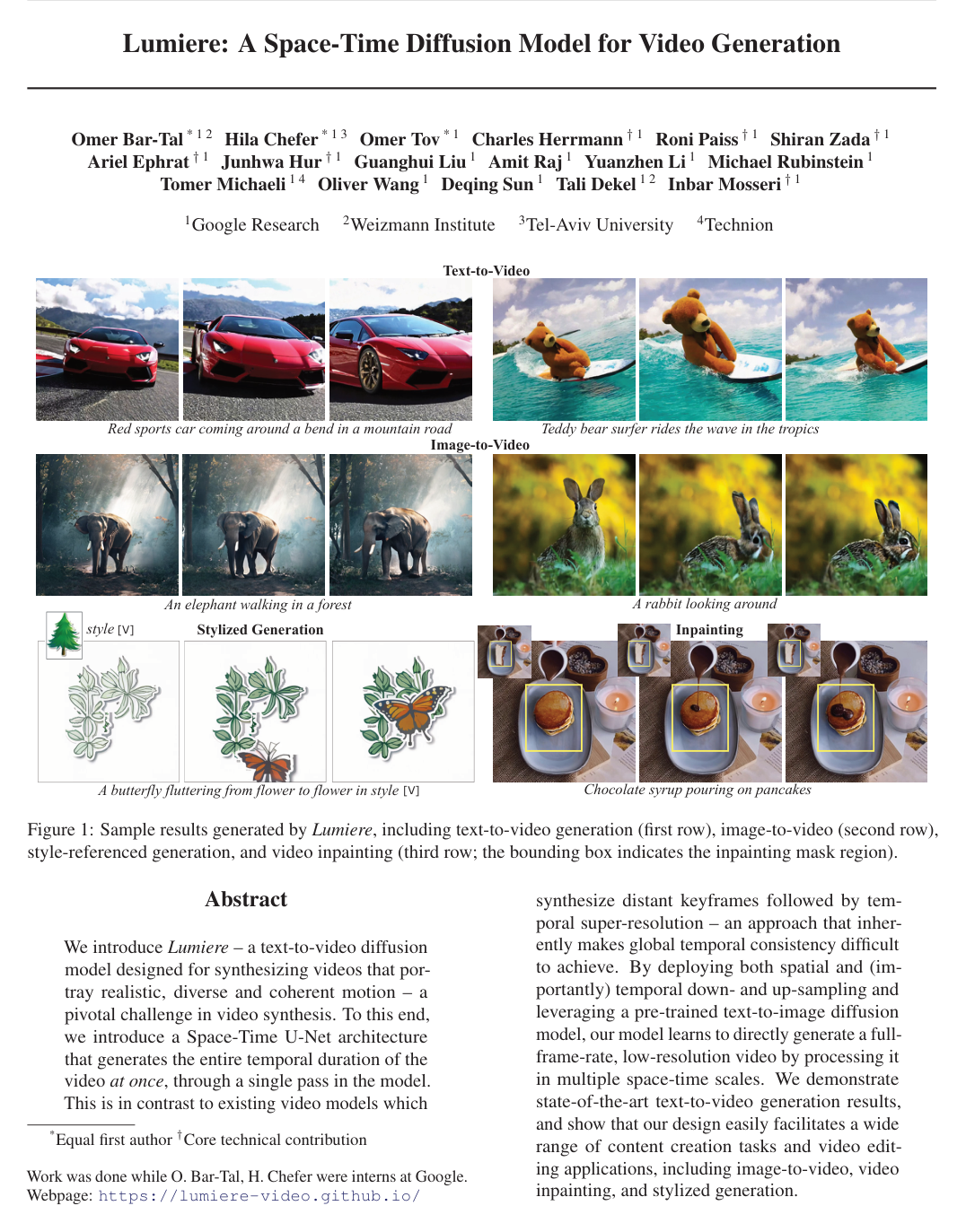
Lumiere: A Space-Time Diffusion Model for Video Generation
Omer Bar-Tal, Hila Chefer, Omer Tov, Charles Herrmann, Roni Paiss, Shiran Zada, Ariel Ephrat, Junhwa Hur, Guanghui Liu, Amit Raj, Yuanzhen Li, Michael Rubinstein, Tomer Michaeli, Oliver Wang, Deqing Sun, Tali Dekel, Inbar Mosseri
Why you should read this
Introduces a Space-Time U-Net architecture that generates the entire temporal duration of a video in a single forward pass, eliminating the global inconsistency issues of previous cascaded models.
We introduce Lumiere – a text-to-video diffusion model designed for synthesizing videos that portray realistic, diverse and coherent motion – a pivotal challenge in video synthesis. To this end, we introduce a Space-Time U-Net architecture that generates the entire temporal duration of the video at once, through a single pass in the model. This is in contrast to existing video models which synthesize distant keyframes followed by temporal super-resolution – an approach that inherently makes global temporal consistency difficult to achieve. By deploying both spatial and (importantly) temporal down- and up-sampling and leveraging a pre-trained text-to-image diffusion model, our model learns to directly generate a full-frame-rate, low-resolution video by processing it in multiple space-time scales. We demonstrate state-of-the-art text-to-video generation results, and show that our design easily facilitates a wide range of content creation tasks and video editing applications, including image-to-video, video inpainting, and stylized generation.
Added
2026-03-11
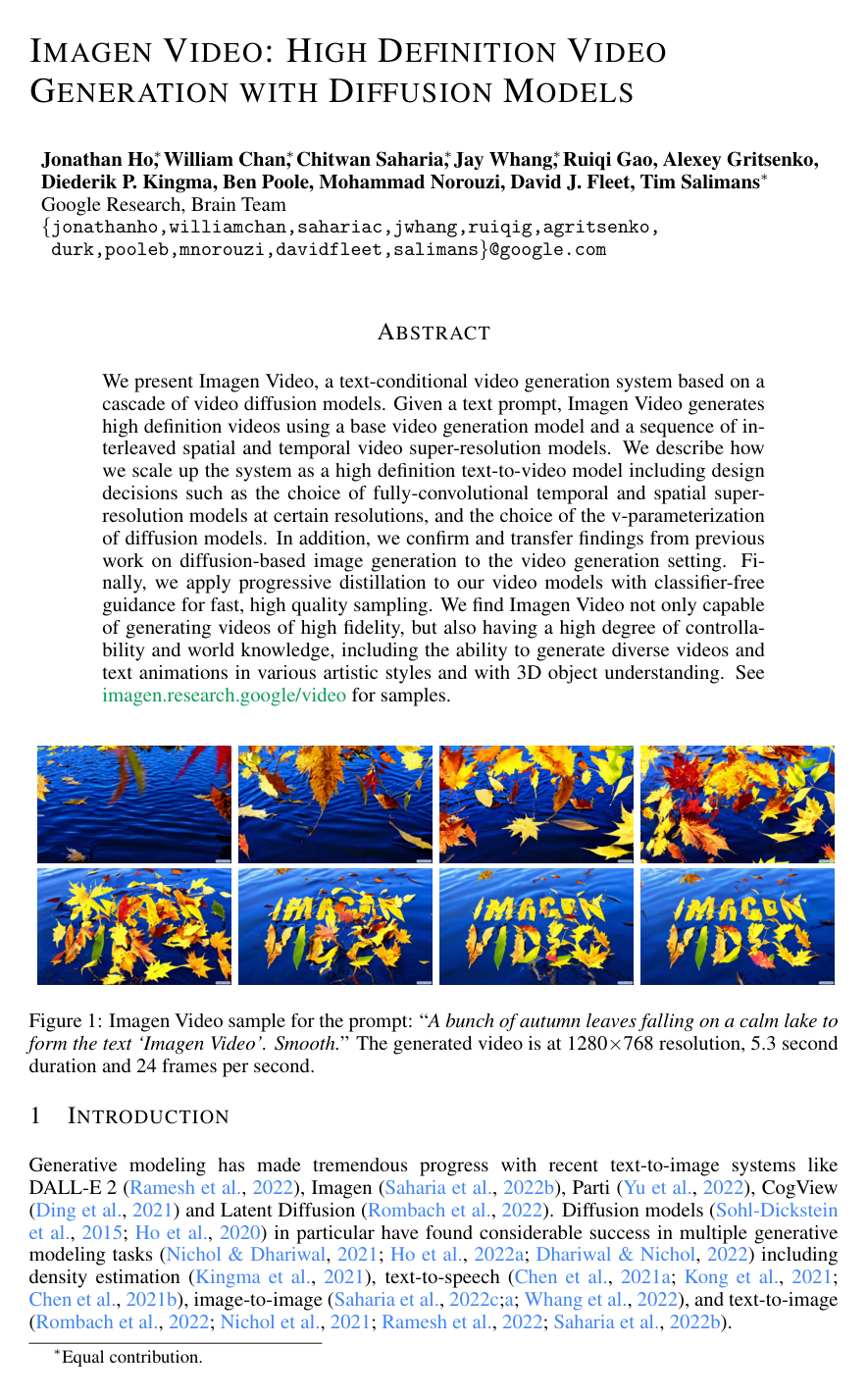
Imagen Video: High Definition Video Generation with Diffusion Models
Jonathan Ho, William Chan, Chitwan Saharia, Jay Whang, Ruiqi Gao, Alexey Gritsenko, Diederik P. Kingma, Ben Poole, Mohammad Norouzi, David J. Fleet, Tim Salimans
Why you should read this
Establishes a cascaded diffusion pipeline that progressively increases spatial and temporal resolution, setting a new standard for high-fidelity, coherent video generation.
We present Imagen Video, a text-conditional video generation system based on a cascade of video diffusion models. Given a text prompt, Imagen Video generates high definition videos using a base video generation model and a sequence of interleaved spatial and temporal video super-resolution models. We describe how we scale up the system as a high definition text-to-video model including design decisions such as the choice of fully-convolutional temporal and spatial super-resolution models at certain resolutions, and the choice of the v-parameterization of diffusion models. In addition, we confirm and transfer findings from previous work on diffusion-based image generation to the video generation setting. Finally, we apply progressive distillation to our video models with classifier-free guidance for fast, high quality sampling. We find Imagen Video not only capable of generating videos of high fidelity, but also having a high degree of controllability and world knowledge, including the ability to generate diverse videos and text animations in various artistic styles and with 3D object understanding. See https://imagen.research.google/video/ for samples.
Added
2026-03-11
Video Diffusion Models
Jonathan Ho, Tim Salimans, Alexey Gritsenko, William Chan, Mohammad Norouzi, David J. Fleet
Why you should read this
Formulates video synthesis as a denoising diffusion process using a 3D U-Net architecture, providing the mathematical and algorithmic foundation for modern high-fidelity video generation.
Generating temporally coherent high fidelity video is an important milestone in generative modeling research. We make progress towards this milestone by proposing a diffusion model for video generation that shows very promising initial results. Our model is a natural extension of the standard image diffusion architecture, and it enables jointly training from image and video data, which we find to reduce the variance of minibatch gradients and speed up optimization. To generate long and higher resolution videos we introduce a new conditional sampling technique for spatial and temporal video extension that performs better than previously proposed methods. We present the first results on a large text-conditioned video generation task, as well as state-of-the-art results on established benchmarks for video prediction and unconditional video generation. Supplementary material is available at https://video-diffusion.github.io/.
Added
2026-02-25