
keyword
video description generation
Video description generation is an artificial intelligence task in which a computational system automatically analyzes a video sequence and produces a coherent natural language text describing the depicted visual content, actions, and events. Situated at the intersection of computer vision and natural language processing, the process requires models to capture both spatial features within individual frames and temporal dynamics across consecutive frames to understand motion, object interactions, and evolving scenes. Systems may also integrate multimodal signals, such as accompanying audio or speech transcripts, to translate complex spatiotemporal representations into syntactically and semantically accurate sentences. This capability supports a variety of practical applications, including content-based video indexing and retrieval, automated video subtitling, and assistive technologies that make visual media accessible to visually impaired individuals.
2 items
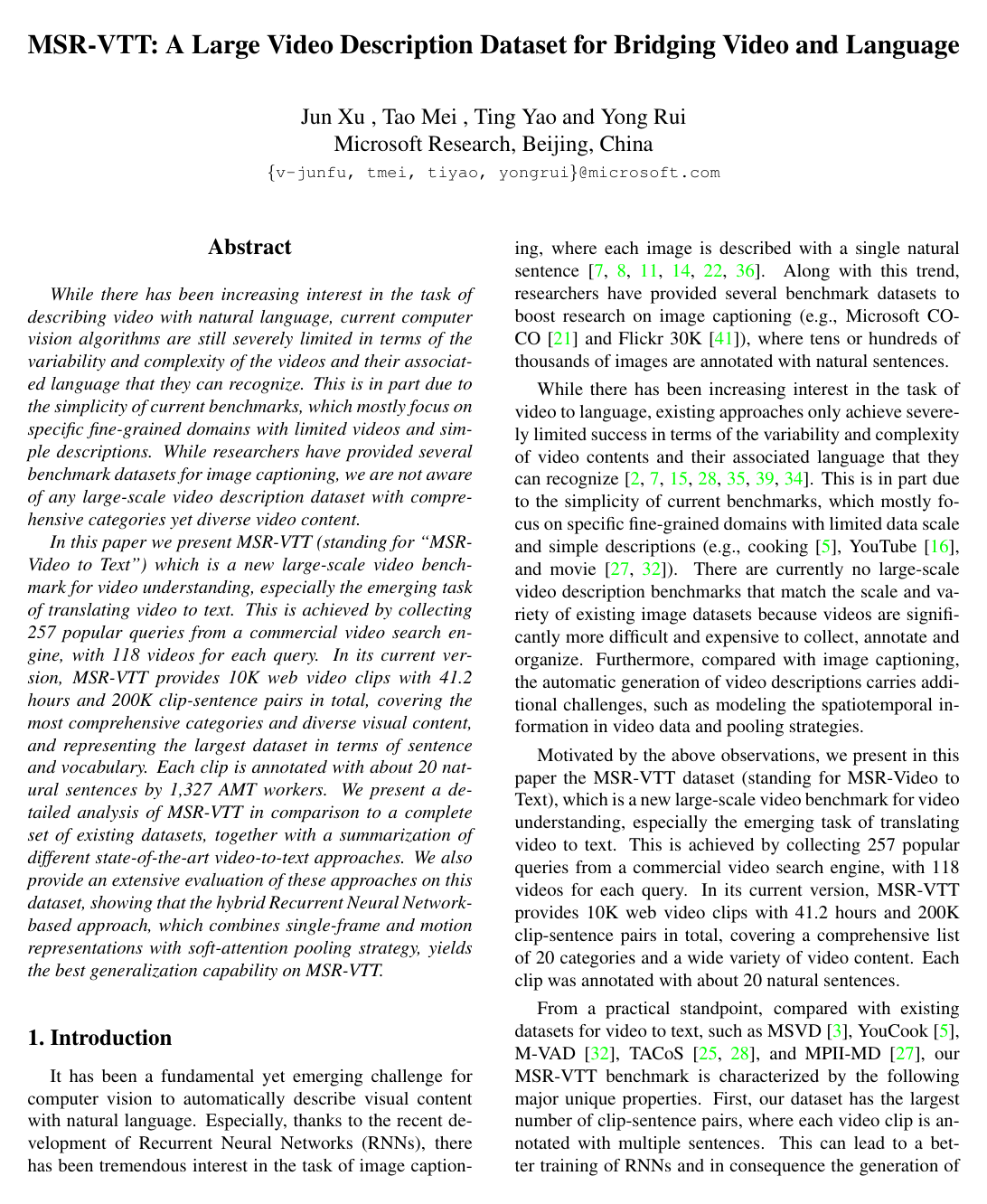
MSR-VTT: A Large Video Description Dataset for Bridging Video and Language
Jun Xu, T. Mei, Ting Yao, Yong Rui
Why you should read this
Introduces MSR-VTT, a large-scale video-to-text benchmark containing 10,000 open-domain video clips and 200,000 natural sentence annotations, paired with extensive evaluations showing that combining 2D spatial and 3D motion features with soft-attention pooling achieves superior video captioning performance.
While there has been increasing interest in the task of describing video with natural language, current computer vision algorithms are still severely limited in terms of the variability and complexity of the videos and their associated language that they can recognize. This is in part due to the simplicity of current benchmarks, which mostly focus on specific fine-grained domains with limited videos and simple descriptions. While researchers have provided several benchmark datasets for image captioning, we are not aware of any large-scale video description dataset with comprehensive categories yet diverse video content. In this paper we present MSR-VTT (standing for “MSR-Video to Text”) which is a new large-scale video benchmark for video understanding, especially the emerging task of translating video to text. This is achieved by collecting 257 popular queries from a commercial video search engine, with 118 videos for each query. In its current version, MSR-VTT provides 10K web video clips with 41.2 hours and 200K clip-sentence pairs in total, covering the most comprehensive categories and diverse visual content, and representing the largest dataset in terms of sentence and vocabulary. Each clip is annotated with about 20 natural sentences by 1,327 AMT workers. We present a detailed analysis of MSR-VTT in comparison to a complete set of existing datasets, together with a summarization of different state-of-the-art video-to-text approaches. We also provide an extensive evaluation of these approaches on this dataset, showing that the hybrid Recurrent Neural Network-based approach, which combines single-frame and motion representations with soft-attention pooling strategy, yields the best generalization capability on MSR-VTT.
Added
2026-09-14
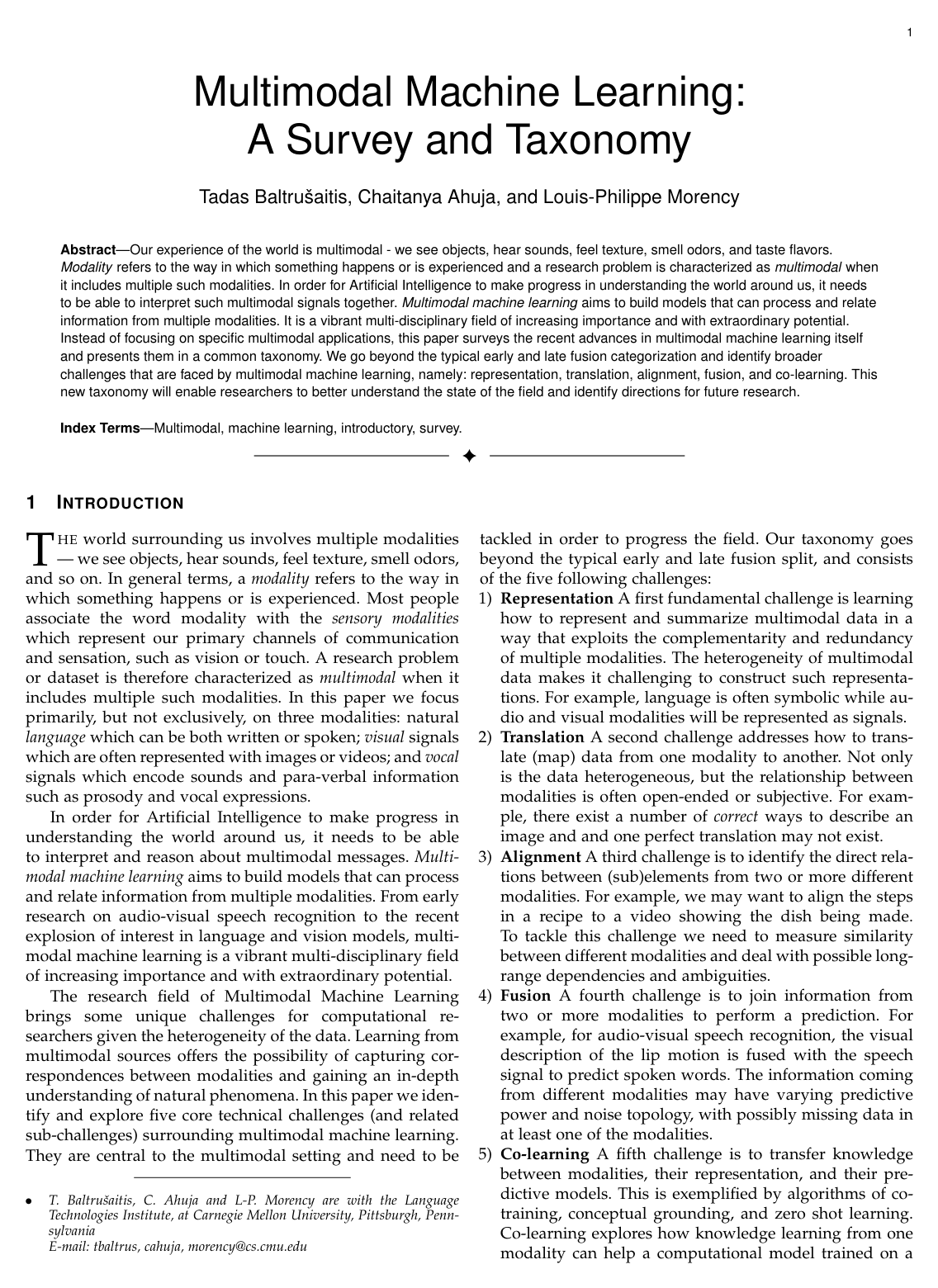
Multimodal Machine Learning: A Survey and Taxonomy
Tadas Baltrušaitis, Chaitanya Ahuja, Louis-Philippe Morency
Why you should read this
Establishes a comprehensive taxonomy for multimodal machine learning by structuring the field around five fundamental technical challenges: representation, translation, alignment, fusion, and co-learning.
Our experience of the world is multimodal - we see objects, hear sounds, feel texture, smell odors, and taste flavors. Modality refers to the way in which something happens or is experienced and a research problem is characterized as multimodal when it includes multiple such modalities. In order for Artificial Intelligence to make progress in understanding the world around us, it needs to be able to interpret such multimodal signals together. Multimodal machine learning aims to build models that can process and relate information from multiple modalities. It is a vibrant multi-disciplinary field of increasing importance and with extraordinary potential. Instead of focusing on specific multimodal applications, this paper surveys the recent advances in multimodal machine learning itself and presents them in a common taxonomy. We go beyond the typical early and late fusion categorization and identify broader challenges that are faced by multimodal machine learning, namely: representation, translation, alignment, fusion, and co-learning. This new taxonomy will enable researchers to better understand the state of the field and identify directions for future research.
Added
2026-09-10