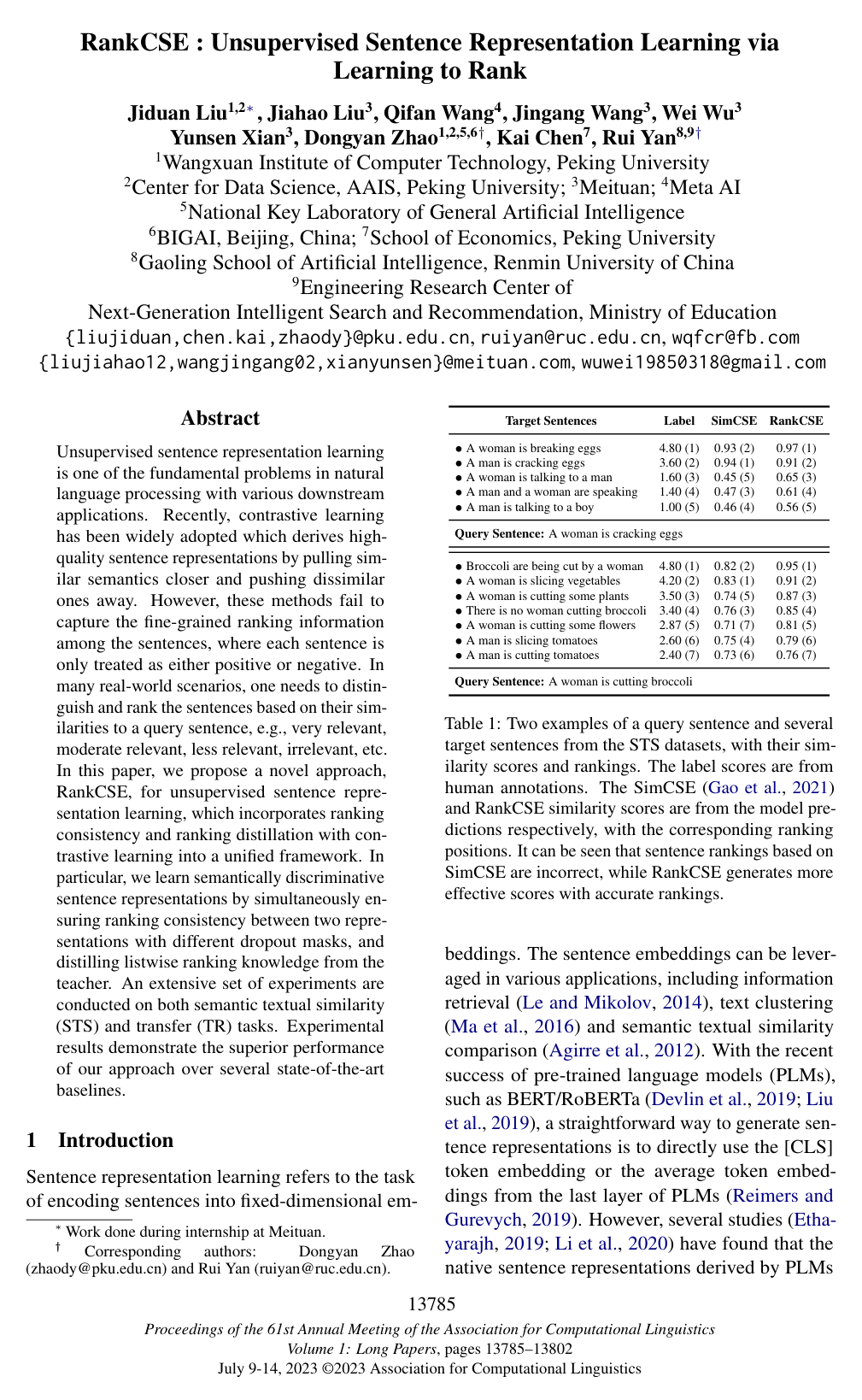
Unsupervised sentence representation learning is a natural language processing methodology that maps entire sentences into dense, fixed-dimensional semantic vectors without relying on human-annotated labels. In this framework, computational models analyze patterns across vast collections of unlabeled text to capture the underlying meaning, context, and structure of sentences. By employing self-supervised objectives, such as contrastive learning, autoencoding, or predictive language modeling, the system learns to position semantically related sentences close together in a continuous vector space while separating unrelated ones. The resulting embeddings provide transferable numerical representations of text that facilitate various downstream tasks, including semantic textual similarity evaluation, information retrieval, text clustering, and ranking.