
keyword
unlabeled data
Unlabeled data refers to raw data samples that lack associated target annotations, category tags, or ground-truth outcome labels. In machine learning, it comprises natural inputs such as text documents, images, audio recordings, or state observations that have been gathered without human verification or explicit task-specific feedback. Because obtaining accurate annotations is typically expensive and time-consuming, unlabeled data is abundant and significantly easier to acquire at scale. Machine learning paradigms including semi-supervised learning, self-supervised learning, and transfer learning utilize unlabeled data to capture underlying input distributions and learn robust feature representations, enabling models to improve predictive performance, correct sample selection bias, and reduce reliance on large quantities of labeled training examples.
7 items
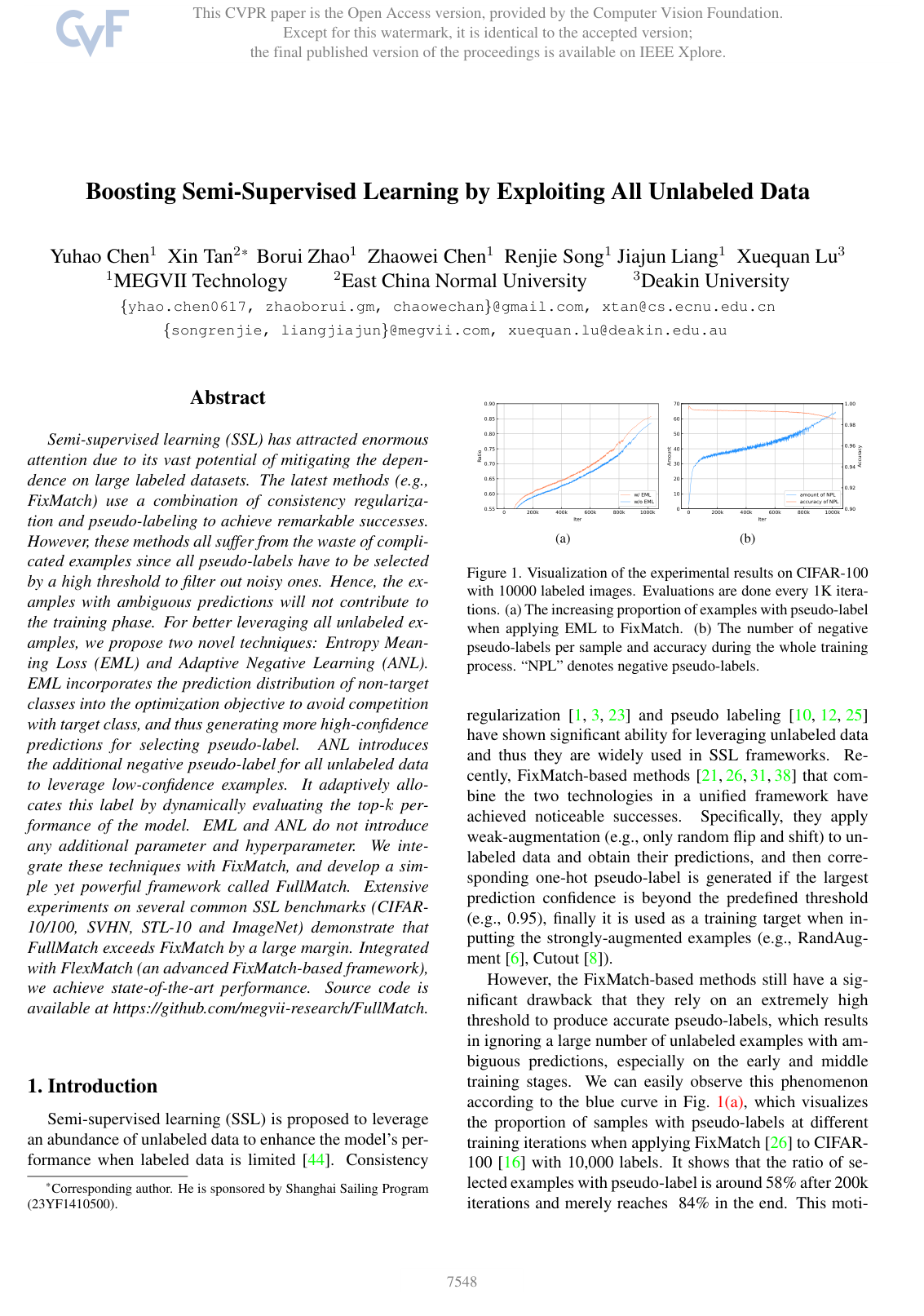
Boosting Semi-Supervised Learning by Exploiting All Unlabeled Data
Yuhao Chen, Xin Tan, Borui Zhao, Zhaowei Chen, Renjie Song, Jiajun Liang, Xuequan Lu
Why you should read this
Presents FullMatch, a semi-supervised learning framework that fully exploits ambiguous unlabeled samples by suppressing non-target class competition and adaptively assigning negative pseudo-labels without introducing extra hyperparameters.
Semi-supervised learning (SSL) has attracted enormous attention due to its vast potential of mitigating the dependence on large labeled datasets. The latest methods (e.g., FixMatch) use a combination of consistency regularization and pseudo-labeling to achieve remarkable successes. However, these methods all suffer from the waste of complicated examples since all pseudo-labels have to be selected by a high threshold to filter out noisy ones. Hence, the examples with ambiguous predictions will not contribute to the training phase. For better leveraging all unlabeled examples, we propose two novel techniques: Entropy Meaning Loss (EML) and Adaptive Negative Learning (ANL). EML incorporates the prediction distribution of non-target classes into the optimization objective to avoid competition with target class, and thus generating more high-confidence predictions for selecting pseudo-label. ANL introduces the additional negative pseudo-label for all unlabeled data to leverage low-confidence examples. It adaptively allocates this label by dynamically evaluating the top-k performance of the model. EML and ANL do not introduce any additional parameter and hyperparameter. We integrate these techniques with FixMatch, and develop a simple yet powerful framework called FullMatch. Extensive experiments on several common SSL benchmarks (CIFAR-10/100, SVHN, STL-10 and ImageNet) demonstrate that FullMatch exceeds FixMatch by a large margin. Integrated with FlexMatch (an advanced FixMatch-based framework), we achieve state-of-the-art performance. Source code is available at https://github.com/megvii-research/FullMatch.
Added
2026-09-26
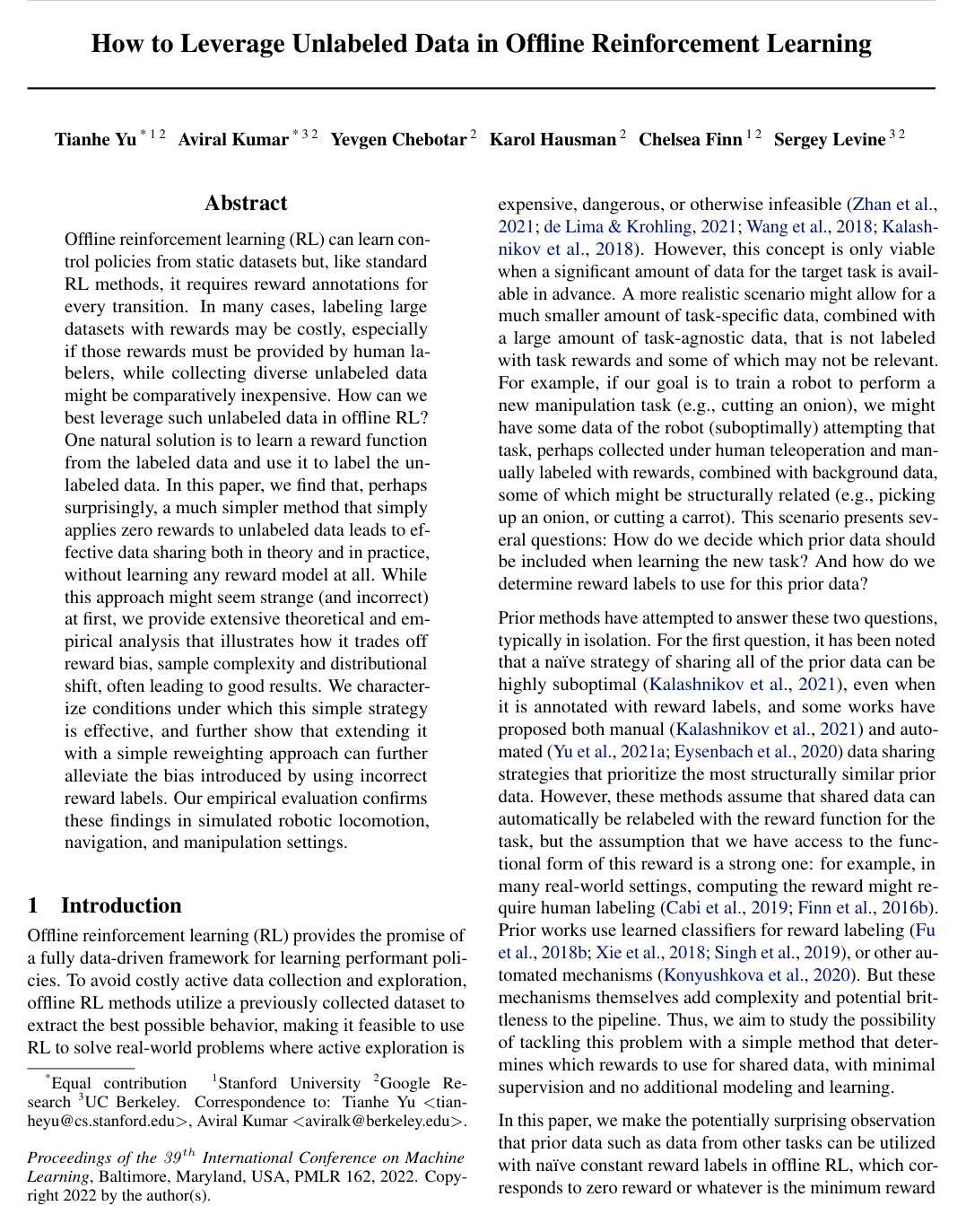
How to Leverage Unlabeled Data in Offline Reinforcement Learning
Tianhe Yu, Aviral Kumar, Yevgen Chebotar, Karol Hausman, Chelsea Finn, Sergey Levine
Why you should read this
Demonstrates that assigning a constant zero reward to unlabeled offline data—when combined with conservative sample reweighting—outperforms learned reward models across robotic control tasks by effectively balancing reward bias against sample complexity.
Offline reinforcement learning (RL) can learn control policies from static datasets but, like standard RL methods, it requires reward annotations for every transition. In many cases, labeling large datasets with rewards may be costly, especially if those rewards must be provided by human labelers, while collecting diverse unlabeled data might be comparatively inexpensive. How can we best leverage such unlabeled data in offline RL? One natural solution is to learn a reward function from the labeled data and use it to label the unlabeled data. In this paper, we find that, perhaps surprisingly, a much simpler method that simply applies zero rewards to unlabeled data leads to effective data sharing both in theory and in practice, without learning any reward model at all. While this approach might seem strange (and incorrect) at first, we provide extensive theoretical and empirical analysis that illustrates how it trades off reward bias, sample complexity and distributional shift, often leading to good results. We characterize conditions under which this simple strategy is effective, and further show that extending it with a simple reweighting approach can further alleviate the bias introduced by using incorrect reward labels. Our empirical evaluation confirms these findings in simulated robotic locomotion, navigation, and manipulation settings.
Added
2026-09-26
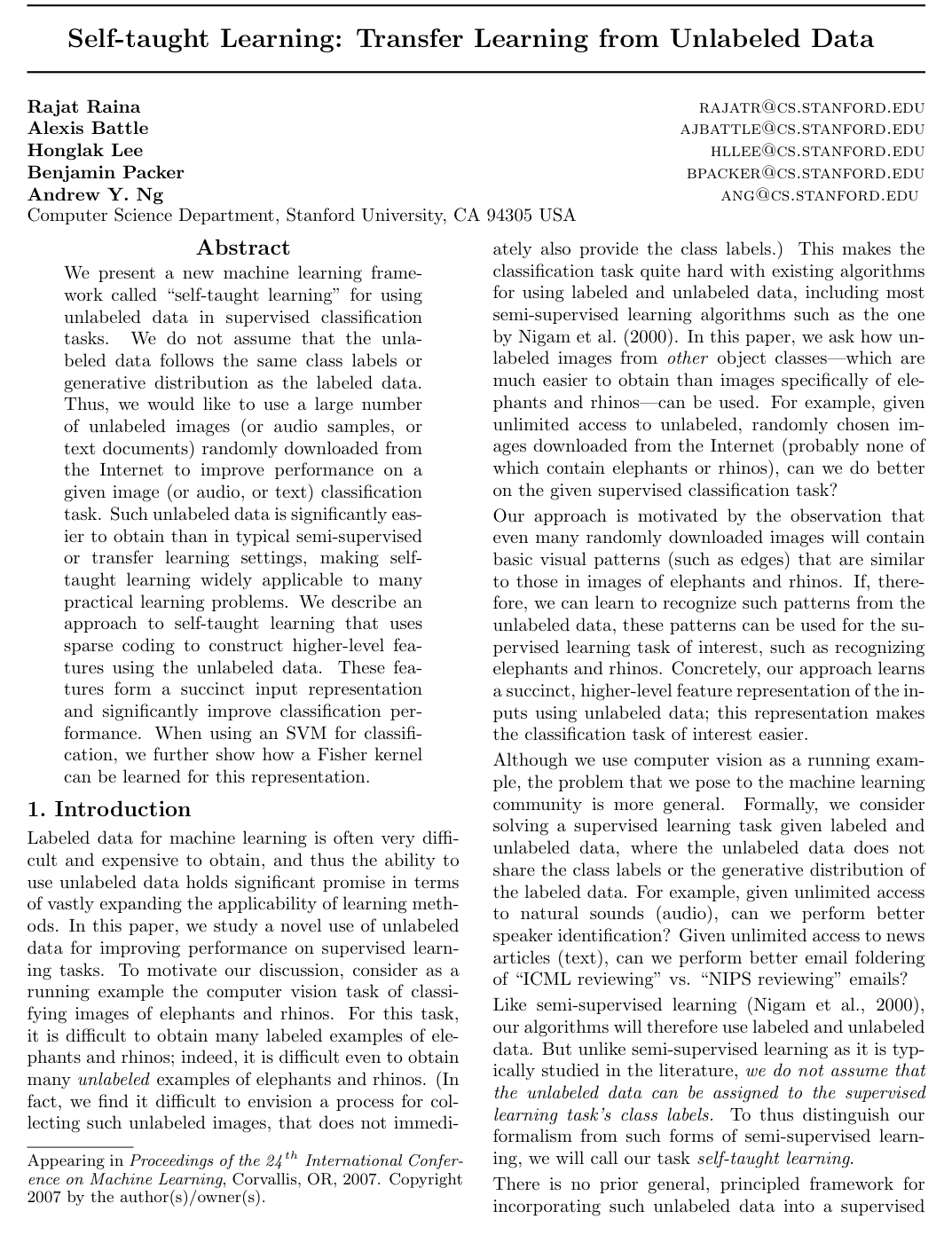
Self-taught learning: transfer learning from unlabeled data
Rajat Raina, Alexis Battle, Honglak Lee, Benjamin Packer, Andrew Y. Ng
Why you should read this
Proposes a machine learning framework that applies sparse coding to easily accessible, uncurated, and unlabeled data from entirely different classes to build higher-level feature representations that improve supervised classification performance across image, audio, and text tasks.
We present a new machine learning framework called “self-taught learning” for using unlabeled data in supervised classification tasks. We do not assume that the unlabeled data follows the same class labels or generative distribution as the labeled data. Thus, we would like to use a large number of unlabeled images (or audio samples, or text documents) randomly downloaded from the Internet to improve performance on a given image (or audio, or text) classification task. Such unlabeled data is significantly easier to obtain than in typical semi-supervised or transfer learning settings, making self-taught learning widely applicable to many practical learning problems. We describe an approach to self-taught learning that uses sparse coding to construct higher-level features using the unlabeled data. These features form a succinct input representation and significantly improve classification performance. When using an SVM for classification, we further show how a Fisher kernel can be learned for this representation.
Added
2026-09-18
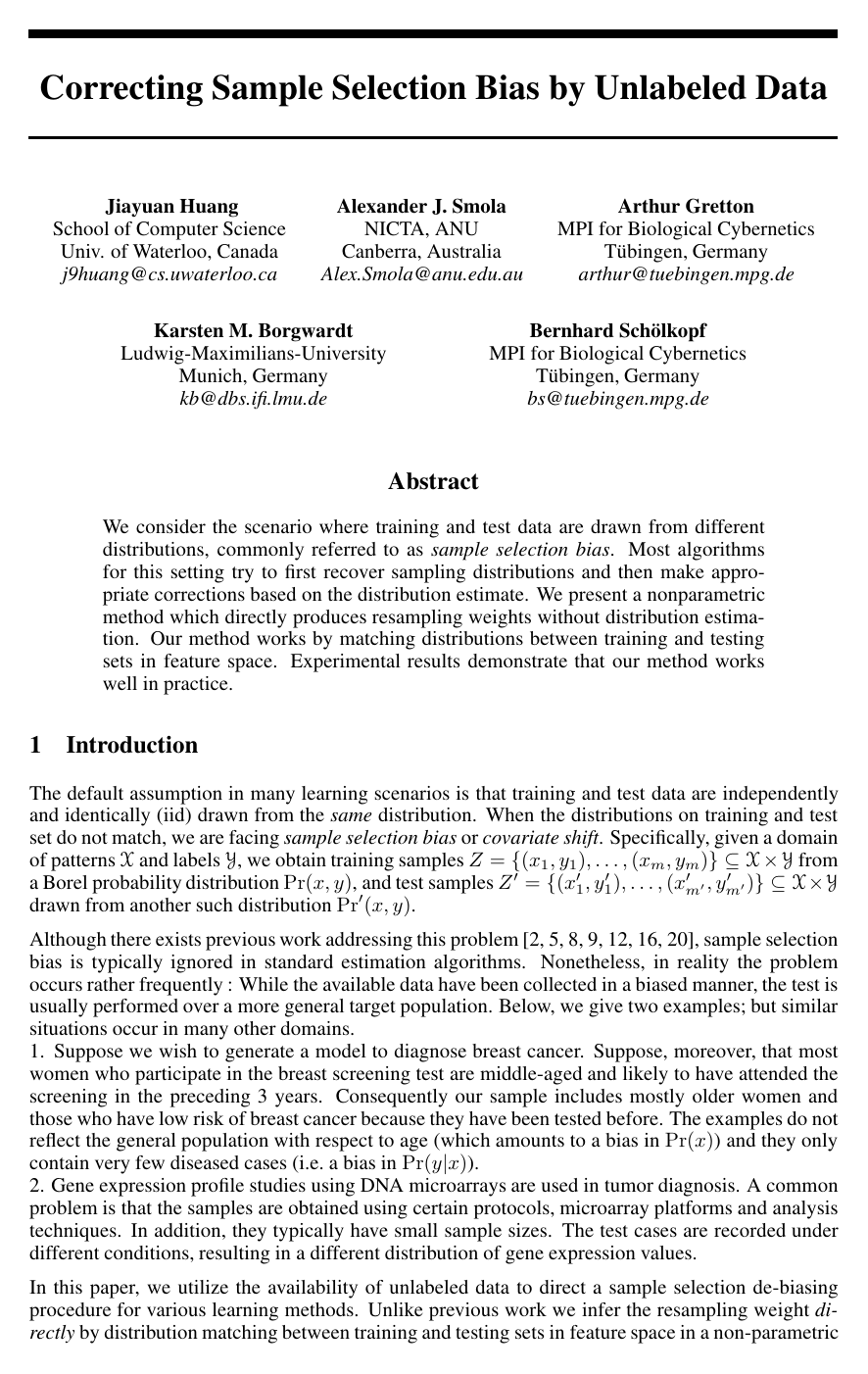
Correcting Sample Selection Bias by Unlabeled Data
Jiayuan Huang, A. Gretton, Karsten M. Borgwardt, B. Schölkopf, Alex Smola
Why you should read this
Introduces Kernel Mean Matching, a nonparametric method that directly corrects sample selection bias by matching training and test feature distributions in reproducing kernel Hilbert spaces without requiring intermediate density estimation.
We consider the scenario where training and test data are drawn from different distributions, commonly referred to as sample selection bias. Most algorithms for this setting try to first recover sampling distributions and then make appropriate corrections based on the distribution estimate. We present a nonparametric method which directly produces resampling weights without distribution estimation. Our method works by matching distributions between training and testing sets in feature space. Experimental results demonstrate that our method works well in practice.
Added
2026-09-18
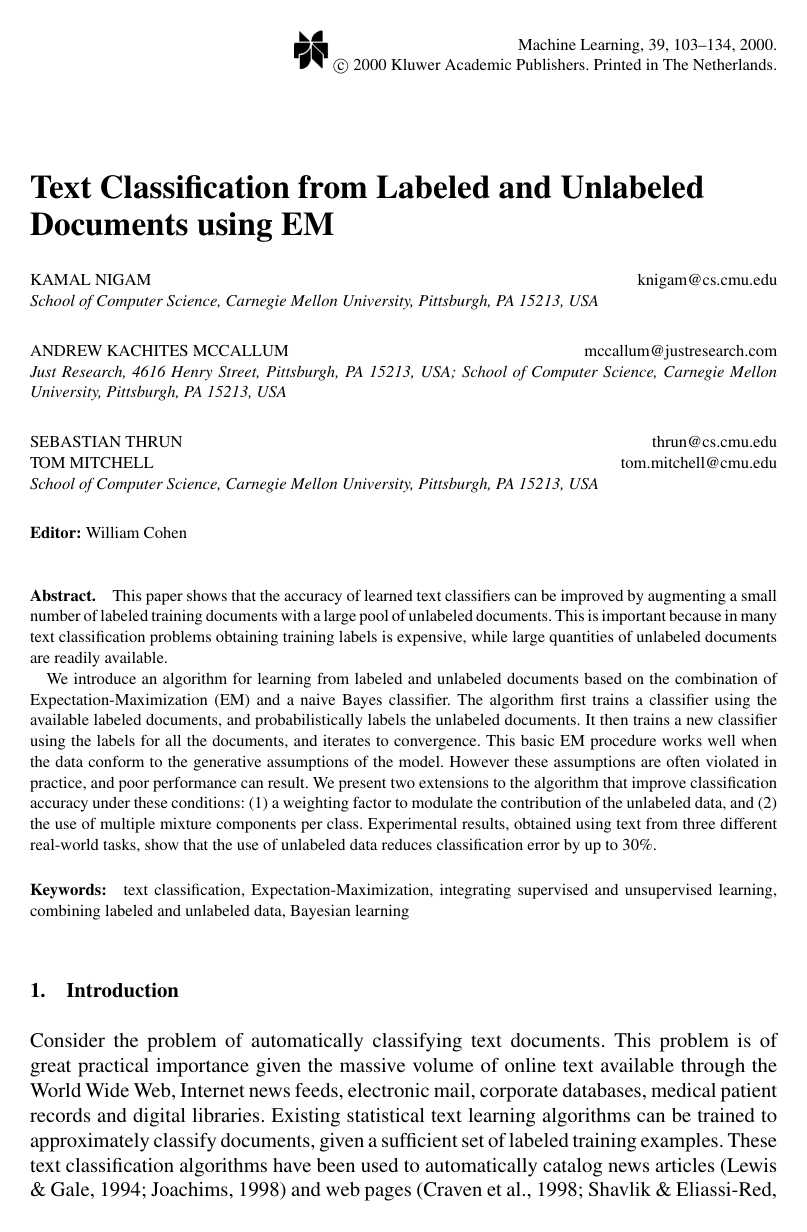
Text Classification from Labeled and Unlabeled Documents using EM
Kamal Nigam, Andrew Kachites Mccallum, Sebastian Thrun, Tom Mitchell
Why you should read this
Demonstrates how combining Expectation-Maximization with naive Bayes leverages abundant unlabeled text to significantly reduce classification error and labeled data requirements, while introducing practical extensions to address violated generative model assumptions.
This paper shows that the accuracy of learned text classifiers can be improved by augmenting a small number of labeled training documents with a large pool of unlabeled documents. This is important because in many text classification problems obtaining training labels is expensive, while large quantities of unlabeled documents are readily available. We introduce an algorithm for learning from labeled and unlabeled documents based on the combination of Expectation-Maximization (EM) and a naive Bayes classifier. The algorithm first trains a classifier using the available labeled documents, and probabilistically labels the unlabeled documents. It then trains a new classifier using the labels for all the documents, and iterates to convergence. This basic EM procedure works well when the data conform to the generative assumptions of the model. However these assumptions are often violated in practice, and poor performance can result. We present two extensions to the algorithm that improve classification accuracy under these conditions: (1) a weighting factor to modulate the contribution of the unlabeled data, and (2) the use of multiple mixture components per class. Experimental results, obtained using text from three different real-world tasks, show that the use of unlabeled data reduces classification error by up to 30%.
Added
2026-09-12
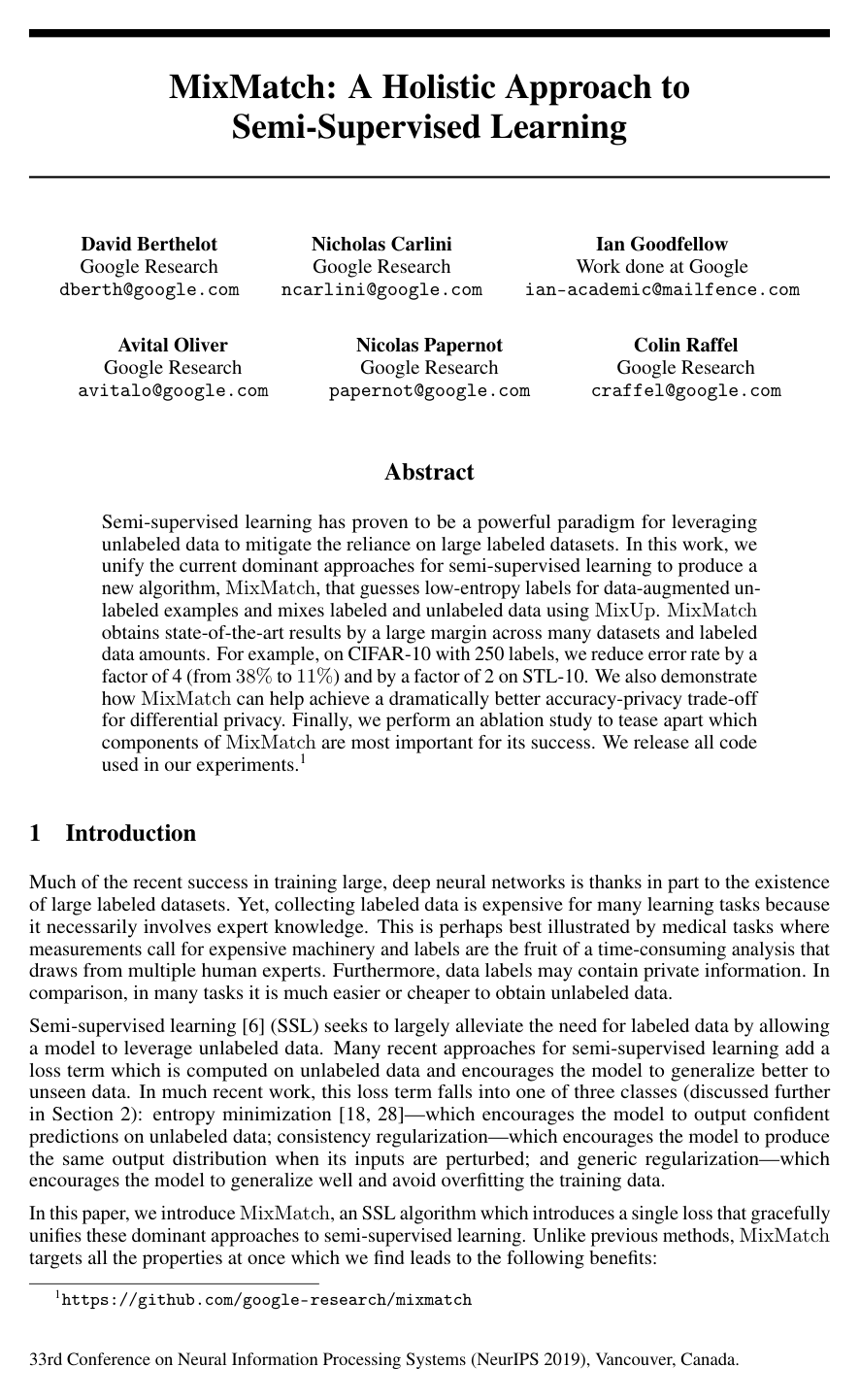
MixMatch: A Holistic Approach to Semi-Supervised Learning
David Berthelot, Nicholas Carlini, Ian Goodfellow, Nicolas Papernot, Avital Oliver, Colin Raffel
Why you should read this
Introduces MixMatch, a unified semi-supervised learning algorithm that combines data augmentation, low-entropy label guessing, and MixUp to dramatically cut classification error rates on scarce labeled data.
Semi-supervised learning has proven to be a powerful paradigm for leveraging unlabeled data to mitigate the reliance on large labeled datasets. In this work, we unify the current dominant approaches for semi-supervised learning to produce a new algorithm, MixMatch, that works by guessing low-entropy labels for data-augmented unlabeled examples and mixing labeled and unlabeled data using MixUp. We show that MixMatch obtains state-of-the-art results by a large margin across many datasets and labeled data amounts. For example, on CIFAR-10 with 250 labels, we reduce error rate by a factor of 4 (from 38% to 11%) and by a factor of 2 on STL-10. We also demonstrate how MixMatch can help achieve a dramatically better accuracy-privacy trade-off for differential privacy. Finally, we perform an ablation study to tease apart which components of MixMatch are most important for its success.
Added
2026-09-11
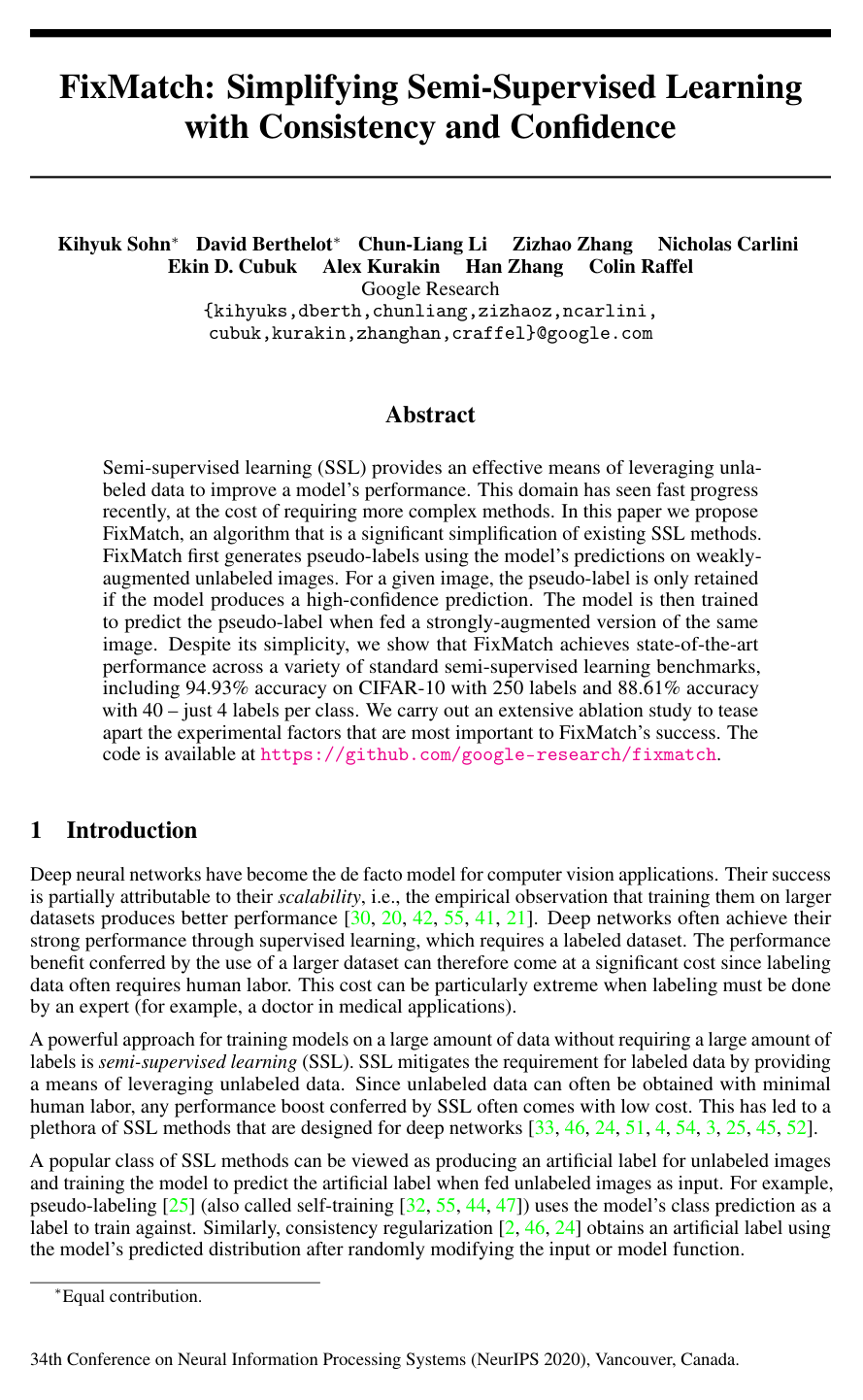
FixMatch: Simplifying Semi-Supervised Learning with Consistency and Confidence
Kihyuk Sohn, David Berthelot, Chun-Liang Li, Zizhao Zhang, Nicholas Carlini, Ekin D. Cubuk, Alex Kurakin, Han Zhang, Colin Raffel
Why you should read this
Introduces FixMatch, a straightforward semi-supervised learning algorithm that combines high-confidence pseudo-labeling with consistency regularization across weak and strong data augmentations, achieving state-of-the-art accuracy with as few as four labeled examples per class.
Semi-supervised learning (SSL) provides an effective means of leveraging unlabeled data to improve a model's performance. In this paper, we demonstrate the power of a simple combination of two common SSL methods: consistency regularization and pseudo-labeling. Our algorithm, FixMatch, first generates pseudo-labels using the model's predictions on weakly-augmented unlabeled images. For a given image, the pseudo-label is only retained if the model produces a high-confidence prediction. The model is then trained to predict the pseudo-label when fed a strongly-augmented version of the same image. Despite its simplicity, we show that FixMatch achieves state-of-the-art performance across a variety of standard semi-supervised learning benchmarks, including 94.93% accuracy on CIFAR-10 with 250 labels and 88.61% accuracy with 40 -- just 4 labels per class. Since FixMatch bears many similarities to existing SSL methods that achieve worse performance, we carry out an extensive ablation study to tease apart the experimental factors that are most important to FixMatch's success. We make our code available at this https URL.
Added
2026-09-10
License
Published with permission