
keyword
univariate forecasting
Univariate forecasting is the process of predicting future values of a single time-dependent variable based solely on its own past observations. Unlike multivariate forecasting, which models relationships across multiple interrelated series or external factors, univariate methods isolate a single sequential data stream to identify inherent temporal patterns, such as trends, cycles, seasonality, and residual noise. This approach is applied across both short-term and long-term prediction horizons using a range of techniques, from classical statistical methods such as autoregressive integrated moving average models and exponential smoothing to modern deep learning architectures designed for time series representation and sequence prediction.
6 items
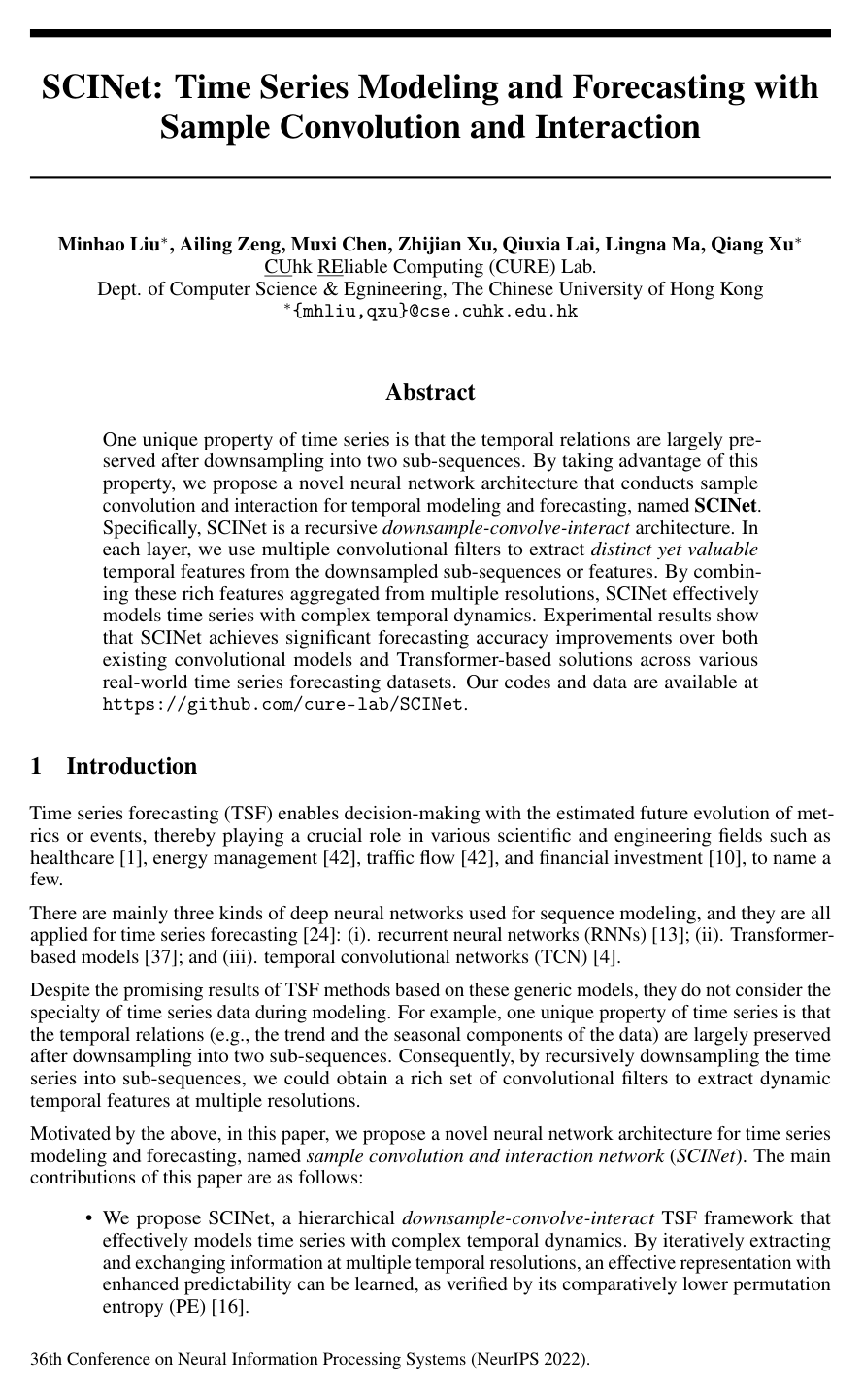
SCINet: Time Series Modeling and Forecasting with Sample Convolution and Interaction
Minhao Liu, Ailing Zeng, Muxi Chen, Zhijian Xu, Qiuxia Lai, Lingna Ma, Qiang Xu
Why you should read this
Proposes a hierarchical downsample-convolve-interact neural network architecture that captures multi-resolution temporal features to outperform existing convolutional and Transformer-based models on complex time series forecasting tasks.
One unique property of time series is that the temporal relations are largely preserved after downsampling into two sub-sequences. By taking advantage of this property, we propose a novel neural network architecture that conducts sample convolution and interaction for temporal modeling and forecasting, named SCINet. Specifically, SCINet is a recursive downsample-convolve-interact architecture. In each layer, we use multiple convolutional filters to extract distinct yet valuable temporal features from the downsampled sub-sequences or features. By combining these rich features aggregated from multiple resolutions, SCINet effectively models time series with complex temporal dynamics. Experimental results show that SCINet achieves significant forecasting accuracy improvements over both existing convolutional models and Transformer-based solutions across various real-world time series forecasting datasets. Our codes and data are available at https://github.com/cure-lab/SCINet.
Added
2026-10-05
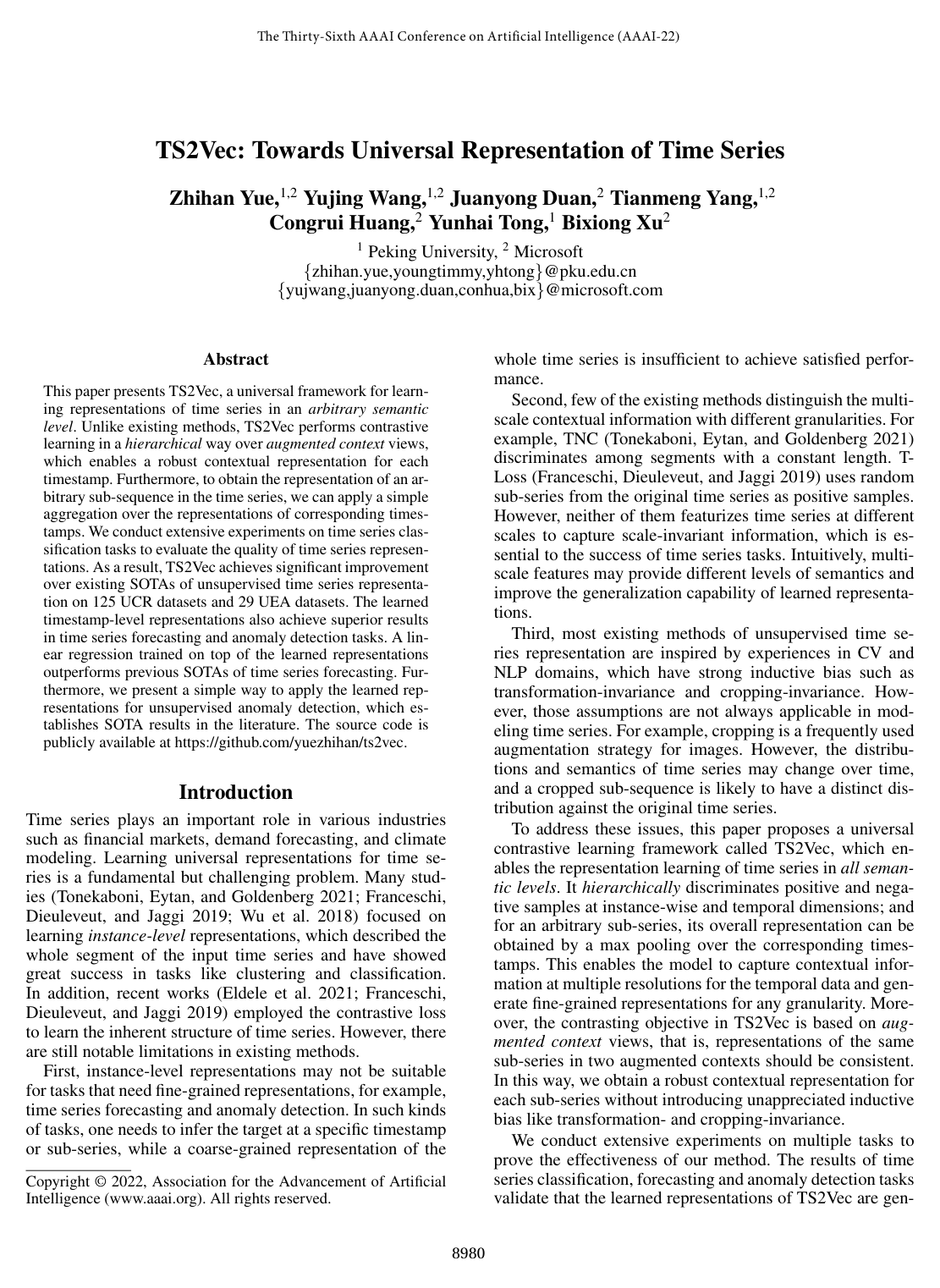
TS2Vec: Towards Universal Representation of Time Series
Zhihan Yue, Yujing Wang, Juanyong Duan, Tianmeng Yang, Congrui Huang, Yunhai Tong, Bixiong Xu
Why you should read this
Proposes a universal contrastive learning framework that uses hierarchical contrasting and contextual consistency to learn multiscale time series representations, achieving state-of-the-art results across classification, forecasting, and anomaly detection benchmarks.
This paper presents TS2Vec, a universal framework for learning representations of time series in an arbitrary semantic level. Unlike existing methods, TS2Vec performs contrastive learning in a hierarchical way over augmented context views, which enables a robust contextual representation for each timestamp. Furthermore, to obtain the representation of an arbitrary sub-sequence in the time series, we can apply a simple aggregation over the representations of corresponding timestamps. We conduct extensive experiments on time series classification tasks to evaluate the quality of time series representations. As a result, TS2Vec achieves significant improvement over existing SOTAs of unsupervised time series representation on 125 UCR datasets and 29 UEA datasets. The learned timestamp-level representations also achieve superior results in time series forecasting and anomaly detection tasks. A linear regression trained on top of the learned representations outperforms previous SOTAs of time series forecasting. Furthermore, we present a simple way to apply the learned representations for unsupervised anomaly detection, which establishes SOTA results in the literature. The source code is publicly available at https://github.com/yuezhihan/ts2vec.
Added
2026-09-26
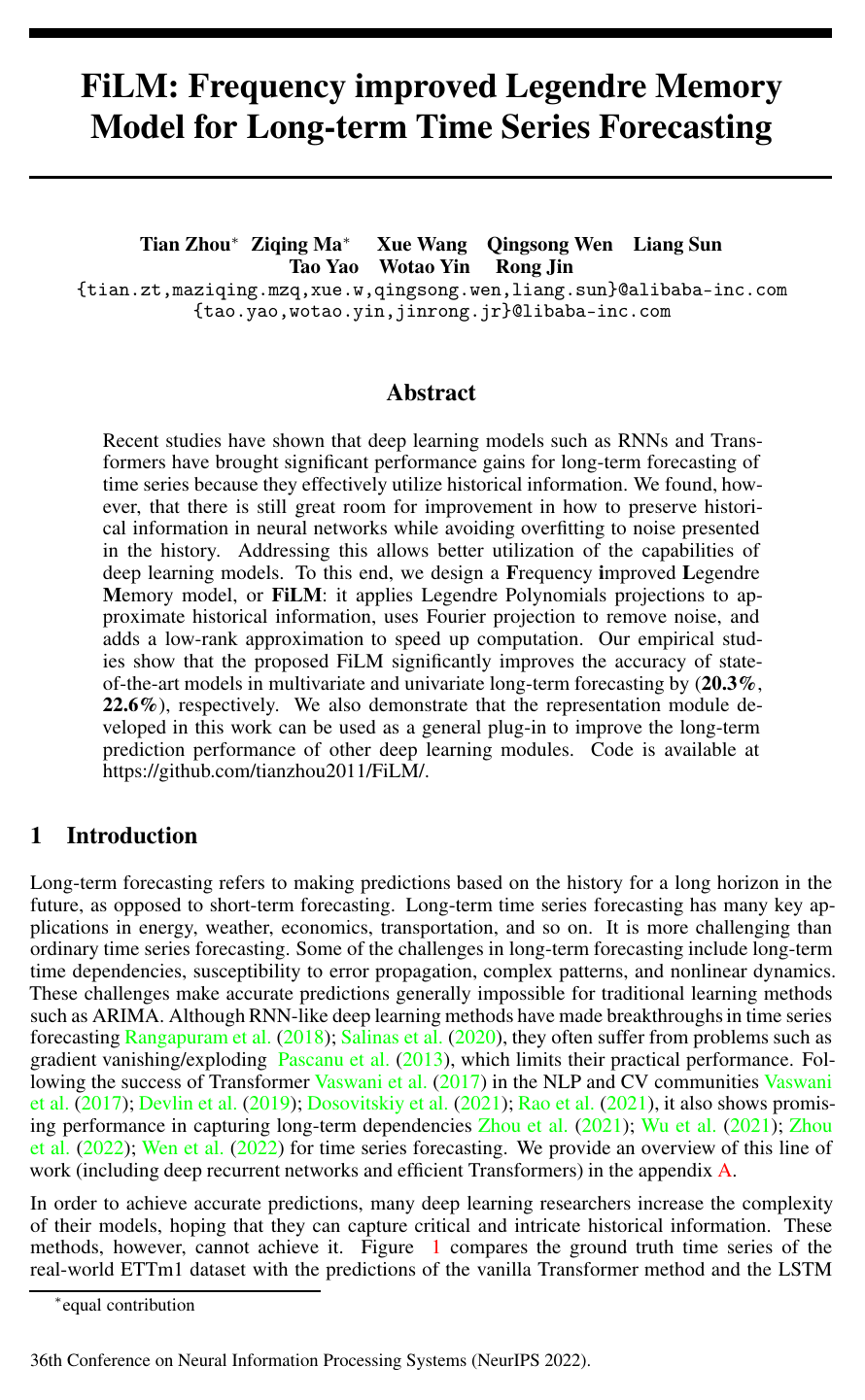
FiLM: Frequency improved Legendre Memory Model for Long-term Time Series Forecasting
Tian Zhou, Ziqing Ma, Xue Wang, Qingsong Wen, Liang Sun, Tao Yao, Wotao Yin, Rong Jin
Why you should read this
Proposes FiLM, a modular time series forecasting framework that combines Legendre polynomial representations with Fourier filtering to preserve historical dynamics while eliminating noise, improving long-term prediction accuracy by over 20%.
Recent studies have shown that deep learning models such as RNNs and Transformers have brought significant performance gains for long-term forecasting of time series because they effectively utilize historical information. We found, however, that there is still great room for improvement in how to preserve historical information in neural networks while avoiding overfitting to noise presented in the history. Addressing this allows better utilization of the capabilities of deep learning models. To this end, we design a \textbf{F}requency \textbf{i}mproved \textbf{L}egendre \textbf{M}emory model, or {\bf FiLM}: it applies Legendre Polynomials projections to approximate historical information, uses Fourier projection to remove noise, and adds a low-rank approximation to speed up computation. Our empirical studies show that the proposed FiLM significantly improves the accuracy of state-of-the-art models in multivariate and univariate long-term forecasting by (\textbf{20.3\%}, \textbf{22.6\%}), respectively. We also demonstrate that the representation module developed in this work can be used as a general plug-in to improve the long-term prediction performance of other deep learning modules. Code is available at this https URL
Added
2026-09-26
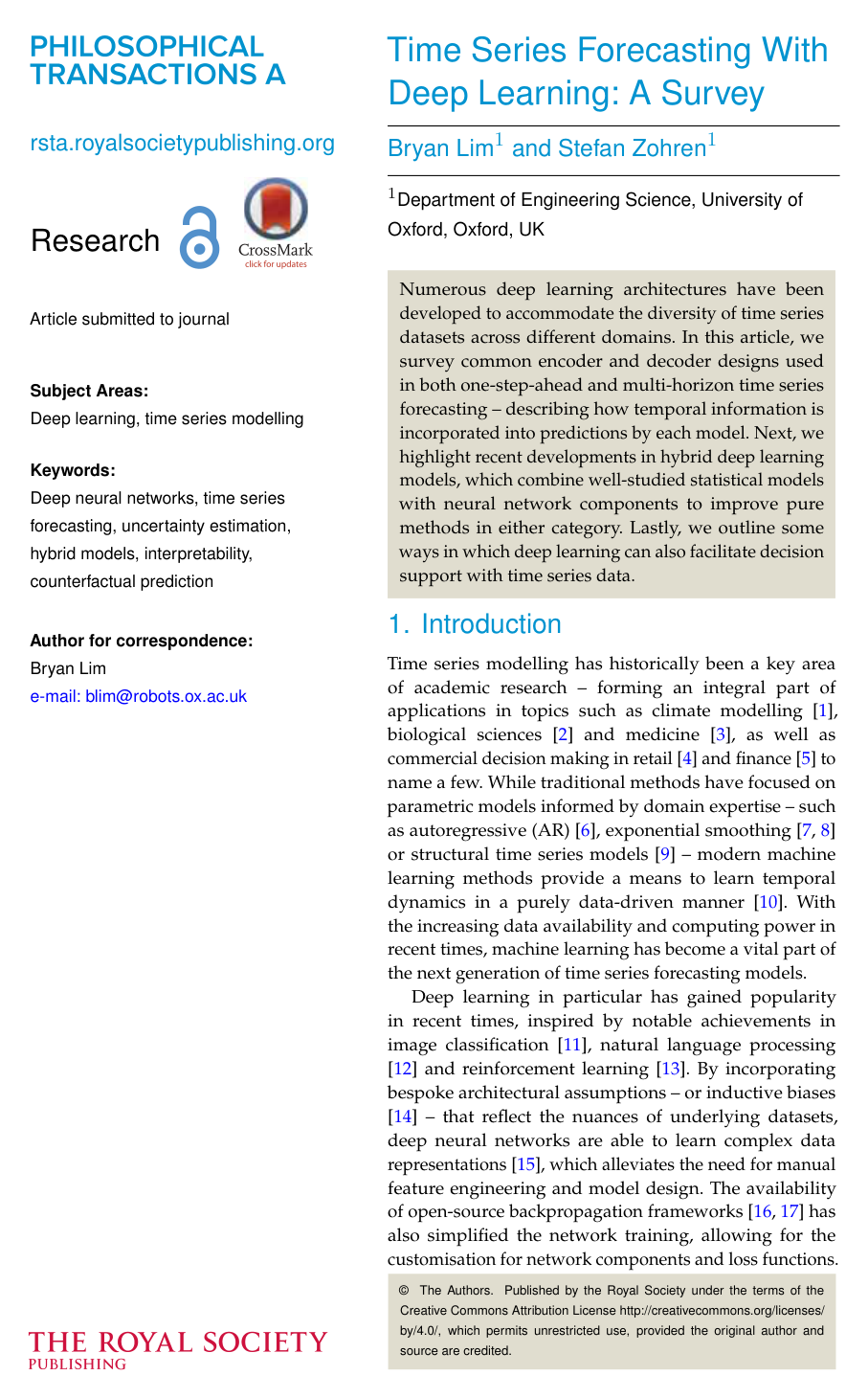
Time-series forecasting with deep learning: a survey
Bryan Lim, Stefan Zohren
Why you should read this
Categorizes modern deep learning and hybrid statistical architectures for multi-horizon time series forecasting, providing a clear guide on how different models encode temporal dynamics for operational decision support.
Numerous deep learning architectures have been developed to accommodate the diversity of time series datasets across different domains. In this article, we survey common encoder and decoder designs used in both one-step-ahead and multi-horizon time series forecasting -- describing how temporal information is incorporated into predictions by each model. Next, we highlight recent developments in hybrid deep learning models, which combine well-studied statistical models with neural network components to improve pure methods in either category. Lastly, we outline some ways in which deep learning can also facilitate decision support with time series data.
Added
2026-09-18
FEDformer: Frequency Enhanced Decomposed Transformer for Long-term Series Forecasting
Tian Zhou, Ziqing Ma, Qingsong Wen, Xue Wang, Liang Sun, Rong Jin
Why you should read this
Proposes FEDformer, a long-term time series forecasting architecture that pairs seasonal-trend decomposition with frequency-domain attention to achieve linear computational complexity and significantly reduce prediction errors over standard Transformers.
Although Transformer-based methods have significantly improved state-of-the-art results for long-term series forecasting, they are not only computationally expensive but more importantly, are unable to capture the global view of time series (e.g. overall trend). To address these problems, we propose to combine Transformer with the seasonal-trend decomposition method, in which the decomposition method captures the global profile of time series while Transformers capture more detailed structures. To further enhance the performance of Transformer for long-term prediction, we exploit the fact that most time series tend to have a sparse representation in well-known basis such as Fourier transform, and develop a frequency enhanced Transformer. Besides being more effective, the proposed method, termed as Frequency Enhanced Decomposed Transformer ({\bf FEDformer}), is more efficient than standard Transformer with a linear complexity to the sequence length. Our empirical studies with six benchmark datasets show that compared with state-of-the-art methods, FEDformer can reduce prediction error by and for multivariate and univariate time series, respectively. Code is publicly available at this https URL.
Added
2026-09-11
A Time Series is Worth 64 Words: Long-term Forecasting with Transformers
Yuqi Nie, Nam H. Nguyen, Phanwadee Sinthong, Jayant Kalagnanam
Why you should read this
Establishes a revolutionary state-of-the-art framework by intelligently patching time series segments into distinct tokens to preserve local semantics while simultaneously conquering the quadratic memory bottleneck of long-range transformers.
We propose an efficient design of Transformer-based models for multivariate time series forecasting and self-supervised representation learning. It is based on two key components: (i) segmentation of time series into subseries-level patches which are served as input tokens to Transformer; (ii) channel-independence where each channel contains a single univariate time series that shares the same embedding and Transformer weights across all the series. Patching design naturally has three-fold benefit: local semantic information is retained in the embedding; computation and memory usage of the attention maps are quadratically reduced given the same look-back window; and the model can attend longer history. Our channel-independent patch time series Transformer (PatchTST) can improve the long-term forecasting accuracy significantly when compared with that of SOTA Transformer-based models. We also apply our model to self-supervised pre-training tasks and attain excellent fine-tuning performance, which outperforms supervised training on large datasets. Transferring of masked pre-trained representation on one dataset to others also produces SOTA forecasting accuracy. Code is available at: https://github.com/yuqinie98/PatchTST.
Added
2026-06-27