Built independently by an author, for readers. Read the story and support ChapterPal

keyword

united visual representation

A united visual representation is a shared feature encoding framework in multimodal artificial intelligence that maps disparate visual modalities, such as static images and temporal video sequences, into a single cohesive embedding space. Rather than processing images and videos through isolated representation pipelines or separate projection mechanisms, this approach harmonizes visual inputs into a unified tokenization structure before interfacing with downstream architectures such as large language models. By establishing an integrated feature representation across differing visual formats, it facilitates joint learning and cross-modal alignment, allowing computational models to process both static spatial details and dynamic temporal motions within a common semantic space.

1 item

Video-LLaVA: Learning United Visual Representation by Alignment Before Projection

Video-LLaVA: Learning United Visual Representation by Alignment Before Projection

Bin Lin, Yang Ye, Bin Zhu, Jiaxi Cui, Munan Ning, Peng Jin, Li Yuan

OrganizationsPandaVilla Tech LimitedPeking UniversityPeng Cheng Laboratory

Why you should read this

Introduces Video-LLaVA, a vision-language model that aligns image and video features into a single representation before projecting them to a large language model, demonstrating that joint multimodal training outperforms specialized single-modality systems across major image and video benchmarks.

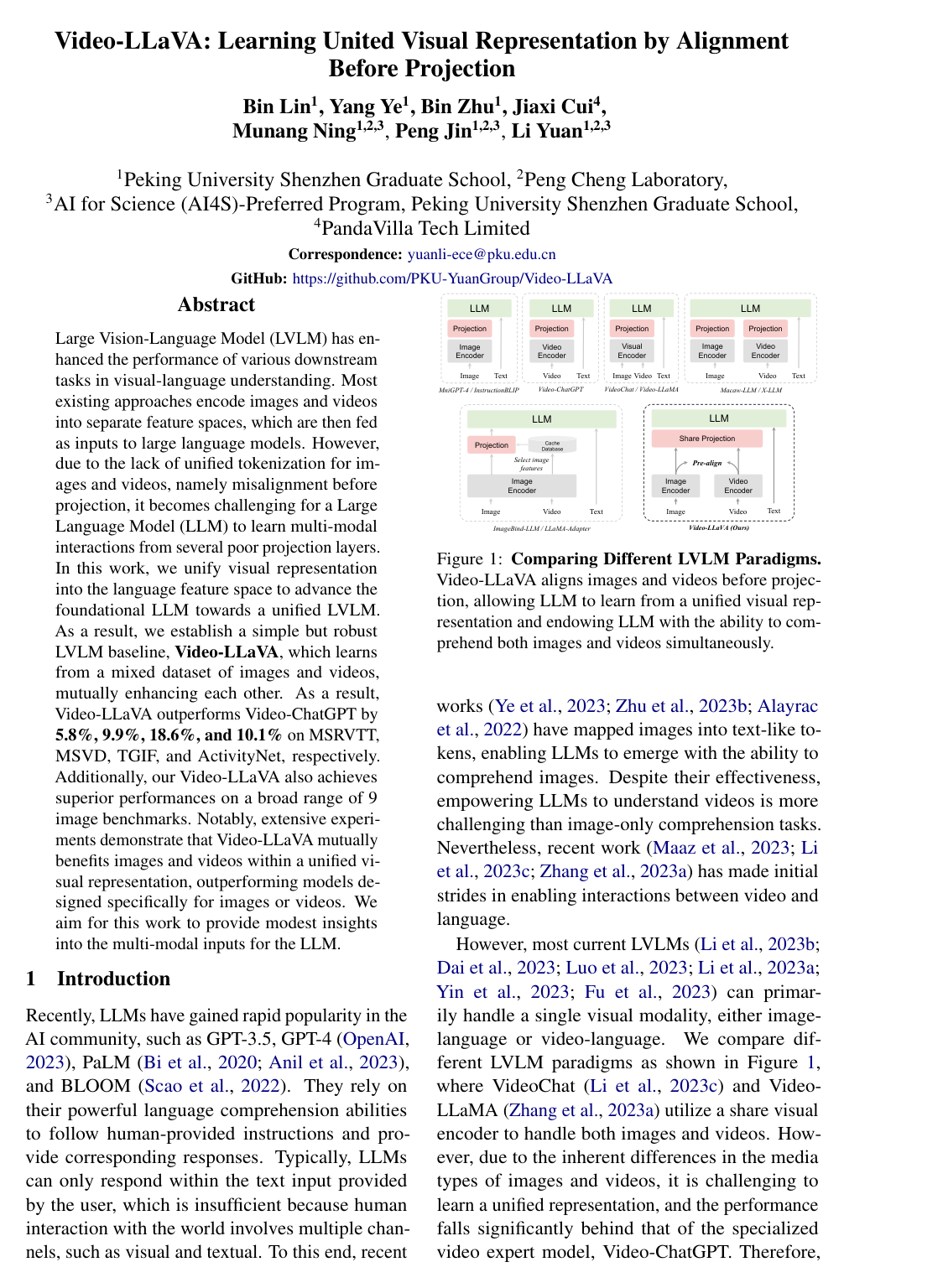
The Large Vision-Language Model (LVLM) has enhanced the performance of various downstream tasks in visual-language understanding. Most existing approaches encode images and videos into separate feature spaces, which are then fed as inputs to large language models. However, due to the lack of unified tokenization for images and videos, namely misalignment before projection, it becomes challenging for a Large Language Model (LLM) to learn multi-modal interactions from several poor projection layers. In this work, we unify visual representation into the language feature space to advance the foundational LLM towards a unified LVLM. As a result, we establish a simple but robust LVLM baseline, Video-LLaVA, which learns from a mixed dataset of images and videos, mutually enhancing each other. Video-LLaVA achieves superior performances on a broad range of 9 image benchmarks across 5 image question-answering datasets and 4 image benchmark toolkits. Additionally, our Video-LLaVA also outperforms Video-ChatGPT by 5.8%, 9.9%, 18.6%, and 10.1% on MSRVTT, MSVD, TGIF, and ActivityNet, respectively. Notably, extensive experiments demonstrate that Video-LLaVA mutually benefits images and videos within a unified visual representation, outperforming models designed specifically for images or videos. We aim for this work to provide modest insights into the multi-modal inputs for the LLM. Code address: \href{this https URL}

Added

2026-09-24