keyword
uniformity loss
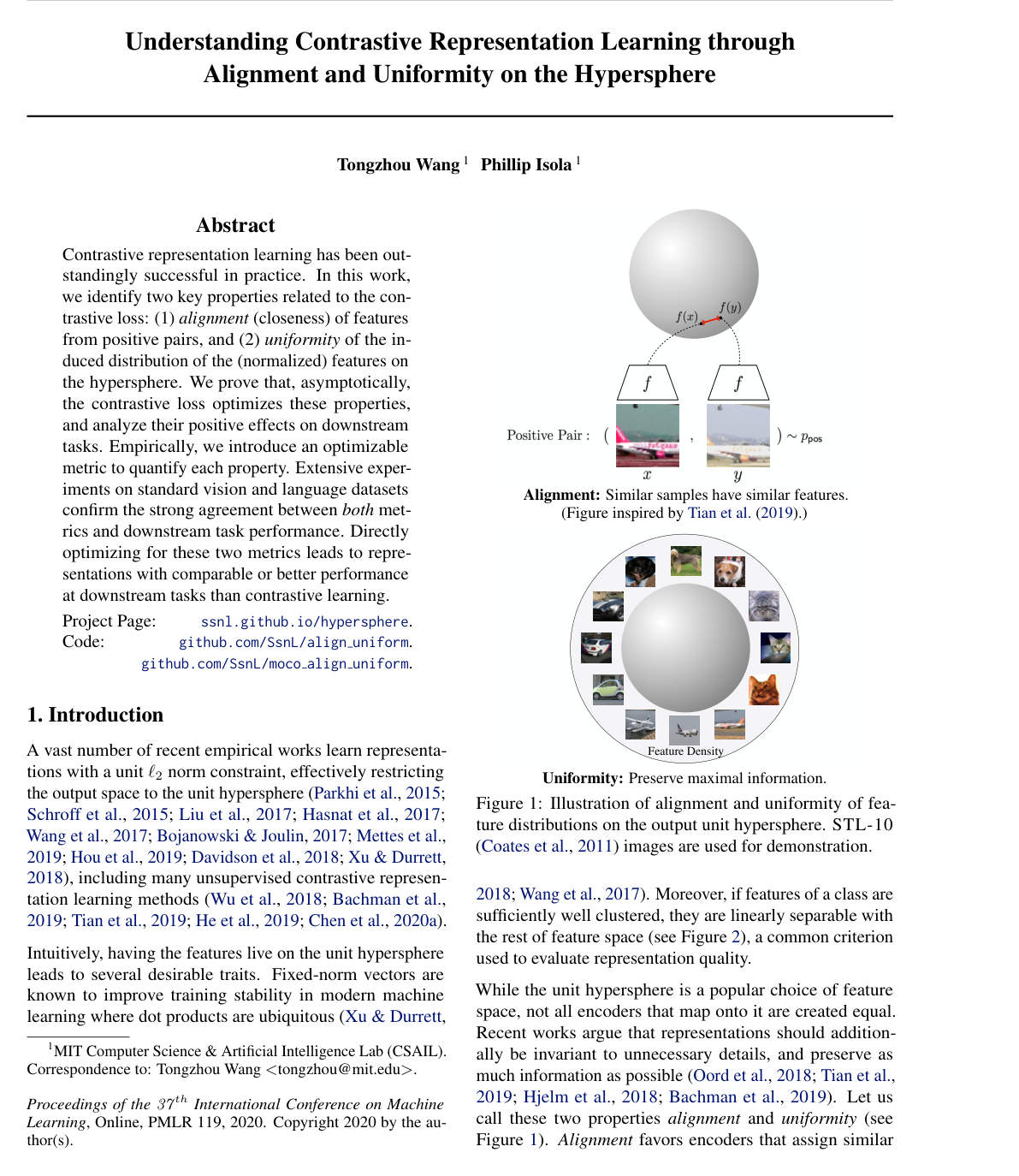
Uniformity loss is an objective function in representation learning designed to encourage normalized feature vectors to be distributed evenly across the surface of a unit hypersphere. By penalizing the clustering of representations and maximizing pairwise distances between data points, this metric helps prevent representation collapse and ensures the latent space preserves maximal information about the input data. Typically formulated as the logarithm of the average pairwise Gaussian potential between feature embeddings, uniformity loss acts as a repulsive force across distinct instances and is commonly paired with alignment objectives in contrastive learning to yield well-separated, generalizable representations for downstream tasks.
1 item