
keyword
uniform quantization
Uniform quantization is a quantization process in which continuous or higher-precision numeric values are mapped to a discrete set of representable levels that are separated by a constant step size across a given dynamic range. By partitioning the input domain into equally spaced intervals, every quantization bin maintains an identical width, typically governed by a fixed scaling factor and an optional zero-point offset. In the context of digital signal processing and deep learning model compression, uniform quantization converts floating-point weights and activations into low-bit integer representations. This equal-interval structure makes it highly compatible with standard computing hardware, facilitating efficient fixed-point arithmetic, reduced memory footprint, and accelerated inference execution without requiring complex decoding tables.
5 items
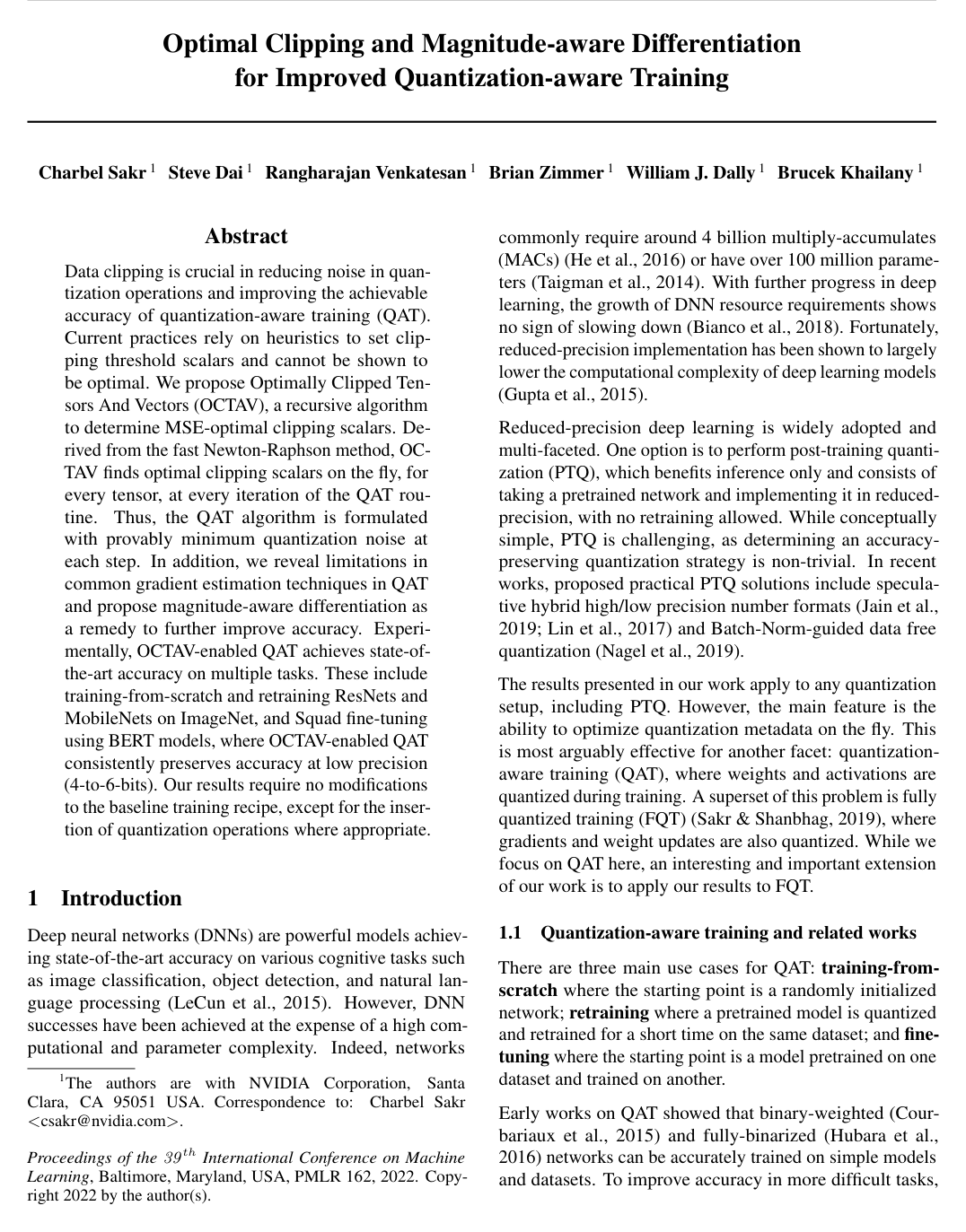
Optimal Clipping and Magnitude-aware Differentiation for Improved Quantization-aware Training
Charbel Sakr, Steve Dai, Rangharajan Venkatesan, Brian Zimmer, William J. Dally, Brucek Khailany
Why you should read this
Proposes a fast Newton-Raphson-based algorithm to dynamically compute MSE-optimal clipping scalars alongside magnitude-aware differentiation, achieving state-of-the-art accuracy in low-precision quantization-aware training without altering standard baseline hyperparameters.
Data clipping is crucial in reducing noise in quantization operations and improving the achievable accuracy of quantization-aware training (QAT). Current practices rely on heuristics to set clipping threshold scalars and cannot be shown to be optimal. We propose Optimally Clipped Tensors And Vectors (OCTAV), a recursive algorithm to determine MSE-optimal clipping scalars. Derived from the fast Newton-Raphson method, OCTAV finds optimal clipping scalars on the fly, for every tensor, at every iteration of the QAT routine. Thus, the QAT algorithm is formulated with provably minimum quantization noise at each step. In addition, we reveal limitations in common gradient estimation techniques in QAT and propose magnitude-aware differentiation as a remedy to further improve accuracy. Experimentally, OCTAV-enabled QAT achieves state-of-the-art accuracy on multiple tasks. These include training-from-scratch and retraining ResNets and MobileNets on ImageNet, and Squad fine-tuning using BERT models, where OCTAV-enabled QAT consistently preserves accuracy at low precision (4-to-6-bits). Our results require no modifications to the baseline training recipe, except for the insertion of quantization operations where appropriate.
Added
2026-10-03
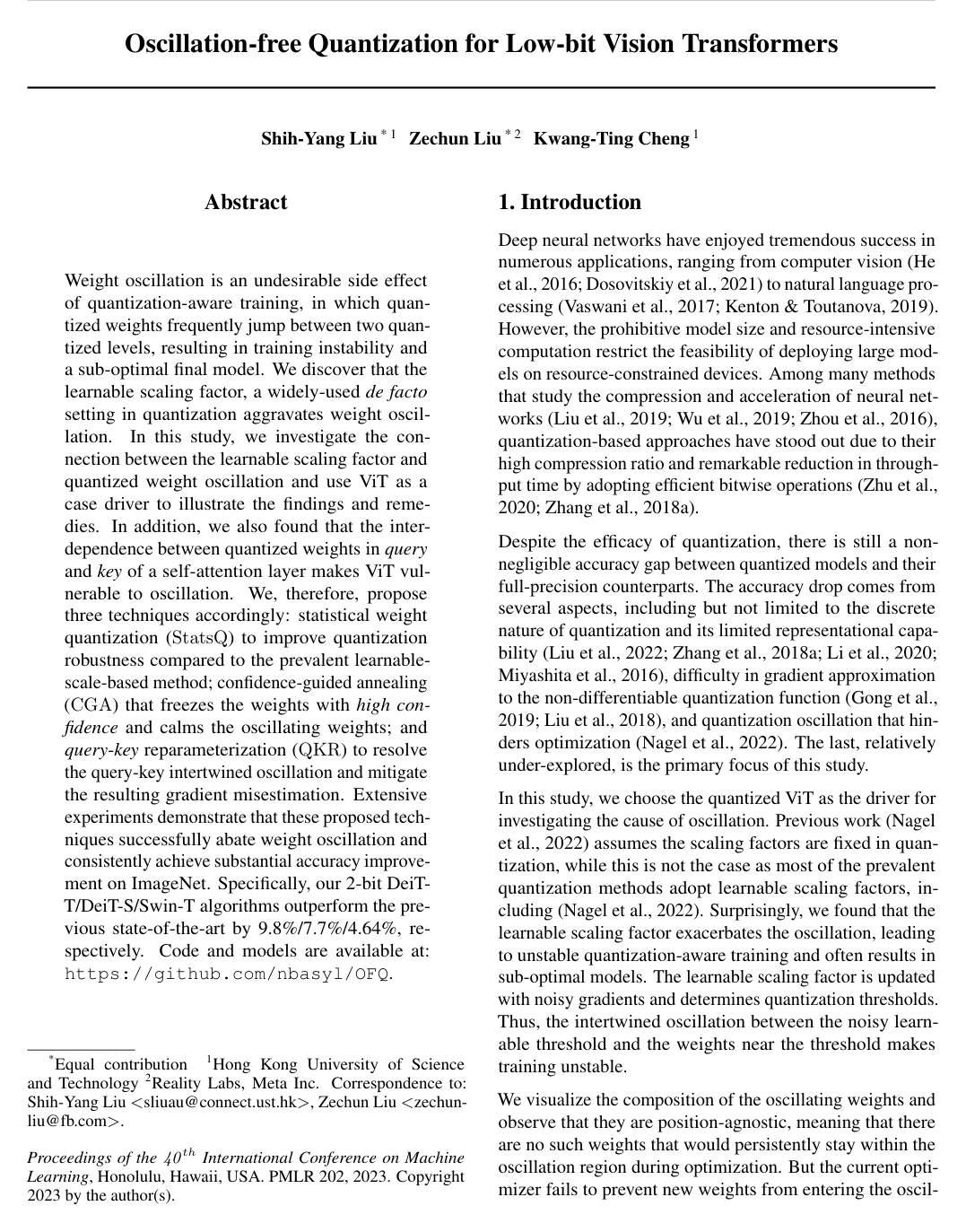
Oscillation-free Quantization for Low-bit Vision Transformers
Shih-Yang Liu, Zechun Liu, Kwang-Ting Cheng
Why you should read this
Develops statistical weight quantization, confidence-guided annealing, and query-key reparameterization to eliminate weight oscillation in quantization-aware training, significantly closing the accuracy gap between low-bit Vision Transformers and their full-precision counterparts on ImageNet.
Weight oscillation is an undesirable side effect of quantization-aware training, in which quantized weights frequently jump between two quantized levels, resulting in training instability and a sub-optimal final model. We discover that the learnable scaling factor, a widely-used de facto setting in quantization aggravates weight oscillation. In this study, we investigate the connection between the learnable scaling factor and quantized weight oscillation and use ViT as a case driver to illustrate the findings and remedies. In addition, we also found that the interdependence between quantized weights in query and key of a self-attention layer makes ViT vulnerable to oscillation. We, therefore, propose three techniques accordingly: statistical weight quantization (StatsQ) to improve quantization robustness compared to the prevalent learnable-scale-based method; confidence-guided annealing (CGA) that freezes the weights with high confidence and calms the oscillating weights; and query-key reparameterization (QKR) to resolve the query-key intertwined oscillation and mitigate the resulting gradient misestimation. Extensive experiments demonstrate that these proposed techniques successfully abate weight oscillation and consistently achieve substantial accuracy improvement on ImageNet. Specifically, our 2-bit DeiT-T/DeiT-S/Swin-T algorithms outperform the previous state-of-the-art by 9.8%/7.7%/4.64%, respectively. Code and models are available at: https://github.com/nbasyl/OFQ.
Added
2026-09-26
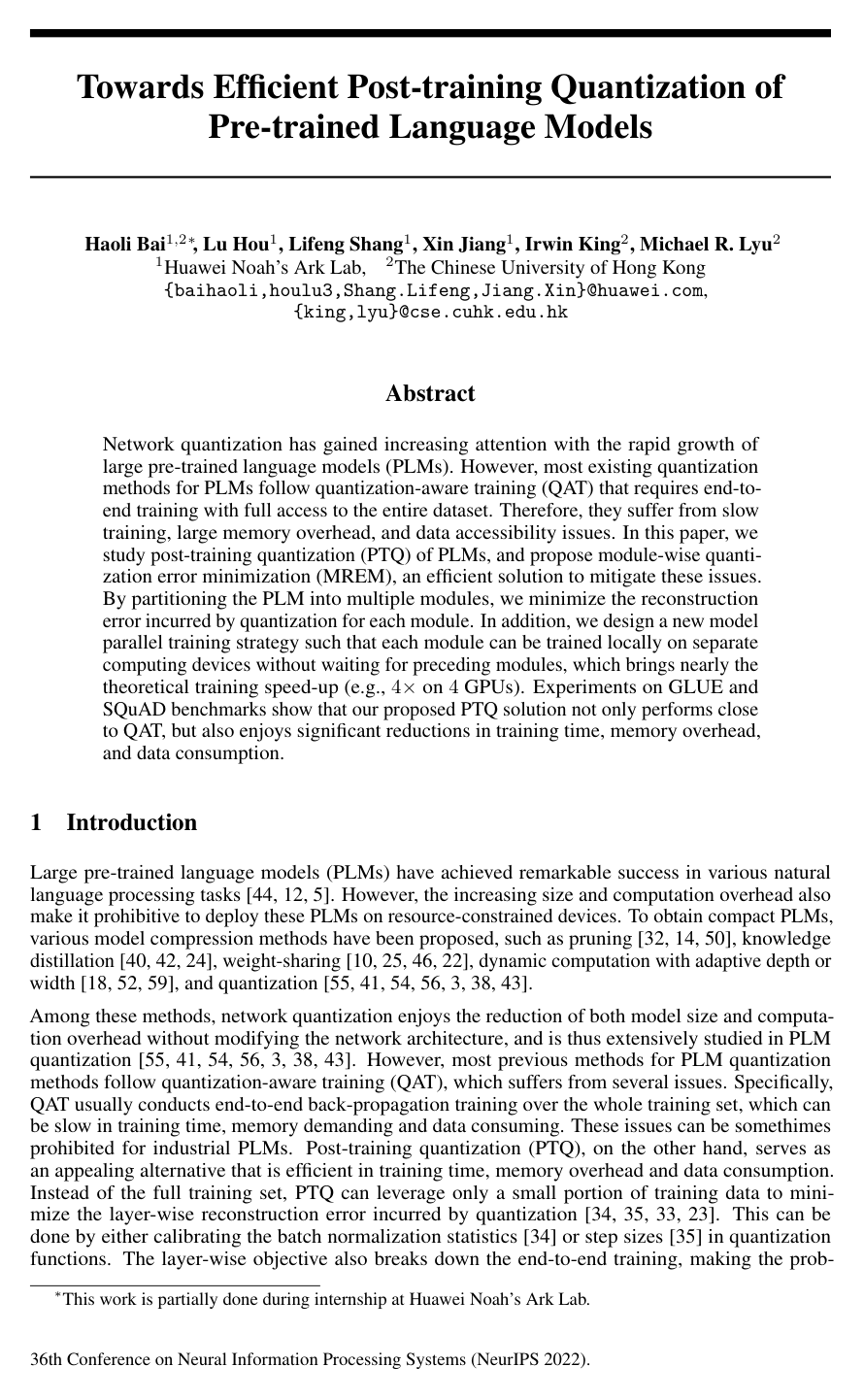
Towards Efficient Post-training Quantization of Pre-trained Language Models
Haoli Bai, Lu Hou, Lifeng Shang, Xin Jiang, Irwin King, Michael R. Lyu
Why you should read this
Proposes a parallel module-wise reconstruction error minimization framework that enables fast, memory-efficient post-training quantization for large language models while achieving accuracy competitive with full quantization-aware training.
Network quantization has gained increasing attention with the rapid growth of large pre-trained language models (PLMs). However, most existing quantization methods for PLMs follow quantization-aware training (QAT) that requires end-to-end training with full access to the entire dataset. Therefore, they suffer from slow training, large memory overhead, and data accessibility issues. In this paper, we study post-training quantization (PTQ) of PLMs, and propose module-wise quantization error minimization (MREM), an efficient solution to mitigate these issues. By partitioning the PLM into multiple modules, we minimize the reconstruction error incurred by quantization for each module. In addition, we design a new model parallel training strategy such that each module can be trained locally on separate computing devices without waiting for preceding modules, which brings nearly the theoretical training speed-up (e.g., 4× on 4 GPUs). Experiments on GLUE and SQuAD benchmarks show that our proposed PTQ solution not only performs close to QAT, but also enjoys significant reductions in training time, memory overhead, and data consumption.
Added
2026-09-26
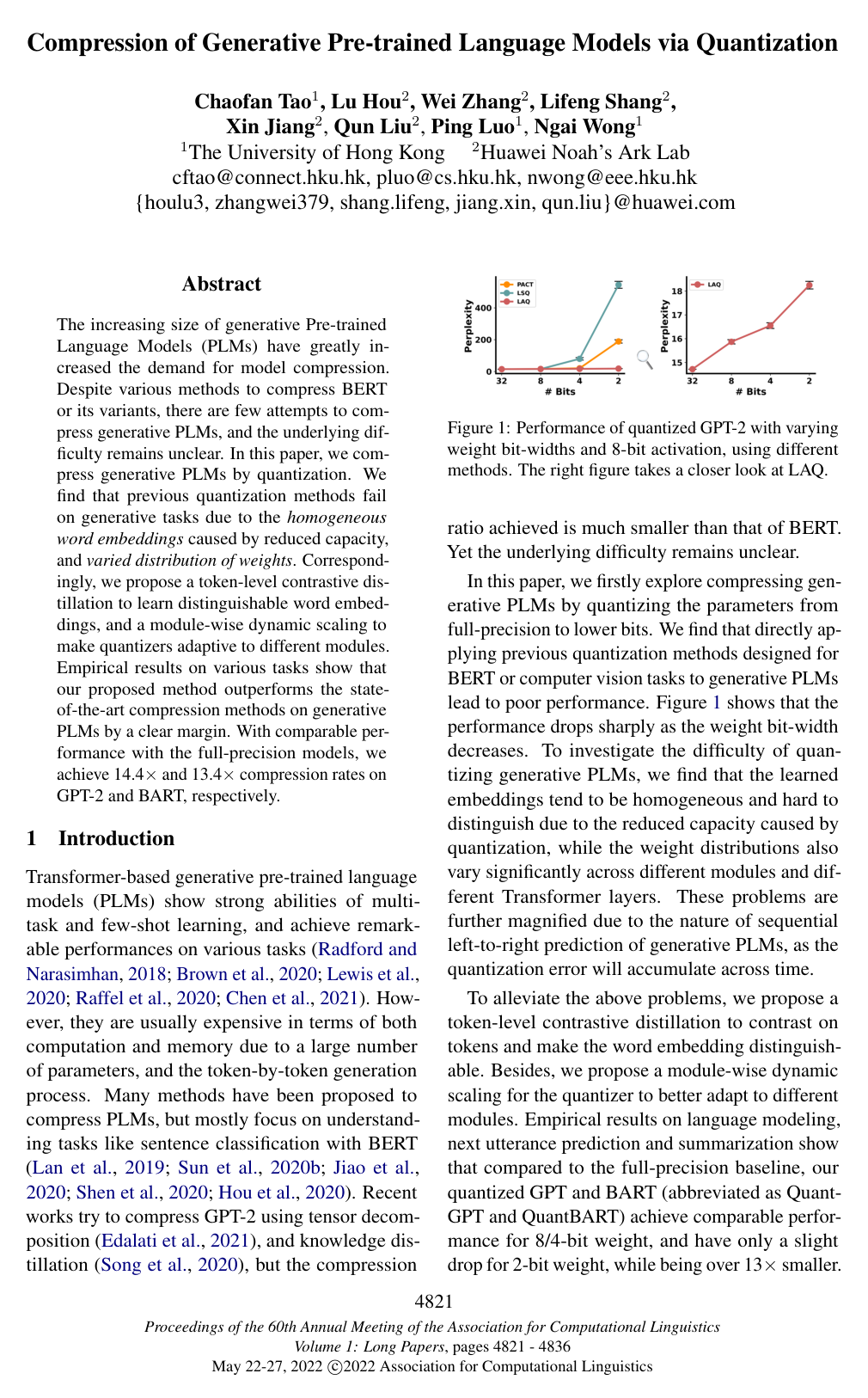
Compression of Generative Pre-trained Language Models via Quantization
Chaofan Tao, Lu Hou, Wei Zhang, Lifeng Shang, Xin Jiang, Qun Liu, Ping Luo, Ngai Wong
Why you should read this
Proposes a token-level contrastive distillation framework and module-wise dynamic scaling to effectively quantize generative pre-trained language models like GPT-2 and BART down to low-bit weights while preserving generation quality.
The increasing size of generative Pre-trained Language Models (PLMs) have greatly increased the demand for model compression. Despite various methods to compress BERT or its variants, there are few attempts to compress generative PLMs, and the underlying difficulty remains unclear. In this paper, we compress generative PLMs by quantization. We find that previous quantization methods fail on generative tasks due to the homogeneous word embeddings caused by reduced capacity, and varied distribution of weights. Correspondingly, we propose a token-level contrastive distillation to learn distinguishable word embeddings, and a module-wise dynamic scaling to make quantizers adaptive to different modules. Empirical results on various tasks show that our proposed method outperforms the state-of-the-art compression methods on generative PLMs by a clear margin. With comparable performance with the full-precision models, we achieve 14.4× and 13.4× compression rates on GPT-2 and BART, respectively.
Added
2026-09-26
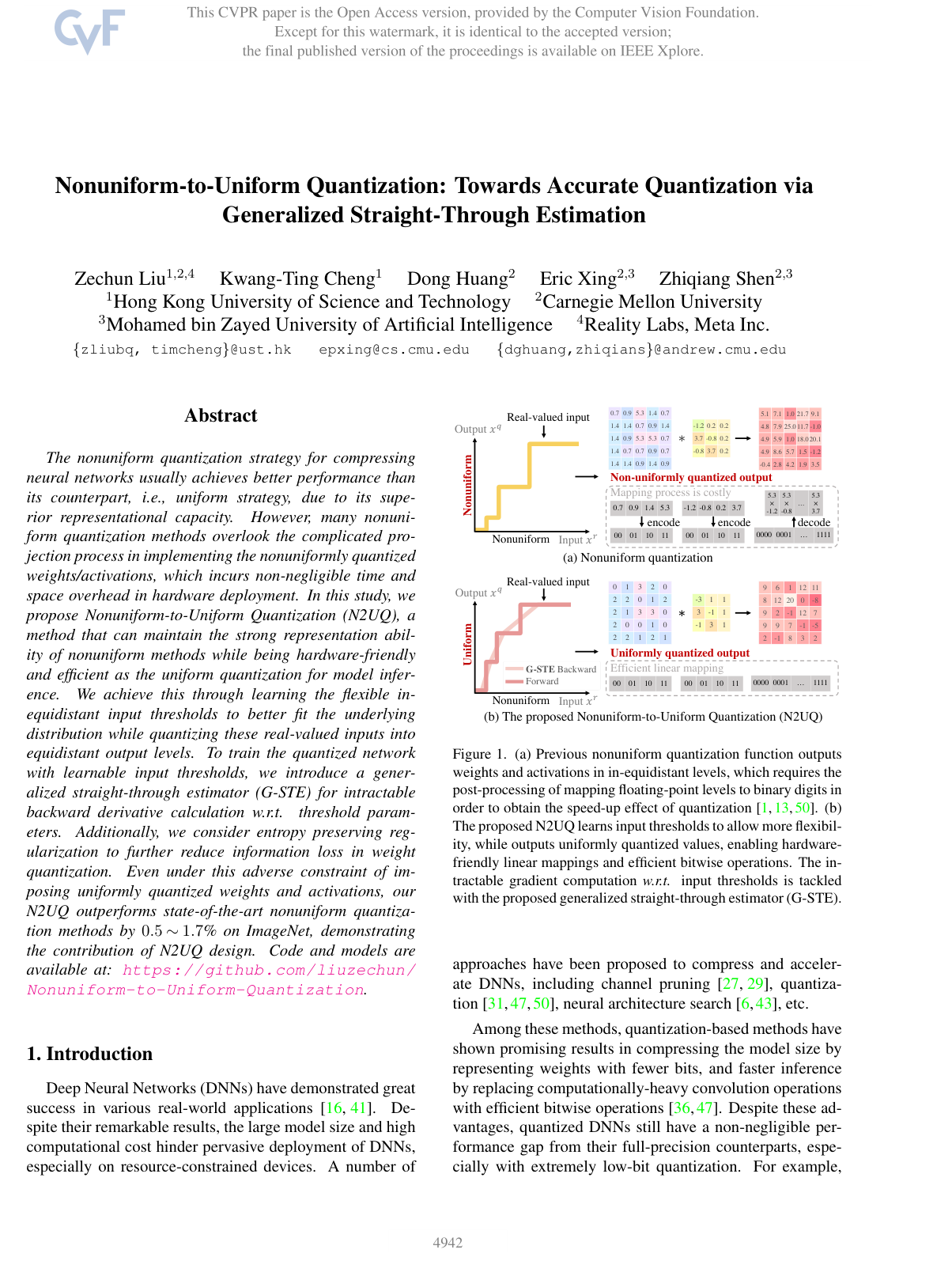
Nonuniform-to-Uniform Quantization: Towards Accurate Quantization via Generalized Straight-Through Estimation
Zechun Liu, Kwang-Ting Cheng, Dong Huang, Eric P. Xing, Zhiqiang Shen
Why you should read this
Presents a hardware-friendly quantization framework that pairs learnable nonuniform input thresholds with uniform output levels, using a generalized straight-through estimator to match the representational capacity of nonuniform methods without incurring inference deployment overhead.
The nonuniform quantization strategy for compressing neural networks usually achieves better performance than its counterpart, i.e., uniform strategy, due to its superior representational capacity. However, many nonuniform quantization methods overlook the complicated projection process in implementing the nonuniformly quantized weights/activations, which incurs non-negligible time and space overhead in hardware deployment. In this study, we propose Nonuniform-to-Uniform Quantization (N2UQ), a method that can maintain the strong representation ability of nonuniform methods while being hardware-friendly and efficient as the uniform quantization for model inference. We achieve this through learning the flexible in-equidistant input thresholds to better fit the underlying distribution while quantizing these real-valued inputs into equidistant output levels. To train the quantized network with learnable input thresholds, we introduce a generalized straight-through estimator (G-STE) for intractable backward derivative calculation w.r.t. threshold parameters. Additionally, we consider entropy preserving regularization to further reduce information loss in weight quantization. Even under this adverse constraint of imposing uniformly quantized weights and activations, our N2UQ outperforms state-of-the-art nonuniform quantization methods by 0.5 ~ 1.7% on ImageNet, demonstrating the contribution of N2UQ design. Code and models are available at: https://github.com/liuzechun/Nonuniform-to-Uniform-Quantization.
Added
2026-09-26