
keyword
uncertainty quantification
Uncertainty quantification is the process of characterizing and measuring the degree of uncertainty in computational models, statistical predictions, and machine learning systems. It assigns confidence scores or probability distributions to model outputs, allowing systems and decision-makers to assess the reliability of generated predictions. Within predictive modeling, uncertainty is commonly decomposed into aleatoric uncertainty, which reflects inherent noise and randomness within the data, and epistemic uncertainty, which stems from incomplete knowledge, limited training data, or model structure limitations. By employing methods such as Bayesian inference, deep ensembles, and evidential modeling, uncertainty quantification improves model calibration, detects out-of-distribution inputs and potential errors, and enhances the overall trustworthiness and safety of automated decision-making.
8 items
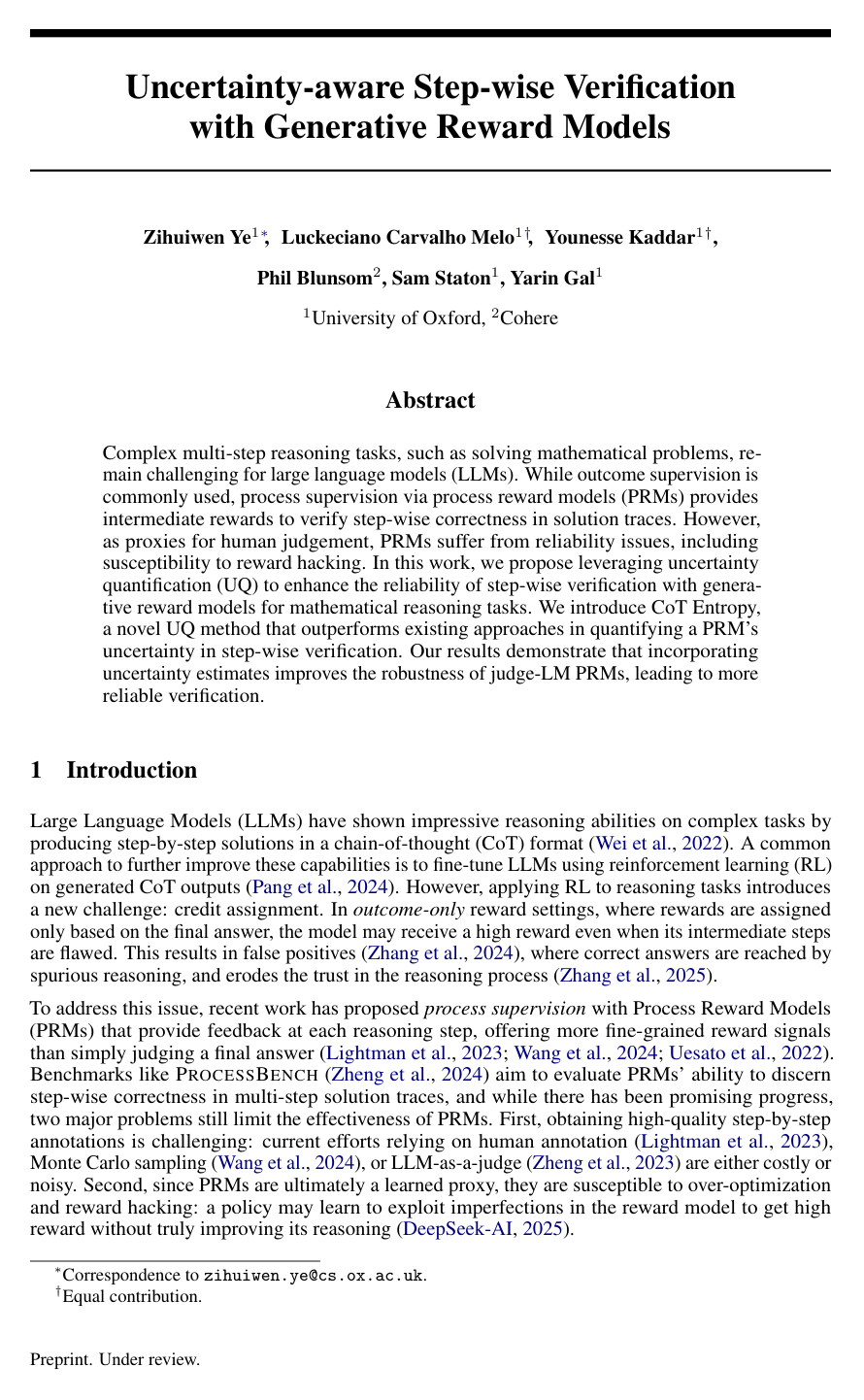
Uncertainty-Aware Step-wise Verification with Generative Reward Models
Daniella (Zihuiwen) Ye, Luckeciano Carvalho Melo, Younesse Kaddar, Phil Blunsom, Sam Staton, Yarin Gal
Why you should read this
Develops CoT Entropy, an uncertainty quantification method for generative process reward models that improves the reliability of step-wise verification and mitigates reward hacking in complex mathematical reasoning.
Complex multi-step reasoning tasks, such as solving mathematical problems, remain challenging for large language models (LLMs). While outcome supervision is commonly used, process supervision via process reward models (PRMs) provides intermediate rewards to verify step-wise correctness in solution traces. However, as proxies for human judgement, PRMs suffer from reliability issues, including susceptibility to reward hacking. In this work, we propose leveraging uncertainty quantification (UQ) to enhance the reliability of step-wise verification with generative reward models for mathematical reasoning tasks. We introduce CoT Entropy, a novel UQ method that outperforms existing approaches in quantifying a PRM's uncertainty in step-wise verification. Our results demonstrate that incorporating uncertainty estimates improves the robustness of judge-LM PRMs, leading to more reliable verification.
Added
2026-10-04
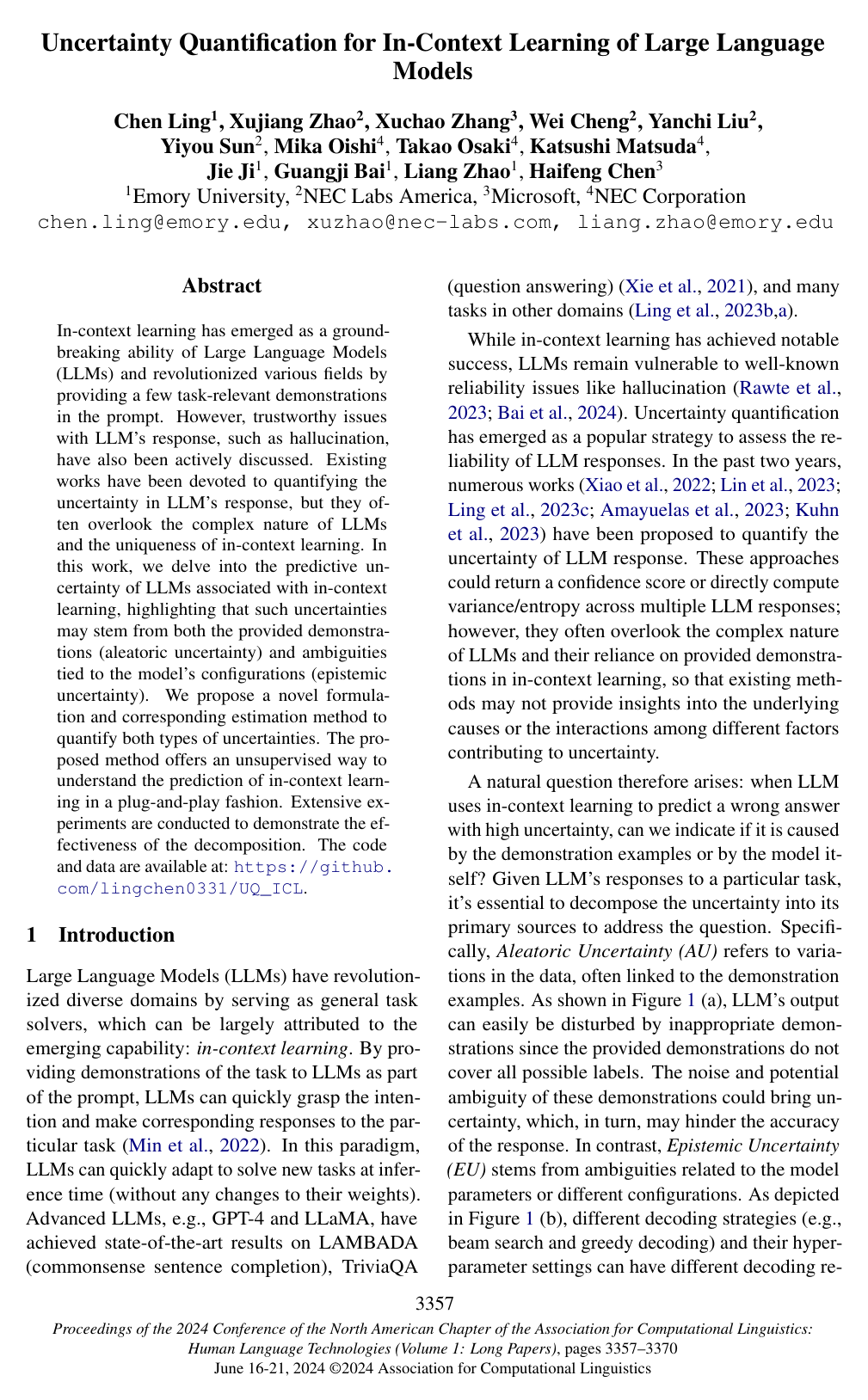
Uncertainty Quantification for In-Context Learning of Large Language Models
Chen Ling, Xujiang Zhao, Xuchao Zhang, Wei Cheng, Yanchi Liu, Yiyou Sun, Mika Oishi, Takao Osaki, Katsushi Matsuda, Jie Ji, Guangji Bai, Liang Zhao, Haifeng Chen
Why you should read this
Presents a Bayesian framework that decomposes predictive uncertainty in large language model in-context learning into prompt-induced aleatoric and model-induced epistemic components, enabling unsupervised diagnostic evaluation of output reliability across both white-box and black-box settings.
In-context learning has emerged as a ground-breaking ability of Large Language Models (LLMs) and revolutionized various fields by providing a few task-relevant demonstrations in the prompt. However, trustworthy issues with LLM’s response, such as hallucination, have also been actively discussed. Existing works have been devoted to quantifying the uncertainty in LLM’s response, but they often overlook the complex nature of LLMs and the uniqueness of in-context learning. In this work, we delve into the predictive uncertainty of LLMs associated with in-context learning, highlighting that such uncertainties may stem from both the provided demonstrations (aleatoric uncertainty) and ambiguities tied to the model’s configurations (epistemic uncertainty). We propose a novel formulation and corresponding estimation method to quantify both types of uncertainties. The proposed method offers an unsupervised way to understand the prediction of in-context learning in a plug-and-play fashion. Extensive experiments are conducted to demonstrate the effectiveness of the decomposition. The code and data are available at: https://github.com/lingchen0331/UQ_ICL.
Added
2026-10-03
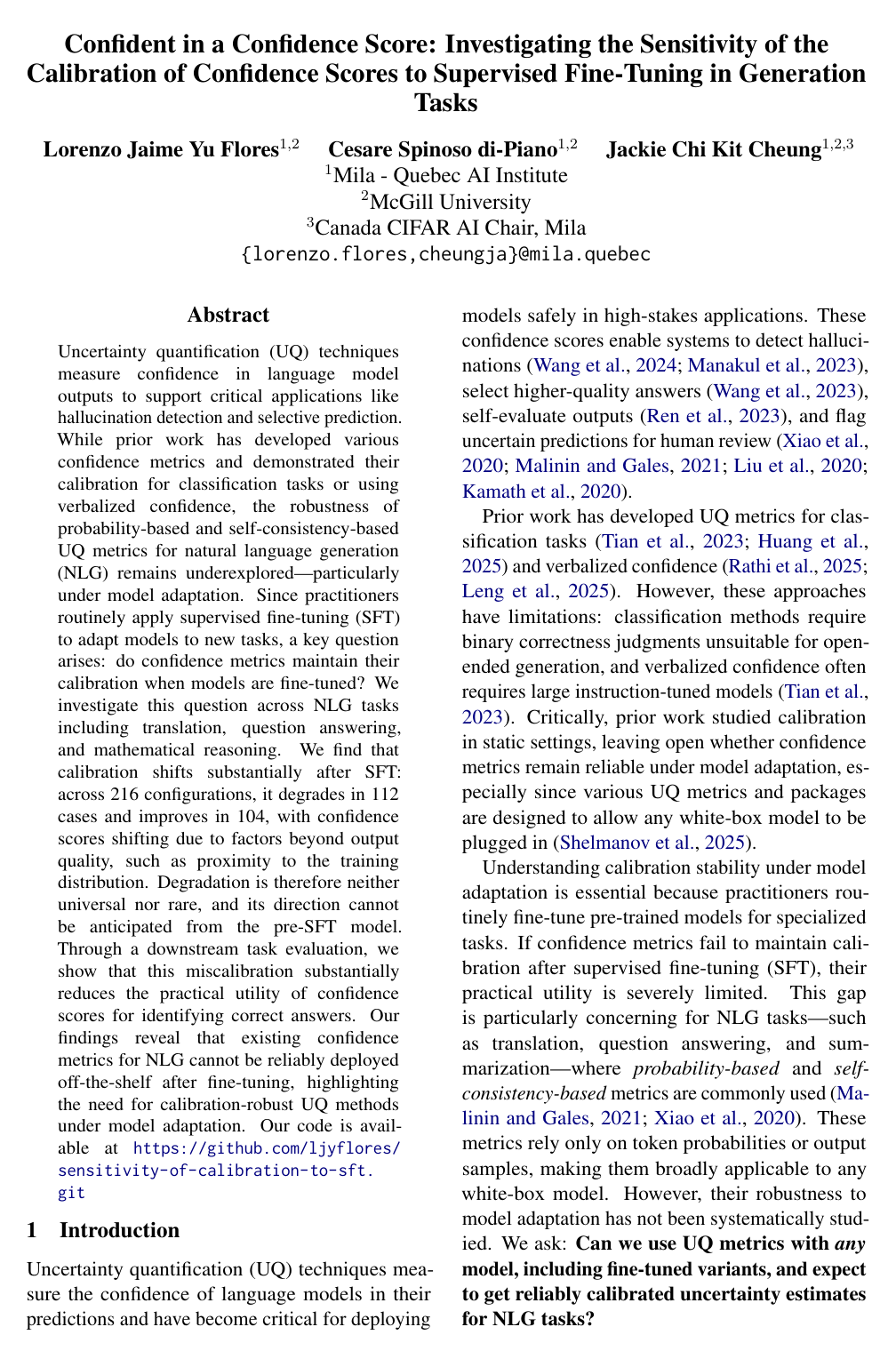
Confident in a Confidence Score: Investigating the Sensitivity of Confidence Scores to Supervised Fine-Tuning
Lorenzo Jaime Flores, Cesare Spinoso di-Piano, Jackie Cheung
Why you should read this
Demonstrates that supervised fine-tuning unpredictably alters language model confidence calibration across text generation tasks, significantly undermining the effectiveness of standard uncertainty metrics for hallucination detection and selective prediction.
Uncertainty quantification techniques measure confidence in language model outputs to support critical applications like hallucination detection and selective prediction. While prior work has developed various confidence metrics and demonstrated their calibration for classification tasks or using verbalized confidence, the robustness of probability-based and self-consistency-based UQ metrics for natural language generation remains underexplored particularly under model adaptation. Since practitioners routinely apply supervised fine-tuning to adapt models to new tasks, a key question arises: do confidence metrics maintain their calibration when models are fine-tuned? We investigate this question across NLG tasks including translation, question answering, and mathematical reasoning. We find that calibration shifts substantially after SFT: across 216 configurations, it degrades in 112 cases and improves in 104, with confidence scores shifting due to factors beyond output quality, such as proximity to the training distribution. Degradation is therefore neither universal nor rare, and its direction cannot be anticipated from the pre-SFT model. Through a downstream task evaluation, we show that this miscalibration substantially reduces the practical utility of confidence scores for identifying correct answers. Our findings reveal that existing confidence metrics for NLG cannot be reliably deployed off-the-shelf after fine-tuning, highlighting the need for calibration-robust UQ methods under model adaptation.
Added
2026-09-29
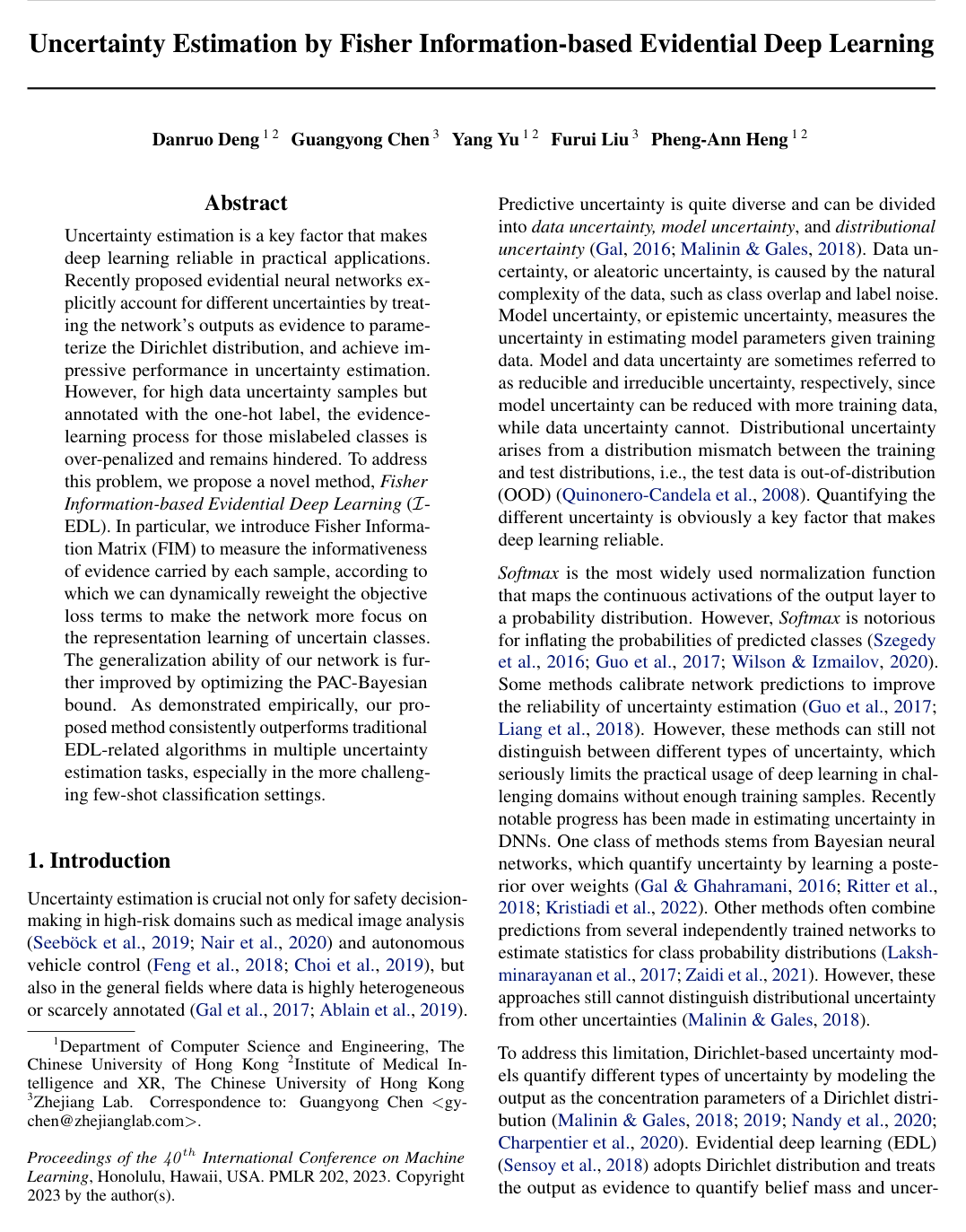
Uncertainty Estimation by Fisher Information-based Evidential Deep Learning
Danruo Deng, Guangyong Chen, Yang Yu, Furui Liu, Pheng-Ann Heng
Why you should read this
Proposes a Fisher Information-based evidential deep learning framework that dynamically reweights loss terms to prevent over-penalizing ambiguous training samples, significantly improving uncertainty quantification and few-shot classification reliability.
Uncertainty estimation is a key factor that makes deep learning reliable in practical applications. Recently proposed evidential neural networks explicitly account for different uncertainties by treating the network’s outputs as evidence to parameterize the Dirichlet distribution, and achieve impressive performance in uncertainty estimation. However, for high data uncertainty samples but annotated with the one-hot label, the evidence-learning process for those mislabeled classes is over-penalized and remains hindered. To address this problem, we propose a novel method, Fisher Information-based Evidential Deep Learning (I-EDL). In particular, we introduce Fisher Information Matrix (FIM) to measure the informativeness of evidence carried by each sample, according to which we can dynamically reweight the objective loss terms to make the network more focus on the representation learning of uncertain classes. The generalization ability of our network is further improved by optimizing the PAC-Bayesian bound. As demonstrated empirically, our proposed method consistently outperforms traditional EDL-related algorithms in multiple uncertainty estimation tasks, especially in the more challenging few-shot classification settings.
Added
2026-09-26
Quantifying Uncertainty in Answers from any Language Model and Enhancing their Trustworthiness
Jiuhai Chen, Jonas Mueller
Why you should read this
Introduces BSDETECTOR, a black-box uncertainty quantification method combining consistency sampling and self-reflection to accurately detect incorrect outputs and select the most reliable answers from any large language model without additional training.
We introduce BSDETECTOR, a method for detecting bad and speculative answers from a pretrained Large Language Model by estimating a numeric confidence score for any output it generated. Our uncertainty quantification technique works for any LLM accessible only via a black-box API, whose training data remains unknown. By expending a bit of extra computation, users of any LLM API can now get the same response as they would ordinarily, as well as a confidence estimate that cautions when not to trust this response. Experiments on both closed and open-form Question-Answer benchmarks reveal that BSDETECTOR more accurately identifies incorrect LLM responses than alternative uncertainty estimation procedures (for both GPT-3 and ChatGPT). By sampling multiple responses from the LLM and considering the one with the highest confidence score, we can additionally obtain more accurate responses from the same LLM, without any extra training steps. In applications involving automated evaluation with LLMs, accounting for our confidence scores leads to more reliable evaluation in both human-in-the-loop and fully-automated settings (across both GPT 3.5 and 4).
Added
2026-09-26
Aleatoric and epistemic uncertainty in machine learning: an introduction to concepts and methods
Eyke Hüllermeier, Willem Waegeman
Why you should read this
Clarifies the critical distinction between irreducible data randomness and reducible model ignorance, providing a comprehensive framework for quantifying both aleatoric and epistemic uncertainty to build safer, more reliable machine learning systems.
The notion of uncertainty is of major importance in machine learning and constitutes a key element of machine learning methodology. In line with the statistical tradition, uncertainty has long been perceived as almost synonymous with standard probability and probabilistic predictions. Yet, due to the steadily increasing relevance of machine learning for practical applications and related issues such as safety requirements, new problems and challenges have recently been identified by machine learning scholars, and these problems may call for new methodological developments. In particular, this includes the importance of distinguishing between (at least) two different types of uncertainty, often referred to as aleatoric and epistemic. In this paper, we provide an introduction to the topic of uncertainty in machine learning as well as an overview of attempts so far at handling uncertainty in general and formalizing this distinction in particular.
Added
2026-09-16
A Review of Uncertainty Quantification in Deep Learning: Techniques, Applications and Challenges
Moloud Abdar, Farhad Pourpanah, Sadiq Hussain, Dana Rezazadegan, Li Liu, Mohammad Ghavamzadeh, Paul Fieguth, Xiaochun Cao, Abbas Khosravi, U. Acharya, Vladimir Makarenkov, Saeid Nahavandi
Why you should read this
Surveys Bayesian approximations, deep ensembles, and non-Bayesian uncertainty quantification techniques across deep learning and reinforcement learning, comparing their practical implementations in computer vision, medical diagnostics, and natural language processing while outlining unresolved research challenges.
Abstract—Uncertainty quantification (UQ) plays a pivotal role in the reduction of uncertainties during both optimization and decision making, applied to solve a variety of real-world applications in science and engineering. Bayesian approximation and ensemble learning techniques are two of the most widely-used UQ methods in the literature. In this regard, researchers have proposed different UQ methods and examined their performance in a variety of applications such as computer vision (e.g., self-driving cars and object detection), image processing (e.g., image restoration), medical image analysis (e.g., medical image classification and segmentation), natural language processing (e.g., text classification, social media texts and recidivism risk-scoring), bioinformatics, etc. This study reviews recent advances in UQ methods used in deep learning, investigates the application of these methods in reinforcement learning, and highlight the fundamental research challenges and directions associated with the UQ field.
Added
2026-09-14
Simple and Scalable Predictive Uncertainty Estimation using Deep Ensembles
Balaji Lakshminarayanan, Alexander Pritzel, Charles Blundell
Why you should read this
Shows how training multiple neural networks with random initialization provides robust predictive uncertainty estimates that scale easily to production environments.
Deep neural networks (NNs) are powerful black box predictors that have recently achieved impressive performance on a wide spectrum of tasks. Quantifying predictive uncertainty in NNs is a challenging and yet unsolved problem. Bayesian NNs, which learn a distribution over weights, are currently the state-of-the-art for estimating predictive uncertainty; however these require significant modifications to the training procedure and are computationally expensive compared to standard (non-Bayesian) NNs. We propose an alternative to Bayesian NNs that is simple to implement, readily parallelizable, requires very little hyperparameter tuning, and yields high quality predictive uncertainty estimates. Through a series of experiments on classification and regression benchmarks, we demonstrate that our method produces well-calibrated uncertainty estimates which are as good or better than approximate Bayesian NNs. To assess robustness to dataset shift, we evaluate the predictive uncertainty on test examples from known and unknown distributions, and show that our method is able to express higher uncertainty on out-of-distribution examples. We demonstrate the scalability of our method by evaluating predictive uncertainty estimates on ImageNet.
Added
2026-03-23
License
Published with permission