
keyword
uncertainty estimation
Uncertainty estimation is the process of quantifying the degree of confidence or doubt associated with a machine learning model's predictions and outputs. Rather than providing only a single definitive answer, systems equipped with uncertainty estimation measure the reliability of their decisions, helping to identify when outputs are likely to be incorrect, ambiguous, or based on data that differs from their training distribution. This capability is critical for safety-sensitive decision-making, misclassification detection, and human-AI collaboration, as it enables models to express calibrated confidence and helps developers distinguish between inherent noise in the input data and limitations in the model's own knowledge. Common techniques for estimating predictive uncertainty include Bayesian neural network approximations, ensemble methods, evidential learning frameworks, and consistency- or probability-based scoring methods.
14 items
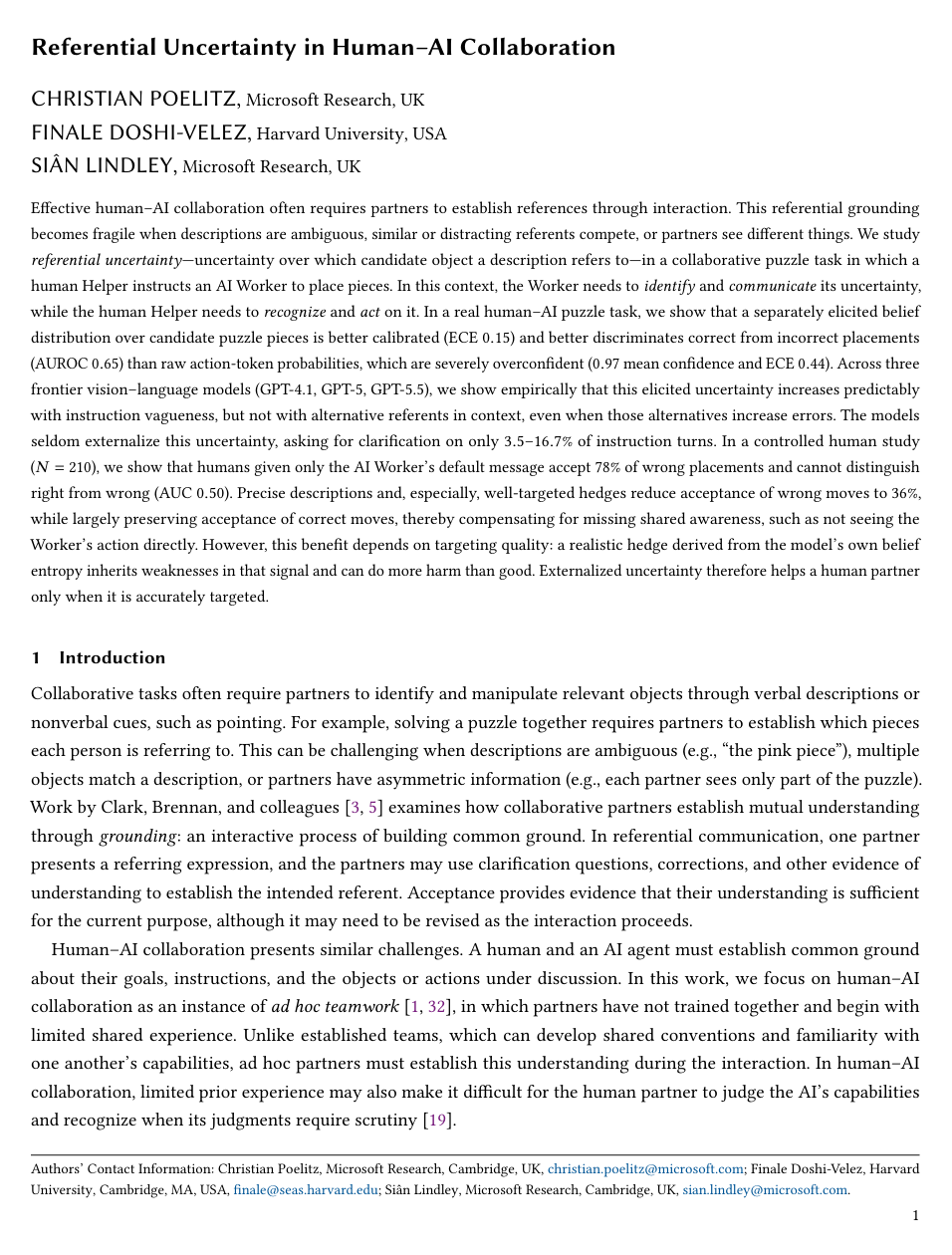
Referential Uncertainty in Human-AI Collaboration
Christian Poelitz, Finale Doshi-Velez, Siân Lindley
Why you should read this
Demonstrates that frontier vision-language models routinely conceal referential ambiguity from human partners, and proves that accurately targeted uncertainty hedges cut human acceptance of AI errors from 78% to 36%.
Effective human-AI collaboration requires partners to establish references through interaction, which becomes fragile when descriptions are ambiguous, similar referents compete, or partners see different things. We study referential uncertainty - uncertainty over which candidate object a description refers to - in a collaborative puzzle task where a human Helper instructs an AI Worker to place pieces. The Worker must identify and communicate its uncertainty, and the Helper must recognize and act on it. We show that a separately elicited belief distribution over candidate pieces is better calibrated (ECE 0.15) and better discriminates correct from incorrect placements (AUROC 0.65) than raw action-token probabilities, which are severely overconfident (0.97 mean confidence, ECE 0.44). Across three frontier vision-language models (GPT-4.1, GPT-5, GPT-5.5), this elicited uncertainty rises predictably with instruction vagueness, but not with competing referents in context, even when those increase errors. The models seldom externalize it, asking for clarification on only 3.5-16.7% of turns. In a controlled human study (N=210), participants given only the Worker's default message accept 78% of wrong placements and cannot tell right from wrong (AUC 0.50). Precise descriptions and, especially, well-targeted hedges cut wrong-move acceptance to 36% while largely preserving correct-move acceptance, compensating for missing shared awareness such as not seeing the Worker's action. But this benefit depends on targeting: a deployable hedge derived from the model's own belief entropy inherits that signal's weakness and can do more harm than good. Externalized uncertainty helps a human partner only when it is accurately targeted.
Added
2026-10-05
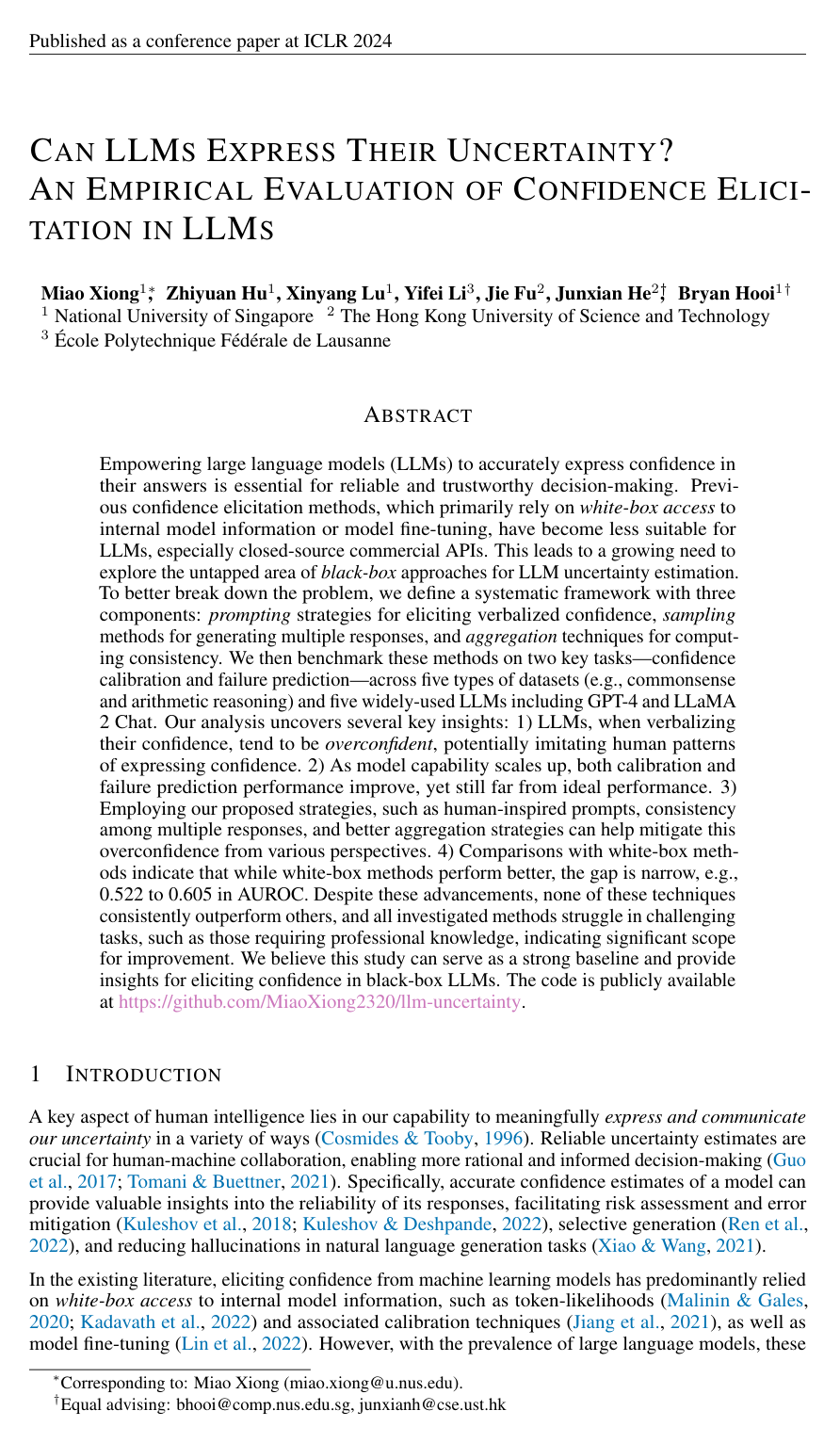
Can LLMs Express Their Uncertainty? An Empirical Evaluation of Confidence Elicitation in LLMs
Miao Xiong, Zhiyuan Hu, Xinyang Lu, Yifei Li, Jie Fu, Junxian He, Bryan Hooi
Why you should read this
Presents a systematic framework for evaluating black-box uncertainty estimation in large language models, showing that verbalized prompting and response consistency can effectively reduce overconfidence to rival white-box calibration methods.
Empowering large language models to accurately express confidence in their answers is essential for trustworthy decision-making. Previous confidence elicitation methods, which primarily rely on white-box access to internal model information or model fine-tuning, have become less suitable for LLMs, especially closed-source commercial APIs. This leads to a growing need to explore the untapped area of black-box approaches for LLM uncertainty estimation. To better break down the problem, we define a systematic framework with three components: prompting strategies for eliciting verbalized confidence, sampling methods for generating multiple responses, and aggregation techniques for computing consistency. We then benchmark these methods on two key tasks-confidence calibration and failure prediction-across five types of datasets (e.g., commonsense and arithmetic reasoning) and five widely-used LLMs including GPT-4 and LLaMA 2 Chat. Our analysis uncovers several key insights: 1) LLMs, when verbalizing their confidence, tend to be overconfident, potentially imitating human patterns of expressing confidence. 2) As model capability scales up, both calibration and failure prediction performance improve. 3) Employing our proposed strategies, such as human-inspired prompts, consistency among multiple responses, and better aggregation strategies can help mitigate this overconfidence from various perspectives. 4) Comparisons with white-box methods indicate that while white-box methods perform better, the gap is narrow, e.g., 0.522 to 0.605 in AUROC. Despite these advancements, none of these techniques consistently outperform others, and all investigated methods struggle in challenging tasks, such as those requiring professional knowledge, indicating significant scope for improvement. We believe this study can serve as a strong baseline and provide insights for eliciting confidence in black-box LLMs.
Added
2026-10-04
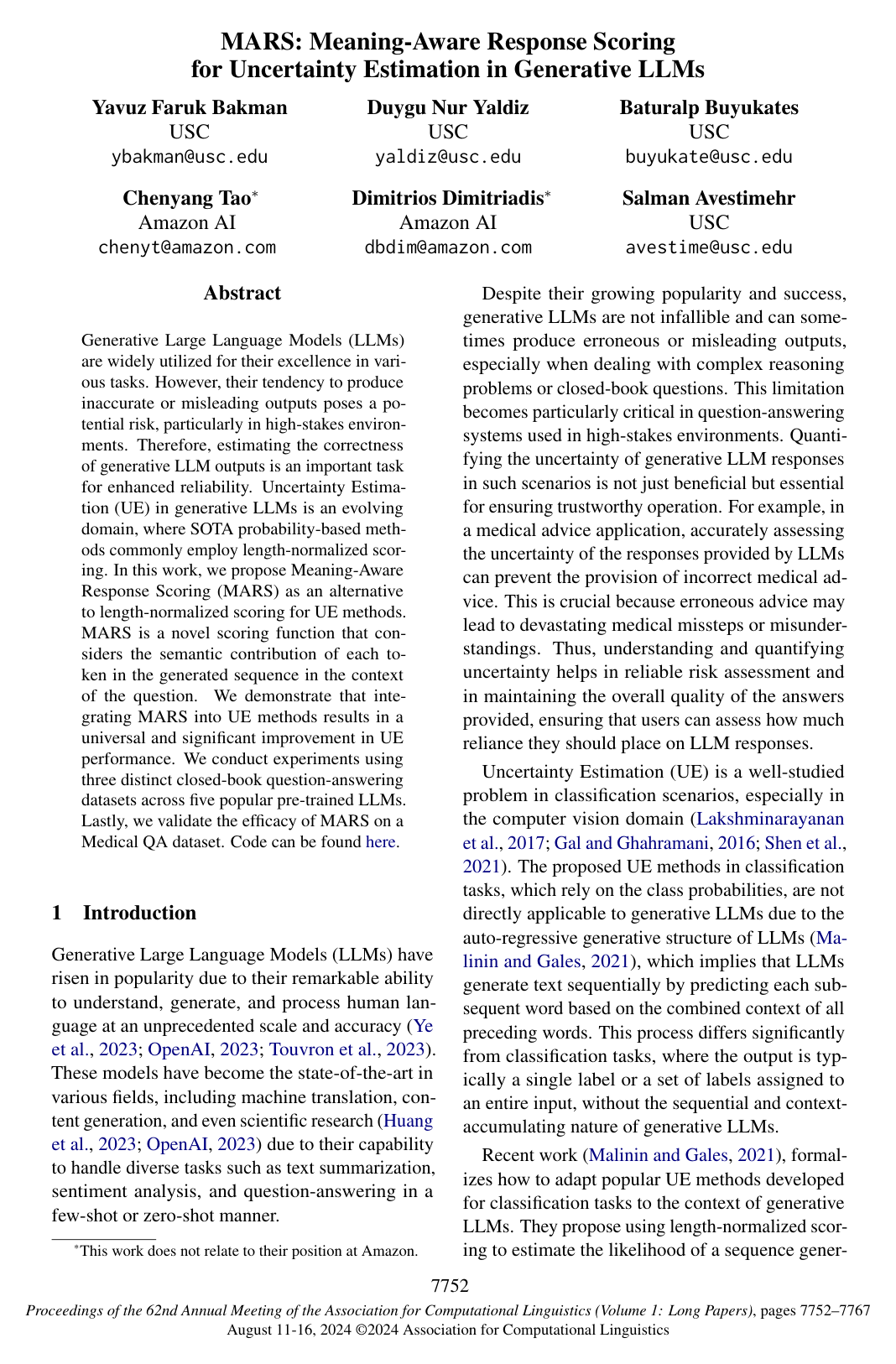
MARS: Meaning-Aware Response Scoring for Uncertainty Estimation in Generative LLMs
Yavuz Faruk Bakman, Duygu Nur Yaldiz, Baturalp Buyukates, Chenyang Tao, Dimitrios Dimitriadis, Salman Avestimehr
Why you should read this
Presents Meaning-Aware Response Scoring (MARS), a framework that weights each token by its semantic contribution to the answer rather than applying uniform length normalization, substantially improving uncertainty estimation and error detection across multiple large language models and question-answering benchmarks.
Generative Large Language Models (LLMs) are widely utilized for their excellence in various tasks. However, their tendency to produce inaccurate or misleading outputs poses a potential risk, particularly in high-stakes environments. Therefore, estimating the correctness of generative LLM outputs is an important task for enhanced reliability. Uncertainty Estimation (UE) in generative LLMs is an evolving domain, where SOTA probability-based methods commonly employ length-normalized scoring. In this work, we propose Meaning-Aware Response Scoring (MARS) as an alternative to length-normalized scoring for UE methods. MARS is a novel scoring function that considers the semantic contribution of each token in the generated sequence in the context of the question. We demonstrate that integrating MARS into UE methods results in a universal and significant improvement in UE performance. We conduct experiments using three distinct closed-book question-answering datasets across five popular pre-trained LLMs. Lastly, we validate the efficacy of MARS on a Medical QA dataset. Code can be found here.
Added
2026-10-04
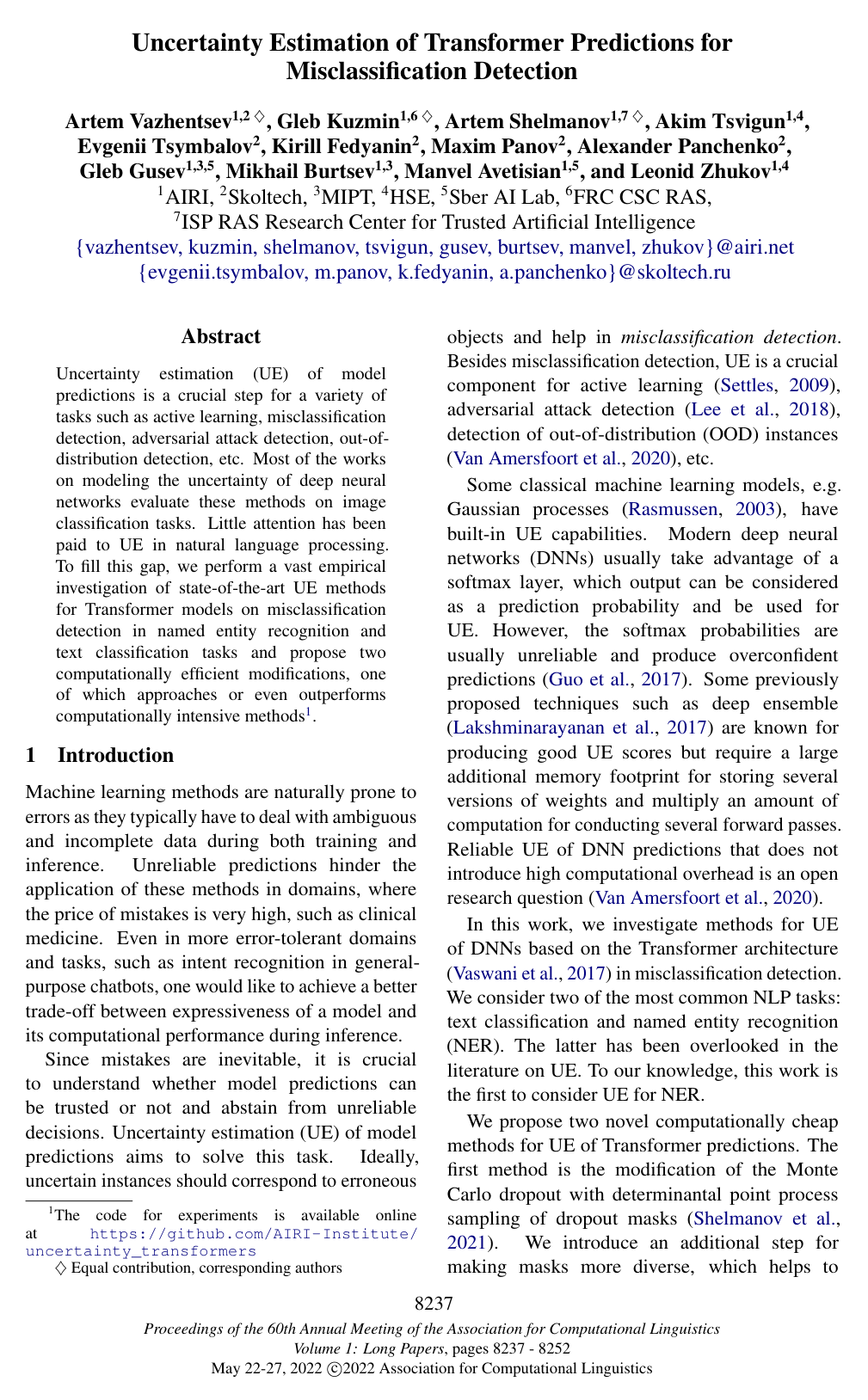
Uncertainty Estimation of Transformer Predictions for Misclassification Detection
Artem Vazhentsev, Gleb Kuzmin, Artem Shelmanov, Akim Tsvigun, Evgenii Tsymbalov, Kirill Fedyanin, Maxim Panov, Alexander Panchenko, Gleb Gusev, Mikhail Burtsev, Manvel Avetisian, Leonid Zhukov
Why you should read this
Develops computationally efficient uncertainty estimation methods for Transformer models in text classification and named entity recognition, demonstrating that a spectral-normalized Mahalanobis distance approach can rival or exceed heavy deep ensembles at detecting misclassifications.
Uncertainty estimation (UE) of model predictions is a crucial step for a variety of tasks such as active learning, misclassification detection, adversarial attack detection, out-of-distribution detection, etc. Most of the works on modeling the uncertainty of deep neural networks evaluate these methods on image classification tasks. Little attention has been paid to UE in natural language processing. To fill this gap, we perform a vast empirical investigation of state-of-the-art UE methods for Transformer models on misclassification detection in named entity recognition and text classification tasks and propose two computationally efficient modifications, one of which approaches or even outperforms computationally intensive methods1.
Added
2026-10-03
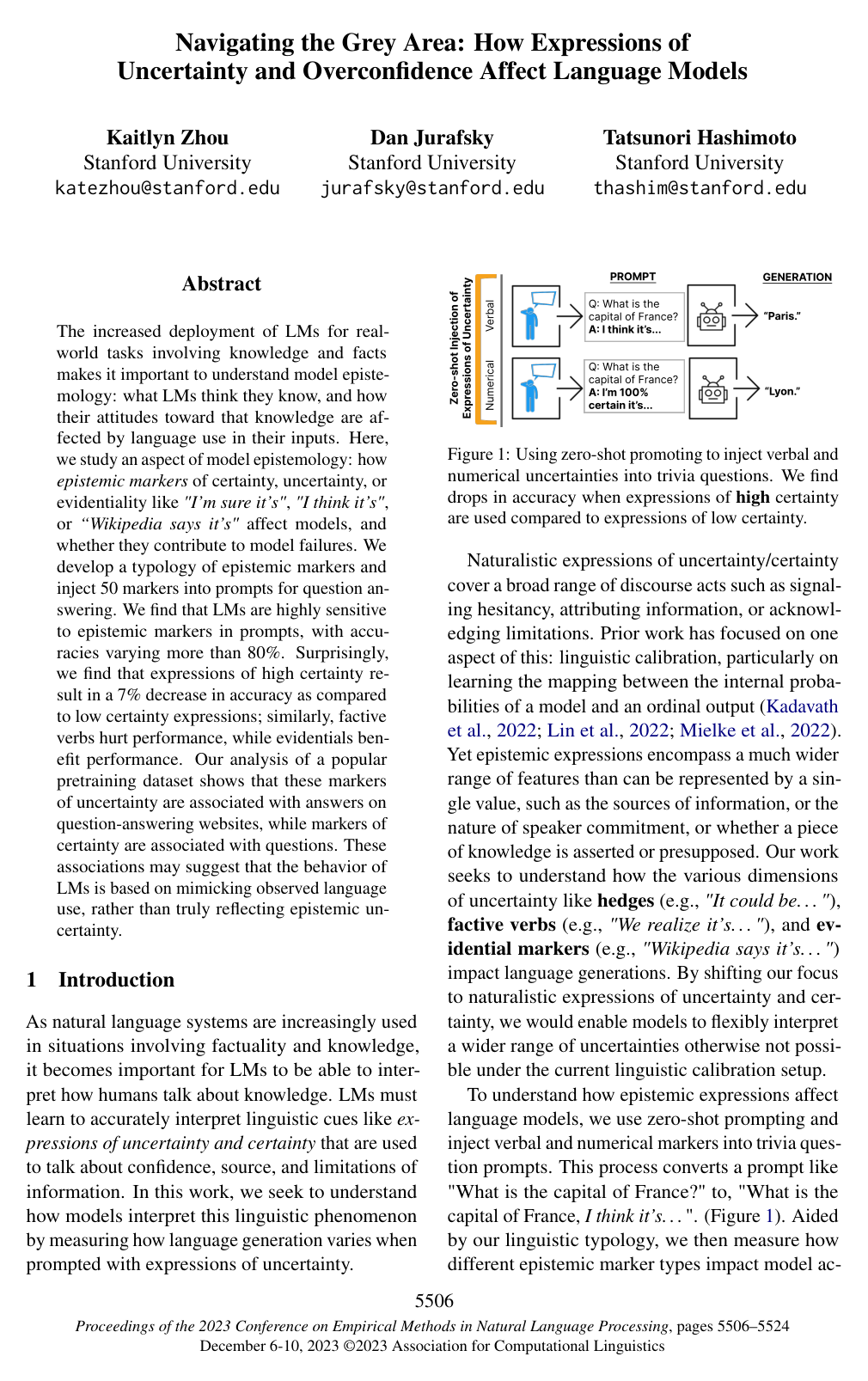
Navigating the Grey Area: How Expressions of Uncertainty and Overconfidence Affect Language Models
Kaitlyn Zhou, Dan Jurafsky, Tatsunori Hashimoto
Why you should read this
Reveals that prompt expressions of high confidence paradoxically degrade language model accuracy by up to seven percent compared to expressions of uncertainty, exposing how pretraining data patterns cause models to mimic surface linguistic habits rather than genuinely track factual truth.
The increased deployment of LMs for real-world tasks involving knowledge and facts makes it important to understand model epistemology: what LMs think they know, and how their attitudes toward that knowledge are affected by language use in their inputs. Here, we study an aspect of model epistemology: how epistemic markers of certainty, uncertainty, or evidentiality like "I'm sure it's", "I think it's", or "Wikipedia says it's" affect models, and whether they contribute to model failures. We develop a typology of epistemic markers and inject 50 markers into prompts for question answering. We find that LMs are highly sensitive to epistemic markers in prompts, with accuracies varying more than 80%. Surprisingly, we find that expressions of high certainty result in a 7% decrease in accuracy as compared to low certainty expressions; similarly, factive verbs hurt performance, while evidentials benefit performance. Our analysis of a popular pretraining dataset shows that these markers of uncertainty are associated with answers on question-answering websites, while markers of certainty are associated with questions. These associations may suggest that the behavior of LMs is based on mimicking observed language use, rather than truly reflecting epistemic uncertainty.
Added
2026-10-01
Inducing Artificial Uncertainty in Language Models
Sophia Hager, Simon Zeng, Nicholas Andrews
Why you should read this
Demonstrates that training uncertainty probes on artificially induced uncertainty in language models significantly improves confidence calibration on difficult tasks where naturally challenging training data is scarce.
In safety-critical applications, language models should be able to characterize their uncertainty with meaningful probabilities. Many uncertainty quantification approaches require supervised data; however, finding suitable unseen challenging data is increasingly difficult for large language models trained on vast amounts of scraped data. If the model is consistently (and correctly) confident in its predictions, the uncertainty quantification method may consistently overestimate confidence on new and unfamiliar data. Finding data which exhibits enough uncertainty to train supervised uncertainty quantification methods for high-performance models may therefore be challenging, and will increase in difficulty as LLMs saturate datasets. To address this issue, we first introduce the problem of inducing artificial uncertainty in language models, then investigate methods of inducing artificial uncertainty on trivially easy data in the absence of challenging data at training time. We use probes trained to recognize artificial uncertainty on the original model, and find that these probes trained on artificial uncertainty outperform probes trained without artificial uncertainty in recognizing real uncertainty, achieving notably higher calibration on hard data with minimal loss of performance on easy data.
Added
2026-09-29
Uncertainty Estimation by Fisher Information-based Evidential Deep Learning
Danruo Deng, Guangyong Chen, Yang Yu, Furui Liu, Pheng-Ann Heng
Why you should read this
Proposes a Fisher Information-based evidential deep learning framework that dynamically reweights loss terms to prevent over-penalizing ambiguous training samples, significantly improving uncertainty quantification and few-shot classification reliability.
Uncertainty estimation is a key factor that makes deep learning reliable in practical applications. Recently proposed evidential neural networks explicitly account for different uncertainties by treating the network’s outputs as evidence to parameterize the Dirichlet distribution, and achieve impressive performance in uncertainty estimation. However, for high data uncertainty samples but annotated with the one-hot label, the evidence-learning process for those mislabeled classes is over-penalized and remains hindered. To address this problem, we propose a novel method, Fisher Information-based Evidential Deep Learning (I-EDL). In particular, we introduce Fisher Information Matrix (FIM) to measure the informativeness of evidence carried by each sample, according to which we can dynamically reweight the objective loss terms to make the network more focus on the representation learning of uncertain classes. The generalization ability of our network is further improved by optimizing the PAC-Bayesian bound. As demonstrated empirically, our proposed method consistently outperforms traditional EDL-related algorithms in multiple uncertainty estimation tasks, especially in the more challenging few-shot classification settings.
Added
2026-09-26
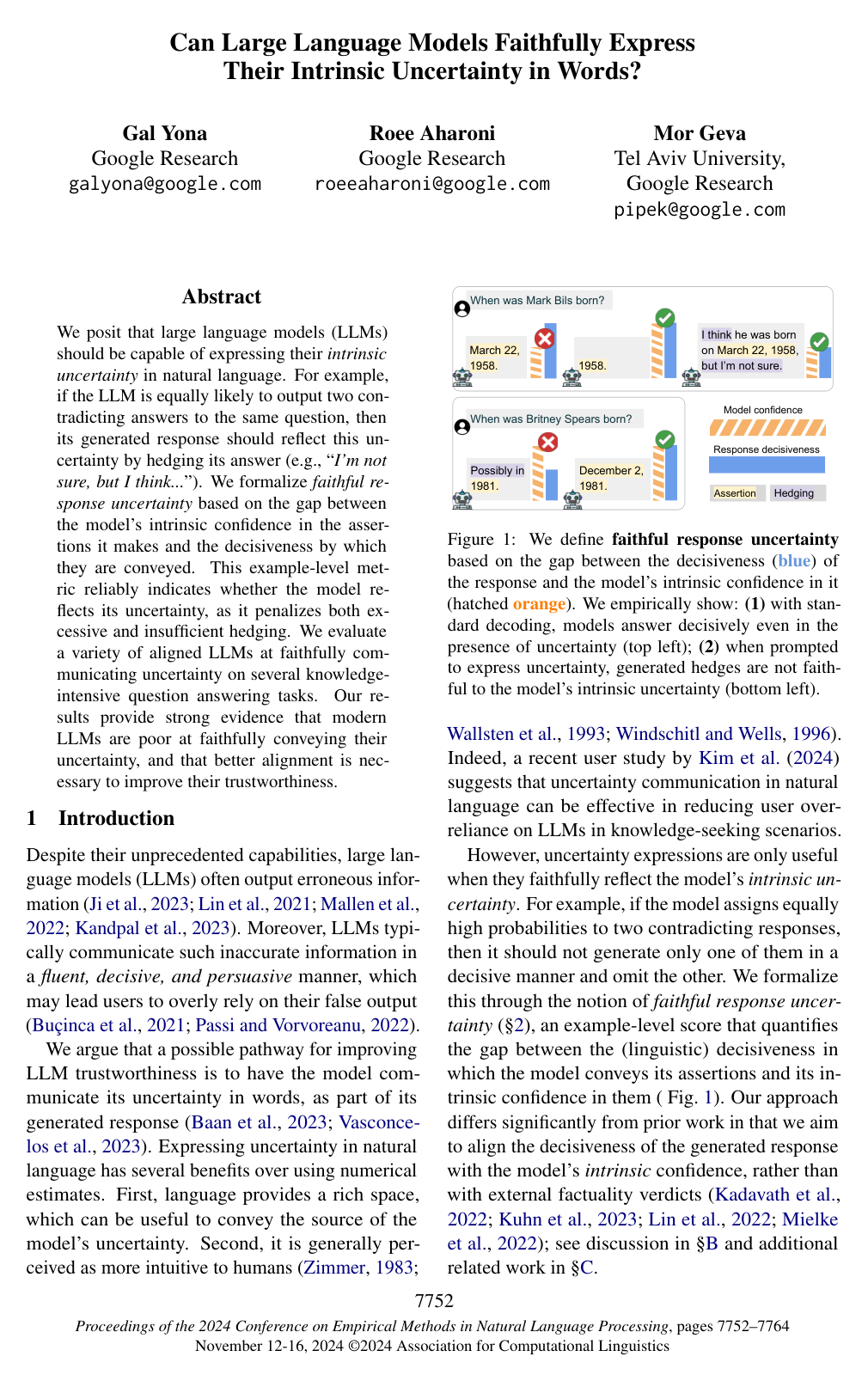
Can Large Language Models Faithfully Express Their Intrinsic Uncertainty in Words?
Gal Yona, Roee Aharoni, Mor Geva
Why you should read this
Reveals that leading large language models consistently fail to faithfully communicate their intrinsic confidence in natural language, exposing critical limitations in how models express certainty and hedge their answers on knowledge-intensive tasks.
We posit that large language models (LLMs) should be capable of expressing their intrinsic uncertainty in natural language. For example, if the LLM is equally likely to output two contradicting answers to the same question, then its generated response should reflect this uncertainty by hedging its answer (e.g., “I’m not sure, but I think…”). We formalize faithful response uncertainty based on the gap between the model’s intrinsic confidence in the assertions it makes and the decisiveness by which they are conveyed. This example-level metric reliably indicates whether the model reflects its uncertainty, as it penalizes both excessive and insufficient hedging. We evaluate a variety of aligned LLMs at faithfully communicating uncertainty on several knowledge-intensive question answering tasks. Our results provide strong evidence that modern LLMs are poor at faithfully conveying their uncertainty, and that better alignment is necessary to improve their trustworthiness.
Added
2026-09-26
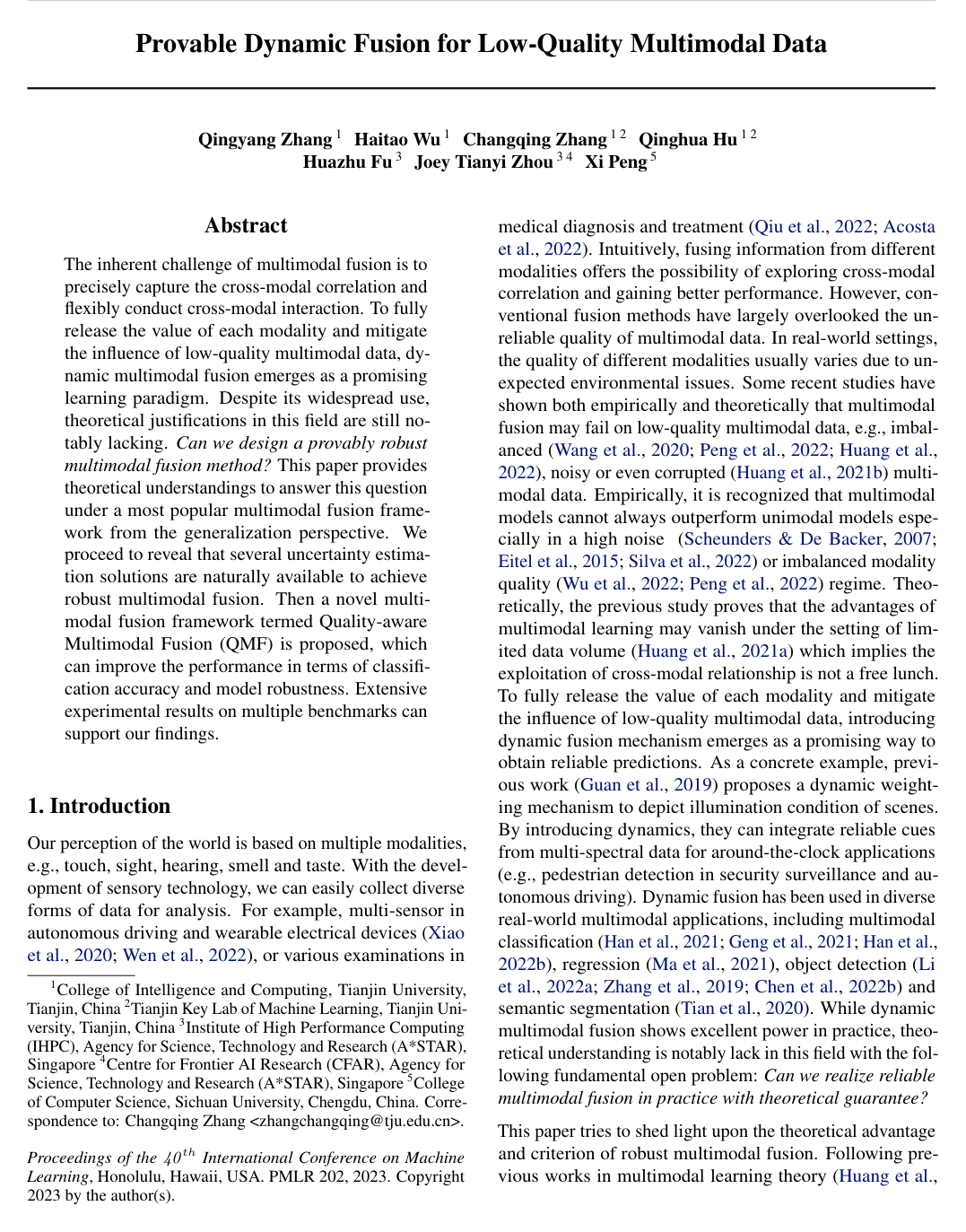
Provable Dynamic Fusion for Low-Quality Multimodal Data
Qingyang Zhang, Haitao Wu, Changqing Zhang, Qinghua Hu, Huazhu Fu, Joey Tianyi Zhou, Xi Peng
Why you should read this
Establishes theoretical generalization bounds for dynamic decision-level multimodal integration and introduces Quality-aware Multimodal Fusion to prevent performance degradation on noisy and low-quality inputs.
The inherent challenge of multimodal fusion is to precisely capture the cross-modal correlation and flexibly conduct cross-modal interaction. To fully release the value of each modality and mitigate the influence of low-quality multimodal data, dynamic multimodal fusion emerges as a promising learning paradigm. Despite its widespread use, theoretical justifications in this field are still notably lacking. Can we design a provably robust multimodal fusion method? This paper provides theoretical understandings to answer this question under a most popular multimodal fusion framework from the generalization perspective. We proceed to reveal that several uncertainty estimation solutions are naturally available to achieve robust multimodal fusion. Then a novel multimodal fusion framework termed Quality-aware Multimodal Fusion (QMF) is proposed, which can improve the performance in terms of classification accuracy and model robustness. Extensive experimental results on multiple benchmarks can support our findings.
Added
2026-09-26
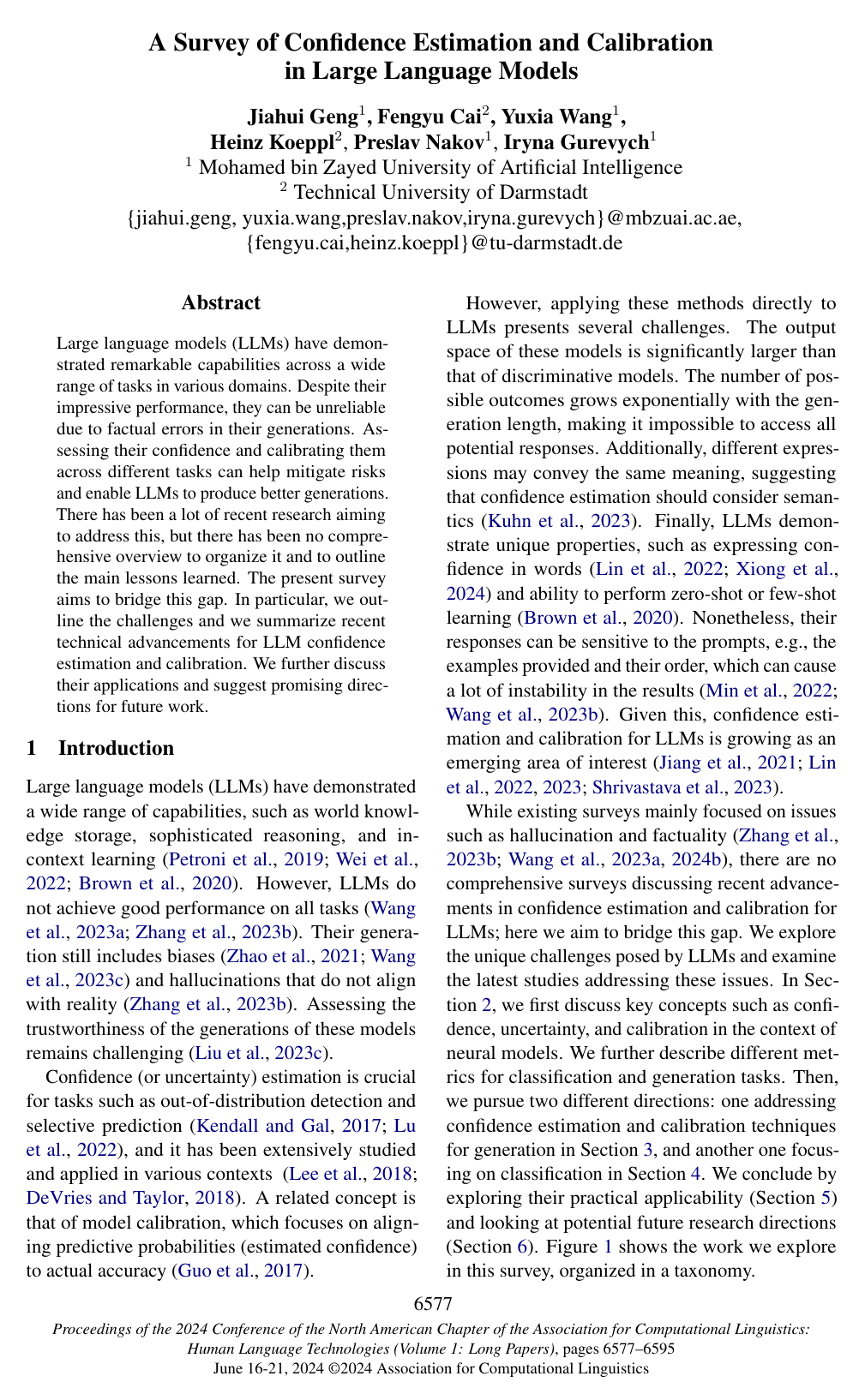
A Survey of Confidence Estimation and Calibration in Large Language Models
Jiahui Geng, Fengyu Cai, Yuxia Wang, Heinz Koeppl, Preslav Nakov, Iryna Gurevych
Why you should read this
Presents a structured taxonomy of methods, metrics, and applications for estimating and calibrating large language model confidence to mitigate factual errors and improve generation reliability.
Large language models (LLMs) have demonstrated remarkable capabilities across a wide range of tasks in various domains. Despite their impressive performance, they can be unreliable due to factual errors in their generations. Assessing their confidence and calibrating them across different tasks can help mitigate risks and enable LLMs to produce better generations. There has been a lot of recent research aiming to address this, but there has been no comprehensive overview to organize it and to outline the main lessons learned. The present survey aims to bridge this gap. In particular, we outline the challenges and we summarize recent technical advancements for LLM confidence estimation and calibration. We further discuss their applications and suggest promising directions for future work.
Added
2026-09-26
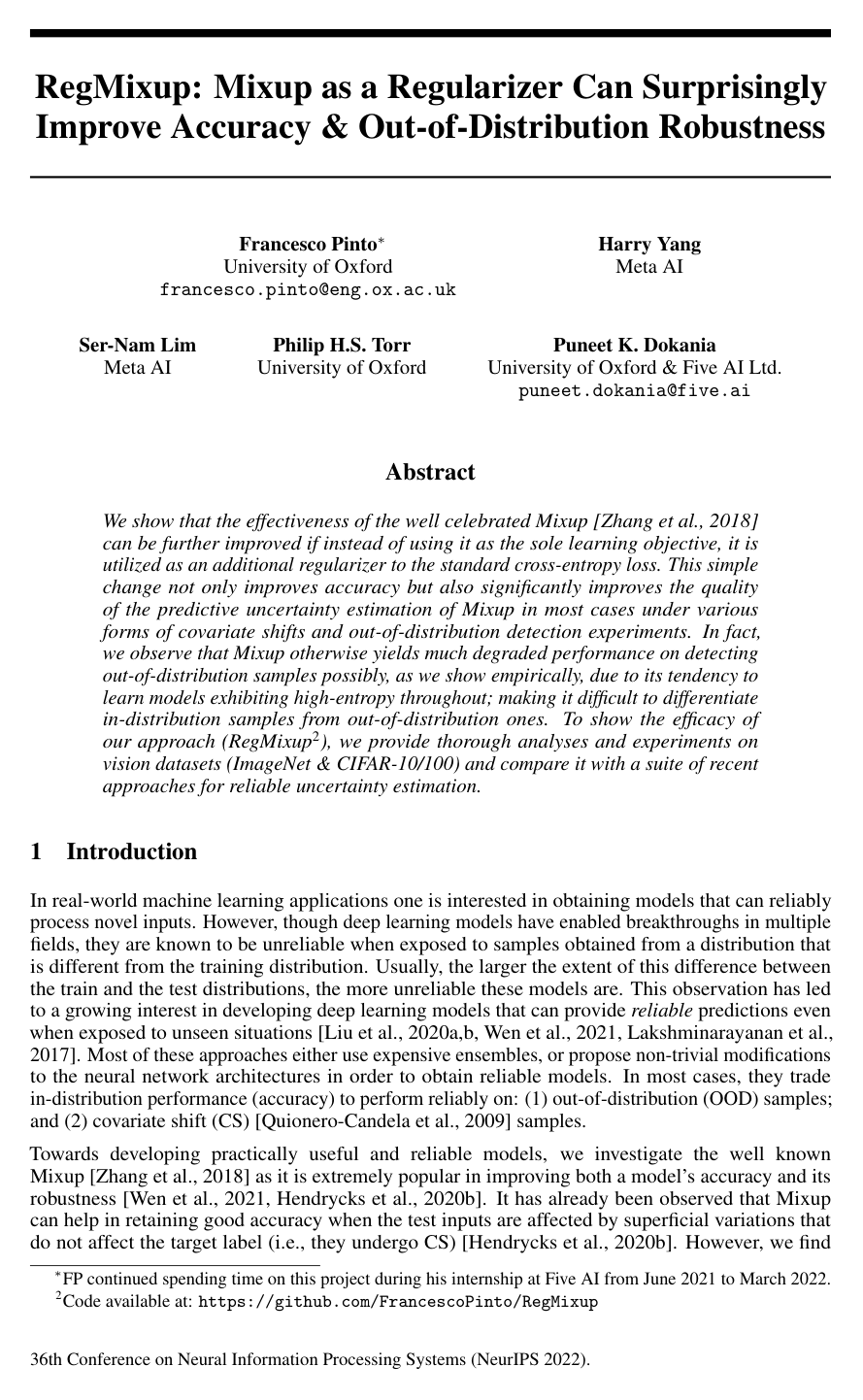
Using Mixup as a Regularizer Can Surprisingly Improve Accuracy & Out-of-Distribution Robustness
Francesco Pinto, Harry Yang, Ser Nam Lim, Philip H. S. Torr, Puneet K. Dokania
Why you should read this
Proposes RegMixup, a simple modification that applies Mixup as an auxiliary regularizer alongside standard cross-entropy loss rather than as a standalone objective, substantially improving classification accuracy and out-of-distribution detection without requiring architectural changes or costly ensembles.
We show that the effectiveness of the well celebrated Mixup [Zhang et al., 2018] can be further improved if instead of using it as the sole learning objective, it is utilized as an additional regularizer to the standard cross-entropy loss. This simple change not only improves accuracy but also significantly improves the quality of the predictive uncertainty estimation of Mixup in most cases under various forms of covariate shifts and out-of-distribution detection experiments. In fact, we observe that Mixup otherwise yields much degraded performance on detecting out-of-distribution samples possibly, as we show empirically, due to its tendency to learn models exhibiting high-entropy throughout; making it difficult to differentiate in-distribution samples from out-of-distribution ones. To show the efficacy of our approach (RegMixup²), we provide thorough analyses and experiments on vision datasets (ImageNet & CIFAR-10/100) and compare it with a suite of recent approaches for reliable uncertainty estimation.
Added
2026-09-26
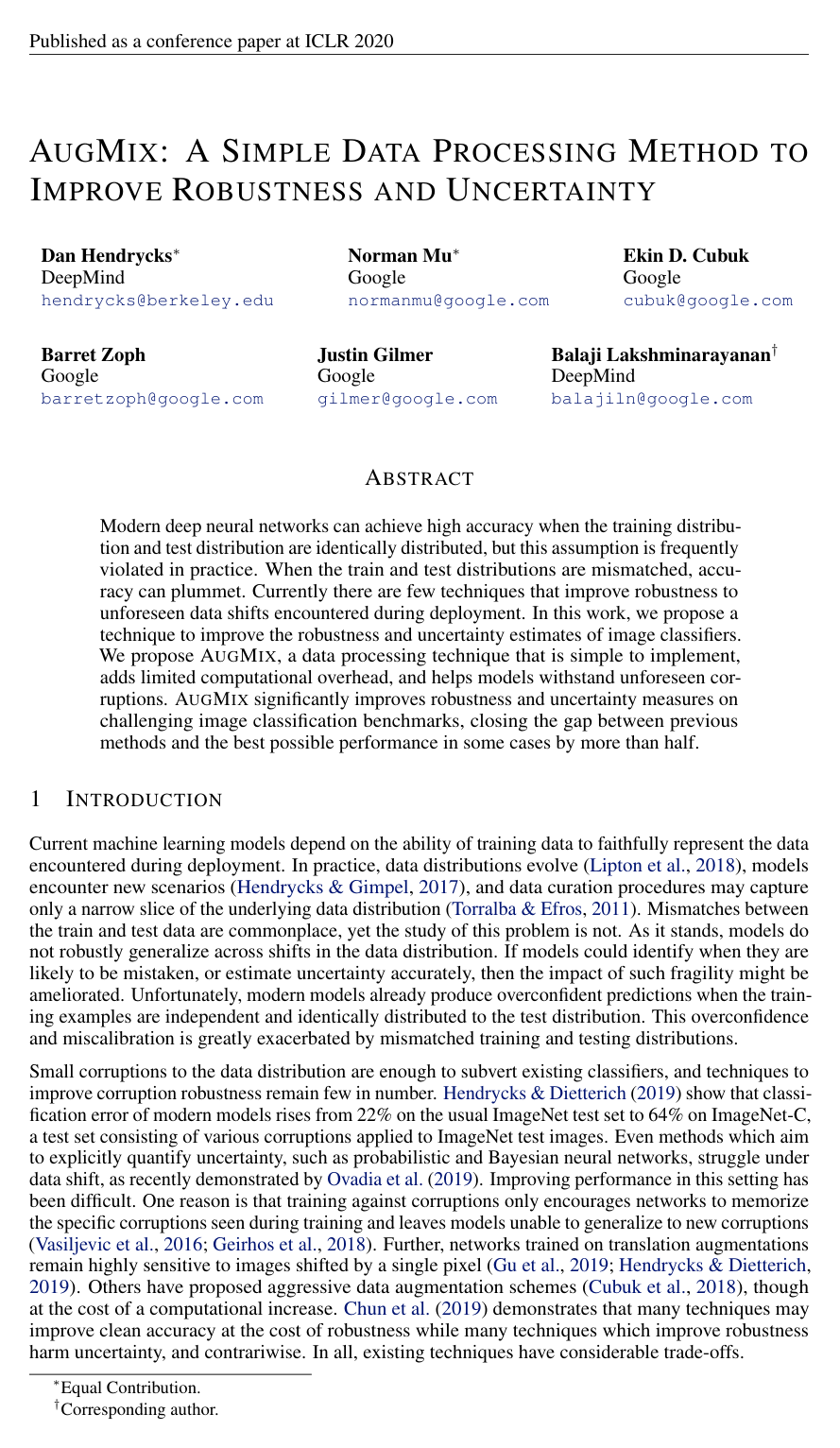
AugMix: A Simple Data Processing Method to Improve Robustness and Uncertainty
Dan Hendrycks, Norman Mu, Ekin D. Cubuk, Barret Zoph, Justin Gilmer, Balaji Lakshminarayanan
Why you should read this
Presents AugMix, a computationally lightweight data augmentation technique that mixes diverse image transformations to help vision models withstand unforeseen corruptions and produce more reliable uncertainty estimates.
Modern deep neural networks can achieve high accuracy when the training distribution and test distribution are identically distributed, but this assumption is frequently violated in practice. When the train and test distributions are mismatched, accuracy can plummet. Currently there are few techniques that improve robustness to unforeseen data shifts encountered during deployment. In this work, we propose a technique to improve the robustness and uncertainty estimates of image classifiers. We propose AugMix, a data processing technique that is simple to implement, adds limited computational overhead, and helps models withstand unforeseen corruptions. AugMix significantly improves robustness and uncertainty measures on challenging image classification benchmarks, closing the gap between previous methods and the best possible performance in some cases by more than half.
Added
2026-09-24
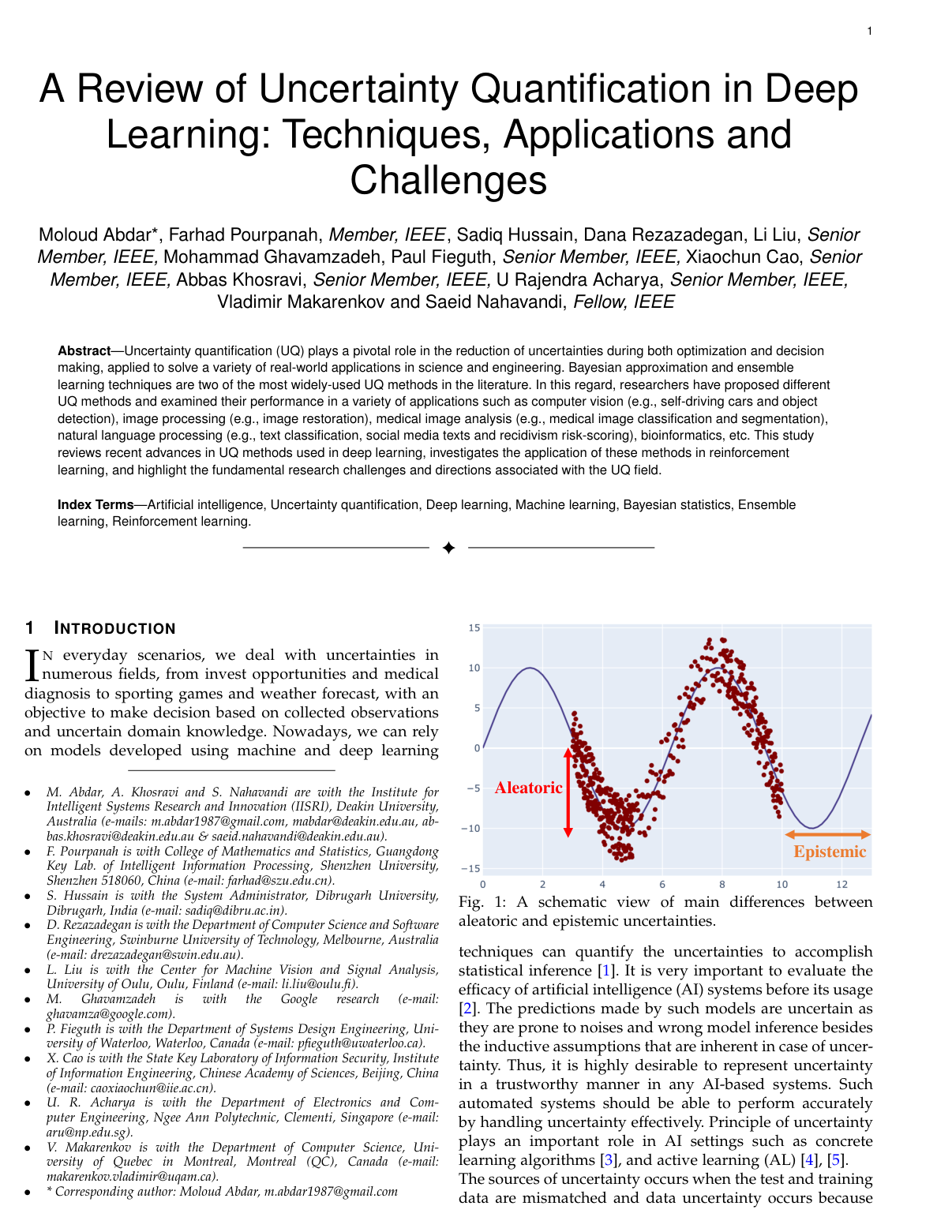
A Review of Uncertainty Quantification in Deep Learning: Techniques, Applications and Challenges
Moloud Abdar, Farhad Pourpanah, Sadiq Hussain, Dana Rezazadegan, Li Liu, Mohammad Ghavamzadeh, Paul Fieguth, Xiaochun Cao, Abbas Khosravi, U. Acharya, Vladimir Makarenkov, Saeid Nahavandi
Why you should read this
Surveys Bayesian approximations, deep ensembles, and non-Bayesian uncertainty quantification techniques across deep learning and reinforcement learning, comparing their practical implementations in computer vision, medical diagnostics, and natural language processing while outlining unresolved research challenges.
Abstract—Uncertainty quantification (UQ) plays a pivotal role in the reduction of uncertainties during both optimization and decision making, applied to solve a variety of real-world applications in science and engineering. Bayesian approximation and ensemble learning techniques are two of the most widely-used UQ methods in the literature. In this regard, researchers have proposed different UQ methods and examined their performance in a variety of applications such as computer vision (e.g., self-driving cars and object detection), image processing (e.g., image restoration), medical image analysis (e.g., medical image classification and segmentation), natural language processing (e.g., text classification, social media texts and recidivism risk-scoring), bioinformatics, etc. This study reviews recent advances in UQ methods used in deep learning, investigates the application of these methods in reinforcement learning, and highlight the fundamental research challenges and directions associated with the UQ field.
Added
2026-09-14
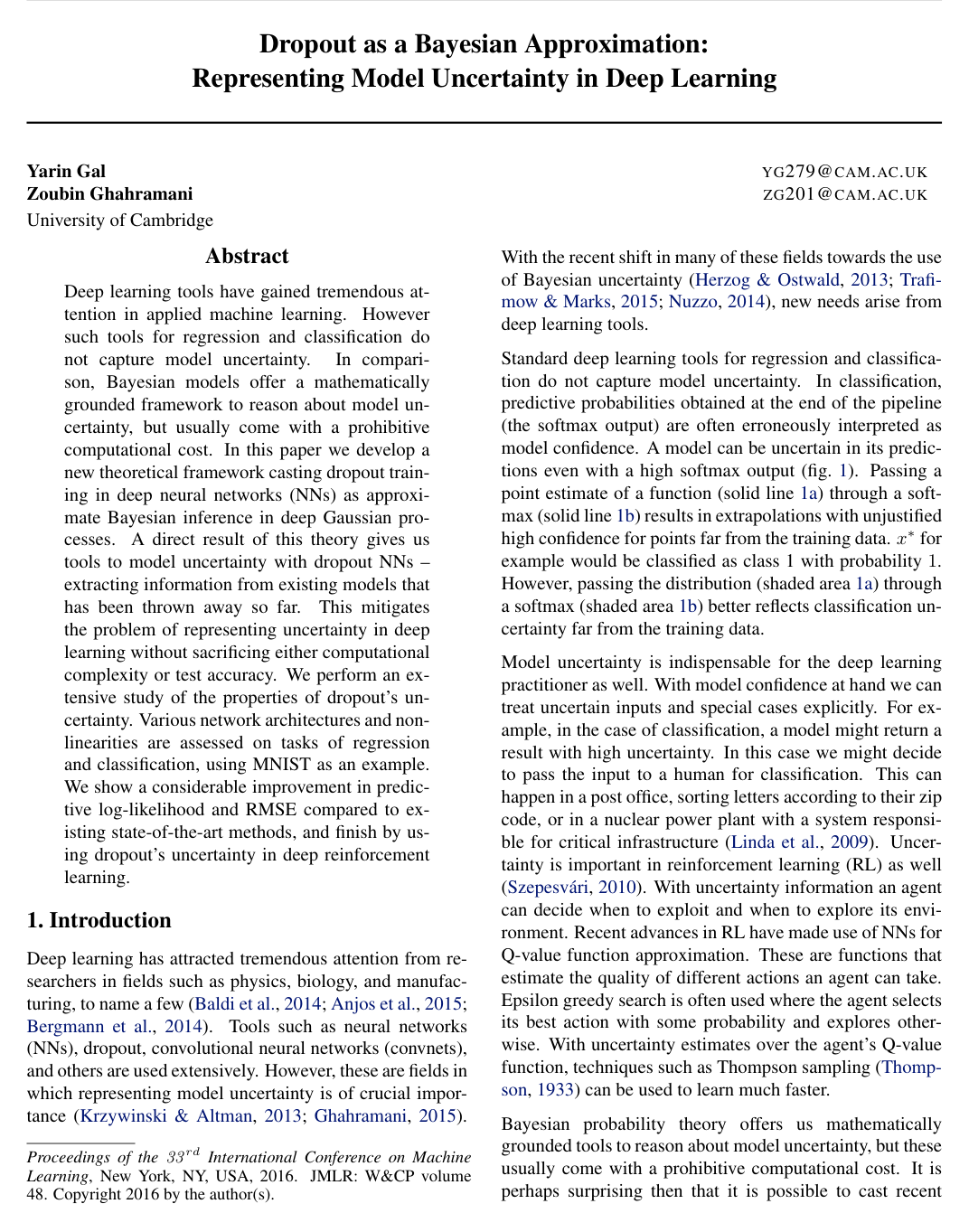
Dropout as a Bayesian Approximation: Representing Model Uncertainty in Deep Learning
Yarin Gal, Zoubin Ghahramani
Why you should read this
Establishes a novel theoretical framework that transforms dropout training into approximate Bayesian inference within deep Gaussian processes, enabling deep neural networks to quantify model uncertainty without compromising computational efficiency or test accuracy.
Deep learning tools have gained tremendous attention in applied machine learning. However such tools for regression and classification do not capture model uncertainty. In comparison, Bayesian models offer a mathematically grounded framework to reason about model uncertainty, but usually come with a prohibitive computational cost. In this paper we develop a new theoretical framework casting dropout training in deep neural networks (NNs) as approximate Bayesian inference in deep Gaussian processes. A direct result of this theory gives us tools to model uncertainty with dropout NNs -- extracting information from existing models that has been thrown away so far. This mitigates the problem of representing uncertainty in deep learning without sacrificing either computational complexity or test accuracy. We perform an extensive study of the properties of dropout's uncertainty. Various network architectures and non-linearities are assessed on tasks of regression and classification, using MNIST as an example. We show a considerable improvement in predictive log-likelihood and RMSE compared to existing state-of-the-art methods, and finish by using dropout's uncertainty in deep reinforcement learning.
Added
2026-04-27
