
keyword
uncertainty decomposition
Uncertainty decomposition is the process of separating the total predictive uncertainty of a statistical or machine learning model into distinct components, primarily aleatoric uncertainty and epistemic uncertainty. Aleatoric uncertainty reflects the inherent randomness, noise, or ambiguity in the data-generating process, representing a baseline of variability that cannot be eliminated simply by collecting more training observations. In contrast, epistemic uncertainty arises from the model's lack of knowledge or limited training coverage, which can theoretically be reduced through additional data, improved parameter estimation, or better architectural design. Distinguishing between these sources allows practitioners to evaluate model trustworthiness, interpret predictions more effectively, and determine whether performance shortfalls should be addressed by gathering more data or by refining the model.
2 items
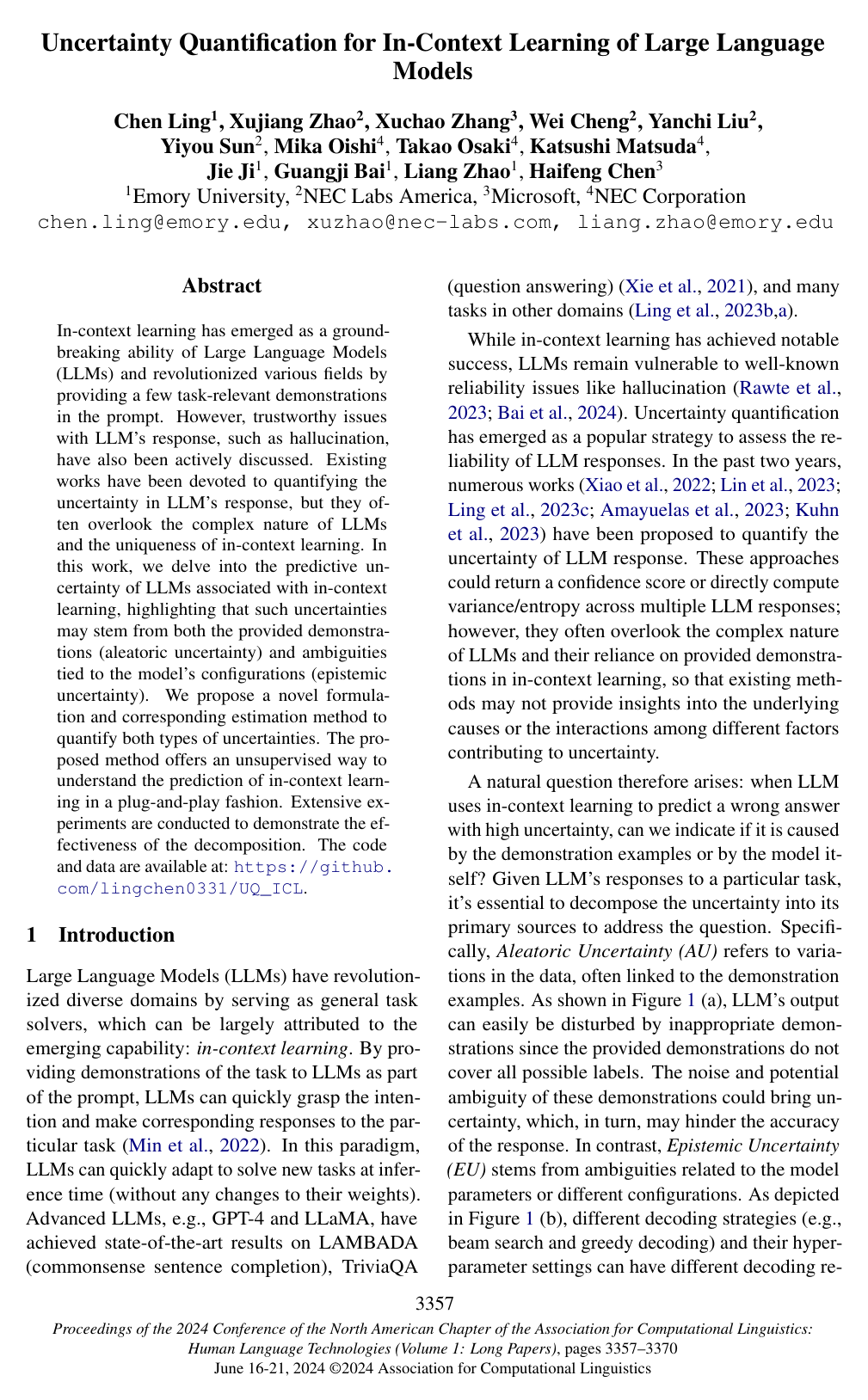
Uncertainty Quantification for In-Context Learning of Large Language Models
Chen Ling, Xujiang Zhao, Xuchao Zhang, Wei Cheng, Yanchi Liu, Yiyou Sun, Mika Oishi, Takao Osaki, Katsushi Matsuda, Jie Ji, Guangji Bai, Liang Zhao, Haifeng Chen
Why you should read this
Presents a Bayesian framework that decomposes predictive uncertainty in large language model in-context learning into prompt-induced aleatoric and model-induced epistemic components, enabling unsupervised diagnostic evaluation of output reliability across both white-box and black-box settings.
In-context learning has emerged as a ground-breaking ability of Large Language Models (LLMs) and revolutionized various fields by providing a few task-relevant demonstrations in the prompt. However, trustworthy issues with LLM’s response, such as hallucination, have also been actively discussed. Existing works have been devoted to quantifying the uncertainty in LLM’s response, but they often overlook the complex nature of LLMs and the uniqueness of in-context learning. In this work, we delve into the predictive uncertainty of LLMs associated with in-context learning, highlighting that such uncertainties may stem from both the provided demonstrations (aleatoric uncertainty) and ambiguities tied to the model’s configurations (epistemic uncertainty). We propose a novel formulation and corresponding estimation method to quantify both types of uncertainties. The proposed method offers an unsupervised way to understand the prediction of in-context learning in a plug-and-play fashion. Extensive experiments are conducted to demonstrate the effectiveness of the decomposition. The code and data are available at: https://github.com/lingchen0331/UQ_ICL.
Added
2026-10-03
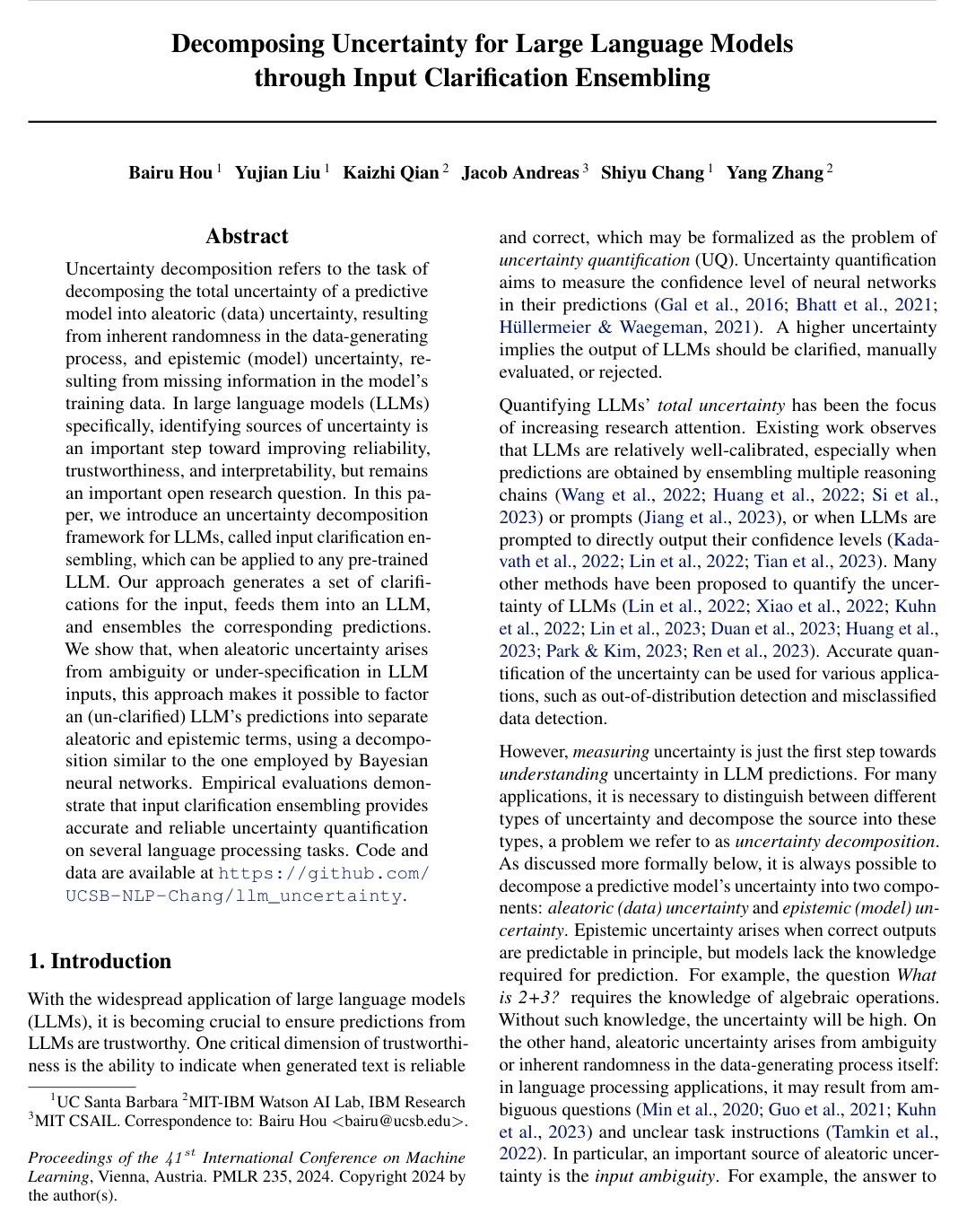
Decomposing Uncertainty for Large Language Models through Input Clarification Ensembling
Bairu Hou, Yujian Liu, Kaizhi Qian, Jacob Andreas, Shiyu Chang, Yang Zhang
Why you should read this
Proposes input clarification ensembling, a practical framework that separates large language model uncertainty into input ambiguity and model knowledge deficits without modifying model parameters or training procedures.
Uncertainty decomposition refers to the task of decomposing the total uncertainty of a predictive model into aleatoric (data) uncertainty, resulting from inherent randomness in the data-generating process, and epistemic (model) uncertainty, resulting from missing information in the model’s training data. In large language models (LLMs) specifically, identifying sources of uncertainty is an important step toward improving reliability, trustworthiness, and interpretability, but remains an important open research question. In this paper, we introduce an uncertainty decomposition framework for LLMs, called input clarification ensembling, which can be applied to any pre-trained LLM. Our approach generates a set of clarifications for the input, feeds them into an LLM, and ensembles the corresponding predictions. We show that, when aleatoric uncertainty arises from ambiguity or under-specification in LLM inputs, this approach makes it possible to factor an (un-clarified) LLM’s predictions into separate aleatoric and epistemic terms, using a decomposition similar to the one employed by Bayesian neural networks. Empirical evaluations demonstrate that input clarification ensembling provides accurate and reliable uncertainty quantification on several language processing tasks. Code and data are available at https://github.com/UCSB-NLP-Chang/llm_uncertainty.
Added
2026-10-01