
keyword
Transformer models
A Transformer model is a deep neural network architecture that processes sequential and contextual data by using self-attention mechanisms to evaluate the relationships between all elements in an input sequence simultaneously. Unlike traditional recurrent neural networks that analyze data step by step, Transformers process entire sequences in parallel, using multi-head attention, layer normalization, feedforward networks, and positional encodings to model long-range dependencies efficiently. Originally developed for natural language processing tasks such as machine translation and text generation, the architecture has become a foundational framework across artificial intelligence, widely applied to computer vision, reinforcement learning, time series analysis, and large generative language models due to its high computational scalability and capacity for transfer and in-context learning.
13 items
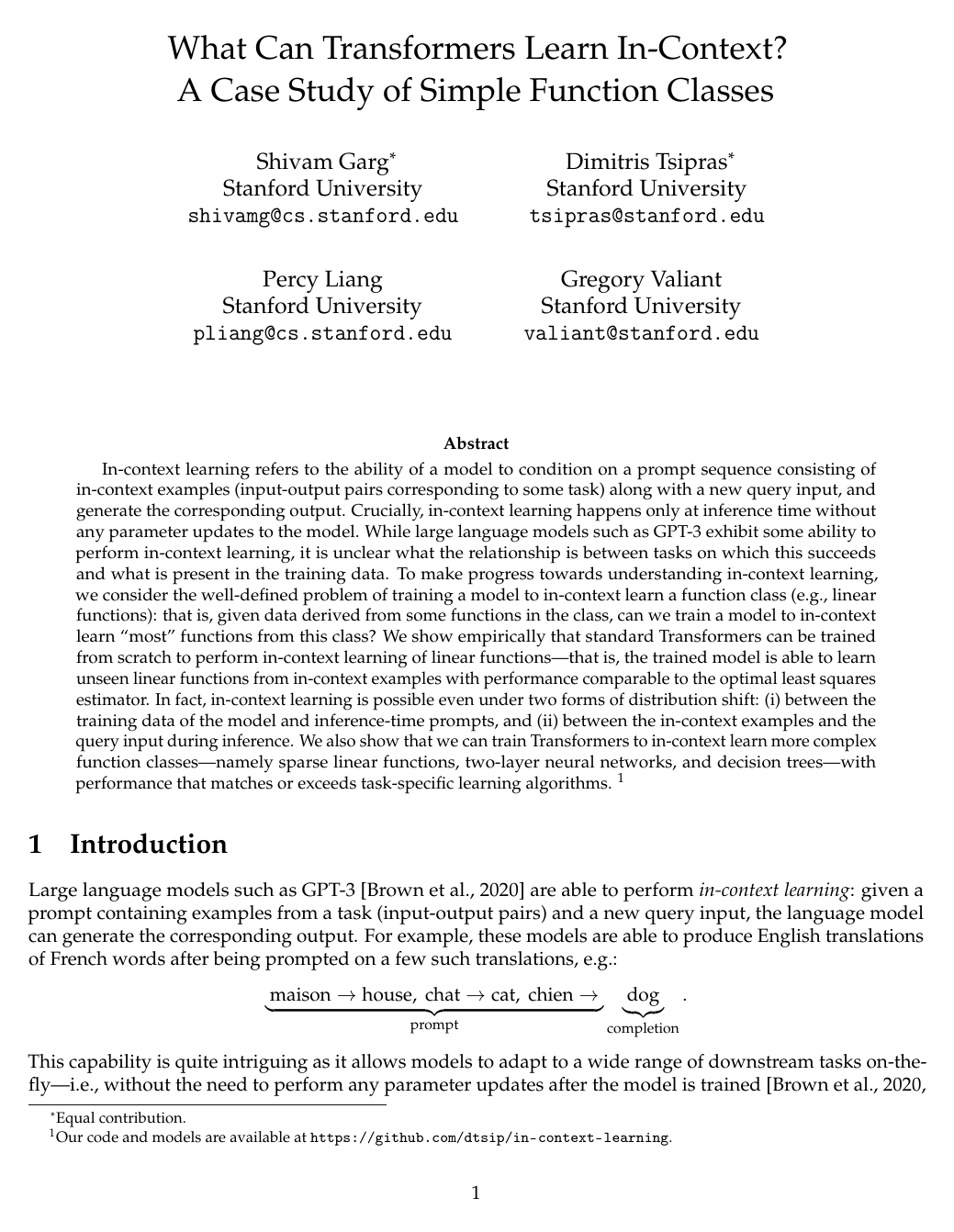
What Can Transformers Learn In-Context? A Case Study of Simple Function Classes
Shivam Garg, Dimitris Tsipras, Percy Liang, Gregory Valiant
Why you should read this
Demonstrates that standard Transformers can be trained from scratch to in-context learn fundamental function classes such as linear models, two-layer neural networks, and decision trees, matching or exceeding the performance of classical task-specific learning algorithms even under distribution shifts.
In-context learning refers to the ability of a model to condition on a prompt sequence consisting of in-context examples (input-output pairs corresponding to some task) along with a new query input, and generate the corresponding output. Crucially, in-context learning happens only at inference time without any parameter updates to the model. While large language models such as GPT-3 exhibit some ability to perform in-context learning, it is unclear what the relationship is between tasks on which this succeeds and what is present in the training data. To make progress towards understanding in-context learning, we consider the well-defined problem of training a model to in-context learn a function class (e.g., linear functions): that is, given data derived from some functions in the class, can we train a model to in-context learn "most" functions from this class? We show empirically that standard Transformers can be trained from scratch to perform in-context learning of linear functions -- that is, the trained model is able to learn unseen linear functions from in-context examples with performance comparable to the optimal least squares estimator. In fact, in-context learning is possible even under two forms of distribution shift: (i) between the training data of the model and inference-time prompts, and (ii) between the in-context examples and the query input during inference. We also show that we can train Transformers to in-context learn more complex function classes -- namely sparse linear functions, two-layer neural networks, and decision trees -- with performance that matches or exceeds task-specific learning algorithms. Our code and models are available at this https URL .
Added
2026-10-05
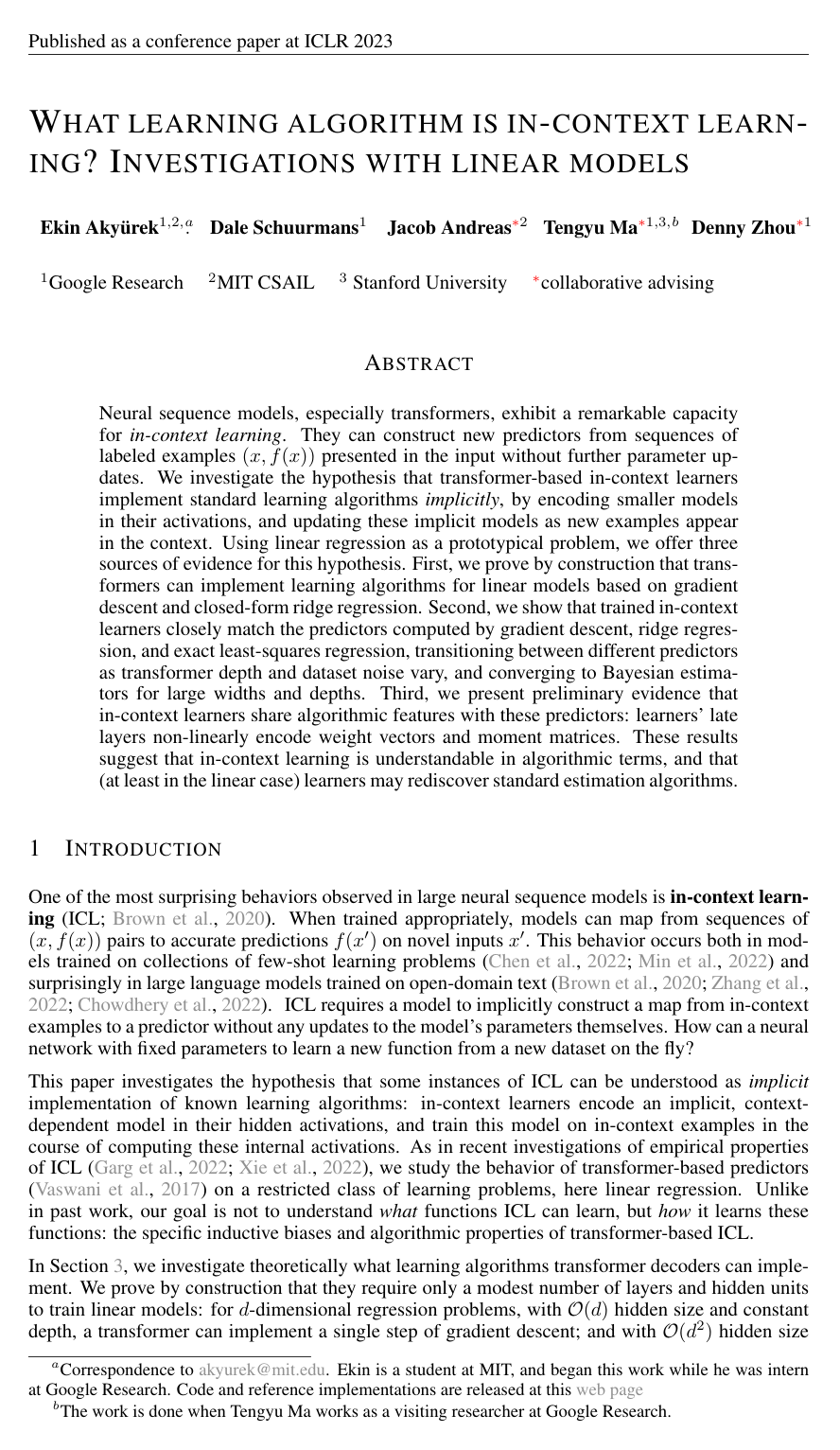
What learning algorithm is in-context learning? Investigations with linear models
Ekin Akyürek, Dale Schuurmans, Jacob Andreas, Tengyu Ma, Denny Zhou
Why you should read this
Demonstrates through constructive proofs and empirical analysis that transformers perform in-context learning by implicitly executing standard algorithms, such as gradient descent and ridge regression, directly within their internal activations.
Neural sequence models, especially transformers, exhibit a remarkable capacity for in-context learning. They can construct new predictors from sequences of labeled examples presented in the input without further parameter updates. We investigate the hypothesis that transformer-based in-context learners implement standard learning algorithms implicitly, by encoding smaller models in their activations, and updating these implicit models as new examples appear in the context. Using linear regression as a prototypical problem, we offer three sources of evidence for this hypothesis. First, we prove by construction that transformers can implement learning algorithms for linear models based on gradient descent and closed-form ridge regression. Second, we show that trained in-context learners closely match the predictors computed by gradient descent, ridge regression, and exact least-squares regression, transitioning between different predictors as transformer depth and dataset noise vary, and converging to Bayesian estimators for large widths and depths. Third, we present preliminary evidence that in-context learners share algorithmic features with these predictors: learners' late layers non-linearly encode weight vectors and moment matrices. These results suggest that in-context learning is understandable in algorithmic terms, and that (at least in the linear case) learners may rediscover standard estimation algorithms. Code and reference implementations are released at this https URL.
Added
2026-10-05
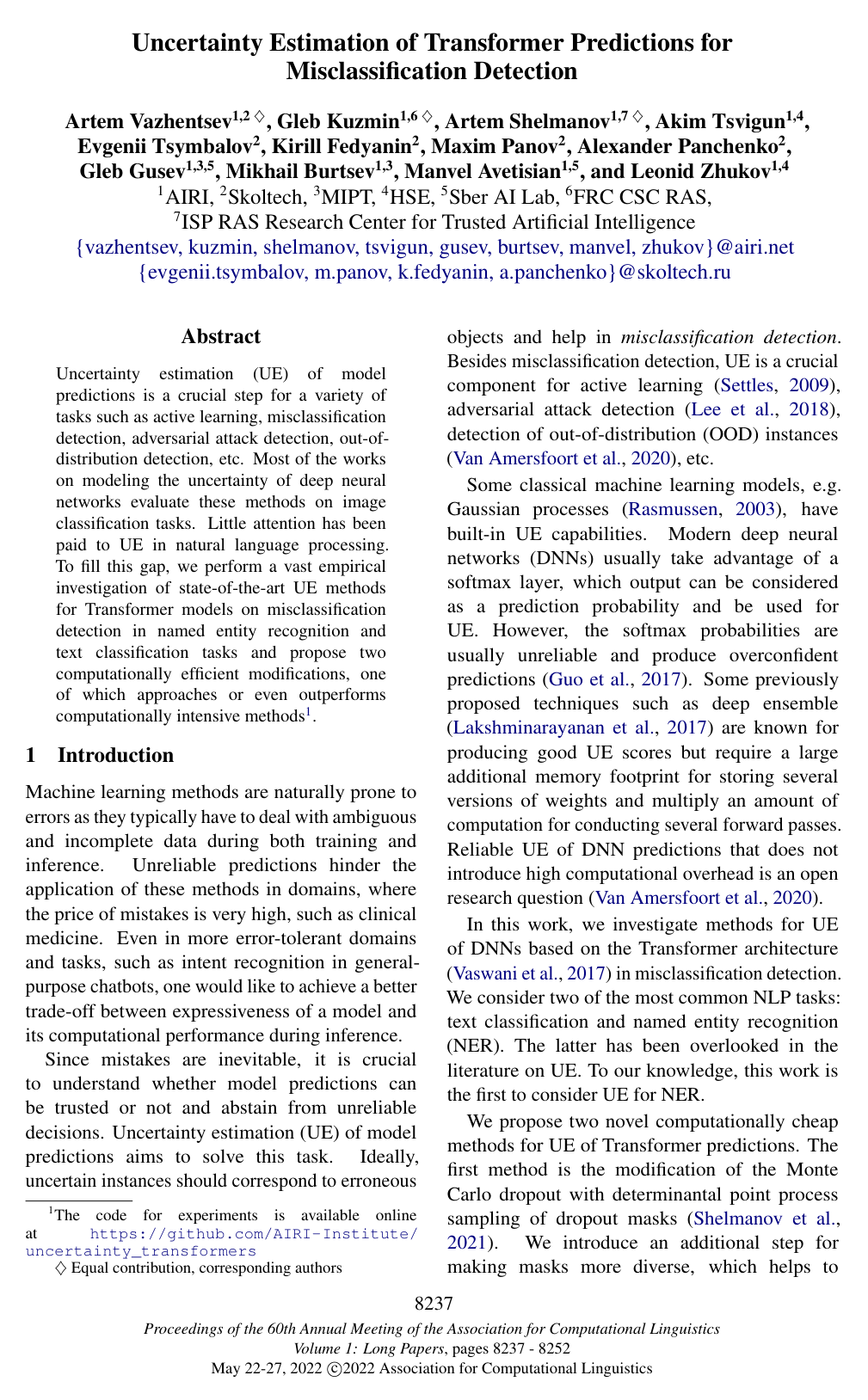
Uncertainty Estimation of Transformer Predictions for Misclassification Detection
Artem Vazhentsev, Gleb Kuzmin, Artem Shelmanov, Akim Tsvigun, Evgenii Tsymbalov, Kirill Fedyanin, Maxim Panov, Alexander Panchenko, Gleb Gusev, Mikhail Burtsev, Manvel Avetisian, Leonid Zhukov
Why you should read this
Develops computationally efficient uncertainty estimation methods for Transformer models in text classification and named entity recognition, demonstrating that a spectral-normalized Mahalanobis distance approach can rival or exceed heavy deep ensembles at detecting misclassifications.
Uncertainty estimation (UE) of model predictions is a crucial step for a variety of tasks such as active learning, misclassification detection, adversarial attack detection, out-of-distribution detection, etc. Most of the works on modeling the uncertainty of deep neural networks evaluate these methods on image classification tasks. Little attention has been paid to UE in natural language processing. To fill this gap, we perform a vast empirical investigation of state-of-the-art UE methods for Transformer models on misclassification detection in named entity recognition and text classification tasks and propose two computationally efficient modifications, one of which approaches or even outperforms computationally intensive methods1.
Added
2026-10-03
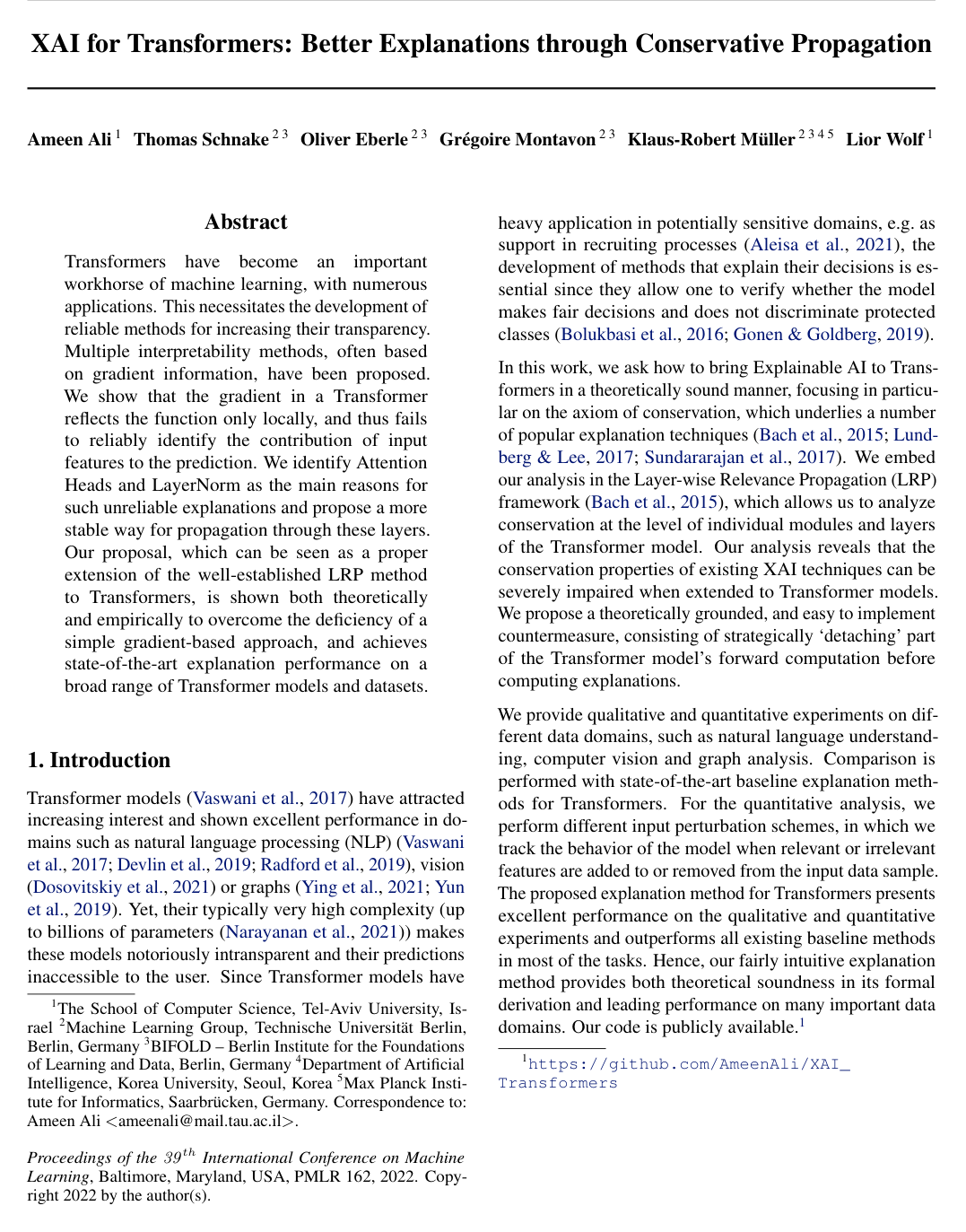
XAI for Transformers: Better Explanations through Conservative Propagation
Ameen Ali, Thomas Schnake, Oliver Eberle, Grégoire Montavon, Klaus-Robert Müller, Lior Wolf
Why you should read this
Extends Layer-wise Relevance Propagation to Transformers by identifying and fixing conservation failures in attention heads and LayerNorm layers, producing more reliable feature attributions across text, vision, and graph benchmarks.
Transformers have become an important workhorse of machine learning, with numerous applications. This necessitates the development of reliable methods for increasing their transparency. Multiple interpretability methods, often based on gradient information, have been proposed. We show that the gradient in a Transformer reflects the function only locally, and thus fails to reliably identify the contribution of input features to the prediction. We identify Attention Heads and LayerNorm as the main reasons for such unreliable explanations and propose a more stable way for propagation through these layers. Our proposal, which can be seen as a proper extension of the well-established LRP method to Transformers, is shown both theoretically and empirically to overcome the deficiency of a simple gradient-based approach, and achieves state-of-the-art explanation performance on a broad range of Transformer models and datasets.
Added
2026-10-01
A Fast Post-Training Pruning Framework for Transformers
Woosuk Kwon, Sehoon Kim, Michael W. Mahoney, Joseph Hassoun, Kurt Keutzer, Amir Gholami
Why you should read this
Proposes a retraining-free structured pruning framework for Transformers that achieves up to a 2.0x reduction in FLOPs with under 1% accuracy loss in less than three minutes on a single GPU.
Pruning is an effective way to reduce the huge inference cost of Transformer models. However, prior work on pruning Transformers requires retraining the models. This can add high training cost and high complexity to model deployment, making it difficult to use in many practical situations. To address this, we propose a fast post-training pruning framework for Transformers that does not require any retraining. Given a resource constraint and a sample dataset, our framework automatically prunes the Transformer model using structured sparsity methods. To retain high accuracy without retraining, we introduce three novel techniques: (i) a lightweight mask search algorithm that finds which heads and filters to prune based on the Fisher information; (ii) mask rearrangement that complements the search algorithm; and (iii) mask tuning that reconstructs the output activations for each layer. We apply our method to BERT_BASE and DistilBERT, and we evaluate its effectiveness on GLUE and SQuAD benchmarks. Our framework achieves up to 2.0× reduction in FLOPs and 1.56× speedup in inference latency, while maintaining < 1% loss in accuracy. Importantly, our framework prunes Transformers in less than 3 minutes on a single GPU, which is over two orders of magnitude faster than existing pruning approaches that retrain the models.1
Added
2026-09-26
Scaling Up Influence Functions
Andrea Schioppa, Polina Zablotskaia, David Vilar, Artem Sokolov
Why you should read this
Presents an Arnoldi iteration-based approximation for inverse Hessian calculation that achieves orders-of-magnitude speedups, scaling influence functions to full-size Transformer models with hundreds of millions of parameters and dataset sizes up to 100 million examples.
We address efficient calculation of influence functions for tracking predictions back to the training data. We propose and analyze a new approach to speeding up the inverse Hessian calculation based on Arnoldi iteration. With this improvement, we achieve, to the best of our knowledge, the first successful implementation of influence functions that scales to full-size (language and vision) Transformer models with several hundreds of millions of parameters. We evaluate our approach on image classification and sequence-to-sequence tasks with tens to a hundred of millions of training examples. Our code will be available at https://github.com/google-research/jax-influence.
Added
2026-09-26
Transformers are SSMs: Generalized Models and Efficient Algorithms Through Structured State Space Duality
Tri Dao, Albert Gu
Why you should read this
Establishes a theoretical connection between Transformers and state-space models via structured semiseparable matrices, introducing the Mamba-2 architecture that processes sequences two to eight times faster than Mamba while matching Transformer language modeling performance.
While Transformers have been the main architecture behind deep learning's success in language modeling, state-space models (SSMs) such as Mamba have recently been shown to match or outperform Transformers at small to medium scale. We show that these families of models are actually quite closely related, and develop a rich framework of theoretical connections between SSMs and variants of attention, connected through various decompositions of a well-studied class of structured semiseparable matrices. Our state space duality (SSD) framework allows us to design a new architecture (Mamba-2) whose core layer is an a refinement of Mamba's selective SSM that is 2-8X faster, while continuing to be competitive with Transformers on language modeling.
Added
2026-09-18
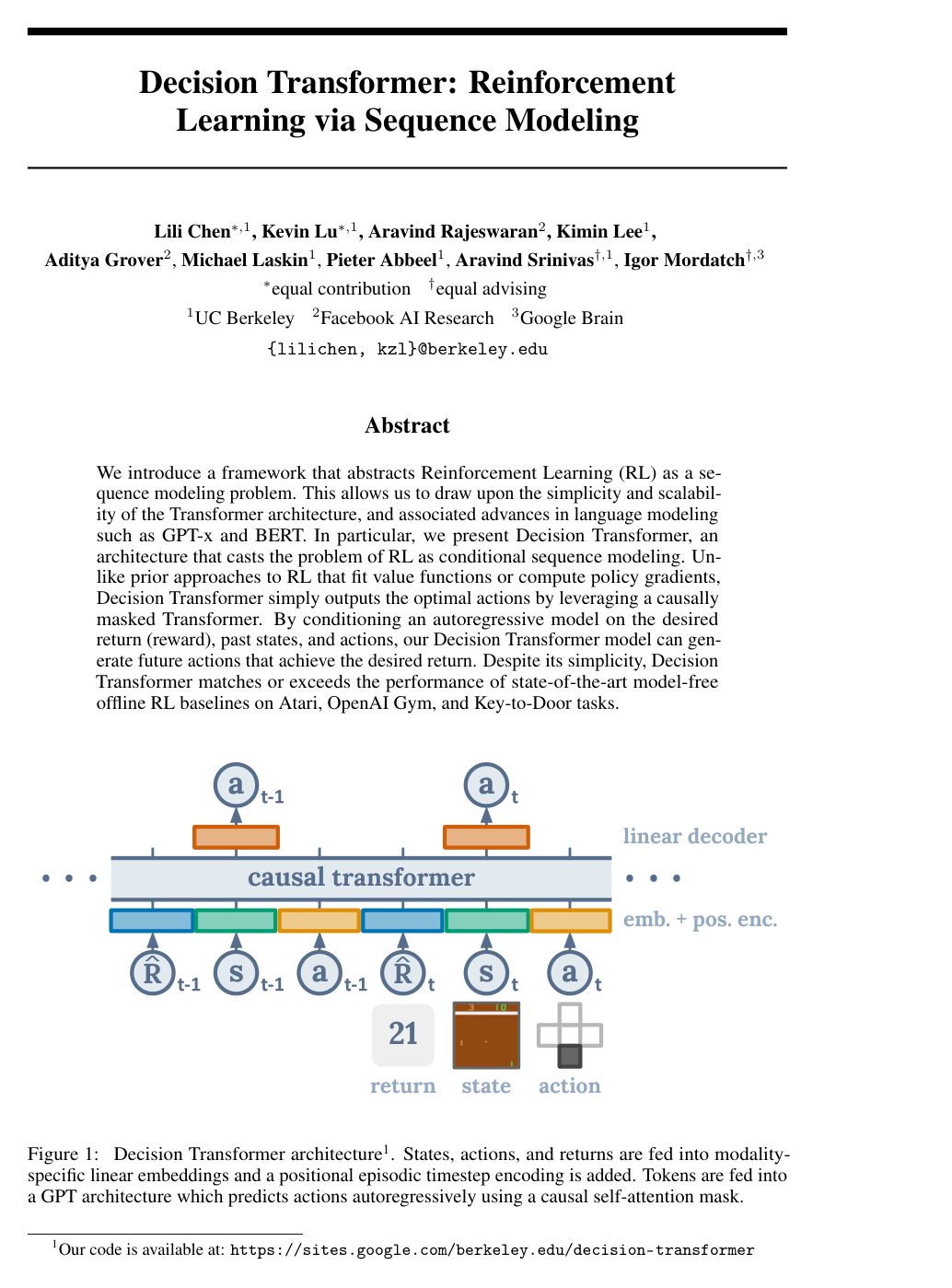
Decision Transformer: Reinforcement Learning via Sequence Modeling
Lili Chen, Kevin Lu, Aravind Rajeswaran, Kimin Lee, Aditya Grover, Michael Laskin, Pieter Abbeel, Aravind Srinivas, Igor Mordatch
Why you should read this
Introduces Decision Transformer, a sequence modeling approach to offline reinforcement learning that generates actions by conditioning an autoregressive Transformer on desired returns, matching or surpassing standard baselines without using dynamic programming or policy gradients.
We introduce a framework that abstracts Reinforcement Learning (RL) as a sequence modeling problem. This allows us to draw upon the simplicity and scalability of the Transformer architecture, and associated advances in language modeling such as GPT-x and BERT. In particular, we present Decision Transformer, an architecture that casts the problem of RL as conditional sequence modeling. Unlike prior approaches to RL that fit value functions or compute policy gradients, Decision Transformer simply outputs the optimal actions by leveraging a causally masked Transformer. By conditioning an autoregressive model on the desired return (reward), past states, and actions, our Decision Transformer model can generate future actions that achieve the desired return. Despite its simplicity, Decision Transformer matches or exceeds the performance of state-of-the-art model-free offline RL baselines on Atari, OpenAI Gym, and Key-to-Door tasks.
Added
2026-09-14
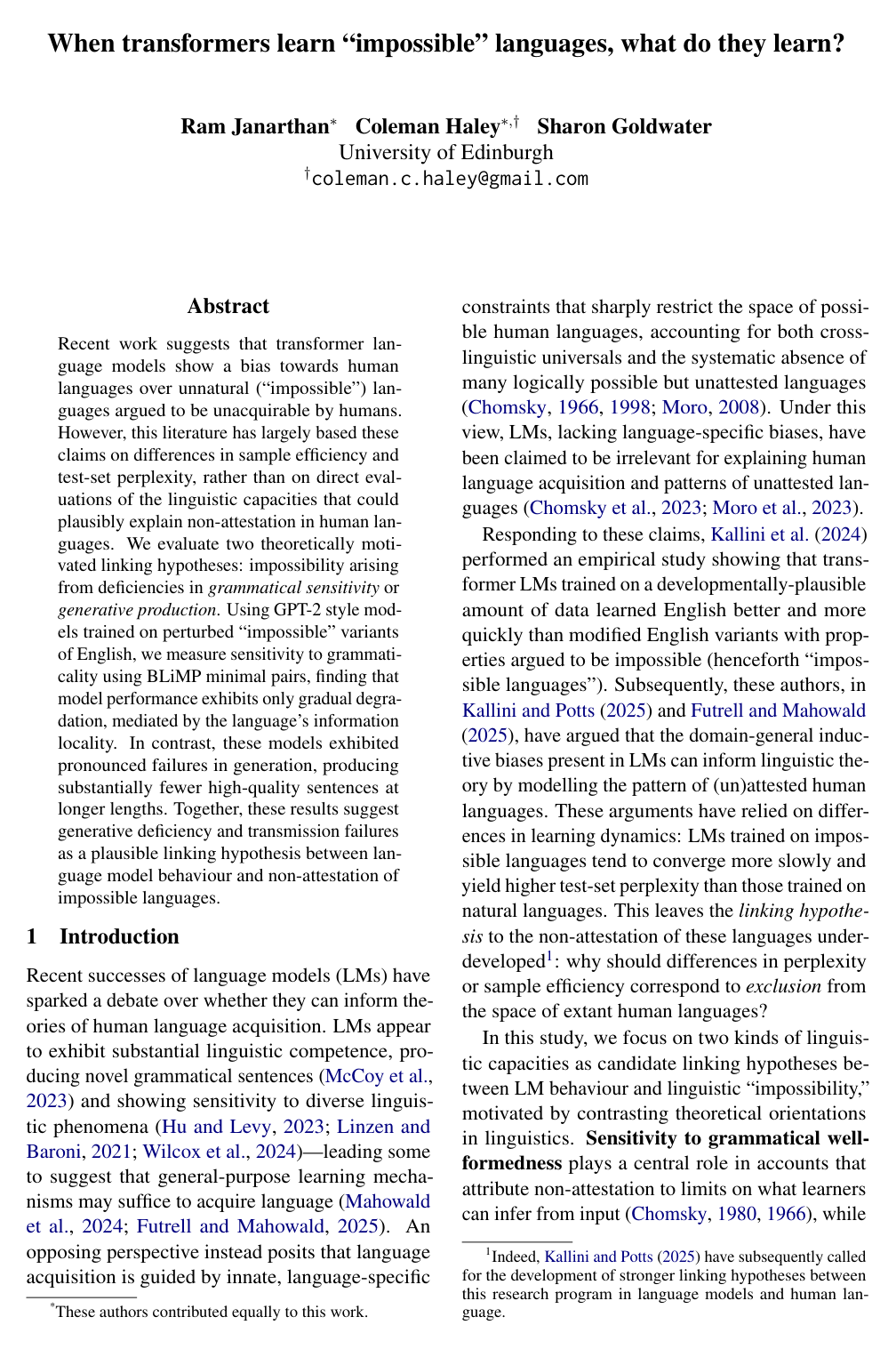
When transformers learn "impossible" languages, what do they learn?
Ram Janarthan, Coleman Haley, Sharon Goldwater
Recent work suggests that transformer language models show a bias towards human languages over unnatural ("impossible") languages argued to be unacquirable by humans. However, this literature has largely based these claims on differences in sample efficiency and test-set perplexity, rather than on direct evaluations of the linguistic capacities that could plausibly explain non-attestation in human languages. We evaluate two theoretically motivated linking hypotheses: impossibility arising from deficiencies in grammatical sensitivity or generative production. Using GPT-2 style models trained on perturbed "impossible" variants of English, we measure sensitivity to grammaticality using BLiMP minimal pairs, finding that model performance exhibits only gradual degradation, mediated by the language's information locality. In contrast, these models exhibited pronounced failures in generation, producing substantially fewer high-quality sentences at longer lengths. Together, these results suggest generative deficiency and transmission failures as a plausible linking hypothesis between language model behaviour and non-attestation of impossible languages.
Added
2026-07-13
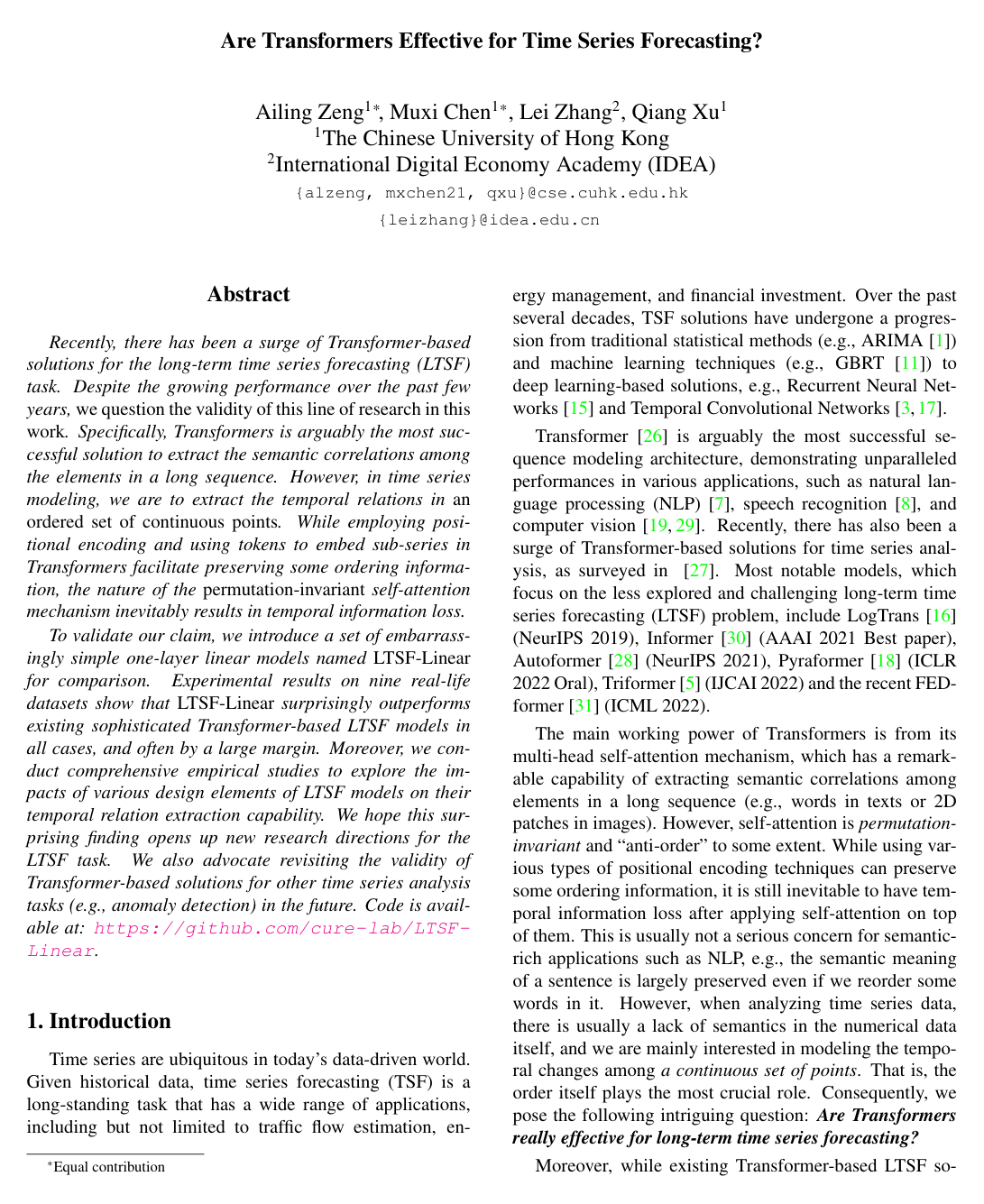
Are Transformers Effective for Time Series Forecasting?
Ailing Zeng, Muxi Chen, Lei Zhang, Qiang Xu
Why you should read this
Demonstrates that embarrassingly simple one-layer linear models consistently outperform sophisticated Transformer-based architectures in long-term time series forecasting, challenging the prevailing research trend by revealing that complex attention mechanisms often fail to capture temporal dependencies as effectively as basic linear baselines.
Recently, there has been a surge of Transformer-based solutions for the long-term time series forecasting (LTSF) task. Despite the growing performance over the past few years, we question the validity of this line of research in this work. Specifically, Transformers is arguably the most successful solution to extract the semantic correlations among the elements in a long sequence. However, in time series modeling, we are to extract the temporal relations in an ordered set of continuous points. While employing positional encoding and using tokens to embed sub-series in Transformers facilitate preserving some ordering information, the nature of the permutation-invariant self-attention mechanism inevitably results in temporal information loss. To validate our claim, we introduce a set of embarrassingly simple one-layer linear models named LTSF-Linear for comparison. Experimental results on nine real-life datasets show that LTSF-Linear surprisingly outperforms existing sophisticated Transformer-based LTSF models in all cases, and often by a large margin. Moreover, we conduct comprehensive empirical studies to explore the impacts of various design elements of LTSF models on their temporal relation extraction capability. We hope this surprising finding opens up new research directions for the LTSF task. We also advocate revisiting the validity of Transformer-based solutions for other time series analysis tasks (e.g., anomaly detection) in the future.
Added
2026-05-18
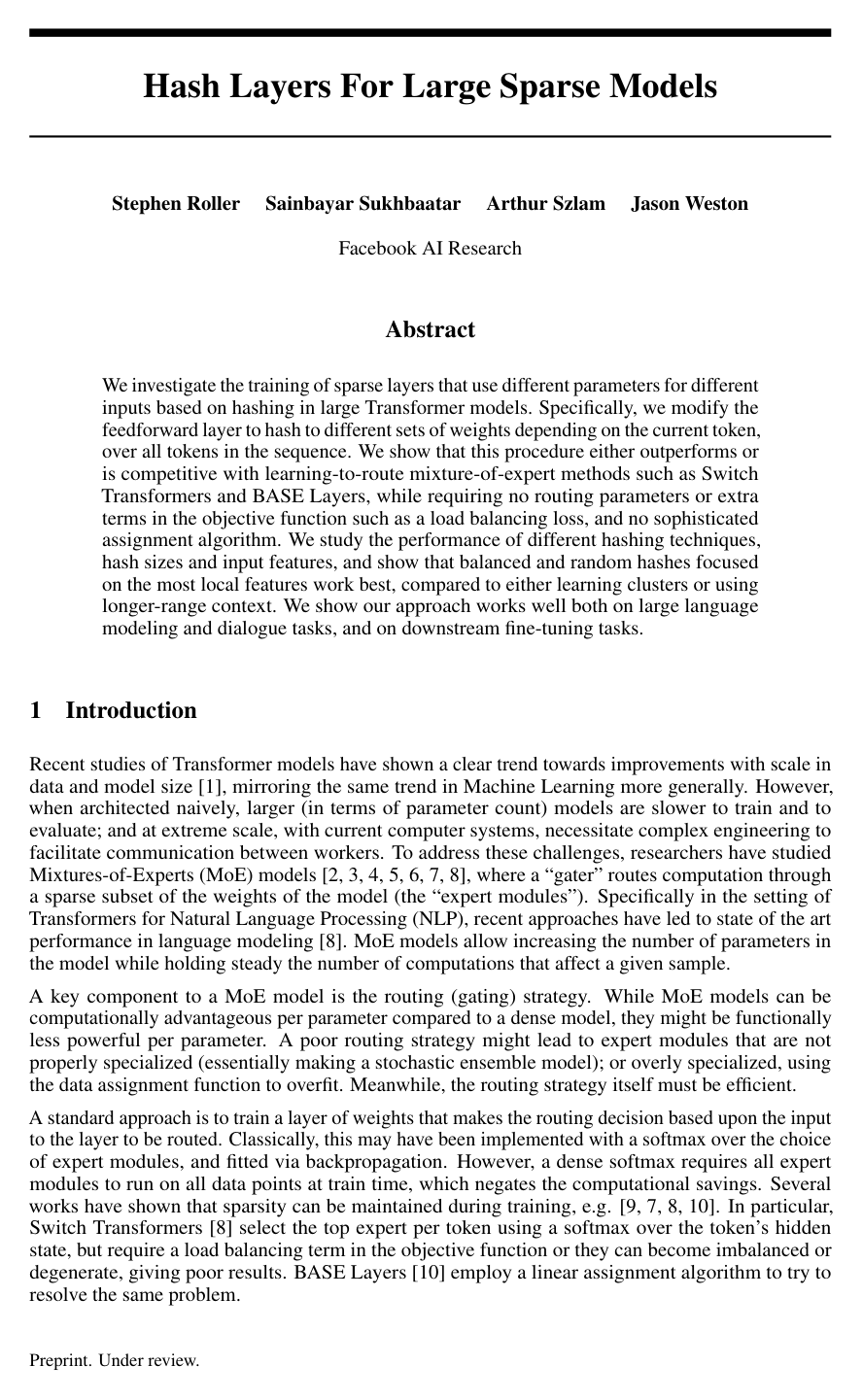
Hash Layers For Large Sparse Models
Stephen Roller, Sainbayar Sukhbaatar, Arthur Szlam, Jason Weston
Why you should read this
Proposes a novel, efficient, and simpler hashing-based routing strategy for sparse Transformer models that outperforms or matches complex Mixture-of-Expert methods without routing parameters, extra objective terms, or sophisticated assignment algorithms.
We investigate the training of sparse layers that use different parameters for different inputs based on hashing in large Transformer models. Specifically, we modify the feedforward layer to hash to different sets of weights depending on the current token, over all tokens in the sequence. We show that this procedure either outperforms or is competitive with learning-to-route mixture-of-expert methods such as Switch Transformers and BASE Layers, while requiring no routing parameters or extra terms in the objective function such as a load balancing loss, and no sophisticated assignment algorithm. We study the performance of different hashing techniques, hash sizes and input features, and show that balanced and random hashes focused on the most local features work best, compared to either learning clusters or using longer-range context. We show our approach works well both on large language modeling and dialogue tasks, and on downstream fine-tuning tasks.
Added
2026-02-23

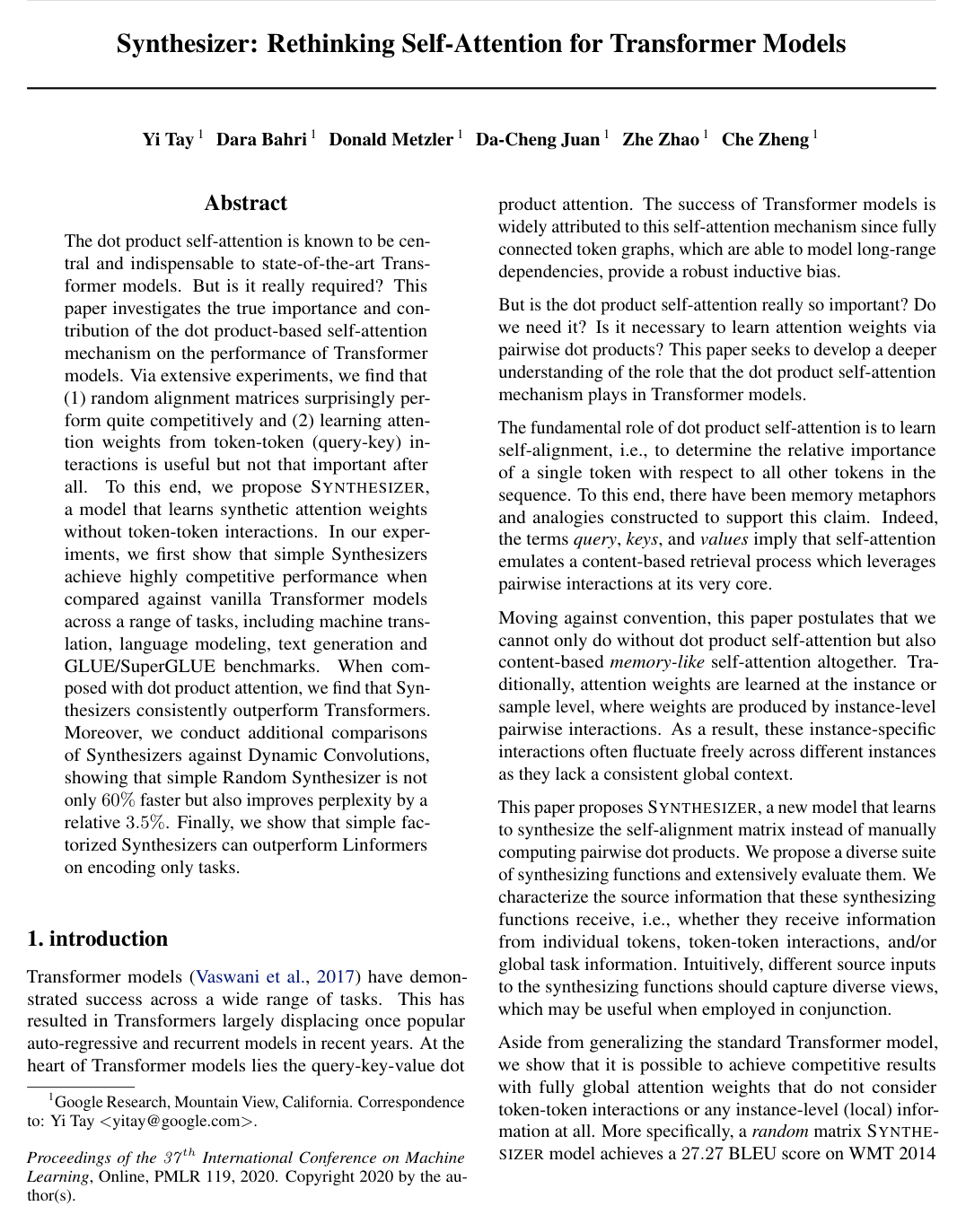
Synthesizer: Rethinking Self-Attention for Transformer Models
Yi Tay, Dara Bahri, Donald Metzler, Da-Cheng Juan, Zhe Zhao, Che Zheng
Why you should read this
Proposes Synthesizer, a novel model that achieves competitive or superior performance to traditional Transformers with significantly increased speed and efficiency by synthesizing attention weights without direct token-token interactions, challenging the fundamental reliance on dot product self-attention.
The dot product self-attention is known to be central and indispensable to state-of-the-art Transformer models. But is it really required? This paper investigates the true importance and contribution of the dot product-based self-attention mechanism on the performance of Transformer models. Via extensive experiments, we find that (1) random alignment matrices surprisingly perform quite competitively and (2) learning attention weights from token-token (query-key) interactions is useful but not that important after all. To this end, we propose \textsc{Synthesizer}, a model that learns synthetic attention weights without token-token interactions. In our experiments, we first show that simple Synthesizers achieve highly competitive performance when compared against vanilla Transformer models across a range of tasks, including machine translation, language modeling, text generation and GLUE/SuperGLUE benchmarks. When composed with dot product attention, we find that Synthesizers consistently outperform Transformers. Moreover, we conduct additional comparisons of Synthesizers against Dynamic Convolutions, showing that simple Random Synthesizer is not only faster but also improves perplexity by a relative . Finally, we show that simple factorized Synthesizers can outperform Linformers on encoding only tasks.
Added
2026-02-13
Synthesizer: Rethinking Self-Attention for Transformer Models
Yi Tay, Dara Bahri, Donald Metzler, Da-Cheng Juan, Zhe Zhao, Che Zheng
Why you should read this
Challenges the necessity of token-to-token interaction by showing that synthetic, learned attention weights (without query-key matching) can perform competitively.
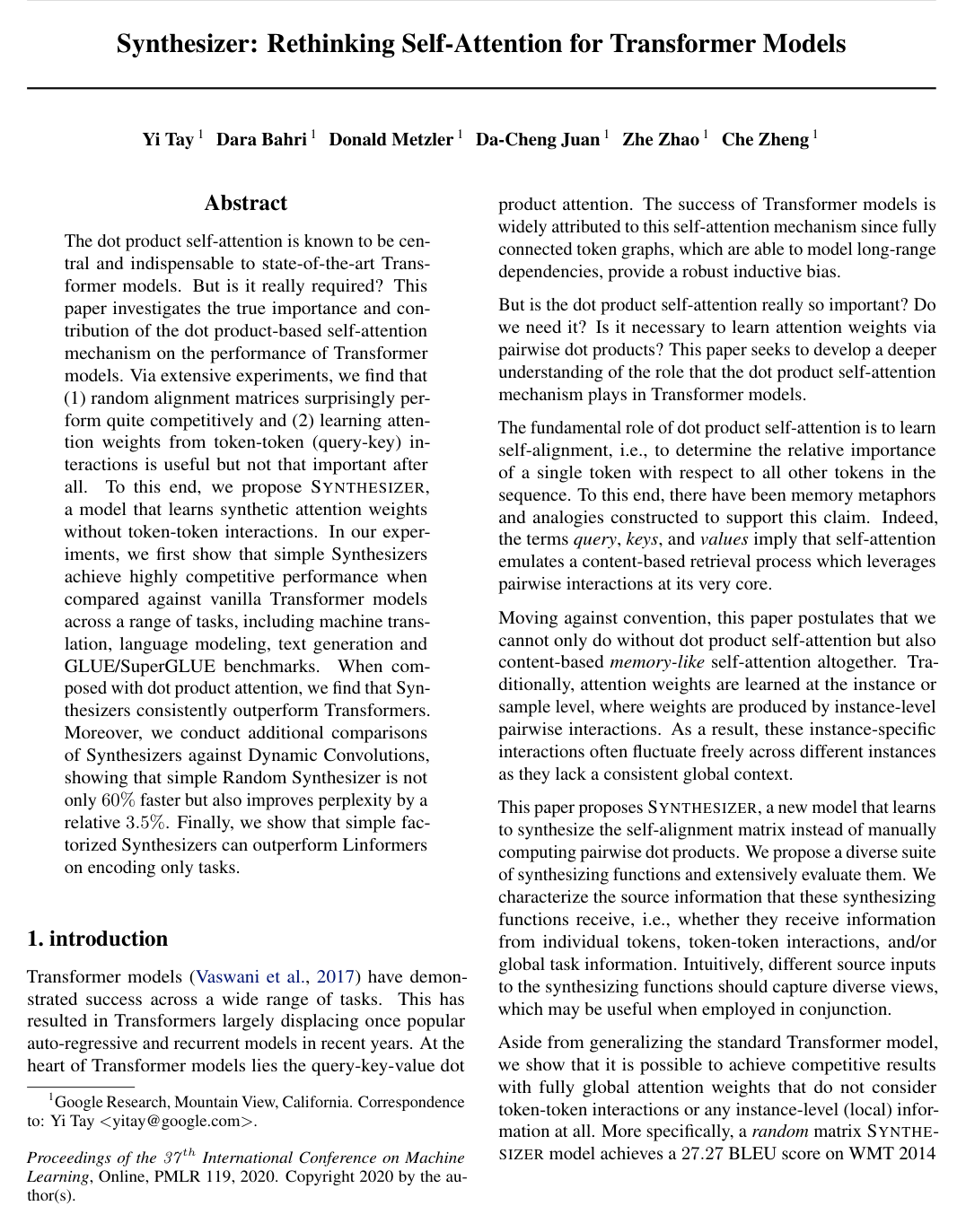
The dot product self-attention is known to be central and indispensable to state-of-the-art Transformer models. But is it really required? This paper investigates the true importance and contribution of the dot product-based self-attention mechanism on the performance of Transformer models. Via extensive experiments, we find that (1) random alignment matrices surprisingly perform quite competitively and (2) learning attention weights from token-token (query-key) interactions is useful but not that important after all. To this end, we propose \textsc{Synthesizer}, a model that learns synthetic attention weights without token-token interactions. In our experiments, we first show that simple Synthesizers achieve highly competitive performance when compared against vanilla Transformer models across a range of tasks, including machine translation, language modeling, text generation and GLUE/SuperGLUE benchmarks. When composed with dot product attention, we find that Synthesizers consistently outperform Transformers. Moreover, we conduct additional comparisons of Synthesizers against Dynamic Convolutions, showing that simple Random Synthesizer is not only 60% faster but also improves perplexity by a relative 3.5%. Finally, we show that simple factorized Synthesizers can outperform Linformers on encoding only tasks.
Added
2026-02-11