
keyword
transformer circuits
Transformer circuits refer to specific subgraphs or subnetworks of interacting components within a transformer-based neural network that perform distinct computational tasks or represent particular features. In mechanistic interpretability, analyzing a model through circuits involves reverse-engineering its operations by decomposing the overall computational graph into pathways made up of individual attention heads, feedforward neurons, and residual stream connections. These functional pathways reveal how information is routed, transformed, and composed across layers to carry out specific algorithmic behaviors, such as tracking contextual dependencies or generating next-token predictions, thereby making the internal reasoning processes of transformer models understandable.
2 items
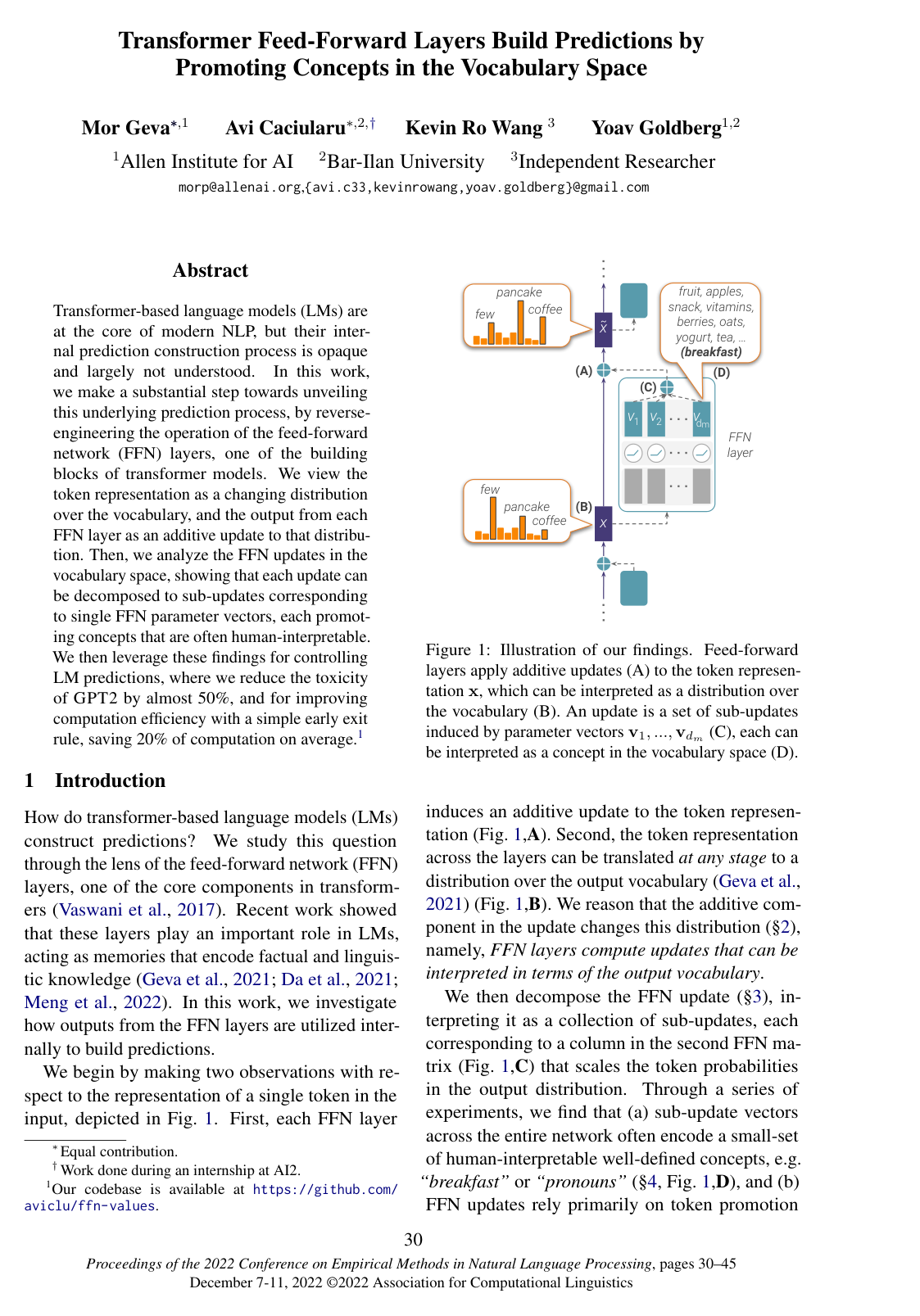
Transformer Feed-Forward Layers Build Predictions by Promoting Concepts in the Vocabulary Space
Mor Geva, Avi Caciularu, Kevin Ro Wang, Yoav Goldberg
Why you should read this
Reveals how transformer feed-forward layers construct predictions by promoting human-interpretable concepts directly in the vocabulary space, enabling practical techniques to cut GPT-2 toxicity by half and save twenty percent of inference computation through early exiting.
Transformer-based language models (LMs) are at the core of modern NLP, but their internal prediction construction process is opaque and largely not understood. In this work, we make a substantial step towards unveiling this underlying prediction process, by reverse-engineering the operation of the feed-forward network (FFN) layers, one of the building blocks of transformer models. We view the token representation as a changing distribution over the vocabulary, and the output from each FFN layer as an additive update to that distribution. Then, we analyze the FFN updates in the vocabulary space, showing that each update can be decomposed to sub-updates corresponding to single FFN parameter vectors, each promoting concepts that are often human-interpretable. We then leverage these findings for controlling LM predictions, where we reduce the toxicity of GPT2 by almost 50%, and for improving computation efficiency with a simple early exit rule, saving 20% of computation on average.
Added
2026-09-29
The Topological Trouble With Transformers
Michael C. Mozer, Shoaib Ahmed Siddiqui, Rosanne Liu
Why you should read this
Proposes a new taxonomy of recurrent and continuous-thought transformer architectures and outlines promising research directions to integrate dynamic state tracking more effectively into foundation models.
Transformers encode structure in sequences via an expanding contextual history. However, their purely feedforward architecture fundamentally limits dynamic state tracking. State tracking -- the iterative updating of latent variables reflecting an evolving environment -- involves inherently sequential dependencies that feedforward networks struggle to maintain. Consequently, feedforward models push evolving state representations deeper into their layer stack with each new input step, rendering information inaccessible in shallow layers and ultimately exhausting the model's depth. While this depth limit can be bypassed by dynamic depth models and by explicit or latent thinking that externalizes state representations, these solutions are computationally and memory inefficient. In this article, we argue that temporally extended cognition requires refocusing from explicit thought traces to implicit activation dynamics via recurrent architectures. We introduce a taxonomy of recurrent and continuous-thought transformer architectures, categorizing them by their recurrence axis (depth versus step) and their ratio of input tokens to recurrence steps. Finally, we outline promising research directions, including enhanced state-space models and coarse-grained recurrence, to better integrate state tracking into modern foundation models.
Added
2026-06-15
