
keyword
transformer architecture
A transformer architecture is a deep learning neural network model designed to process sequential data and capture complex relationships between input elements primarily through self-attention mechanisms. Unlike traditional recurrent or convolutional networks that process inputs sequentially or through local receptive fields, transformers evaluate the pairwise dependencies across all tokens in a sequence concurrently, enabling efficient parallelization during training. In a typical transformer framework, inputs are augmented with positional encodings to preserve order, and representations are transformed through stacked layers composed of multi-head attention, point-wise feed-forward networks, residual connections, and layer normalization. Although initially developed for natural language processing tasks such as machine translation, the architecture serves as a foundational paradigm across modern artificial intelligence, powering applications in computer vision, time-series forecasting, audio processing, and graph representation learning.
15 items
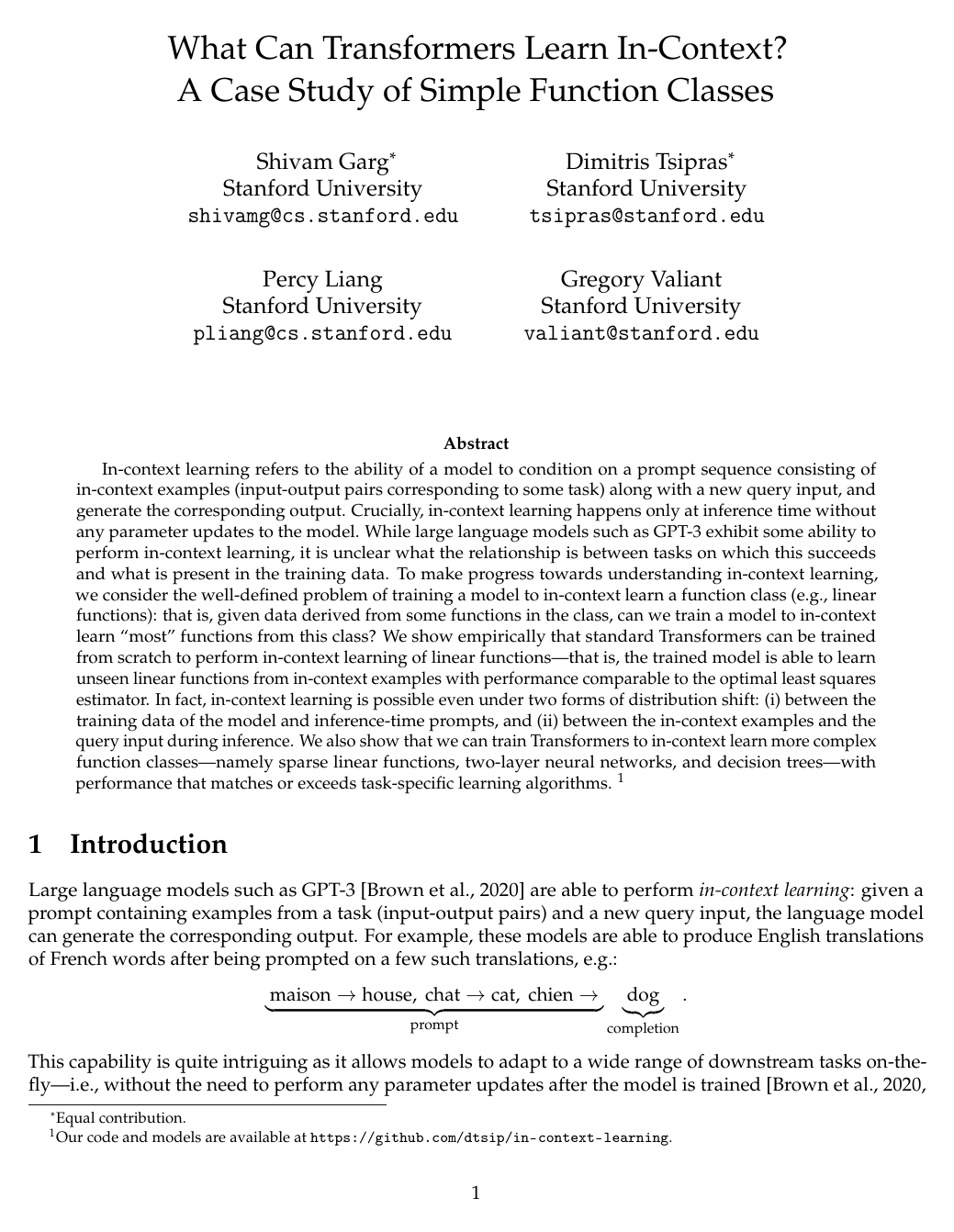
What Can Transformers Learn In-Context? A Case Study of Simple Function Classes
Shivam Garg, Dimitris Tsipras, Percy Liang, Gregory Valiant
Why you should read this
Demonstrates that standard Transformers can be trained from scratch to in-context learn fundamental function classes such as linear models, two-layer neural networks, and decision trees, matching or exceeding the performance of classical task-specific learning algorithms even under distribution shifts.
In-context learning refers to the ability of a model to condition on a prompt sequence consisting of in-context examples (input-output pairs corresponding to some task) along with a new query input, and generate the corresponding output. Crucially, in-context learning happens only at inference time without any parameter updates to the model. While large language models such as GPT-3 exhibit some ability to perform in-context learning, it is unclear what the relationship is between tasks on which this succeeds and what is present in the training data. To make progress towards understanding in-context learning, we consider the well-defined problem of training a model to in-context learn a function class (e.g., linear functions): that is, given data derived from some functions in the class, can we train a model to in-context learn "most" functions from this class? We show empirically that standard Transformers can be trained from scratch to perform in-context learning of linear functions -- that is, the trained model is able to learn unseen linear functions from in-context examples with performance comparable to the optimal least squares estimator. In fact, in-context learning is possible even under two forms of distribution shift: (i) between the training data of the model and inference-time prompts, and (ii) between the in-context examples and the query input during inference. We also show that we can train Transformers to in-context learn more complex function classes -- namely sparse linear functions, two-layer neural networks, and decision trees -- with performance that matches or exceeds task-specific learning algorithms. Our code and models are available at this https URL .
Added
2026-10-05
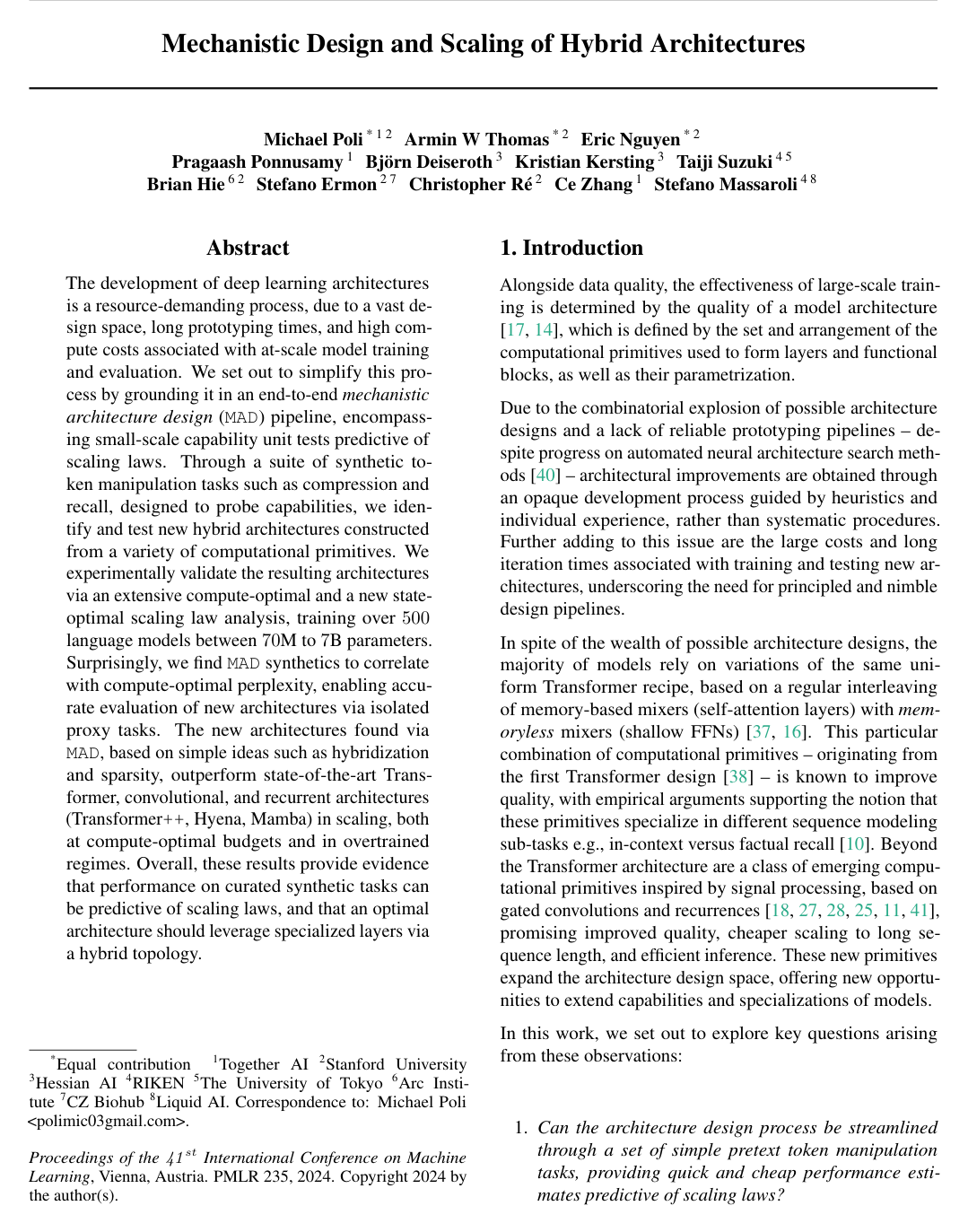
Mechanistic Design and Scaling of Hybrid Architectures
Michael Poli, Armin W. Thomas, Eric Nguyen, Pragaash Ponnusamy, Björn Deiseroth, Kristian Kersting, Taiji Suzuki, Brian L. Hie, Stefano Ermon, Christopher Ré, Ce Zhang, Stefano Massaroli
Why you should read this
Proposes a mechanistic architecture design framework that uses small-scale synthetic token manipulation tasks to predict large-scale compute-optimal performance, yielding hybrid models combining attention, convolutions, and recurrences that outperform standard Transformers and Mamba across models up to 7B parameters.
The development of deep learning architectures is a resource-demanding process, due to a vast design space, long prototyping times, and high compute costs associated with at-scale model training and evaluation. We set out to simplify this process by grounding it in an end-to-end mechanistic architecture design (MAD) pipeline, encompassing small-scale capability unit tests predictive of scaling laws. Through a suite of synthetic token manipulation tasks such as compression and recall, designed to probe capabilities, we identify and test new hybrid architectures constructed from a variety of computational primitives. We experimentally validate the resulting architectures via an extensive compute-optimal and a new state-optimal scaling law analysis, training over 500 language models between 70M to 7B parameters. Surprisingly, we find MAD synthetics to correlate with compute-optimal perplexity, enabling accurate evaluation of new architectures via isolated proxy tasks. The new architectures found via MAD, based on simple ideas such as hybridization and sparsity, outperform state-of-the-art Transformer, convolutional, and recurrent architectures (Transformer++, Hyena, Mamba) in scaling, both at compute-optimal budgets and in overtrained regimes. Overall, these results provide evidence that performance on curated synthetic tasks can be predictive of scaling laws, and that an optimal architecture should leverage specialized layers via a hybrid topology.
Added
2026-10-03
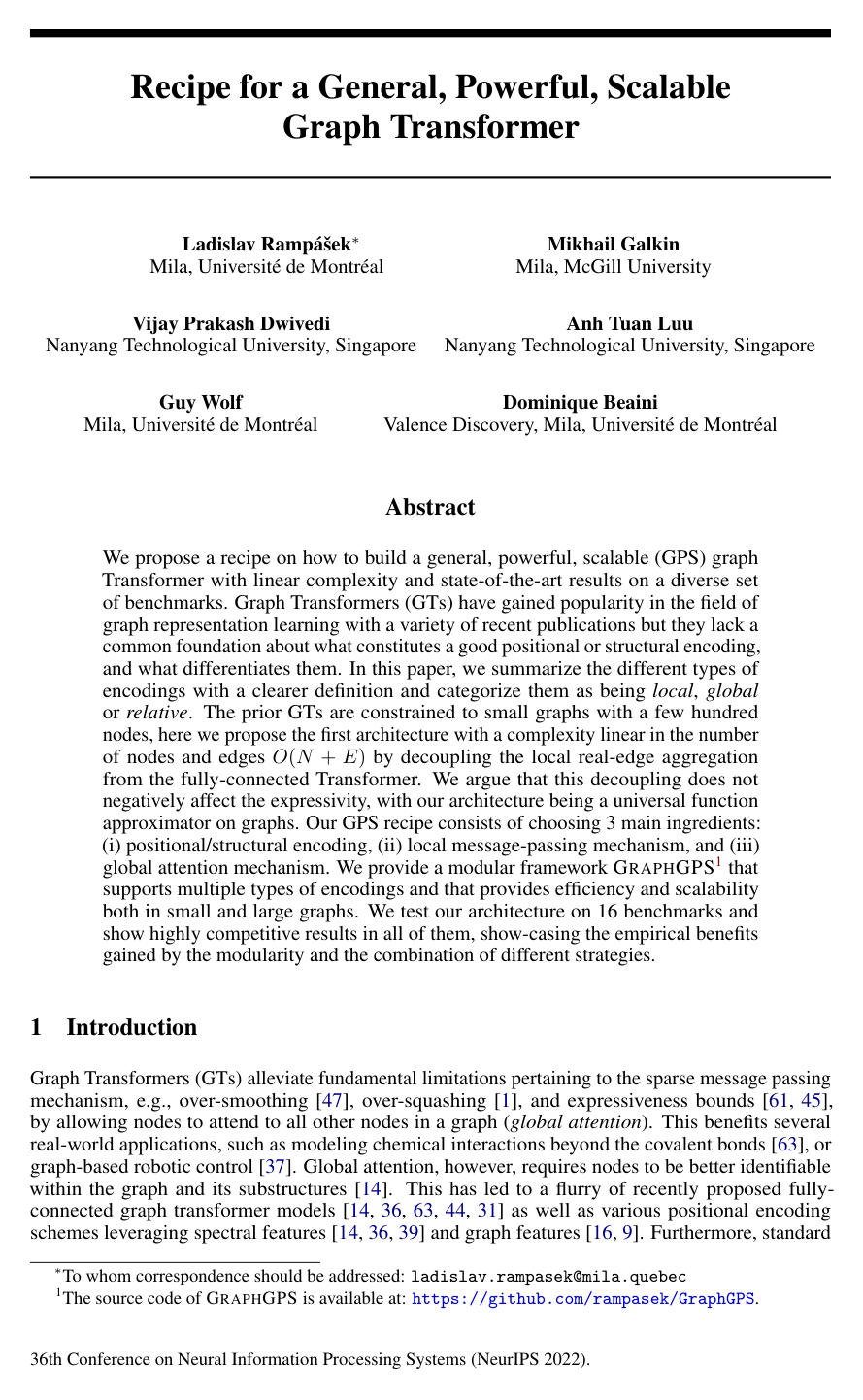
Recipe for a General, Powerful, Scalable Graph Transformer
Ladislav Rampásek, Michael Galkin, Vijay Prakash Dwivedi, Anh Tuan Luu, Guy Wolf, Dominique Beaini
Why you should read this
Presents GraphGPS, a modular graph Transformer framework that achieves linear computational complexity by decoupling local message passing from global attention while delivering state-of-the-art performance across 16 standard benchmarks.
We propose a recipe on how to build a general, powerful, scalable (GPS) graph Transformer with linear complexity and state-of-the-art results on a diverse set of benchmarks. Graph Transformers (GTs) have gained popularity in the field of graph representation learning with a variety of recent publications but they lack a common foundation about what constitutes a good positional or structural encoding, and what differentiates them. In this paper, we summarize the different types of encodings with a clearer definition and categorize them as being , or . The prior GTs are constrained to small graphs with a few hundred nodes, here we propose the first architecture with a complexity linear in the number of nodes and edges by decoupling the local real-edge aggregation from the fully-connected Transformer. We argue that this decoupling does not negatively affect the expressivity, with our architecture being a universal function approximator on graphs. Our GPS recipe consists of choosing 3 main ingredients: (i) positional/structural encoding, (ii) local message-passing mechanism, and (iii) global attention mechanism. We provide a modular framework that supports multiple types of encodings and that provides efficiency and scalability both in small and large graphs. We test our architecture on 16 benchmarks and show highly competitive results in all of them, show-casing the empirical benefits gained by the modularity and the combination of different strategies.
Added
2026-09-26
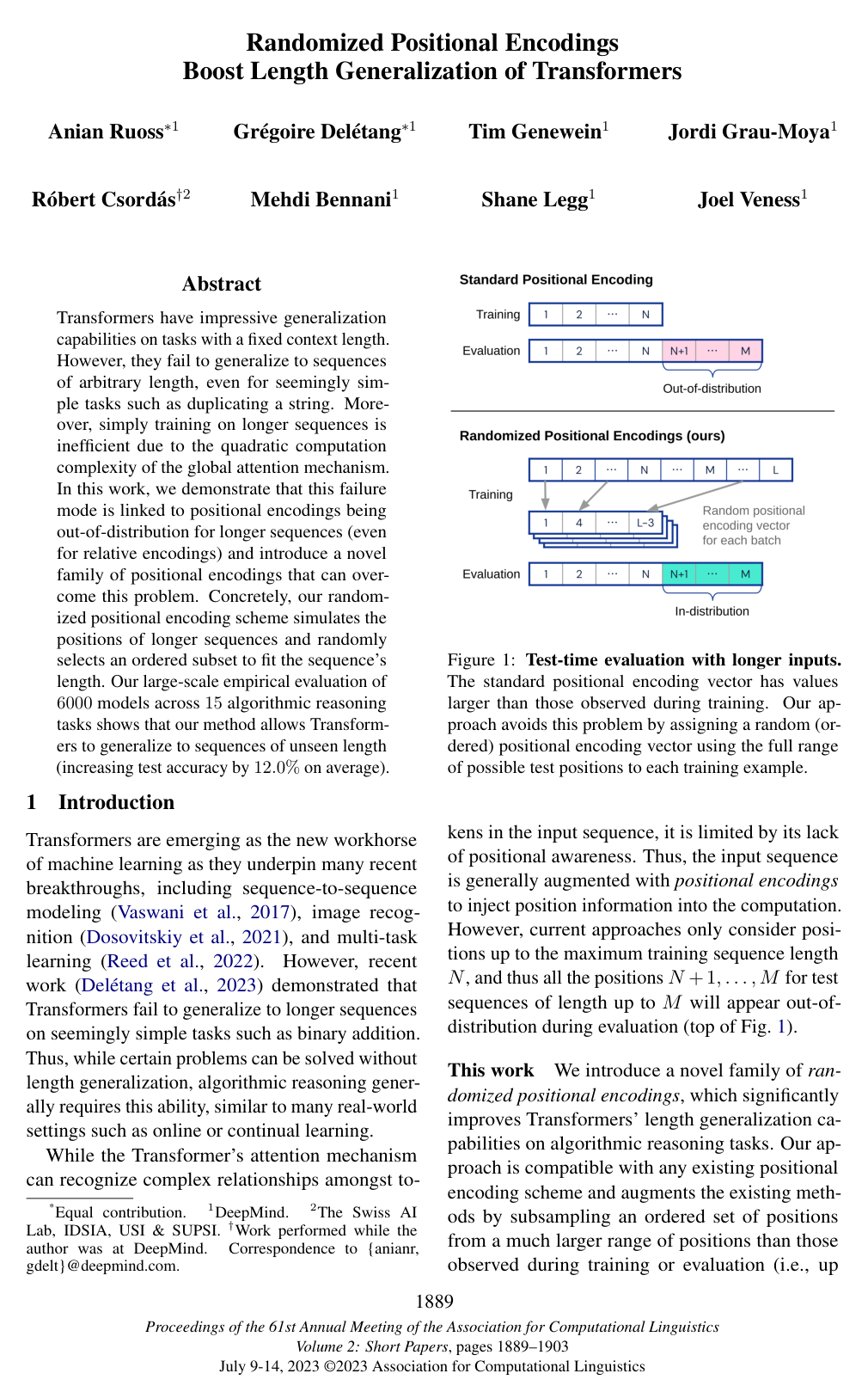
Randomized Positional Encodings Boost Length Generalization of Transformers
Anian Ruoss, Grégoire Delétang, Tim Genewein, Jordi Grau-Moya, Róbert Csordás, Mehdi Bennani, Shane Legg, Joel Veness
Why you should read this
Introduces a randomized positional encoding scheme that subsamples ordered positions from an extended range during training, enabling Transformers trained on short sequences to generalize effectively to unseen sequence lengths across algorithmic reasoning tasks.
Transformers have impressive generalization capabilities on tasks with a fixed context length. However, they fail to generalize to sequences of arbitrary length, even for seemingly simple tasks such as duplicating a string. Moreover, simply training on longer sequences is inefficient due to the quadratic computation complexity of the global attention mechanism. In this work, we demonstrate that this failure mode is linked to positional encodings being out-of-distribution for longer sequences (even for relative encodings) and introduce a novel family of positional encodings that can overcome this problem. Concretely, our randomized positional encoding scheme simulates the positions of longer sequences and randomly selects an ordered subset to fit the sequence's length. Our large-scale empirical evaluation of 6000 models across 15 algorithmic reasoning tasks shows that our method allows Transformers to generalize to sequences of unseen length (increasing test accuracy by 12.0% on average).
Added
2026-09-26
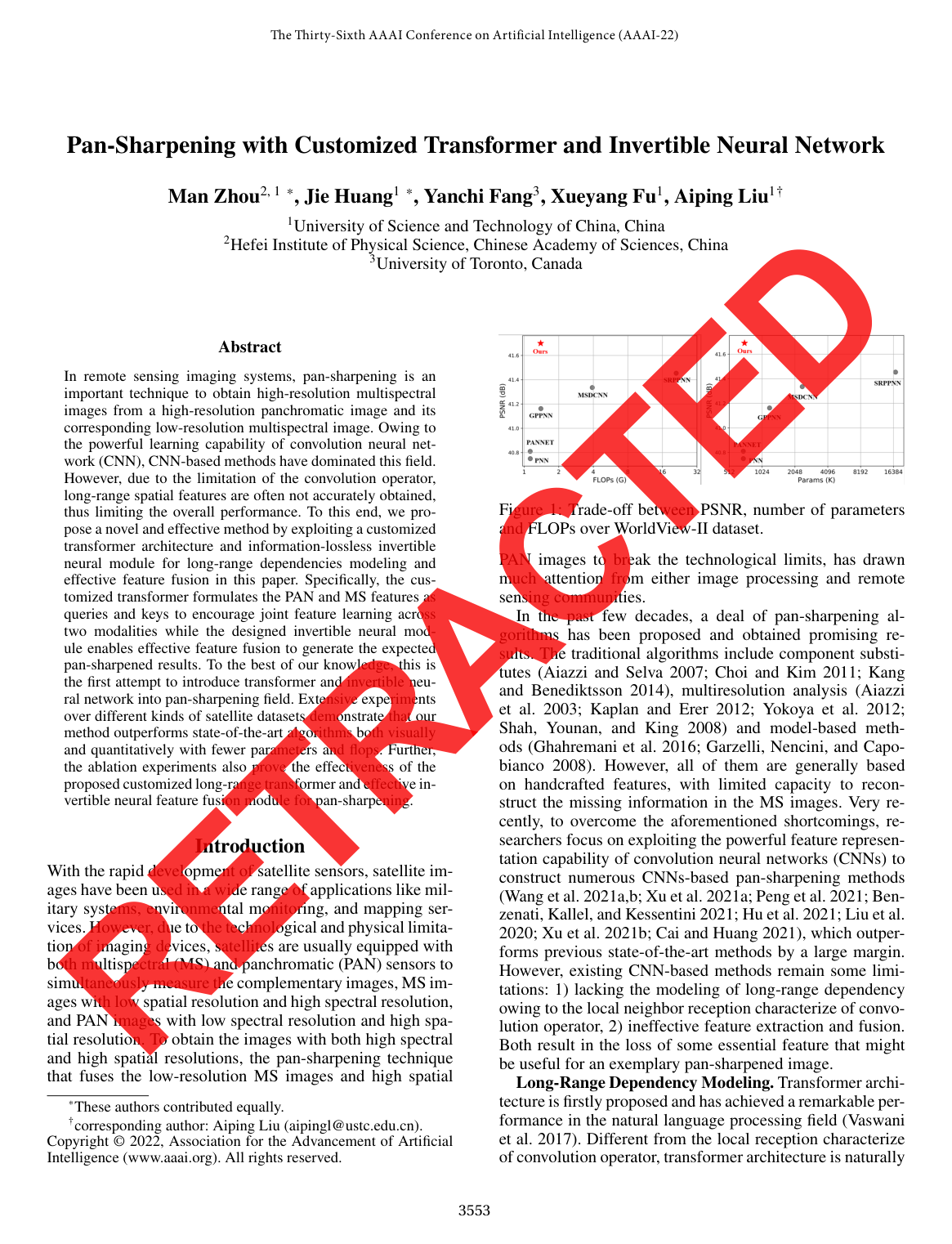
Pan-Sharpening with Customized Transformer and Invertible Neural Network
Man Zhou, Jie Huang, Yanchi Fang, Xueyang Fu, Aiping Liu
Why you should read this
Proposes a pan-sharpening framework that combines a customized cross-modal transformer for long-range dependency modeling with an invertible neural network to achieve information-lossless fusion of panchromatic and multispectral satellite images.
In remote sensing imaging systems, pan-sharpening is an important technique to obtain high-resolution multispectral images from a high-resolution panchromatic image and its corresponding low-resolution multispectral image. Owing to the powerful learning capability of convolution neural network (CNN), CNN-based methods have dominated this field. However, due to the limitation of the convolution operator, long-range spatial features are often not accurately obtained, thus limiting the overall performance. To this end, we propose a novel and effective method by exploiting a customized transformer architecture and information-lossless invertible neural module for long-range dependencies modeling and effective feature fusion in this paper. Specifically, the customized transformer formulates the PAN and MS features as queries and keys to encourage joint feature learning across two modalities while the designed invertible neural module enables effective feature fusion to generate the expected pan-sharpened results. To the best of our knowledge, this is the first attempt to introduce transformer and invertible neural network into pan-sharpening field. Extensive experiments over different kinds of satellite datasets demonstrate that our method outperforms state-of-the-art algorithms both visually and quantitatively with fewer parameters and flops. Further, the ablation experiments also prove the effectiveness of the proposed customized long-range transformer and effective invertible neural feature fusion module for pan-sharpening.
Added
2026-09-26
Transformers are Meta-Reinforcement Learners
Luckeciano C. Melo
Added
2026-09-26
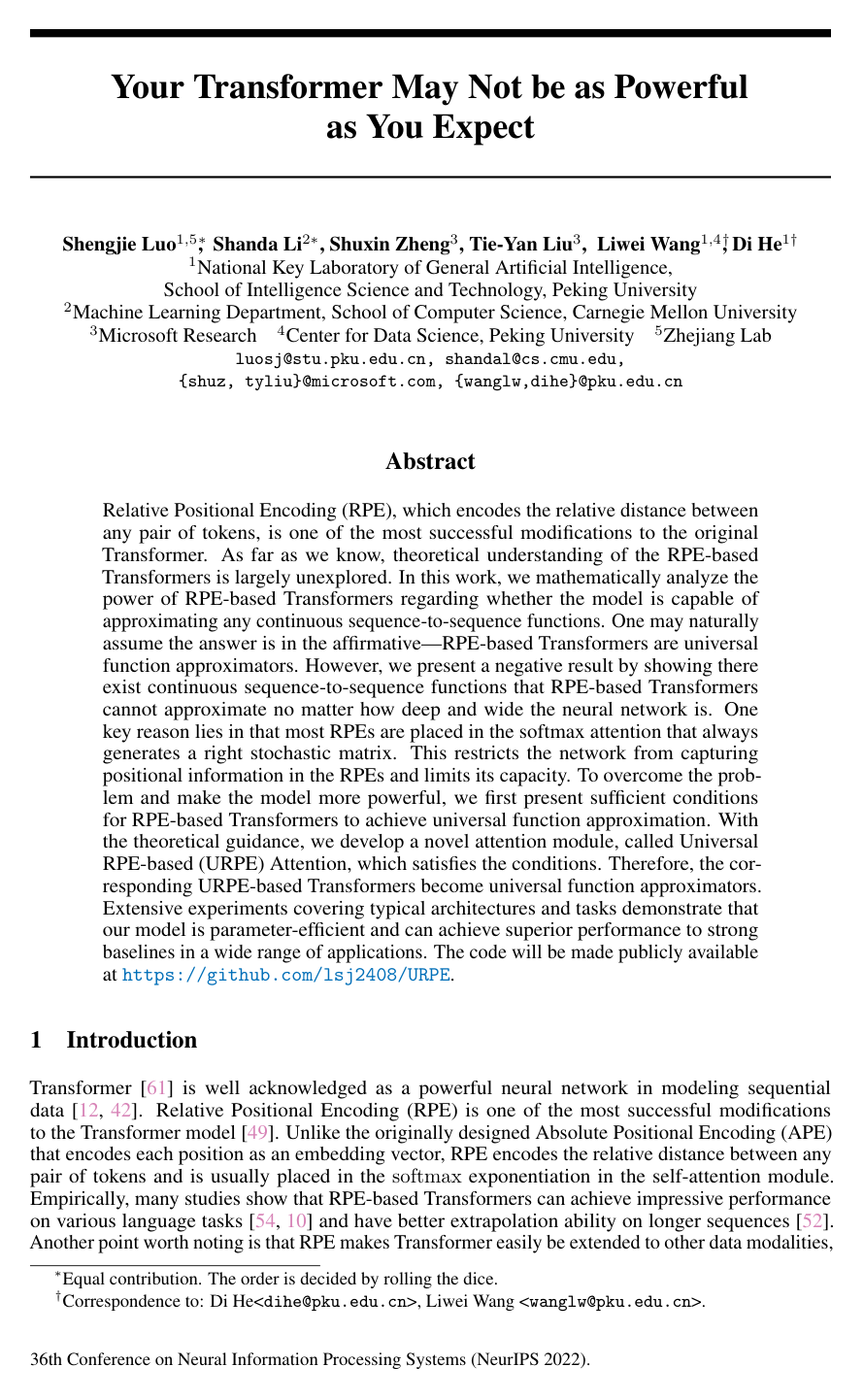
Your Transformer May Not be as Powerful as You Expect
Shengjie Luo, Shanda Li, Shuxin Zheng, Tie-Yan Liu, Liwei Wang, Di He
Why you should read this
Proves that standard relative positional encoding prevents Transformers from being universal function approximators due to softmax stochasticity, and introduces a mathematically grounded alternative attention module that restores full expressive capacity with minimal parameter overhead.
Relative Positional Encoding (RPE), which encodes the relative distance between any pair of tokens, is one of the most successful modifications to the original Transformer. As far as we know, theoretical understanding of the RPE-based Transformers is largely unexplored. In this work, we mathematically analyze the power of RPE-based Transformers regarding whether the model is capable of approximating any continuous sequence-to-sequence functions. One may naturally assume the answer is in the affirmative—RPE-based Transformers are universal function approximators. However, we present a negative result by showing there exist continuous sequence-to-sequence functions that RPE-based Transformers cannot approximate no matter how deep and wide the neural network is. One key reason lies in that most RPEs are placed in the softmax attention that always generates a right stochastic matrix. This restricts the network from capturing positional information in the RPEs and limits its capacity. To overcome the problem and make the model more powerful, we first present sufficient conditions for RPE-based Transformers to achieve universal function approximation. With the theoretical guidance, we develop a novel attention module, called Universal RPE-based (URPE) Attention, which satisfies the conditions. Therefore, the corresponding URPE-based Transformers become universal function approximators. Extensive experiments covering typical architectures and tasks demonstrate that our model is parameter-efficient and can achieve superior performance to strong baselines in a wide range of applications. The code will be made publicly available at https://github.com/lsj2408/URPE.
Added
2026-09-26
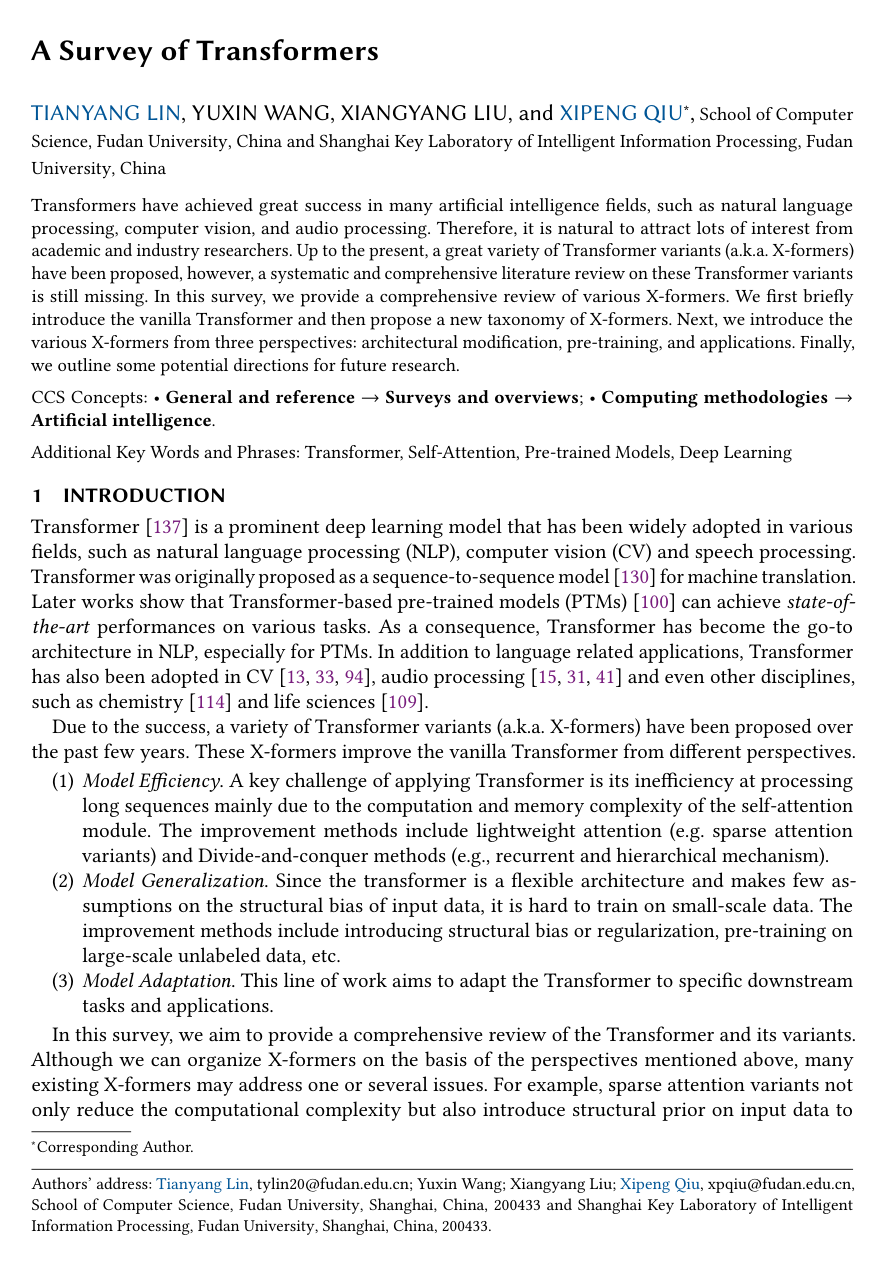
A Survey of Transformers
Tianyang Lin, Yuxin Wang, Xiangyang Liu, Xipeng Qiu
Why you should read this
Establishes a comprehensive taxonomy of Transformer variants by analyzing architectural modifications, pre-training strategies, and cross-domain applications to help researchers select and design attention-based models.
Transformers have achieved great success in many artificial intelligence fields, such as natural language processing, computer vision, and audio processing. Therefore, it is natural to attract lots of interest from academic and industry researchers. Up to the present, a great variety of Transformer variants (a.k.a. X-formers) have been proposed, however, a systematic and comprehensive literature review on these Transformer variants is still missing. In this survey, we provide a comprehensive review of various X-formers. We first briefly introduce the vanilla Transformer and then propose a new taxonomy of X-formers. Next, we introduce the various X-formers from three perspectives: architectural modification, pre-training, and applications. Finally, we outline some potential directions for future research.
Added
2026-09-24
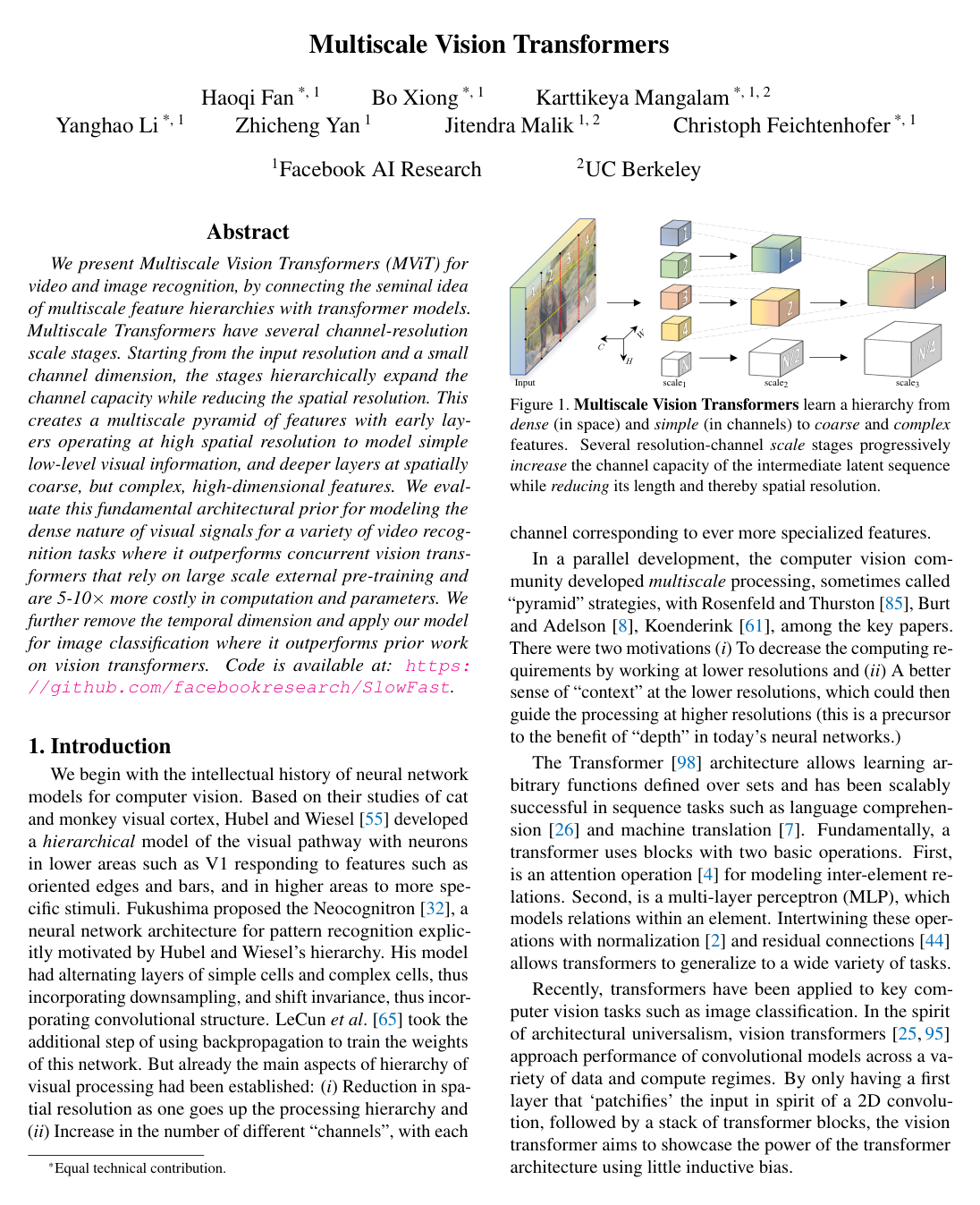
Multiscale Vision Transformers
Haoqi Fan, Bo Xiong, Karttikeya Mangalam, Yanghao Li, Zhicheng Yan, Jitendra Malik, Christoph Feichtenhofer
Why you should read this
Develops Multiscale Vision Transformers, a hierarchical architecture that incorporates multiscale feature pyramids into visual attention to achieve superior video and image recognition performance with up to ten times less computation and without requiring massive external pre-training.
We present Multiscale Vision Transformers (MViT) for video and image recognition, by connecting the seminal idea of multiscale feature hierarchies with transformer models. Multiscale Transformers have several channel-resolution scale stages. Starting from the input resolution and a small channel dimension, the stages hierarchically expand the channel capacity while reducing the spatial resolution. This creates a multiscale pyramid of features with early layers operating at high spatial resolution to model simple low-level visual information, and deeper layers at spatially coarse, but complex, high-dimensional features. We evaluate this fundamental architectural prior for modeling the dense nature of visual signals for a variety of video recognition tasks where it outperforms concurrent vision transformers that rely on large scale external pre-training and are 5-10x more costly in computation and parameters. We further remove the temporal dimension and apply our model for image classification where it outperforms prior work on vision transformers. Code is available at: this https URL
Added
2026-09-24
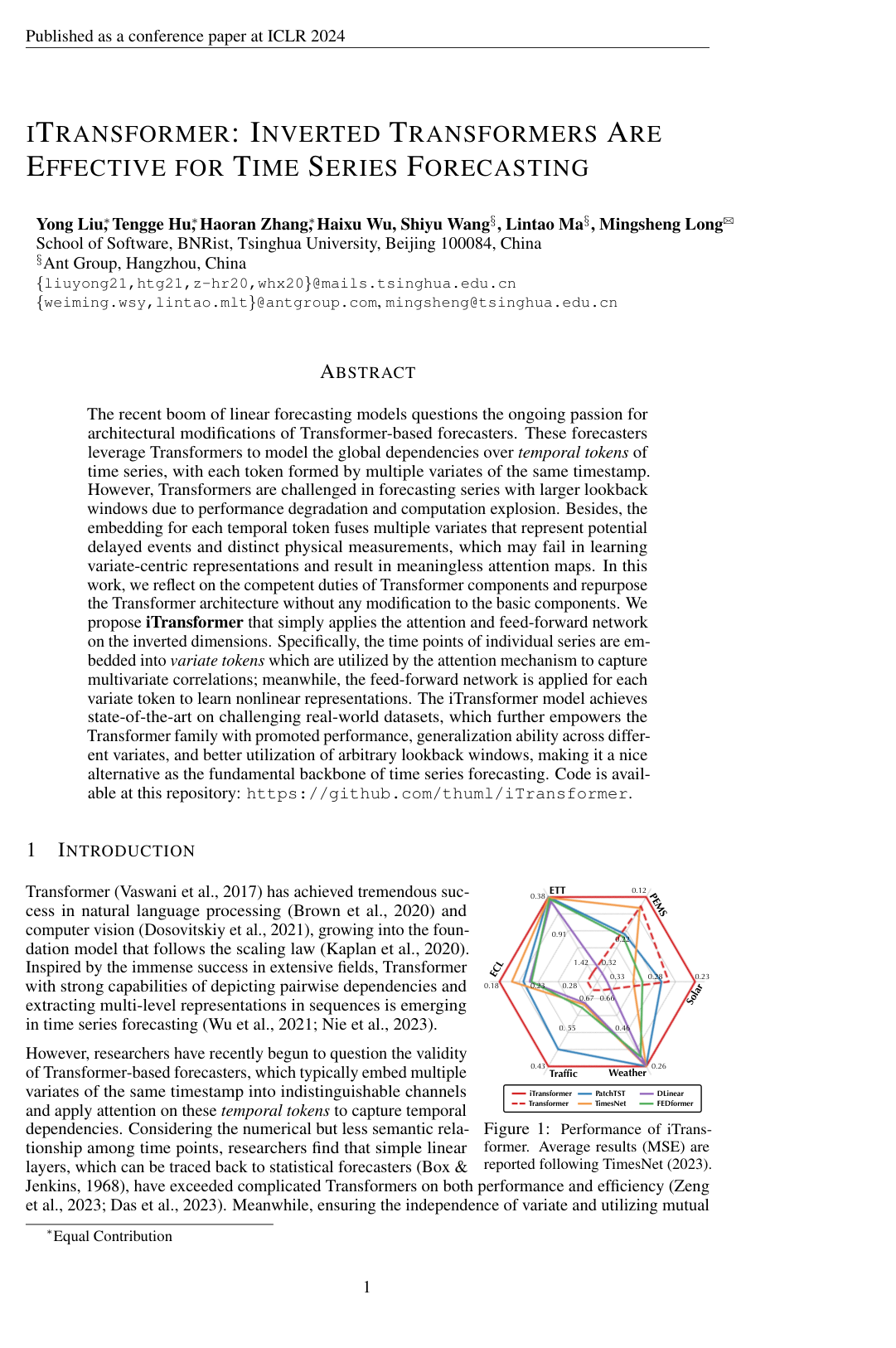
iTransformer: Inverted Transformers Are Effective for Time Series Forecasting
Yong Liu, Tengge Hu, Haoran Zhang, Haixu Wu, Shiyu Wang, Lintao Ma, Mingsheng Long
Why you should read this
Proposes iTransformer, an architecture that inverts conventional attention by embedding entire time series into individual variate tokens, outperforming both linear baselines and standard Transformers on long-sequence multivariate forecasting.
The recent boom of linear forecasting models questions the ongoing passion for architectural modifications of Transformer-based forecasters. These forecasters leverage Transformers to model the global dependencies over temporal tokens of time series, with each token formed by multiple variates of the same timestamp. However, Transformers are challenged in forecasting series with larger lookback windows due to performance degradation and computation explosion. Besides, the embedding for each temporal token fuses multiple variates that represent potential delayed events and distinct physical measurements, which may fail in learning variate-centric representations and result in meaningless attention maps. In this work, we reflect on the competent duties of Transformer components and repurpose the Transformer architecture without any modification to the basic components. We propose iTransformer that simply applies the attention and feed-forward network on the inverted dimensions. Specifically, the time points of individual series are embedded into variate tokens which are utilized by the attention mechanism to capture multivariate correlations; meanwhile, the feed-forward network is applied for each variate token to learn nonlinear representations. The iTransformer model achieves state-of-the-art on challenging real-world datasets, which further empowers the Transformer family with promoted performance, generalization ability across different variates, and better utilization of arbitrary lookback windows, making it a nice alternative as the fundamental backbone of time series forecasting. Code is available at this repository: this https URL.
Added
2026-09-16
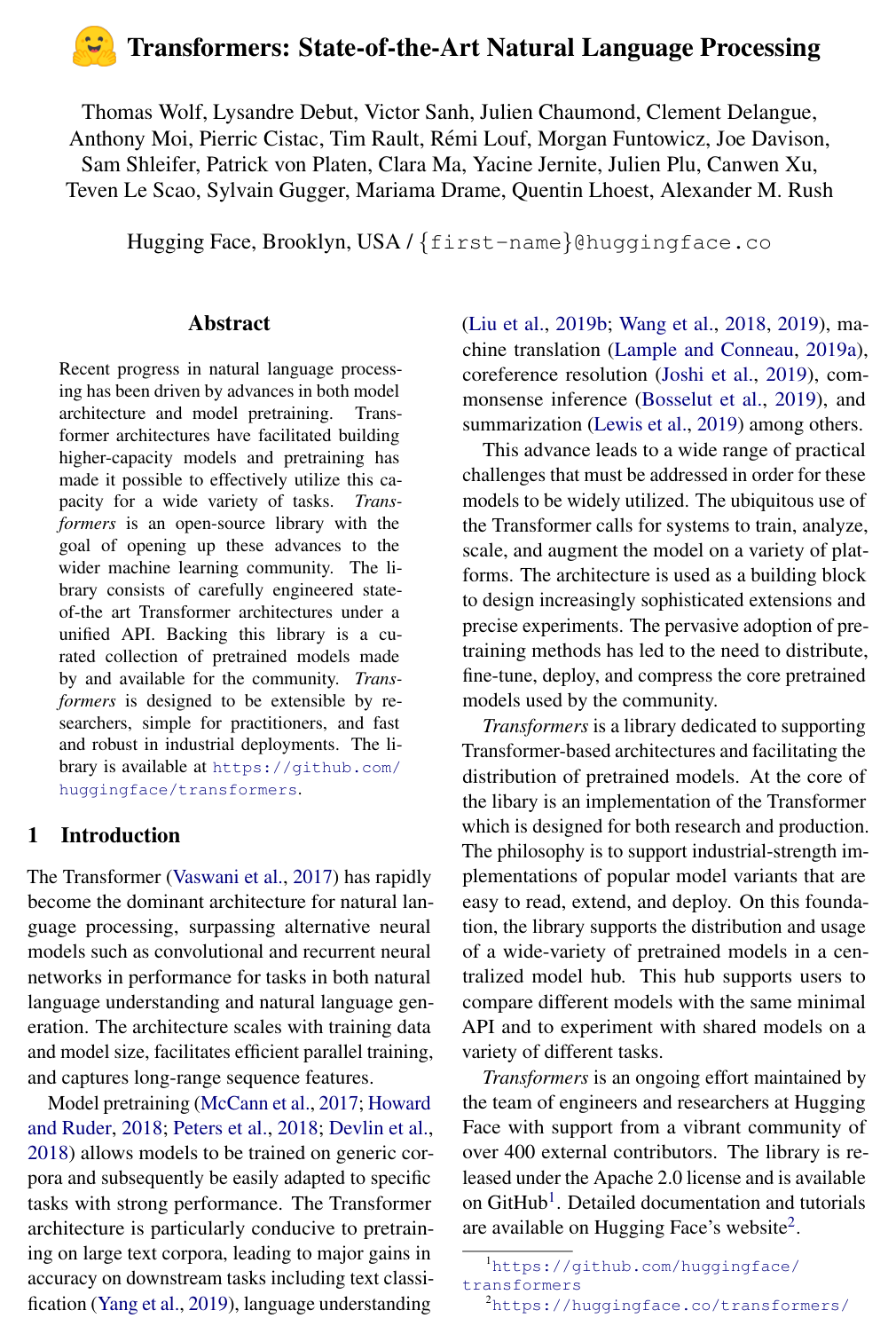
Transformers: State-of-the-Art Natural Language Processing
Thomas Wolf, Lysandre Debut, Victor Sanh, Julien Chaumond, Clement Delangue, Anthony Moi, Pierric Cistac, Tim Rault, Rémi Louf, Morgan Funtowicz, Joe Davison, Sam Shleifer, Patrick von Platen, Clara Ma, Yacine Jernite, Julien Plu, Canwen Xu, Teven Le Scao, Sylvain Gugger, Mariama Drame, Quentin Lhoest, Alexander M. Rush
Why you should read this
Presents the open-source Transformers library, standardizing access to state-of-the-art pretrained neural architectures under a single interface for natural language processing research and production deployment.
Recent progress in natural language processing has been driven by advances in both model architecture and model pretraining. Transformer architectures have facilitated building higher-capacity models and pretraining has made it possible to effectively utilize this capacity for a wide variety of tasks. \textit{Transformers} is an open-source library with the goal of opening up these advances to the wider machine learning community. The library consists of carefully engineered state-of-the art Transformer architectures under a unified API. Backing this library is a curated collection of pretrained models made by and available for the community. \textit{Transformers} is designed to be extensible by researchers, simple for practitioners, and fast and robust in industrial deployments. The library is available at \url{this https URL}.
Added
2026-09-11
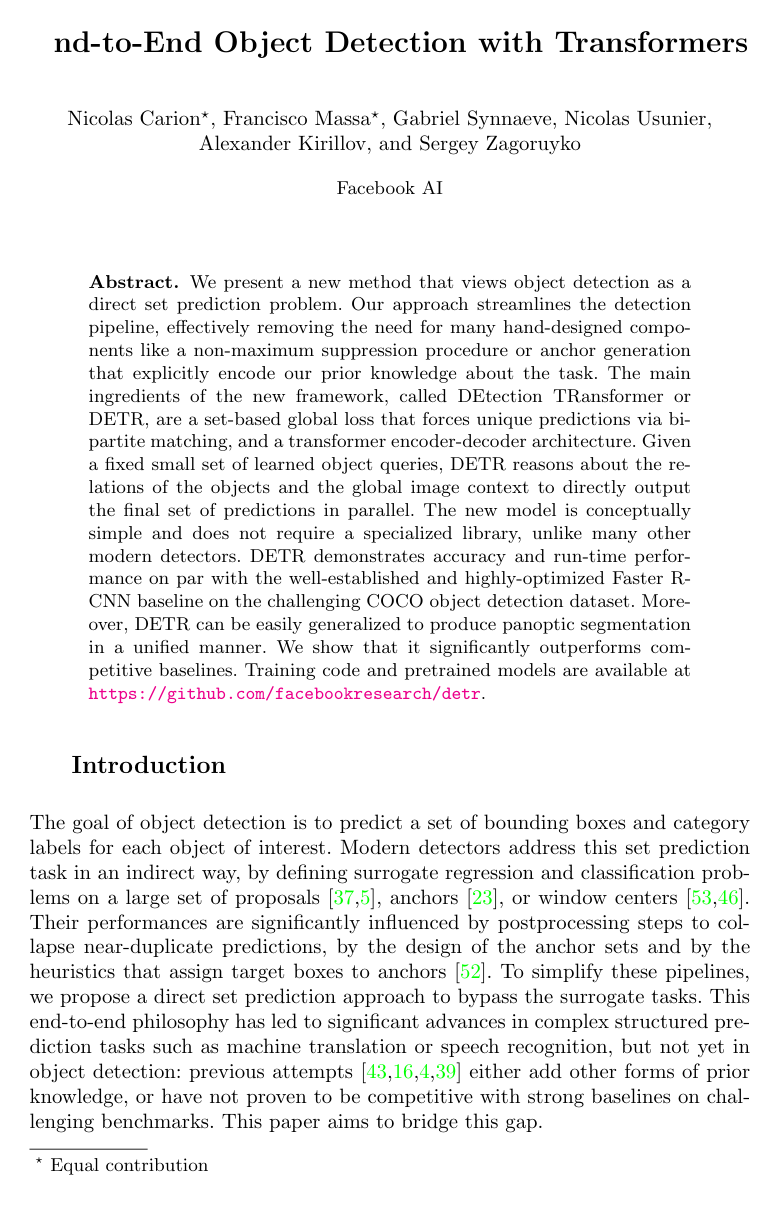
End-to-End Object Detection with Transformers
Nicolas Carion, Francisco Massa, Gabriel Synnaeve, Nicolas Usunier, Alexander Kirillov, Sergey Zagoruyko
Why you should read this
Introduces DETR, a transformer-based framework that reformulates object detection as a direct set prediction task, eliminating hand-engineered components like anchor generation and non-maximum suppression while matching the accuracy of established baselines on COCO.
We present a new method that views object detection as a direct set prediction problem. Our approach streamlines the detection pipeline, effectively removing the need for many hand-designed components like a non-maximum suppression procedure or anchor generation that explicitly encode our prior knowledge about the task. The main ingredients of the new framework, called DEtection TRansformer or DETR, are a set-based global loss that forces unique predictions via bipartite matching, and a transformer encoder-decoder architecture. Given a fixed small set of learned object queries, DETR reasons about the relations of the objects and the global image context to directly output the final set of predictions in parallel. The new model is conceptually simple and does not require a specialized library, unlike many other modern detectors. DETR demonstrates accuracy and run-time performance on par with the well-established and highly-optimized Faster RCNN baseline on the challenging COCO object detection dataset. Moreover, DETR can be easily generalized to produce panoptic segmentation in a unified manner. We show that it significantly outperforms competitive baselines. Training code and pretrained models are available at this https URL.
Added
2026-09-06

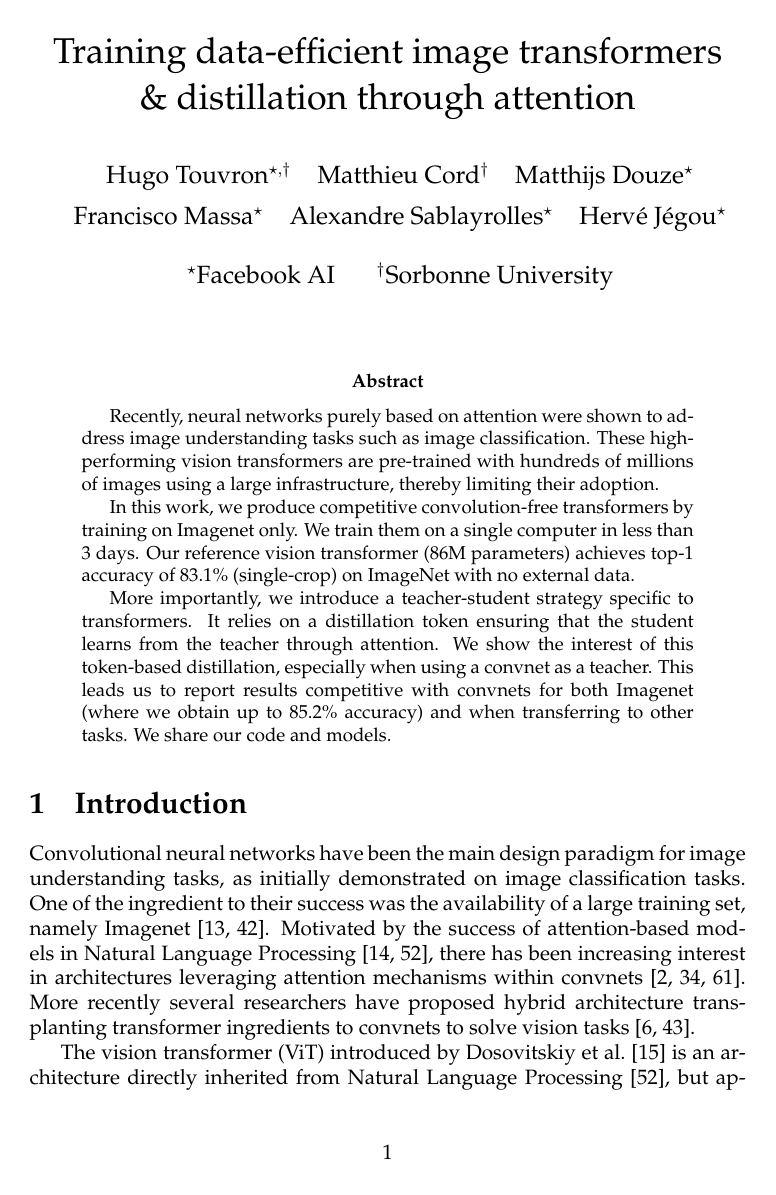
Training data-efficient image transformers & distillation through attention
Hugo Touvron, Matthieu Cord, Matthijs Douze, Francisco Massa, Alexandre Sablayrolles, Hervé Jégou
Why you should read this
Introduces the distillation token concept uniquely engineered for Vision Transformers to enable data-efficient training of attention-based models without relying on gigantic proprietary datasets.
Recently, neural networks purely based on attention were shown to address image understanding tasks such as image classification. However, these visual transformers are pre-trained with hundreds of millions of images using an expensive infrastructure, thereby limiting their adoption. In this work, we produce a competitive convolution-free transformer by training on Imagenet only. We train them on a single computer in less than 3 days. Our reference vision transformer (86M parameters) achieves top-1 accuracy of 83.1% (single-crop evaluation) on ImageNet with no external data. More importantly, we introduce a teacher-student strategy specific to transformers. It relies on a distillation token ensuring that the student learns from the teacher through attention. We show the interest of this token-based distillation, especially when using a convnet as a teacher. This leads us to report results competitive with convnets for both Imagenet (where we obtain up to 85.2% accuracy) and when transferring to other tasks. We share our code and models.
Added
2026-06-19
Generating Long Sequences with Sparse Transformers
Rewon Child, Scott Gray, Alec Radford, Ilya Sutskever
Why you should read this
Pioneers factorized attention patterns (strided and fixed), providing the first blueprint for reducing quadratic complexity to sub-quadratic.
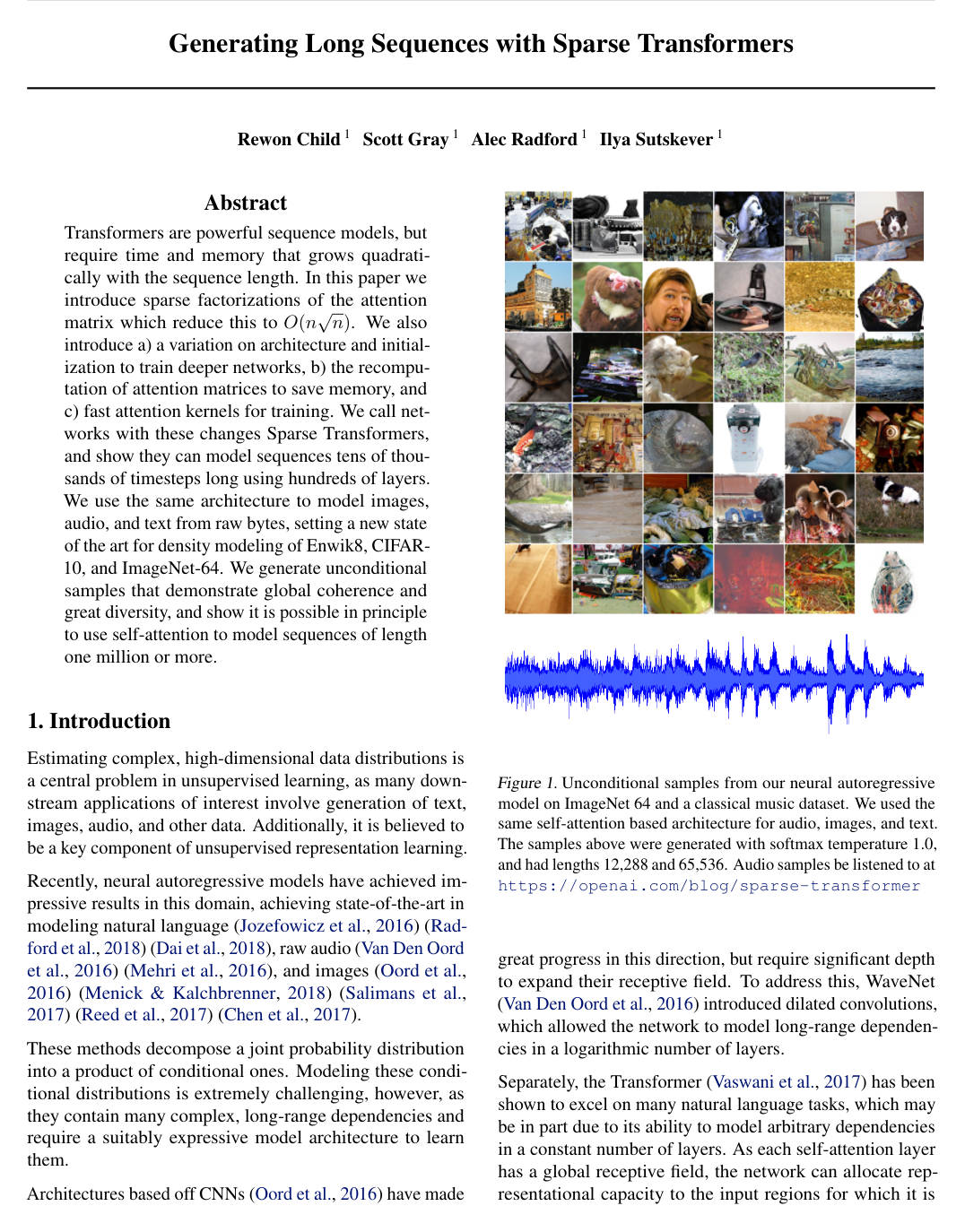
Transformers are powerful sequence models, but require time and memory that grows quadratically with the sequence length. In this paper we introduce sparse factorizations of the attention matrix which reduce this to . We also introduce a) a variation on architecture and initialization to train deeper networks, b) the recomputation of attention matrices to save memory, and c) fast attention kernels for training. We call networks with these changes Sparse Transformers, and show they can model sequences tens of thousands of timesteps long using hundreds of layers. We use the same architecture to model images, audio, and text from raw bytes, setting a new state of the art for density modeling of Enwik8, CIFAR-10, and ImageNet-64. We generate unconditional samples that demonstrate global coherence and great diversity, and show it is possible in principle to use self-attention to model sequences of length one million or more.
Added
2026-02-11
On Layer Normalization in the Transformer Architecture
Ruibin Xiong, Yunchang Yang, Di He, Kai Zheng, Shuxin Zheng, Chen Xing, Huishuai Zhang, Yanyan Lan, Liwei Wang, Tie-Yan Liu
Why you should read this
Proves that placing layer normalization inside the residual blocks (Pre-LN) is essential for the stability and convergence of deep Transformers.
The Transformer is widely used in natural language processing tasks. To train a Transformer however, one usually needs a carefully designed learning rate warm-up stage, which is shown to be crucial to the final performance but will slow down the optimization and bring more hyper-parameter tunings. In this paper, we first study theoretically why the learning rate warm-up stage is essential and show that the location of layer normalization matters. Specifically, we prove with mean field theory that at initialization, for the original-designed Post-LN Transformer, which places the layer normalization between the residual blocks, the expected gradients of the parameters near the output layer are large. Therefore, using a large learning rate on those gradients makes the training unstable. The warm-up stage is practically helpful for avoiding this problem. On the other hand, our theory also shows that if the layer normalization is put inside the residual blocks (recently proposed as Pre-LN Transformer), the gradients are well-behaved at initialization. This motivates us to remove the warm-up stage for the training of Pre-LN Transformers. We show in our experiments that Pre-LN Transformers without the warm-up stage can reach comparable results with baselines while requiring significantly less training time and hyper-parameter tuning on a wide range of applications.
Added
2026-02-09