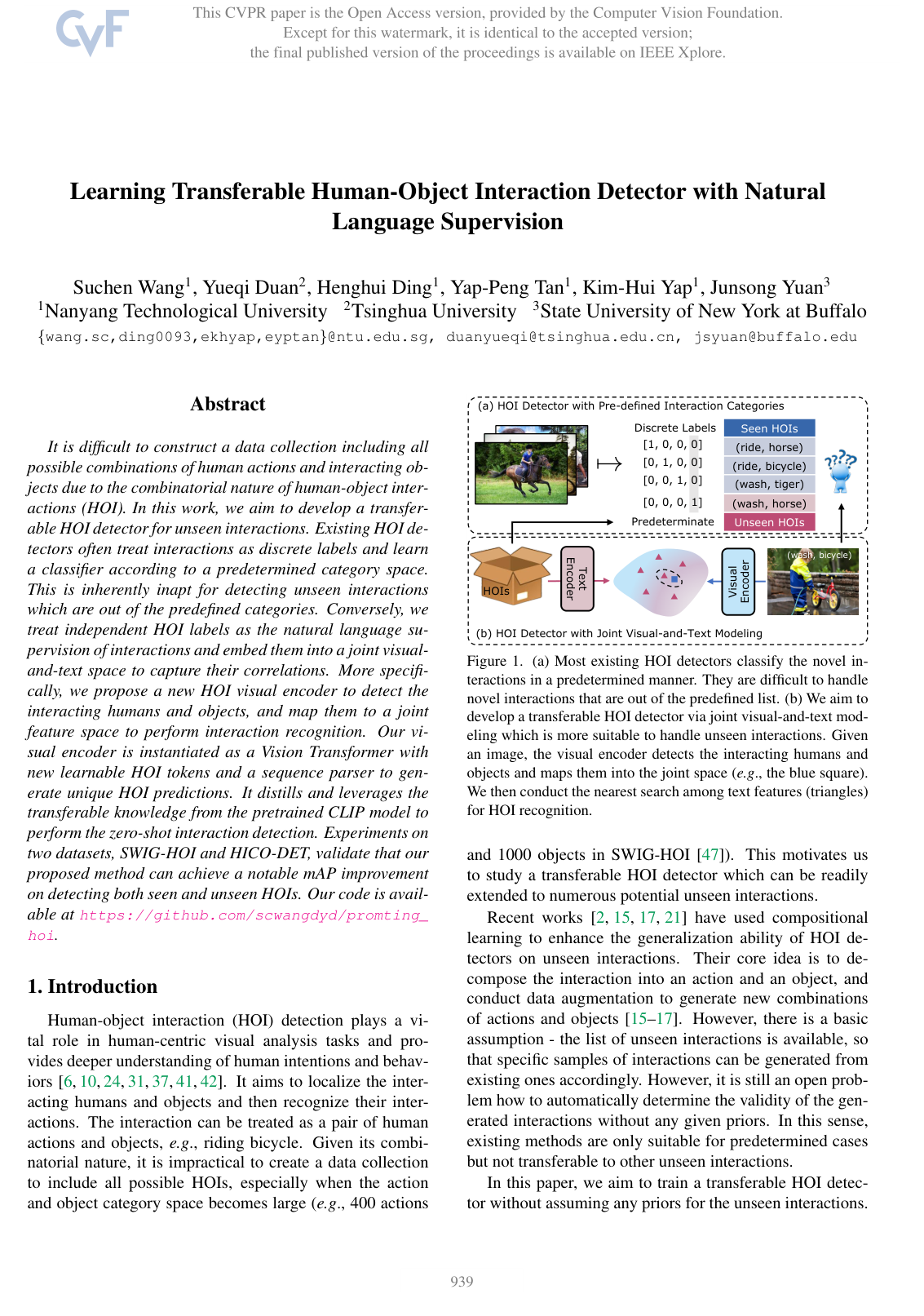
A transferable human-object interaction detector is a computer vision model that localizes people and objects within visual scenes and identifies the actions or relationships linking them, while possessing the capability to generalize beyond a fixed set of training categories. Traditional interaction detectors rely on closed-set classifiers restricted to predefined combinations of verbs and target objects, whereas a transferable detector uses shared semantic knowledge, compositional modeling, or vision-language representations to adapt to novel, rare, or unseen interaction pairs. This allows the system to recognize unfamiliar human-object pairings and transfer learned relationship concepts across diverse domains or zero-shot scenarios without requiring exhaustive annotated training examples for every possible interaction.