
keyword
transductive inference
Transductive inference is a machine learning paradigm in which predictions are made directly for a specific set of unlabeled test instances by analyzing both the labeled training data and the unlabeled test data simultaneously. Unlike inductive inference, which infers a general decision rule from training examples to classify any arbitrary future input, transductive inference bypasses the construction of a general function and focuses exclusively on predicting the labels of the given test set. By incorporating the structure and distribution of the target unlabeled instances during the learning process, transductive methods can achieve higher predictive accuracy, especially in settings with limited labeled data such as few-shot learning, semi-supervised learning, and graph-based classification.
2 items
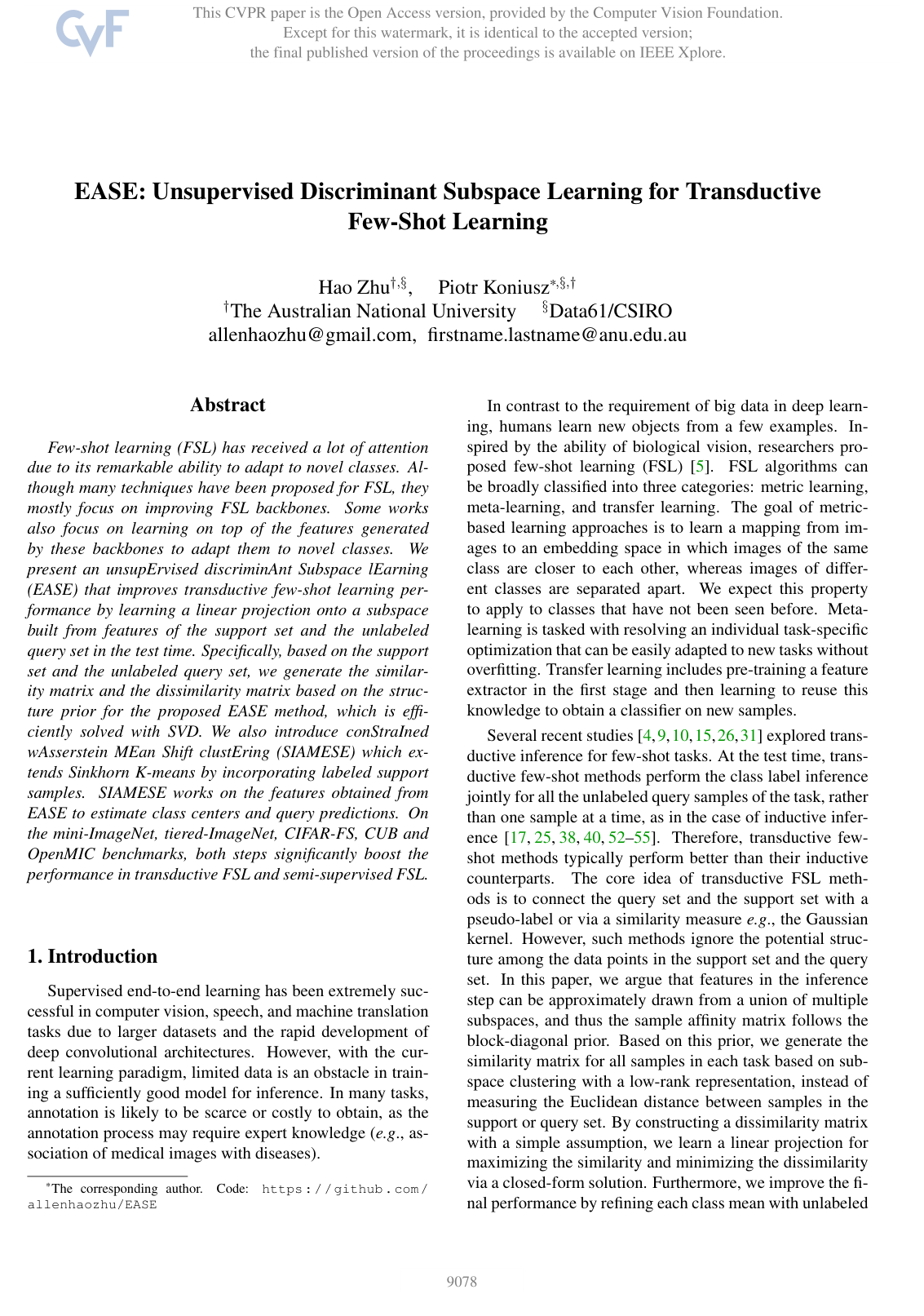
EASE: Unsupervised Discriminant Subspace Learning for Transductive Few-Shot Learning
Hao Zhu, Piotr Koniusz
Why you should read this
Proposes an unsupervised subspace projection and a constrained Wasserstein clustering method to efficiently separate novel classes at test time without backbone fine-tuning, achieving strong performance gains across multiple transductive few-shot benchmarks.
Few-shot learning (FSL) has received a lot of attention due to its remarkable ability to adapt to novel classes. Although many techniques have been proposed for FSL, they mostly focus on improving FSL backbones. Some works also focus on learning on top of the features generated by these backbones to adapt them to novel classes. We present an unsuPervised discriminAnt Subspace lEarning (EASE) that improves transductive few-shot learning performance by learning a linear projection onto a subspace built from features of the support set and the unlabeled query set in the test time. Specifically, based on the support set and the unlabeled query set, we generate the similarity matrix and the dissimilarity matrix based on the structure prior for the proposed EASE method, which is efficiently solved with SVD. We also introduce conStraIned wAsserstein MEan Shift clustEring (SIAMESE) which extends Sinkhorn K-means by incorporating labeled support samples. SIAMESE works on the features obtained from EASE to estimate class centers and query predictions. On the mini-ImageNet, tiered-ImageNet, CIFAR-FS, CUB and OpenMIC benchmarks, both steps significantly boost the performance in transductive FSL and semi-supervised FSL.
Added
2026-09-26
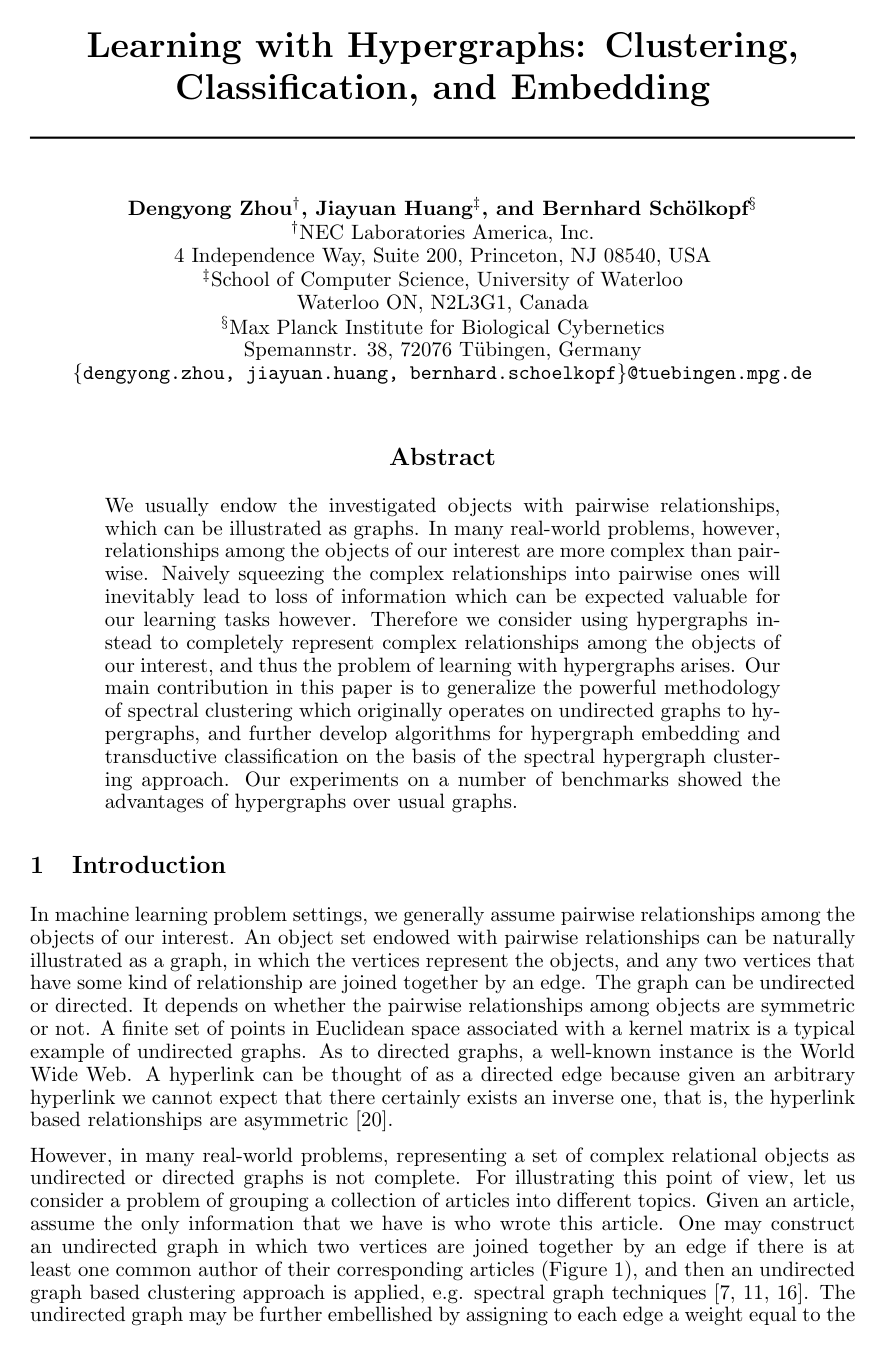
Learning with Hypergraphs: Clustering, Classification, and Embedding
Dengyong Zhou, Jiayuan Huang, B. Schölkopf
Why you should read this
Generalizes spectral graph theory to hypergraphs by formulating normalized hypergraph cuts, Laplacians, and random walks to enable higher-order relational clustering, embedding, and transductive classification without losing multi-object structural information.
We usually endow the investigated objects with pairwise relationships, which can be illustrated as graphs. In many real-world problems, however, relationships among the objects of our interest are more complex than pairwise. Naively squeezing the complex relationships into pairwise ones will inevitably lead to loss of information which can be expected valuable for our learning tasks however. There we consider using hypergraphs instead to completely represent complex relationships among the objects of our interest, and thus the problem of learning with hypergraphs arises. Our main contribution in this paper is to generalize the powerful methodology of spectral clustering which originally operates on undirected graphs to hypergraphs, and further develop algorithms for hypergraph embedding and transductive classification on the basis of the spectral hypergraph clustering approach. Our experiments on a number of benchmarks showed the advantages of hypergraphs over usual graphs.
Added
2026-09-24