
keyword
training corpus
A training corpus is a curated collection of text or linguistic data compiled specifically to train machine learning and natural language processing models. In computational linguistics and artificial intelligence, it serves as the foundational material from which algorithms learn vocabulary, grammar, statistical patterns, contextual relationships, and factual knowledge. These datasets can vary widely in scale, ranging from specialized domain-specific texts to vast composite datasets comprising billions or trillions of tokens gathered across diverse sources, formats, and languages. The composition, quality, diversity, and curation standards of a training corpus play a critical role in shaping a model's capabilities, behavioral tendencies, and overall performance across downstream tasks.
3 items
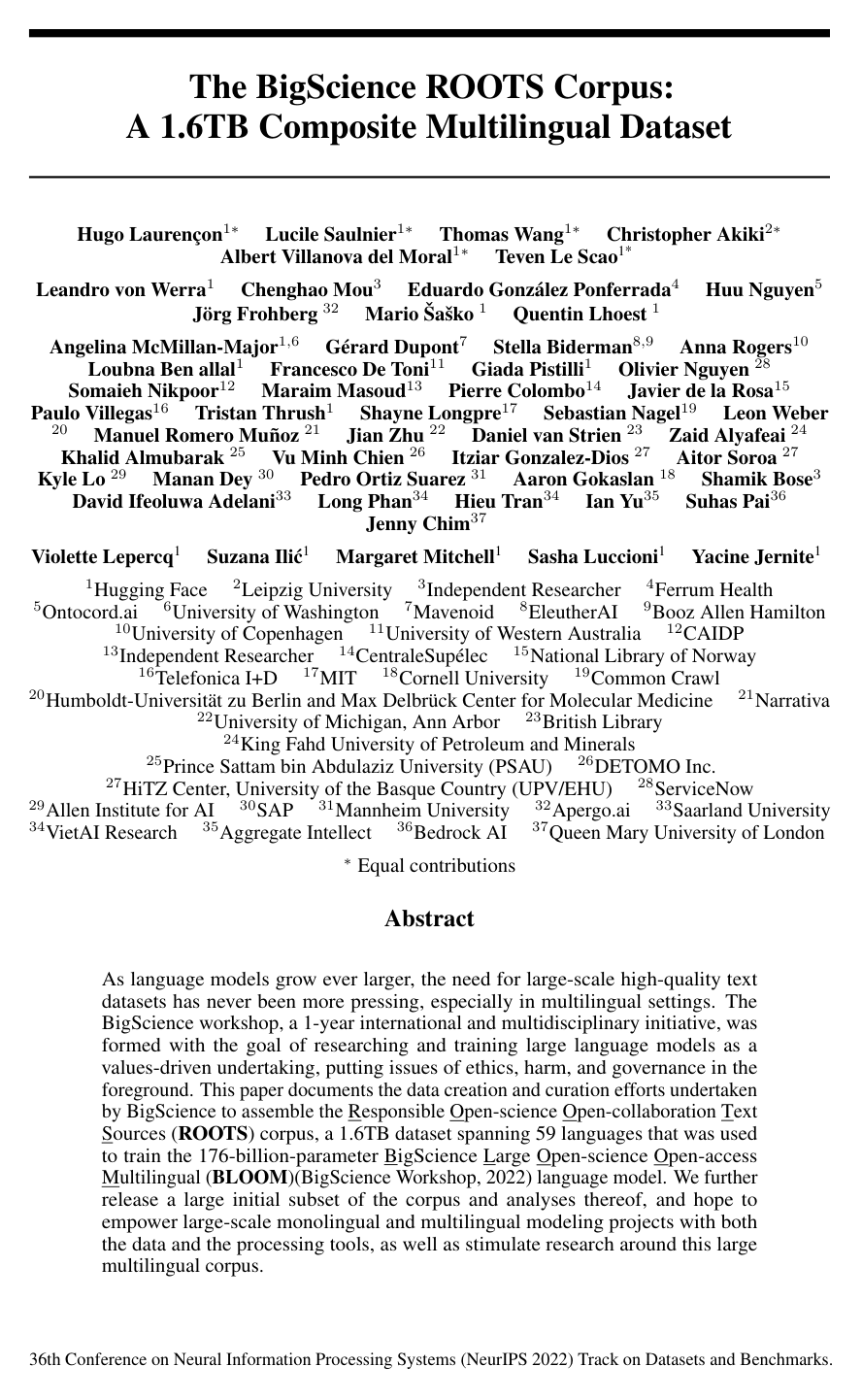
The BigScience ROOTS Corpus: A 1.6TB Composite Multilingual Dataset
Hugo Laurençon, Lucile Saulnier, Thomas Wang, Christopher Akiki, Albert Villanova del Moral, Teven Le Scao, Leandro von Werra, Chenghao Mou, Eduardo González Ponferrada, Huu Nguyen, Jörg Frohberg, Mario Sasko, Quentin Lhoest, Angelina McMillan-Major, Gérard Dupont, Stella Biderman, Anna Rogers, Loubna Ben Allal, Francesco De Toni, Giada Pistilli, Olivier Nguyen, Somaieh Nikpoor, Maraim Masoud, Pierre Colombo, Javier de la Rosa, Paulo Villegas, Tristan Thrush, Shayne Longpre, Sebastian Nagel, Leon Weber, Manuel Muñoz, Jian Zhu, Daniel van Strien, Zaid Alyafeai, Khalid Almubarak, Minh Chien Vu, Itziar Gonzalez-Dios, Aitor Soroa, Kyle Lo, Manan Dey, Pedro Ortiz Suarez, Aaron Gokaslan, Shamik Bose, David Ifeoluwa Adelani, Long Phan, Hieu Tran, Ian Yu, Suhas Pai, Jenny Chim, Violette Lepercq, Suzana Ilic, Margaret Mitchell, Alexandra Sasha Luccioni, Yacine Jernite
Why you should read this
Presents the construction, governance framework, and filtering methodology behind the 1.6TB multilingual ROOTS dataset, providing a transparent foundation and reusable tools for training open language models across 59 languages.
As language models grow ever larger, the need for large-scale high-quality text datasets has never been more pressing, especially in multilingual settings. The BigScience workshop, a 1-year international and multidisciplinary initiative, was formed with the goal of researching and training large language models as a values-driven undertaking, putting issues of ethics, harm, and governance in the foreground. This paper documents the data creation and curation efforts undertaken by BigScience to assemble the Responsible Open-science Open-collaboration Text Sources (ROOTS) corpus, a 1.6TB dataset spanning 59 languages that was used to train the 176-billion-parameter BigScience Large Open-science Open-access Multilingual (BLOOM)(BigScience Workshop, 2022) language model. We further release a large initial subset of the corpus and analyses thereof, and hope to empower large-scale monolingual and multilingual modeling projects with both the data and the processing tools, as well as stimulate research around this large multilingual corpus.
Added
2026-10-05
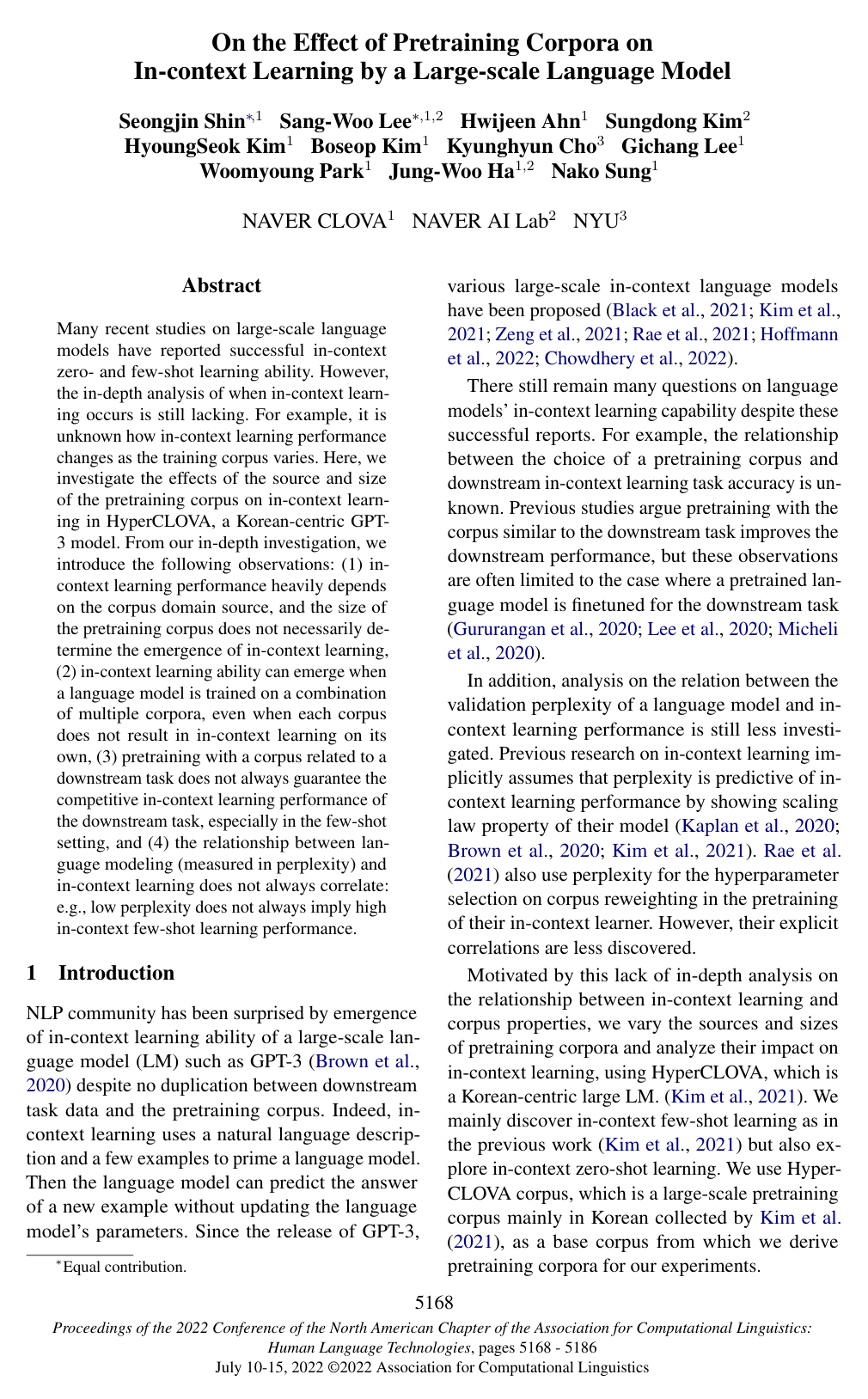
On the Effect of Pretraining Corpora on In-context Learning by a Large-scale Language Model
Seongjin Shin, Sang-Woo Lee, Hwijeen Ahn, Sungdong Kim, HyoungSeok Kim, Boseop Kim, Kyunghyun Cho, Gichang Lee, Woo-Myoung Park, Jung-Woo Ha, Nako Sung
Why you should read this
Reveals that large language model in-context learning capabilities depend heavily on pretraining data sources and combinations rather than corpus size alone, showing that low validation perplexity does not reliably predict few-shot performance.
Many recent studies on large-scale language models have reported successful in-context zero- and few-shot learning ability. However, the in-depth analysis of when in-context learning occurs is still lacking. For example, it is unknown how in-context learning performance changes as the training corpus varies. Here, we investigate the effects of the source and size of the pretraining corpus on in-context learning in HyperCLOVA, a Korean-centric GPT-3 model. From our in-depth investigation, we introduce the following observations: (1) in-context learning performance heavily depends on the corpus domain source, and the size of the pretraining corpus does not necessarily determine the emergence of in-context learning, (2) in-context learning ability can emerge when a language model is trained on a combination of multiple corpora, even when each corpus does not result in in-context learning on its own, (3) pretraining with a corpus related to a downstream task does not always guarantee the competitive in-context learning performance of the downstream task, especially in the few-shot setting, and (4) the relationship between language modeling (measured in perplexity) and in-context learning does not always correlate: e.g., low perplexity does not always imply high in-context few-shot learning performance.
Added
2026-10-01
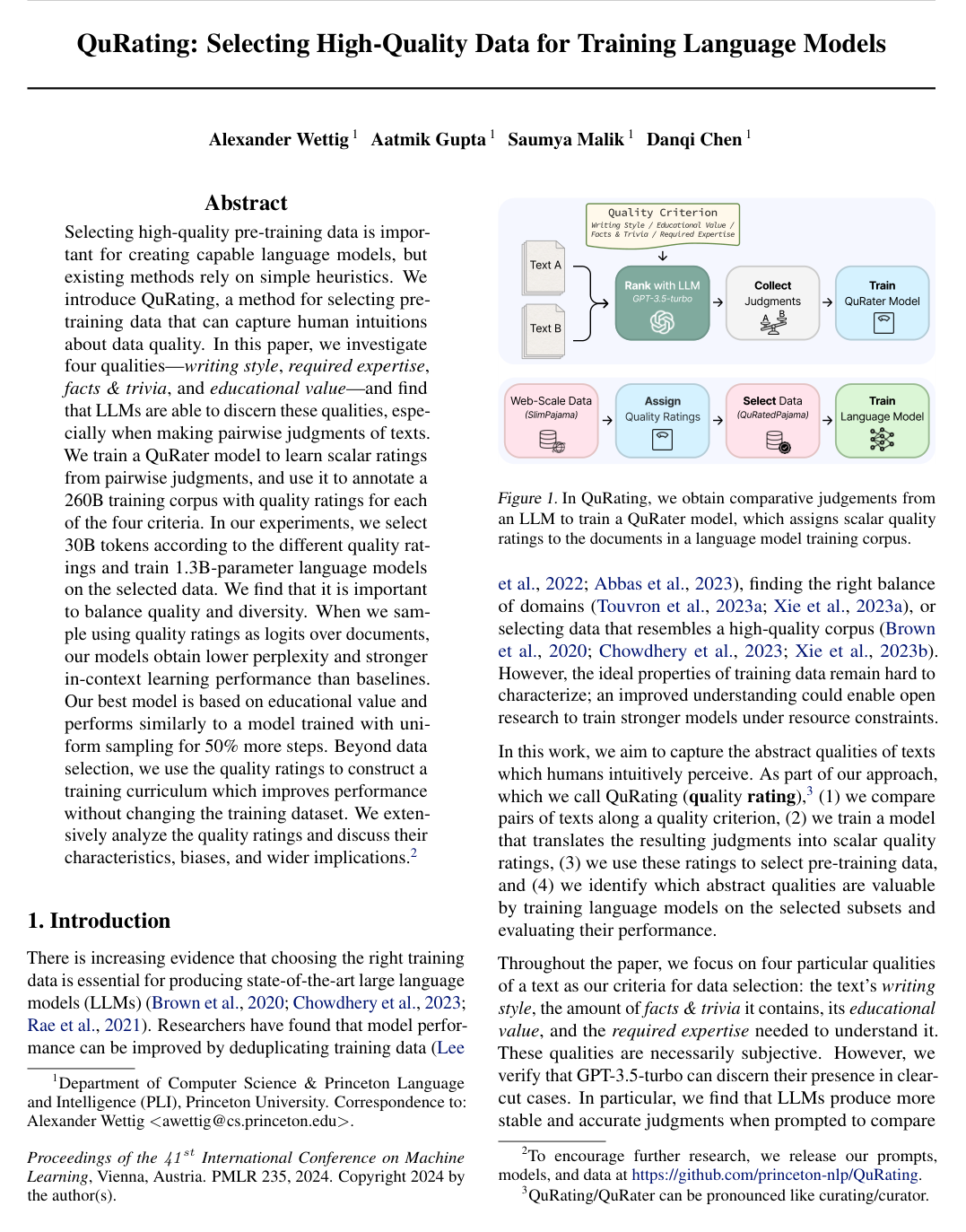
QuRating: Selecting High-Quality Data for Training Language Models
Alexander Wettig, Aatmik Gupta, Saumya Malik, Danqi Chen
Why you should read this
Presents a scalable data selection method that trains compact rating models on LLM pairwise judgments across qualitative criteria like educational value, enabling language models to match the performance of baselines trained on 50% more data.
Selecting high-quality pre-training data is important for creating capable language models, but existing methods rely on simple heuristics. We introduce QuRating, a method for selecting pre-training data that can capture human intuitions about data quality. In this paper, we investigate four qualities—writing style, required expertise, facts & trivia, and educational value—and find that LLMs are able to discern these qualities, especially when making pairwise judgments of texts. We train a QuRater model to learn scalar ratings from pairwise judgments, and use it to annotate a 260B training corpus with quality ratings for each of the four criteria. In our experiments, we select 30B tokens according to the different quality ratings and train 1.3B-parameter language models on the selected data. We find that it is important to balance quality and diversity. When we sample using quality ratings as logits over documents, our models obtain lower perplexity and stronger in-context learning performance than baselines. Our best model is based on educational value and performs similarly to a model trained with uniform sampling for 50% more steps. Beyond data selection, we use the quality ratings to construct a training curriculum which improves performance without changing the training dataset. We extensively analyze the quality ratings and discuss their characteristics, biases, and wider implications.2
Added
2026-09-26